What Is an HSS Drill Bit | The 3 Types That Change the Cut
This post contains affiliate links. As an Amazon Associate, we earn from qualifying purchases.
An HSS drill bit is a cutting tool made from high-speed steel, an alloy that retains its hardness at temperatures up to about 600°C. This heat resistance lets it drill through metals, wood, and plastics at higher speeds than standard carbon steel bits. The key to using it correctly is matching one of its three standardized types—N (normal), H (hard), or W (soft)—to your specific material.
That heat ceiling is the whole game. It’s why HSS replaced carbon steel for metalwork and why it’s still the default for most shop drilling. But the label “HSS” alone doesn’t tell you which of the three distinct tool geometries you’re holding.
The rest walks through the alloy recipe, the three DIN-standardized types with their specific flute angles, the coatings that push the temperature limit, and where HSS sits against tougher options like cobalt. By the end, you’ll read a drill bit’s specs like a shop-floor cheat sheet.
Key Takeaways
- HSS bits are classified into three types by DIN 1836: Type N for general steel/iron, Type H for hard/brittle materials, and Type W for soft/stringy metals like aluminum.
- Adding cobalt (HSS-E) boosts heat resistance for stainless steel but makes the bit more brittle and prone to snapping under side load.
- A titanium nitride (TiN) coating is good to 450°C; a titanium aluminum nitride (TiAlN) coating pushes that to 900°C for harder use.
- For most home and shop work on common steels, a standard HSS Type N bit is the correct, cost-effective choice.
- Drilling soft aluminum with a Type N bit will clog the flutes and work-harden the material; you need the wider flute angle of a Type W.
What HSS Actually Is (The Alloy Recipe)
High-speed steel isn’t one specific formula. It’s a family of tool steels defined by a key trait: red hardness. Where a plain carbon steel bit would lose its temper and go soft at a few hundred degrees, a proper HSS bit keeps cutting at a dull red heat, around 600°C.
The alloy achieves this through a mix of tungsten, molybdenum, chromium, and vanadium, totaling more than 5% by weight. The steel is annealed above 1,200°C and quenched, creating a dense matrix of hard carbides that resist softening.
That’s the manufacturer-level view. For you at the drill press, it means you can take a deeper cut or run a higher RPM without instantly destroying the tool’s edge. The bit dulls from abrasive wear, not from thermal collapse.
This is the core advantage over basic carbon steel bits, which are only suitable for wood and very soft plastics. The initial cost is higher, but an HSS bit lasts orders of magnitude longer in metal and can be resharpened many times. It’s a consumable, but a slow-wearing one.
Where does the “high-speed” name come from? From the early 20th century, when these alloys first allowed metal-cutting machine tools to run at the then-revolutionary speeds that are now standard. The name stuck, even though today we have materials that can go much faster.
The 3 HSS Drill Types (N, H, W) and What They’re For
This is the part most drill bit packages get wrong. They’ll say “HSS for metal” and leave it there. But the German industrial standard DIN 1836 splits HSS drills into three application groups based on one visible feature: the helix angle of the flutes.
The helix angle controls how aggressively the bit pulls chips out of the hole. Get it wrong, and the bit either jams or doesn’t cut cleanly.
| DIN Type | Flute Angle (γ) | Best For | Will Fail On |
|---|---|---|---|
| Type N (Normal) | 19° to 40° | General construction steels, cast iron, non-ferrous metals. The shop default. | Soft, gummy materials like pure aluminum or copper. |
| Type H (Hard) | 10° to 19° | Hard, short-chipping materials: tool steel, stainless, hard plastic, plexiglass. | Ductile materials; the shallow flutes clog instantly. |
| Type W (Soft) | 27° to 45° | Soft, long-chipping materials: aluminum, copper, soft plastics, wood. | Hard steels; the steep helix can cause poor chip breakage. |
Type N is your universal soldier. Its moderate helix angle is a compromise that works reasonably well on most common materials. If you’re only buying one set of bits for general shop work, get Type N. It’s what’s in 90% of those packaged HSS drill bit sets.
Type H has a slow, drawn-out helix. This gives the chip a tighter curl path, breaking it into small pieces so it can evacuate easily from hard, brittle materials. If you’re drilling stainless steel or hardened steel, this is the geometry you want. Using a Type N here often leads to poor chip clearance and excessive heat.
Common mistake: Using a Type N bit on soft aluminum. The chips are long and stringy. They weld to the flutes, clog the bit, and work-harden the aluminum, making it nearly impossible to drill through. You’ll smell burnt aluminum before you see the bit stop turning.
Type W has a fast, steep helix. It acts like an auger, aggressively pulling long, stringy chips up and out of the hole before they can clog. This is your bit for aluminum, copper, and deep holes in wood. The downside is that the sharp helix can be weaker, so you need a lighter feed pressure.
You won’t always find these letters stamped on the bit. Look at the flutes. A shallow, lazy spiral is Type H. A tight, aggressive corkscrew is Type W. Everything in between is likely Type N. Knowing this is more useful than any brand name when you’re selecting a drill bit.
HSS-E, Cobalt, and the Brittleness Trade-Off
When standard HSS isn’t enough, the next step is an HSS-E bit. The “E” stands for “extra,” and it usually means the alloy includes 5% or 8% cobalt.
Cobalt increases the steel’s hot hardness. It lets the bit withstand the higher temperatures generated by drilling into tough, high-tensile-strength materials like stainless steel, titanium, and high-temperature alloys. For a professional facing these materials daily, HSS-E is a essential step up.
But cobalt has a cost: it reduces toughness.
Adding 8% cobalt makes the drill bit more brittle. It can snap from a slight side load or a misaligned start, especially in smaller diameters. You trade resilience for heat resistance.
This is the critical trade-off that gets missed in simple cobalt vs HSS comparisons. Cobalt isn’t just “better HSS.” It’s a different tool for a different problem. For drilling mild steel or cast iron, a standard HSS bit is actually more forgiving and less likely to break.
If you need more longevity than standard HSS but are worried about brittleness, look for HSS-E-PM. The “PM” means powder metallurgy. The manufacturing process creates a finer, more even grain structure in the steel. This bridges the gap between conventional HSS and solid carbide, offering excellent wear resistance for medium-strength steels without the extreme brittleness of high-cobalt alloys.
HSS Coatings: The 450°C vs 900°C Divide
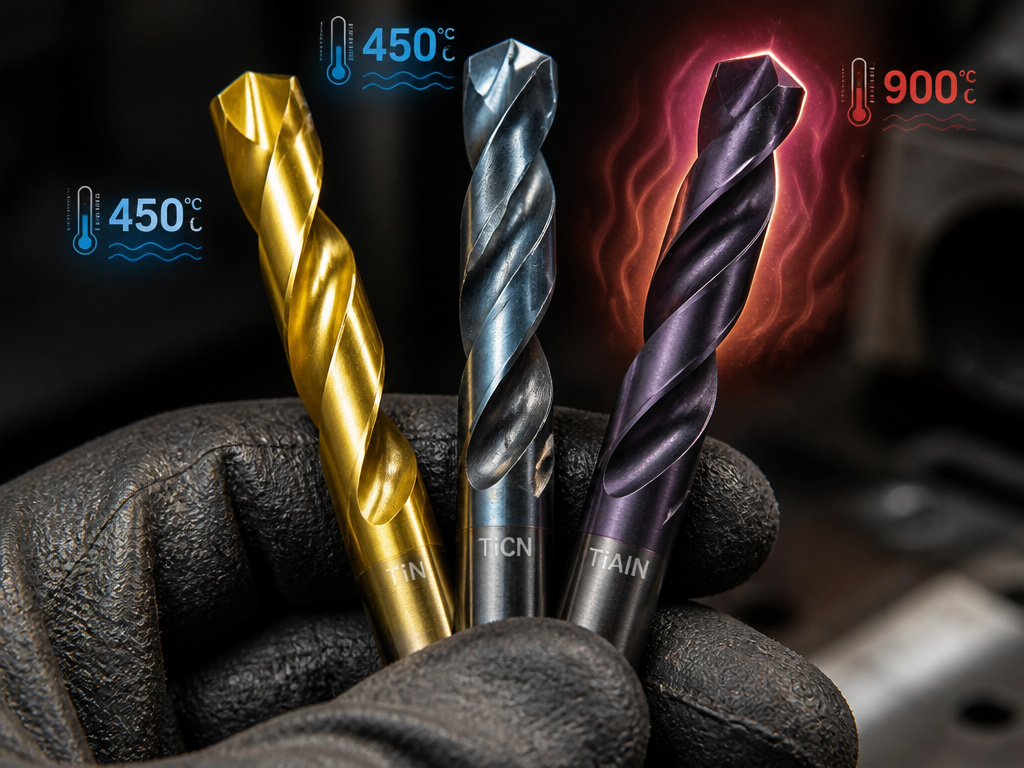
A coating on an HSS bit isn’t just for color or rust prevention. It’s a functional layer that reduces friction and, more importantly, acts as a thermal barrier, protecting the underlying steel.
The coating’s maximum service temperature tells you what jobs it can handle. Exceed that temperature, and the coating breaks down, leaving the bare steel exposed.
| Coating | Max Temp | What It Does | Typical Color |
|---|---|---|---|
| TiN (Titanium Nitride) | 450°C | Reduces friction, improves lubricity. Good general-purpose coating. | Gold |
| TiCN (Titanium Carbonitride) | 450°C | Harder than TiN, better for abrasive materials. | Bluish-Grey |
| TiAlN (Titanium Aluminum Nitride) | 900°C | Forms a protective aluminum oxide layer at high heat. For dry, high-temperature drilling. | Dark Purple/Grey |
A gold TiN-coated bit is excellent for most shop work. It runs cooler and lasts longer than an uncoated bit. But if you’re pushing into very hard materials or drilling dry (without coolant), the TiAlN coating is the only one that will survive. Its ability to handle nearly double the temperature is why it’s the coating of choice for titanium drill bits meant for serious metalwork.
Remember, the coating wears. Once it’s gone, you’re back to drilling with an uncoated bit. That’s when knowing your base material—standard HSS, HSS-E, or HSS-E-PM—really matters.
When to Use HSS (And When to Step Up)
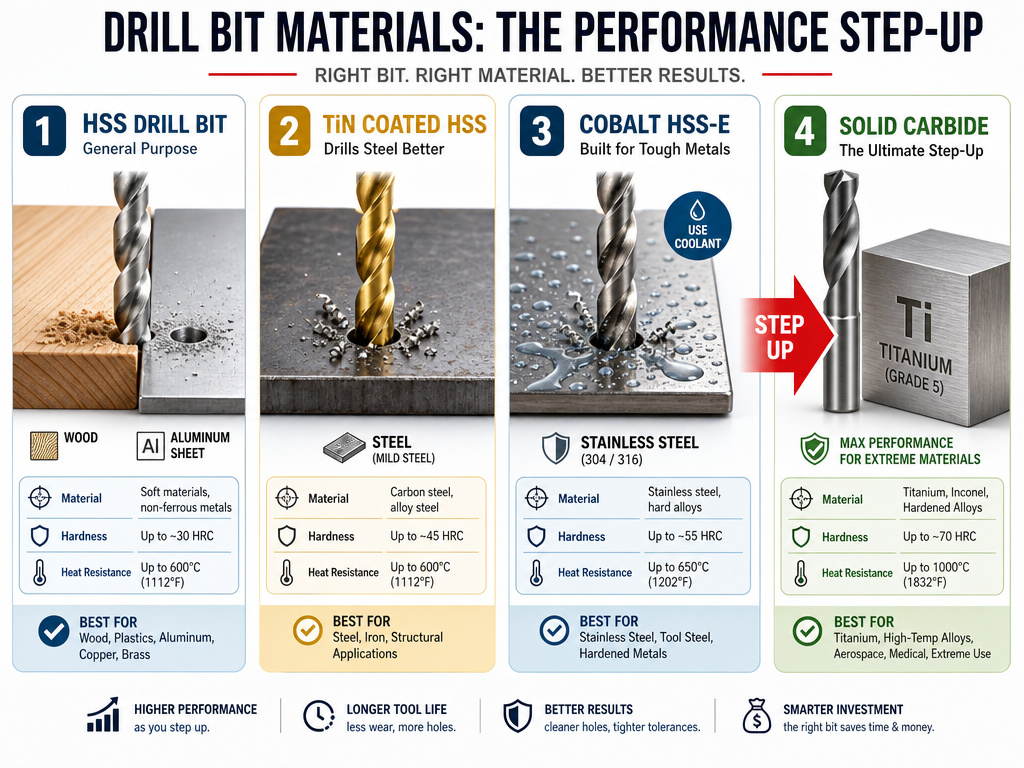
HSS is the workhorse for a reason. Its balance of performance, cost, and durability is unmatched for the vast majority of drilling applications. Your decision tree looks like this:
- Drilling wood, plastic, or soft metals (aluminum, brass)? Use a standard HSS bit. For aluminum, prefer a Type W geometry.
- Drilling common steels, cast iron, or general fabrication? A standard HSS Type N bit is perfect. A TiN coating will extend its life.
- Drilling stainless steel, tool steel, or hard alloys occasionally? An HSS-E (cobalt) bit in Type H geometry is the right call. Use steady pressure and coolant.
- Drilling hardened steel, titanium, or abrasive composites regularly? You’re at the limit of HSS technology. It’s time to consider solid carbide or specialized carbide drill bits.
The line between step 3 and 4 is where HSS bows out. Solid carbide can run hotter and harder, but it’s also far more expensive and brittle. For the DIYer or general machinist, mastering HSS and its variants covers 99% of needs.
This includes knowing how to maintain them. A dull HSS bit is a candidate for sharpening a drill bit, not the trash. And if the worst happens, you’ll need the techniques for removing a broken bit from your workpiece.
Frequently Asked Questions
Are HSS drill bits good for concrete?
No. HSS bits are for metal, wood, and plastic. Concrete, brick, and masonry require a carbide-tipped masonry bit designed to withstand the abrasive aggregate and to be used with a hammering action. Using an HSS bit on concrete will dull it in seconds.
Can you sharpen an HSS drill bit?
Yes, and you should. HSS bits are designed to be reground. Using a bench grinder with a proper jig or a dedicated drill sharpener can restore the 118-degree point angle and clear the cutting lips. A sharp bit cuts cleaner, produces less heat, and is safer than a dull one forcing its way through material.
What’s the difference between HSS and titanium drill bits?
“Titanium” drill bits are almost always standard HSS bits with a titanium nitride (TiN) coating. The titanium is just a thin surface layer that reduces friction and increases hardness. The core material is still HSS. A true solid titanium bit would be exotic and expensive, not found in common hardware stores.
Why did my HSS drill bit break?
The two most common reasons are side load and overheating. A side load happens if the bit wanders or you apply uneven pressure, snapping it, especially in smaller diameters. Overheating (turning the steel blue) removes the temper, making it soft and then brittle. If it snaps while backing out, you might be dealing with a stuck drill bit that’s bound in the hole.
How do I choose the right HSS drill bit size?
The size is stamped on the shank. For unmarked bits or to verify, use a drill gauge—a metal plate with graduated holes. Knowing the exact drill bit size is critical for tapping holes or installing hardware. When in doubt, drill a test hole in a scrap piece of the same material first.
The Bottom Line
An HSS drill bit is defined by its ability to take heat. That simple property makes it the default for metal drilling. But the real skill is in the details: picking the N, H, or W geometry for your material and understanding that a cobalt bit is stronger but more fragile.
For the home workshop, a good set of TiN-coated HSS Type N bits will handle nearly everything. Add a few Type W bits for aluminum and some HSS-E bits for stainless, and you’re equipped. Remember the core purpose of a drill bit is to make a clean hole efficiently. Let the material you’re holding dictate the tool you pick up, not the other way around.
