
Your Guide to SDS Hammer Drills: How They Work and Why
This post contains affiliate links. As an Amazon Associate, we earn from qualifying purchases.
An SDS hammer drill is a heavy-duty rotary hammer that uses a specialized Slotted Drive System (SDS) chuck. This system employs slots and ball bearings on the bit shank to lock into the tool, allowing the bit to slide back and forth. This mechanism transfers high-impact energy directly for drilling into concrete, masonry, and stone, with far more power and efficiency than a standard hammer drill.
The core of that power is a pneumatic hammering system. A piston compresses air to drive a striker, which hits an anvil inside the chuck, delivering thousands of blows per minute to the bit. This separates it from the basic mechanical clattering of a regular hammer drill. The SDS chuck is what makes that efficient power transfer possible, and it’s why you can’t just use any old bit.
What follows is a breakdown of the SDS mechanism, a direct comparison to standard tools, and a guide to the two main SDS standards (Plus and Max). You’ll also find the specific jobs these drills excel at, the ones they’ll fail at, and how to pick the right model without overbuying.
Key Takeaways
- The SDS chuck uses slots and sprung ball bearings for a secure, quick-change connection that lets the bit slide to maximize hammer impact.
- SDS hammer drills use a pneumatic piston mechanism, not just gears, generating significantly higher impact energy (measured in Joules) for concrete.
- They are strictly for masonry, concrete, and light demolition. Using an SDS drill to mix mortar or drill precise holes in wood will damage the tool.
- SDS-Plus is for holes up to about 1-1/4 inches; SDS-Max is for heavy demolition and holes over 1-1/2 inches. They are not interchangeable.
- Always disable the hammer function if you use a standard bit with an adapter, or you will ruin the bit and risk injury.
How an SDS Hammer Drill Actually Works: The Pneumatic System
Forget the spinning and banging of a basic hammer drill. An SDS rotary hammer uses an internal air compressor. This is the source of its brute force.
The motor turns a crankshaft connected to a piston. As the piston moves back in its cylinder, it compresses air. That pressurized air then launches a separate, free-floating piece called the striker forward. The striker slams into an anvil that’s directly connected to the SDS chuck. This chain reaction, piston, air, striker, anvil, happens thousands of times per minute, driving the drill bit with consistent, high-energy impacts.
The pneumatic system is why you can lean on a standard hammer drill and stall it, but an SDS hammer drill seems to pull itself into the concrete with minimal pressure. The air does the work, not your shoulder.
That internal cushion of air also absorbs recoil. It’s the difference between a harsh, jarring vibration and a controlled, deep rumble you feel in your core. Your hands and arms fatigue much slower.
The SDS Chuck System: Slots, Ball Bearings, and Power Transfer
The pneumatic hammer needs a bit that can keep up. A standard three-jaw chuck would shake itself loose or break under the strain. The SDS system solves this with a marriage of simple geometry and mechanical cleverness.
Look at the shank of an SDS bit. You’ll see two open slots, two closed slots, and a groove running around it. Inside the tool’s chuck, corresponding rails and sprung ball bearings engage these features. The open slots guide the bit in and out. The closed slots transfer the rotational torque from the motor. The ball bearings snap into the circumferential groove, locking the bit in place securely, no key, no tightening.
This “sliding fit” is the magic. It allows the bit to reciprocate, to move back and forth freely, as the anvil hits it. This free travel ensures every ounce of impact energy from the striker is transferred into the tip of the bit, not wasted grinding against the chuck. It also enables the quick-change function: push the bit in, compress the springs, and it clicks into place.
The ball bearings are not just for locking. They are a safety clutch. Under extreme binding, like hitting rebar, the force can overcome the spring tension, allowing the bearings to pop out of the groove and the bit to release. This prevents a catastrophic kickback that could break your wrist or the tool’s gearbox.
SDS Drill vs. Standard Hammer Drill: It’s a Different Class of Tool
Calling an SDS tool a “hammer drill” is like calling a pickup truck a “car.” They share a basic function, but their capabilities and construction are worlds apart. Choosing wrong here costs you time, money, and results.
| Feature | SDS Rotary Hammer Drill | Standard Hammer Drill |
|---|---|---|
| Core Mechanism | Pneumatic piston & striker | Mechanical clutch or cam plates |
| Impact Energy | High (2–10+ Joules) | Low (< 2 Joules) |
| Primary Use | Drilling & chiseling concrete, masonry, stone | Occasional drilling in brick, drilling in wood/metal |
| Chuck System | Specialized SDS (Plus or Max) | Standard 3-jaw keyed or keyless chuck |
| User Feedback | Smooth, deep rumble; self-feeding | Harsh, high-frequency vibration; requires pressure |
| Modes | Drill, Hammer Drill, Hammer-Only (chisel) | Drill, Hammer Drill |
A standard hammer drill works by using two ribbed metal discs that clatter together as the tool rotates. It’s a loud, abrasive action that’s fine for a few holes in brick or cinder block. For solid concrete, it’s frustratingly slow and will dull bits almost immediately.
The SDS vs hammer drill decision comes down to material and volume. Are you mounting a shelf into a brick wall? Use a hammer drill. Are you running conduit through a poured concrete foundation or installing a dozen concrete anchors? You need the SDS rotary hammer.
Where this goes sideways: Using a standard hammer drill on concrete with a masonry bit. The bit will glaze over, the drill will overheat, and you’ll be left with a shallow, burnt hole and a dead battery. It’s not a matter of patience; the tool physically lacks the mechanism to succeed.
The rotary hammer vs hammer drill distinction is critical for your wallet and your project timeline. Investing in an SDS rotary hammer for serious masonry work isn’t overkill, it’s the correct tool for the job.
SDS-Plus vs. SDS-Max: Choosing the Right Standard
Not all SDS tools are the same. The two main standards, SDS-Plus and SDS-Max, are incompatible and serve different tiers of work. Picking the wrong one means your accessories won’t fit, or you’ll be trying to use a sledgehammer to drive a finish nail.
SDS-Plus is the workhorse for contractors and serious DIYers. The shank is about 10mm in diameter. It’s designed for drilling holes from about 1/8 inch up to 1-1/4 inches (30mm) in diameter. This covers probably 95% of all concrete drilling tasks: anchor holes, plumbing and electrical penetrations, and light chiseling. A model like the popular Bosch Bulldog or the Milwaukee M18 Fuel SDS-Plus rotary hammer lives here.
SDS-Max is for heavy demolition and large-diameter drilling. The shank is about 18mm thick, built to handle the higher impact energy needed for busting out concrete, drilling holes for plumbing stacks, or using large core bits. If you’re drilling a hole wider than your fist in reinforced concrete, you’re in SDS-Max territory. These are almost always corded, bulky tools like the DeWalt D25901K.
| Aspect | SDS-Plus | SDS-Max |
|---|---|---|
| Shank Diameter | ~10 mm | ~18 mm |
| Typical Hole Range | 5 mm – 30 mm (up to 1-1/4″) | 32 mm – 52 mm+ (1-1/4″ and up) |
| Primary Use | General construction, anchoring, utility holes | Heavy demolition, large-diameter core drilling, deep chiseling |
| Tool Size | Compact to mid-size, often cordless | Large, almost always corded |
| Impact Energy | 2–4 Joules (medium) | 8–15+ Joules (high) |
They are not interchangeable. An SDS-Plus bit will rattle uselessly in an SDS-Max chuck. An SDS-Max bit simply will not fit into an SDS-Plus tool. This is why understanding your project scope is step one before looking at best SDS hammer drills or best SDS Max drills.
What You Can and Cannot Do with an SDS Hammer Drill
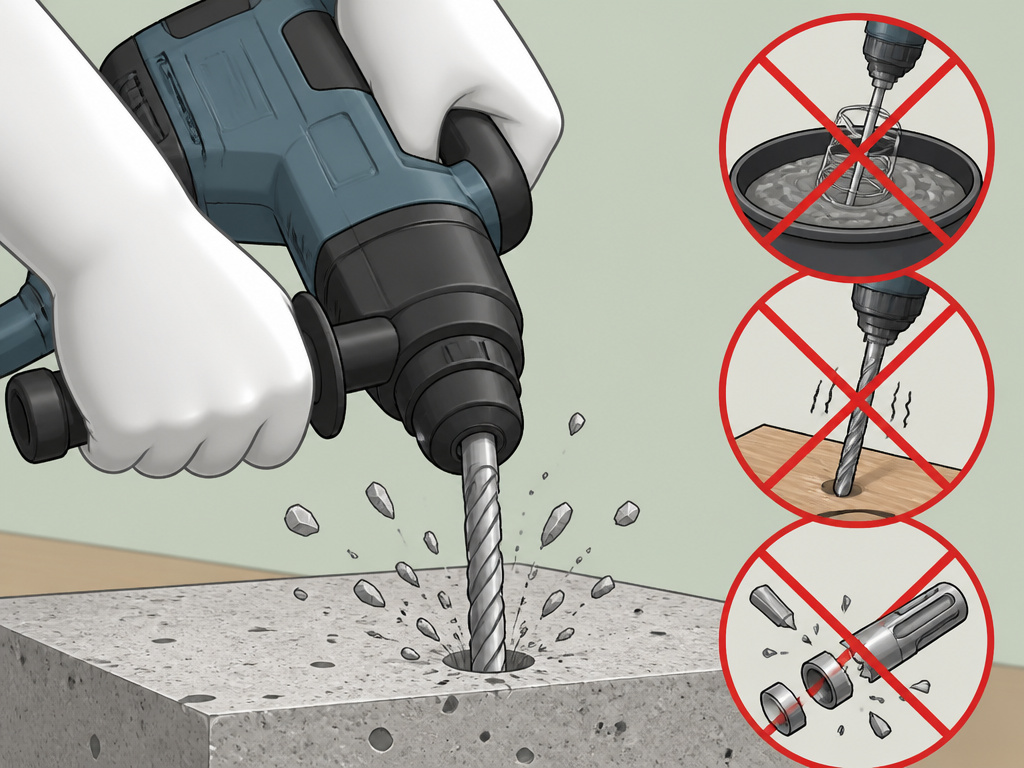
These are specialized tools with clear boundaries. Respect them, and the tool will last for years. Ignore them, and you’ll cause immediate damage.
What It’s For:
- Drilling into concrete, brick, block, and stone. This is its sole purpose. The SDS system and pneumatic hammer are engineered specifically to pulverize hard, brittle materials.
- Light demolition and chiseling. In “hammer-only” mode, you can use flat or pointed chisel bits to remove tile, chase channels in walls, or break up small concrete sections.
- Installing mechanical anchors. Sleeve anchors, wedge anchors, and drop-in anchors all require a clean, precise hole in concrete, which an SDS drill provides efficiently.
What It’s NOT For (The Manuals Scream This):
- Mixing. Never use an SDS drill to mix concrete, mortar, grout, or drywall mud. The viscous load will overheat and burn out the motor, and the lateral strain can snap the gearbox. The SDS65 manual states this voids the warranty.
- Precision drilling in wood or metal. The sliding SDS chuck has inherent axial play, meaning the bit can wobble slightly. This results in rough, oversized holes. For clean holes in wood or metal, use a standard drill.
- Using standard bits in hammer mode. If you use an adapter to fit a standard round-shank bit, you must disable the hammer mechanism. The hammer action will destroy the adapter and the bit, and can send metal shrapnel flying.
How to Choose the Right SDS Hammer Drill
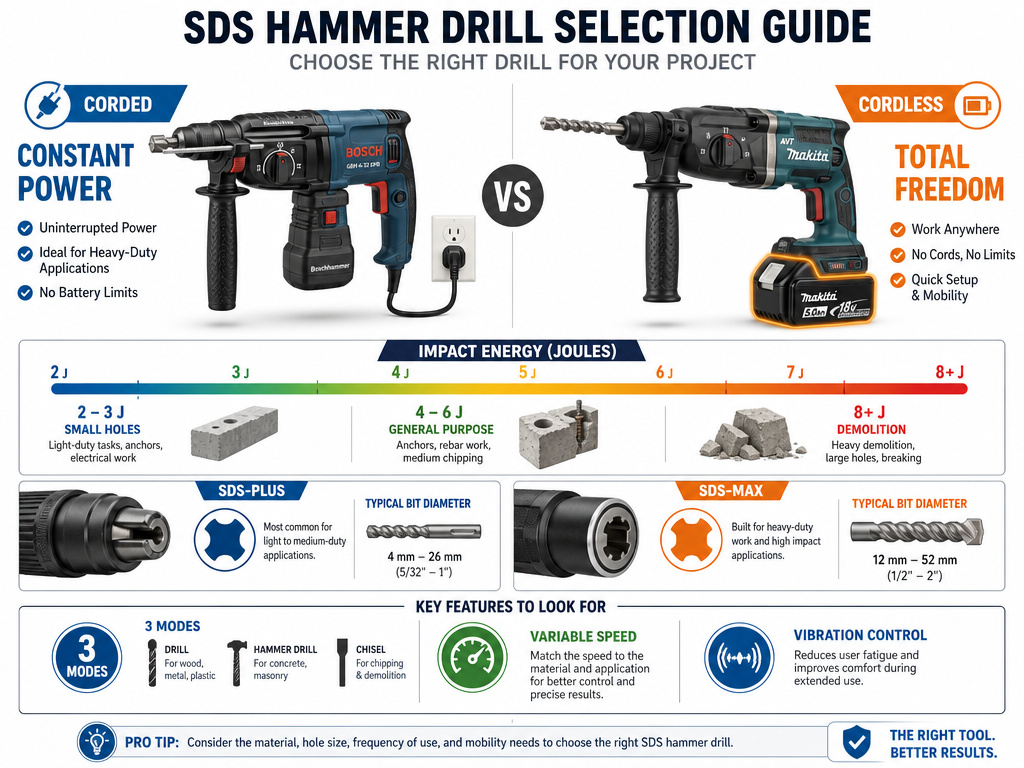
Shopping based on brand loyalty or the biggest number on the box is a mistake. Your choice should be dictated by your project list and your work environment.
1. Corded vs. Cordless
This is the first fork in the road. Corded models (like many DeWalt SDS and Bosch professional tools) deliver constant, maximum power. You never wait for a charge, and they’re often less expensive for the performance. The cord is a hassle on large sites or when working at height. Cordless models (dominant in the Milwaukee M18 Fuel and Makita XGT lines) offer incredible freedom. Modern lithium-ion batteries can handle a day of intermittent drilling. For service work, roofing, or anywhere outlets are scarce, cordless is the only practical choice. Just buy at least two high-capacity batteries.
2. Impact Energy (Joules)
This number, when honestly reported, tells you how hard the tool hits. For drilling holes up to 1/2 inch for anchors, 2-3 Joules is plenty. For 1-inch holes or light chiseling, look for 4-5 Joules. For SDS Max rotary hammer drills doing demolition, you need 8+ Joules. More impact energy means faster drilling and less physical effort.
3. Chuck Type: SDS-Plus or SDS-Max?
Let your maximum hole diameter decide. If you can’t imagine ever needing a hole bigger than 1-1/4 inches, SDS-Plus is your answer. It’s lighter, cheaper, and the bits are more affordable. If large penetrations or demolition are on the menu, you need the SDS-Max system.
4. Essential Features
- Three Modes: Drill-only, Hammer Drill, and Hammer-Only are non-negotiable. The chisel function is invaluable.
- Variable Speed: A trigger or dial that lets you start a hole slowly prevents the bit from skidding and marring the surface.
- Vibration Control: Especially on corded models, rubberized grips and internal counterweights reduce fatigue.
- Active Torque Control (ATC): A premium feature on top-tier models from Makita and Bosch. It detects sudden binding (like hitting rebar) and disengages the drive to prevent violent kickback.
For most homeowners tackling occasional projects, a mid-range corded SDS-Plus model or a mid-tier cordless kit will be overkill in a good way. It will get the job done fast and live in your garage for a decade. Professionals will look at the best rotary hammer drills in their battery ecosystem and choose based on daily grind.
Frequently Asked Questions
Can I use regular drill bits in an SDS hammer drill?
Yes, but only with a dedicated SDS-to-standard chuck adapter, and you must switch the tool to “drill-only” mode. The hammer mechanism will destroy a standard bit and likely the adapter. It’s a workaround for the odd hole in wood or metal, not a standard practice.
What does SDS stand for?
SDS stands for Slotted Drive System (or Slotted Drive Shaft). It refers to the unique chuck and bit shank design that uses slots and ball bearings to lock the bit in place while allowing it to slide back and forth for efficient hammer action.
How is an SDS drill different from a rotary hammer?
They are the same thing. “SDS drill” typically refers to the tool’s chuck system, while “rotary hammer” describes its pneumatic hammer mechanism. An SDS hammer drill is a type of rotary hammer. The terms are used interchangeably.
What is the concrete drilling capacity of an SDS drill?
It varies by model. A typical SDS-Plus drill like the SDS65 has a rated capacity of 1 inch (25.4 mm) in concrete. SDS-Max drills can handle diameters of 2 inches and beyond. Always check the manual for your specific tool’s limits.
Why is my SDS drill not hammering?
First, ensure it’s set to “hammer drill” or “hammer only” mode. If it’s in the correct mode but not hammering, the problem is likely internal: a broken piston, striker, or seal. These are major components, and repair usually means sending it to a service center. For basic troubleshooting, check our guide on the internal mechanism of a hammer drill.
Before You Go
An SDS hammer drill isn’t just a stronger hammer drill. It’s a different machine built around a brilliant bit-holding system. The SDS chuck turns a powerful pneumatic hammer into a practical, safe, and efficient tool for conquering masonry.
Remember the limits. This is a concrete specialist. Using it for anything else is like using a chainsaw to carve a turkey, possible, but messy, dangerous, and damaging to the tool. Match the standard (Plus or Max) to your largest planned hole, and choose cordless for freedom or corded for relentless power. When you need to get into rock-solid material, nothing else comes close.
