
Cobalt vs HSS Drill Bits | The 5% Cobalt Edge That Breaks
This post contains affiliate links. As an Amazon Associate, we earn from qualifying purchases.
Cobalt drill bits are not a different material from HSS bits; they are high-speed steel alloyed with 5% or 8% cobalt. This specific addition increases heat resistance and hardness, making HSS-Co bits the default for stainless steel and high-tensile alloys, while standard HSS bits excel in general steel, wood, and plastic.
That “Co” in HSS-Co is the whole game. It changes how the steel’s microstructure handles the friction point, which hits 600°C in seconds when you push into 304 stainless. A standard HSS M2 bit will soften and lose its edge there. The cobalt version holds its temper.
The rest of this breaks down into three decisions: the metal you’re drilling, the precision you need, and the budget you’re guarding against counterfeit grade substitutions. We’ll walk through the alloy science, the tangible performance split, and the one spec sheet line that tells you which bit you’re actually holding.
Key Takeaways
- Cobalt bits are HSS bits with 5–8% cobalt added. The alloy increases hot hardness, letting the bit withstand the 600°C+ temperatures generated by drilling stainless steel and tough alloys.
- Standard HSS (like M2) is for general purpose work. It’s your go-to for wood, plastic, aluminum, and mild steel. For precise holes in alloyed steel, look for HSS-G (ground) bits compliant with DIN 338.
- The biggest risk with cheap bits is grade substitution. A price 15% below market for “M2 HSS” often means the steel lacks the proper tungsten and molybdenum, causing premature failure on the first hard material.
- Match the helix type to your material. A standard helix (Type H) is for steel and hard plastics. A narrow helix (Type W) is for soft, long-chipping materials like aluminum and copper.
- Coatings like Titanium Nitride (TiN) add surface hardness to HSS, but they don’t replace the bulk material properties of a true cobalt alloy. TiN is for wear resistance on standard HSS, not for extreme heat.
What’s the Actual Difference in the Metal?
The labels “HSS” and “Cobalt” aren’t opposites. Cobalt drill bits are a subtype of high-speed steel. Every drill bit marketed as cobalt is an HSS-Co bit, high-speed steel with a cobalt alloy.
Standard HSS is a family of tool steels defined by their ability to retain hardness at high temperatures. The most common grade is M2, which contains tungsten, molybdenum, chromium, and vanadium. It’s the workhorse.
HSS-Co designates grades like M35 (5% cobalt) and M42 (8% cobalt). The cobalt atoms integrate into the steel’s matrix, stabilizing the hard carbides at elevated temperatures. Where M2 HSS starts to soften around 500°C, HSS-Co can maintain cutting ability past 600°C.
A Hilti HSS M2 drill bit uses a 135-degree split point for self-centering in metal, per DIN 338. A Bosch PRO Stainless Steel HSS-Co bit uses the same geometry but with the cobalt-alloyed steel to survive the heat of stainless steel.
This isn’t a minor upgrade. When drilling stainless steel, the work-hardening material and high friction can push the cutting edge past the red hardness limit of standard HSS. The edge rounds over, the bit stops cutting, and you apply more pressure. That creates more heat, and the bit is now ruined.
The 3-Step Material Match (HSS, HSS-Co, or Carbide)
Your material dictates the bit. This isn’t a suggestion; it’s a rule of physics. Picking wrong costs you bits, time, and a finished workpiece.
1. For General Steel, Wood, Plastic, and Aluminum: Standard HSS
This covers 80% of DIY and light professional work. A quality HSS M2 bit, especially a ground (HSS-G) version, will drill clean, precise holes. The “G” means the flutes and cutting edges were precision-ground after forging, resulting in better concentricity and chip evacuation.
When to reach for HSS-G: Drilling alloyed or unalloyed steel, cast iron, brass, bronze, and most plastics. The Metabo HSS-G drill bits, for example, are rated for materials up to 900 N/mm² tensile strength.
Common mistake: Using a standard HSS bit on stainless steel or titanium. The bit will dull within the first inch, often seizing and snapping if forced. The telltale sign is blueing at the cutting edges, that’s temper loss.
2. For Stainless Steel, High-Tensile Alloys, and Hardened Steel: HSS-Co (5% or 8% Cobalt)
This is the primary use case for cobalt bits. Stainless steel work-hardens. If your bit isn’t sharp enough or can’t handle the heat, it burnishes the surface instead of cutting it, creating an impenetrable glassy layer.
HSS-Co bits resist this work-hardening effect. The cobalt addition provides the necessary hot hardness. The trade-off is that cobalt makes the steel slightly more brittle. You must use steady pressure and avoid side-loading or wobble.
HSS-Co5 (5% cobalt) is the standard for most stainless steel jobs. HSS-Co8 (8% cobalt) is for extreme production environments or interrupted cuts (like drilling through spot welds). The Bosch PRO Stainless Steel HSS-Co line is a benchmark here.
| Material | Best Bit Type | Critical Setting | What Happens If You Use the Wrong Bit |
|---|---|---|---|
| Mild Steel, Aluminum | HSS or HSS-G | Medium RPM, cutting fluid | Slow cutting, but usually completes the job. |
| Stainless Steel (304, 316) | HSS-Co5 or HSS-Co8 | Low RPM, high pressure, constant lubricant | Bit dulls immediately, work-hardens the metal, seizes or snaps. |
| Cast Iron | HSS or Carbide | High RPM, no lubricant | Bit abrasively wears down over many holes. |
| Hardened Steel (>45 HRC) | Solid Carbide or Cobalt | Very low RPM, peck drilling | HSS shatters; HSS-Co may survive with extreme care. |
3. For Production, Abrasive Composites, and Ceramics: Solid Carbide
When you move beyond metals entirely, into fiberglass, carbon fiber, ceramics, or abrasive boards, solid carbide is the only choice. It’s exponentially harder than any HSS but also brittle and expensive. That’s a separate discussion covered in our guide on cobalt vs carbide.
Decoding the Labels: Grades, Coatings, and Fraud Warnings
The drill bit aisle is a minefield of misleading labels. Knowing how to read them protects your wallet and your project.
The “HSS-E” and “HSS-Co” Designation
In Europe, HSS-E is the standard term for cobalt-alloyed high-speed steel. The “E” stands for “super high-speed steel.” HSS-Co is the more universal term. They mean the same thing: steel with a cobalt addition. If a bit is labeled for stainless steel and doesn’t say “cobalt” or “HSS-E,” be suspicious.
Coatings: TiN, TiAlN, and Black Oxide
Coatings are a surface treatment, not a bulk material change. They are applied to both standard HSS and HSS-Co bits. * Titanium Nitride (TiN): The familiar gold coating. It increases surface hardness to about 2300 HV and offers some lubricity. It’s excellent for extending the life of standard HSS drill bits in general metalworking. Ruko makes popular HSS-TiN jobber bits. * Titanium Aluminum Nitride (TiAlN): A darker, harder coating that withstands even higher temperatures. It’s often used on better-quality HSS-Co bits. * Black Oxide: A rust-inhibiting finish that also provides some lubricity. It’s a budget-friendly option but doesn’t add significant hardness.
Where this goes sideways: Assuming a gold TiN coating makes a cheap bit a “cobalt” bit. The coating is a few microns thick. Once it wears through, you’re left with the base steel. A true HSS-Co bit will be made of cobalt alloy from core to surface.
The Grade Substitution Problem
This is the critical, unspoken risk with ultra-cheap drill bit sets, particularly from certain mass-production regions. A genuine M2 HSS formulation requires specific amounts of expensive elements like tungsten and molybdenum.
A documented industry insight notes that a price 15% or more below an established supplier for a like-for-like “M2 HSS” bit often indicates grade fraud. The manufacturer substitutes cheaper steel alloys that lack the necessary hot hardness.
The bit will feel okay drilling wood or soft plastic. The first time it encounters real metal, the cutting edges will deform almost instantly. You’re not buying a bargain; you’re buying a single-use tool. This is why understanding common drill bit materials matters.
The Pro’s Choice: When to Buy Which Set
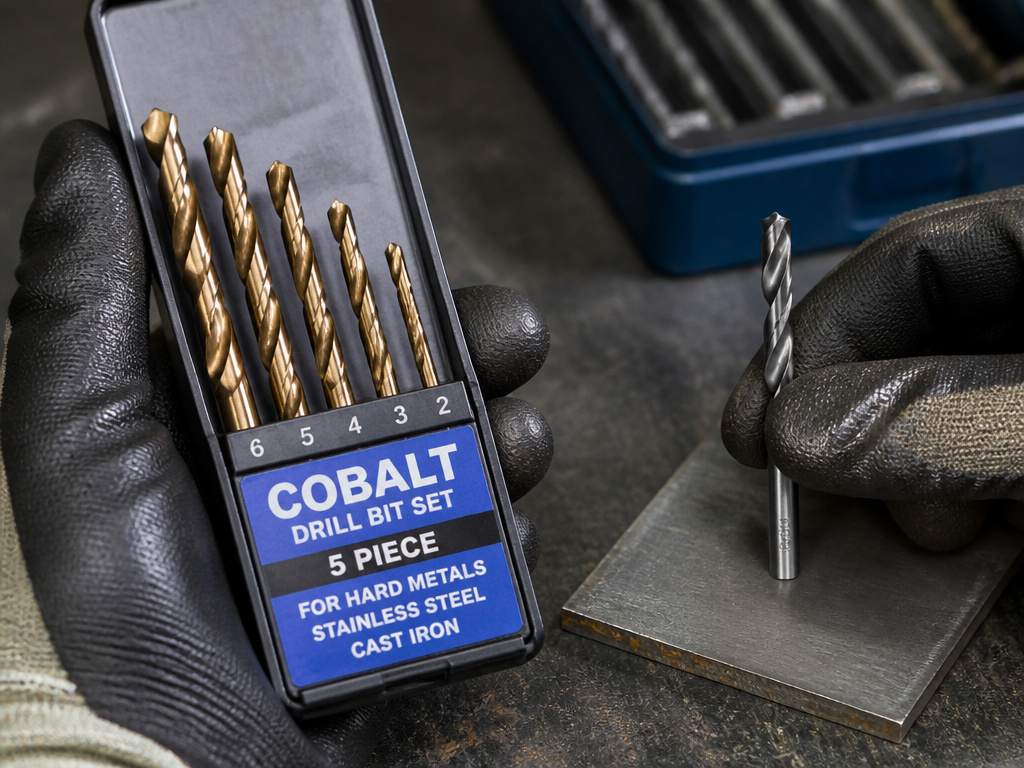 You don’t need every type. Most workshops can thrive with two sets: a general-purpose HSS set and a dedicated HSS-Co set for tough metals.
The General-Purpose Workhorse: A Quality HSS-G Set
For a home workshop, start with a 29-piece HSS-G jobber length set in fractional sizes. The “ground” manufacturing ensures precision for metal. Use it for everything except stainless steel, hardened steel, and masonry. This set handles all your drilling into stainless steel prep work on softer materials.
The Stainless & Alloy Specialist: A Small HSS-Co5 Set
Don’t buy a 100-piece cobalt set. Buy a small, quality set of the most common sizes: 1/8″, 3/16″, 1/4″, 5/16″, and 3/8″. Brands like Bosch PRO or Milwaukee make these in 5-piece packs. This is your dedicated kit for drill bits for stainless steel and other tough jobs. Guard them fiercely.
What about “Cobalt” Masonry Bits?
They exist, but the role of cobalt here is different. In a masonry bit, a cobalt alloy is used to braze the carbide tip to the steel shaft, creating a stronger bond that resists the vibration of hammer drilling. It’s not a cutting edge material.
Frequently Asked Questions
Are cobalt bits always better than HSS?
No. They are better only for specific materials, primarily stainless steel and high-tensile alloys. For everyday drilling in mild steel, wood, or plastic, a standard HSS bit is more cost-effective and less brittle. Using cobalt on soft materials is overkill and wastes money.
Can you sharpen cobalt drill bits?
Yes, but it requires a good bench grinder and knowledge of the correct angles (often 135 degrees for HSS-Co). The cobalt alloy is harder, so it takes more time and care to sharpen without overheating and ruining the temper. Many pros send them out for professional sharpening.
Why are some cobalt bits silver and some gold?
The color indicates the coating, not the base metal. A silver bit is likely bare HSS-Co steel or has a black oxide coating. A gold bit has a Titanium Nitride (TiN) coating applied over the HSS-Co steel. The coating reduces friction and increases wear resistance. The underlying cobalt alloy is the same.
What’s the difference between 5% and 8% cobalt?
HSS-Co5 (5% cobalt) offers a great balance of heat resistance and toughness for most stainless steel applications. HSS-Co8 (8% cobalt) has higher hot hardness for extreme-duty or production work but is more brittle and prone to chipping if not used perfectly. For 95% of users, 5% is the right choice.
How do I identify a real HSS-Co bit?
First, check the label and packaging for “HSS-Co,” “HSS-E,” or “M35/M42.” Second, look at the price, if it’s drastically cheaper than known brands, it’s suspect. Third, many genuine bits have the size and “Co” etched or stamped on the shank. When in doubt, buy from a reputable tool supplier, not a generic online marketplace.
The Bottom Line
Skip the marketing. The choice between cobalt and HSS drill bits is a material specification, not a brand war.
For your daily drilling in common materials, a set of ground HSS (HSS-G) bits is the efficient, precise choice. When your project list includes stainless steel, titanium, or hardened alloys, you need the heat resistance of HSS-Co5 bits. Invest in a small, high-quality set of these and use them only for their intended purpose.
Finally, trust the specs, not the color. A gold coating doesn’t make a cheap bit tough. The strongest drill bits earn their title through verified alloy composition and proper geometry, stamped right on the steel. Your work shows the difference.
