Titanium vs Carbide Drill Bit: Which Material Is Superior?
This post contains affiliate links. As an Amazon Associate, we earn from qualifying purchases.
Titanium drill bits are titanium nitride-coated high-speed steel. Carbide drill bits are solid tungsten carbide with a cobalt binder. Titanium bits are tougher, cheaper, and good for general steel and wood. Carbide bits are harder, more brittle, and the only choice for hardened steel, composites, and high-volume production. The choice isn’t about which is better overall. It’s about which one fails last on the specific material you’re drilling.
That difference between a coating and a solid material decides everything: how you feed the drill, what speed you run, and what happens when you hit a hidden nail or a hard spot. Get it wrong and you’re not just wasting a bit. You’re burning out a motor or sending shrapnel across the shop.
What follows: the exact metallurgical split, a table that maps material to bit type, the one mistake that shatters carbide instantly, and the hidden cost-per-hole math that makes carbide cheaper for a production line.
Key Takeaways
- Titanium bits are coated HSS; carbide bits are solid cemented tungsten carbide. Confusing them buys the wrong tool.
- Carbide’s extreme hardness (HRA 91) makes it the only option for materials above 45-50 HRC, like hardened steel or fiberglass.
- The braze joint on a carbide-tipped bit is a failure point; overheating it weakens the bond and the tip flies off.
- For most home shops drilling occasional steel or wood, titanium nitride-coated HSS is the default. It’s cheaper and tolerates hand-held mistakes.
- In a CNC or rigid drill press running hundreds of holes a day, carbide’s lower cost-per-hole wins, even at three times the upfront price.
The Titanium vs Carbide Difference Isn’t Academic
This isn’t a subtle distinction. A titanium drill bit is almost always a high-speed steel bit with a thin titanium nitride coating applied for wear resistance. The core material is tough, flexible steel. A carbide drill bit is made from cemented tungsten carbide, a composite of ultra-hard tungsten carbide grains held together by a cobalt metal binder. The entire bit is that brittle, rock-hard material.
Titanium nitride (TiN) coating is a 1–4 micron surface layer. Cemented tungsten carbide is a bulk material with a typical density of 14.70 g/cm³, a hardness over HRA 90, and a flexural strength around 2,000 MPa, as specified in Ruixin Tungsten Carbide’s SR7X grade datasheet.
Think of it like a non-stick pan versus a cast-iron skillet. The non-stick coating changes the surface, but the pan underneath is still aluminum. Titanium coating changes the surface of the bit. Carbide is the cast iron — the whole thing is the hard stuff.
Where this goes sideways: Buying a “titanium” bit for drilling into brick or ceramic tile. The coating is great for reducing friction in metal, but it does nothing against abrasives. You’ll wear through the titanium nitride coating in about six holes on masonry, and then you’re just using a plain HSS bit that dulls immediately. For tile or brick, you need a carbide-tipped masonry bit or a diamond core bit.
Head-to-Head: When to Use Which Bit
The table below isn’t a suggestion. It’s a rule-of-thumb forged from broken bits and stalled projects. Match your primary material to the left column.
| Material | Best Bit Type | Why It Wins | What Happens If You Use the Other |
|---|---|---|---|
| Mild Steel, Aluminum, Wood | Titanium Nitride-Coated HSS | Coating reduces friction and heat; HSS core absorbs vibration from hand drilling. | Carbide will work but is overkill. You risk chipping the cutting edge if the drill wanders. |
| Stainless Steel, Hardened Steel (>45 HRC) | Solid Carbide or Carbide-Tipped | Hardness (HRA 91+) abrades the work-hardening surface without immediate dulling. | Titanium-coated HSS dulls within seconds, glazes the work surface, and can snap under the increased pressure. |
| Fiberglass, Carbon Fiber Composites | Solid Carbide (Polished Flute) | Sharp edge shears fibers cleanly; hardness resists abrasive wear from the matrix. | HSS, even coated, wears rapidly, leaving a frayed, resin-clogged hole that weakens the part. |
| High-Volume Production (100+ holes/day) | Solid Carbide | Lower cost-per-hole due to vastly longer life between changes, less machine downtime. | The upfront savings on titanium bits are erased by frequent changes and lost production time. |
| Masonry, Concrete, Tile | Carbide-Tipped Masonry Bit | The carbide tip is brazed to a tough steel body designed for hammer-action impact. | A “titanium” bit is just coated HSS. It will blunt on the first aggregate stone and overheat. |
The takeaway is mechanical, not philosophical. Carbide is harder. Titanium-coated steel is tougher. Hardness beats abrasion. Toughness beats impact. Your material decides which enemy you’re facing.
Titanium Drill Bits: A Coating, Not a Core
Let’s be precise. The “titanium” in drill bits refers to a titanium nitride coating (TiN). Sometimes you see TiCN (titanium carbonitride) or TiAlN (titanium aluminum nitride). These are all thin, hard ceramic coatings applied via physical vapor deposition. They work by reducing friction at the cutting edge, which lowers heat and lets the underlying HSS steel last longer.
The steel underneath is the hero. High-speed steel can withstand the intermittent pressure and slight misalignment of a hand-held drill. It bends a little. It doesn’t snap.
Common mistake: Using a titanium-coated bit as a step bit or in a drill press with high runout. The coating is only a few microns thick. Any lateral force or vibration wears through it at a single point, and then that spot becomes a wear hotspot that accelerates failure. The bit will look partially coated but cut poorly.
Why-layer: The coating reduces the coefficient of friction between the bit and the metal chips. Lower friction means less heat stays in the bit. Since HSS loses hardness at temperatures above 600°C, keeping it cooler lets it hold an edge longer. The coating itself can handle about 800°C before it starts to break down.
For the home workshop, a set of titanium nitride-coated bits like the DeWalt DW1361 or the Irwin Industrial Tools Marathon is the sensible default. They drill most common materials, survive the occasional dropped drill, and cost a fraction of a single solid carbide bit.
Carbide Drill Bits: The Grain-Size Trade-Off
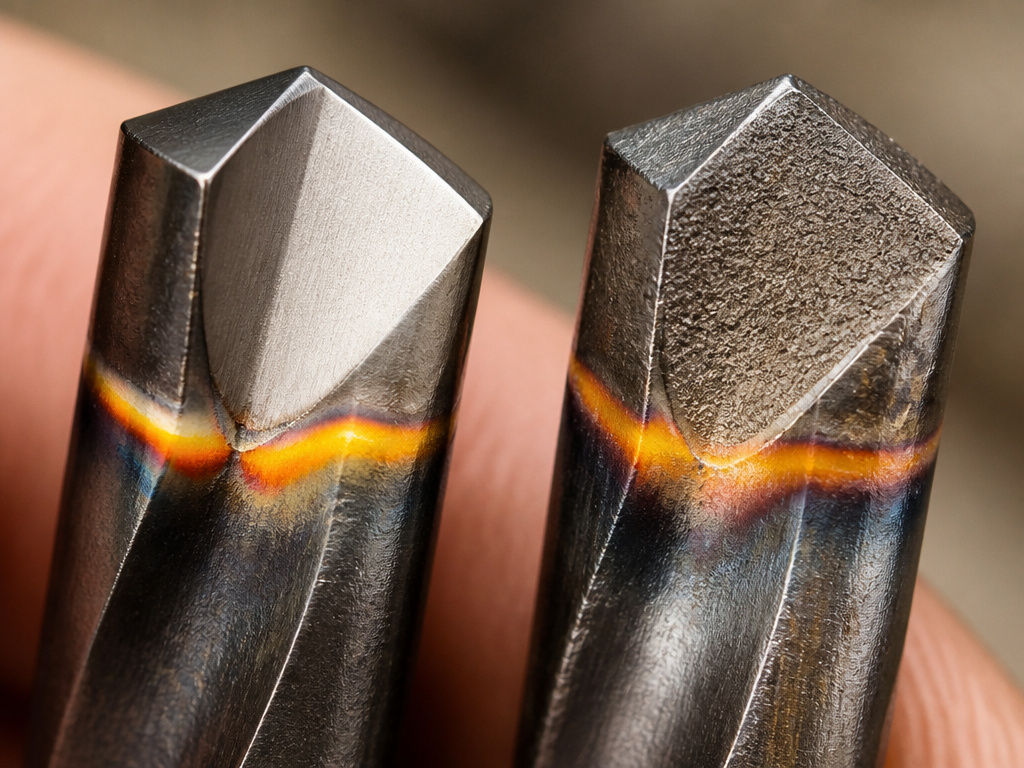 When we say “carbide,” we mean cemented tungsten carbide. It’s a powder metallurgy product: tungsten carbide grains are mixed with a cobalt binder, pressed into shape, and sintered at high temperature. The percentage of cobalt and the size of the carbide grains determine its performance.
- Fine grain (1–1.2 µm): Higher hardness (HRA 91+), better wear resistance. Best for finishing cuts and abrasive materials.
- Coarse grain (2–3 µm): Higher flexural strength (≥2,200 MPa), better shock resistance. Best for roughing and interrupted cuts.
The Ruixin SR7X grade (fine grain) is designed for maximum wear resistance. The Ruixin SR10C grade (coarse grain) trades some hardness for greater toughness to resist impact fracture. You don’t get both.
This is the part nobody mentions: That braze joint holding a carbide tip onto a steel drill body? It’s a fuse. If you run the bit too fast without coolant, or jam it in a deep hole with packed chips, the heat soaks back into the braze alloy. It softens. The next time the tip hits a hard spot, it can spin in its socket or eject completely. That’s not a defect. It’s a predictable failure mode of the design.
The Solid Carbide Alternative
For the ultimate in precision and heat resistance, solid carbide drill bits are the answer. There’s no steel body, no braze joint—just a single piece of carbide ground to a sharp edge. They’re standard in CNC machining centers and are the only choice for drilling hardened steels or composites.
But they have a vice: brittleness. A solid carbide bit cannot handle lateral force. An interrupted cut (like drilling into a piece of angle iron where the bit contacts two edges separately) can shatter it. They demand a rigid setup—a CNC mill or a high-quality drill press with minimal runout. Putting one in a hand-held cordless drill is asking for a broken tool and a potential injury.
Titanium vs Carbide: Direct Comparison by Job
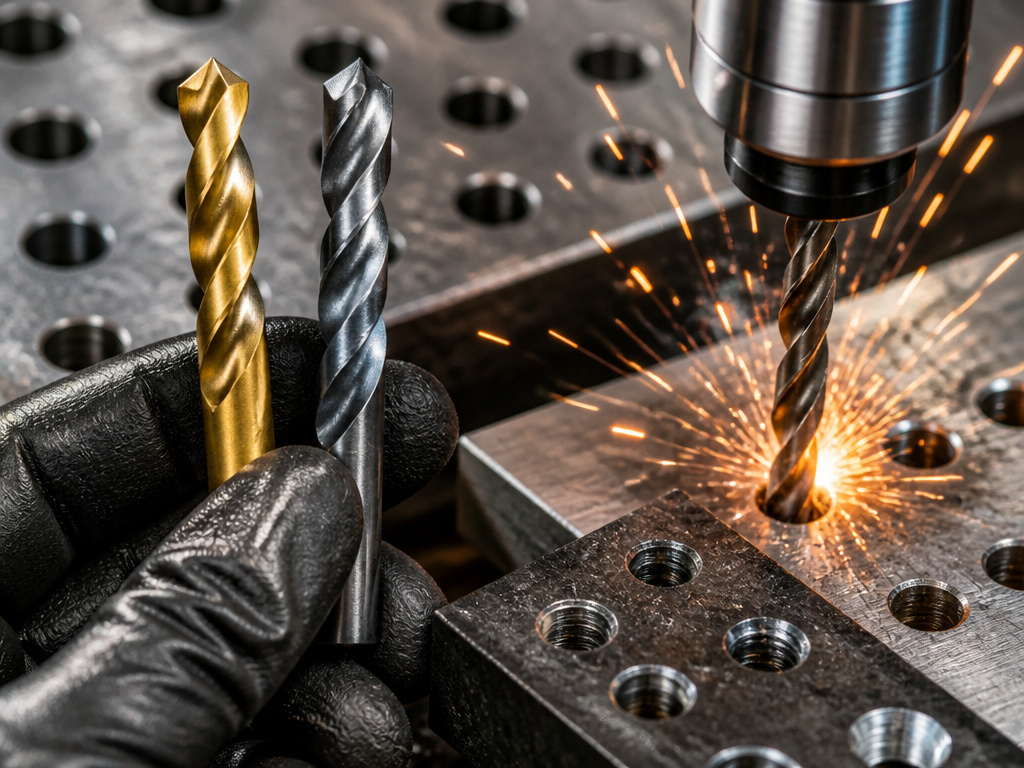 You’re standing at the bench with a piece of material. Which bit do you load? Let’s get specific.
Drilling Steel and Stainless Steel
For occasional holes in mild steel, a titanium nitride-coated bit is fine. The coating’s lubricity helps prevent the chip welding that can gum up flutes.
For stainless steel, especially work-hardening grades like 304 or 316, you need carbide. Stainless steel doesn’t cut; it abrades. The moment a cutting edge starts to dull, the material work-hardens just ahead of the bit, becoming even harder. A sharp carbide bit maintains its edge long enough to get through the material before this cycle begins. A titanium-coated bit will skate, burnish, and snap.
Our guide on the best drill bit for steel dives deeper into feed rates and pecking cycles.
Drilling Hardened Materials and Composites
This is where the debate ends. For materials above 45 HRC (hardened tool steel, axle shafts) or abrasive composites (fiberglass, carbon fiber), carbide is the only viable option. The YDS Tools industry analysis states this plainly: HSS-based bits, even coated, wear down rapidly.
The drill bit for stainless steel logic applies doubly here: hardness and sharpness are everything. A solid carbide bit with a polished flute is the professional standard.
High-Volume Production and Cost-Per-Hole
Here’s the economic pivot. A single carbide drill bit can cost three times more than a titanium-coated HSS bit. But in a production setting running hundreds of holes per day, the carbide bit lasts ten to twenty times longer. The math of cost-per-hole flips the script.
The part nobody mentions: Downtime for tool changes is the hidden cost. A CNC machine stopped for a bit change isn’t making money. Carbide’s extended life means fewer changes, less downtime, and higher overall equipment effectiveness. That’s why shops running mass production specify carbide—not because it’s fancier, but because it’s cheaper at scale.
Safety and Handling: What Breaks First
These materials fail in predictable ways. Knowing the failure mode keeps you safe.
For Titanium-Coated Bits:
- Failure: The coating wears through, then the HSS core dulls or snaps.
- Cause: Excessive speed, lack of cutting fluid, or using on abrasive materials.
- Sign: Discoloration (blueing) behind the cutting edge, then rounded edges.
- Fix: Reduce speed, use lubricant, reserve for metals and wood.
For Carbide Bits (Tipped or Solid):
- Failure: Tip braze failure or shattering.
- Cause: Lateral shock, interrupted cuts, or thermal shock from no coolant.
- Sign: A missing tip, visible cracks in the carbide, or a suddenly rough, chattering cut.
- Fix: Ensure rigid setup, use steady feed, employ coolant for deep holes.
Before you start: Always wear safety glasses when drilling metal. Dull bits require more force and can bind, causing the drill to kick back. Securely clamp your workpiece. When a carbide bit breaks, it can send sharp fragments flying at high speed.
How to Choose: A Decision Flowchart
Stop guessing. Follow this path.
- What are you drilling? If it’s masonry, tile, or concrete, select a carbide-tipped masonry bit. Stop here.
- Is it hardened steel, stainless steel, or composite? If yes, select a solid carbide or premium carbide-tipped bit. Use a rigid machine and coolant.
- Are you drilling more than 50 holes in a session? If yes, lean toward carbide for its longevity.
- Is this a hand-held drill job on mild steel, aluminum, or wood? If yes, a titanium nitride-coated HSS bit is the correct, economical choice.
- Still unsure? Default to titanium-coated HSS. Its toughness forgives common errors, and it’s cheaper to replace if you’re wrong.
The process of choosing a drill bit always starts with the workpiece, not the tool.
Frequently Asked Questions
Can you sharpen titanium or carbide drill bits?
Titanium-coated bits can be sharpened, but you’ll grind off the coating on the cutting edge. The resharpened bit will perform like a plain HSS bit. Solid carbide bits require a diamond grinding wheel and precise jigs to maintain the complex geometry. Most users send them to a professional sharpening service. Attempting to hand-sharpen carbide usually ruins the bit.
Why are some carbide bits so much cheaper than others?
The grade of tungsten carbide and the quality control vary wildly. Cheap bits may use recycled carbide with inconsistent grain structure or a higher, weaker cobalt binder ratio. They might lack the precise flute geometry needed for efficient chip ejection. They’ll work for a few holes, then dull or chip unexpectedly. Brands like Ruixin, Sandvik (PowerCarbide®), or premium industrial suppliers publish their material specs for a reason.
Is a black oxide bit the same as a titanium bit?
No. Black oxide is a surface treatment that provides mild corrosion resistance and helps retain cutting oil. It offers almost no improvement in wear resistance compared to titanium nitride coating. The debate between titanium vs black oxide is really about corrosion protection versus friction reduction.
Can I use a carbide bit in a regular drill?
You can, but you shouldn’t. The hand-held drill’s inherent wobble and potential for side load are exactly what solid carbide bits cannot tolerate. If you must, use only carbide-tipped bits designed for impact drivers (like some masonry bits), and be prepared for a shorter life. For true solid carbide bits, a drill press or CNC machine is mandatory.
What’s better for aluminum: titanium or carbide?
For aluminum, titanium nitride-coated HSS is usually better. Aluminum is soft and gummy. The sharp edge of a new HSS bit shears it cleanly, and the coating helps prevent material adhesion (built-up edge). Carbide can be used, especially in high-speed CNC applications, but its brittleness isn’t needed for the soft material, and it’s more prone to chipping if chips pack in the flutes.
The Bottom Line
Stop looking for a winner. There isn’t one.
For the home garage, the truck toolbox, or the weekend project bag, titanium nitride-coated high-speed steel bits are your workhorse. They’re affordable, durable enough for mistakes, and they’ll handle 95% of what you throw at them. Keep a set handy.
For the professional shop, the production line, or the specialized job involving hardened metals or composites, carbide drill bits are a consumable necessity. They’re not a luxury; they’re the tool that matches the task’s physics. Budget for them, respect their limits, and they’ll outwork anything else.
Your next hole decides. Pick the bit that fails last on that specific material. Everything else is just noise.
