
What Drill Press Swing Is and Why This Spec Is Crucial
This post contains affiliate links. As an Amazon Associate, we earn from qualifying purchases.
Drill press swing is the maximum diameter of a cylindrical workpiece you can center-drill on that machine. It’s defined as twice the distance from the center of the spindle (where the chuck sits) to the nearest surface of the supporting column. A 10-inch swing means you can drill a hole through the exact center of a 10-inch round piece of stock.
That distance is the single number that decides whether your project fits on the table. It has nothing to do with motor horsepower, speed settings, or how deep you can drill. It is purely a measurement of physical clearance. Get this wrong, and your drill press cannot physically reach the center of your workpiece, no matter how powerful it is.
What follows is a breakdown of how swing dictates your machine’s real capacity, how to measure it on any press, and the common size categories you’ll find from 8-inch benchtop units to 17-inch floor models.
Key Takeaways
- Swing is a physical clearance limit, not a power rating. A 1/2 HP press can have the same 14-inch swing as a 1 HP model.
- To measure swing, find the distance from the spindle center to the column and double it. This gives you the maximum cylindrical workpiece diameter.
- Ignoring swing leads to project incompatibility. You cannot drill the center of a 12-inch disk on a 10-inch swing press.
- Common benchtop swings start at 8 inches (Rikon 30-100M5). Mid-size floor models are often 14 or 17 inches (WEN 4227).
- The column diameter and table size grow with swing. A 17-inch press needs a massive 3-1/8 inch column and a 13-3/4 inch table for stability.
How to Measure Drill Press Swing
The factory spec is printed on the nameplate. If it’s worn off or you’re looking at a used machine, you need a tape measure.
The Technical Snippet: Drill press swing is a standardized specification representing twice the radius from the spindle’s rotational centerline to the machine’s column. This measurement, expressed in inches or millimeters, defines the maximum diameter of a circular workpiece that can be centered under the chuck for a through-hole operation. It is independent of quill travel, motor horsepower, or speed range.
Step 1: Find the spindle center. Lower the quill so the chuck is close to the table. Imagine a vertical line running straight down through the exact center of the chuck jaws.
Step 2: Measure to the column. Hold your tape measure at that imaginary center point. Measure horizontally to the nearest point on the machine’s vertical column. Do not measure to the table edge or the belt cover. It’s the solid steel column.
Step 3: Double the number. Take that measurement and multiply it by two. If you measured 7 inches to the column, you have a 14-inch swing drill press.
That’s it. This method works on any drill press, whether it’s a vintage cast-iron beast or a modern benchtop unit. The number you get is the hard limit for centered cylindrical work.
Why Swing Isn’t About Power
This is the part that trips people up. They see a 1 HP motor and a 14-inch swing on one machine, and a 1/2 HP motor with the same 14-inch swing on another. The motor doesn’t change the geometry.
Swing is a function of the cast iron or steel head casting and the column’s diameter. A manufacturer designs a head that positions the spindle motor a certain distance from the column. That distance is fixed by the physical shape of the parts. The motor bolted to that head can be swapped for a more or less powerful unit without altering the swing measurement.
The Rikon 30-100M5 benchtop model has an 8-inch swing and a 1/3 HP motor. The Hi-Yard BDP4120B floor model has a 14-inch swing and a 1 HP motor. The swing didn’t increase because of the motor. The entire machine is built larger to accommodate a bigger swing, and a larger machine often gets a more powerful motor to handle the larger drills you’d use with it. The correlation is incidental, not causal.
Where this goes sideways: Choosing a drill press based on motor horsepower alone. You could buy a 1-1/2 HP monster, but if it only has a 10-inch swing, you’ll never center-drill a 12-inch wooden wheel. The project simply won’t fit.
Common Swing Sizes and What They Fit
Drill presses cluster around standard swing sizes. Each size represents a class of machine suited for a different scale of work.
| Swing Size | Typical Class | Example Model | Max Cylindrical Workpiece | Real-World Fit |
|---|---|---|---|---|
| 8 inches | Benchtop, Light Duty | Rikon 30-100M5 | 8″ diameter disk | Cabinet knobs, small dowels, hobbyist parts. |
| 10 inches | Benchtop, Standard | PowerSmart PS310 | 10″ diameter disk | Lamp bases, larger craft turnings, tool handles. |
| 14 inches | Floor, Mid-Duty | Hi-Yard BDP4120B | 14″ diameter disk | Furniture legs, large pulleys, automotive drums. |
| 17 inches | Floor, Heavy Duty | WEN 4227 | 17″ diameter disk | Large gear blanks, wagon wheels, serious workshop projects. |
An 8-inch swing is for detailed work and small shops. The Rikon 30-100M5 that fits this category has a modest 6-5/8″ x 6-3/8″ table. It’s a light-duty machine for drilling precise angles in small stock.
Jump to a 17-inch swing like the WEN 4227, and everything scales up. You need a column over 3 inches thick to resist the leverage of a large workpiece. The table balloons to handle that big stock. This is the tool for drilling through metal on large brackets or fabricating parts for a milling machine conversion.
The choice comes down to your largest common project. If you never work with anything wider than a 2×4, a 10-inch swing is abundant. If you restore furniture or build machinery, 14 inches is the practical minimum.
Swing vs. Other Critical Specs
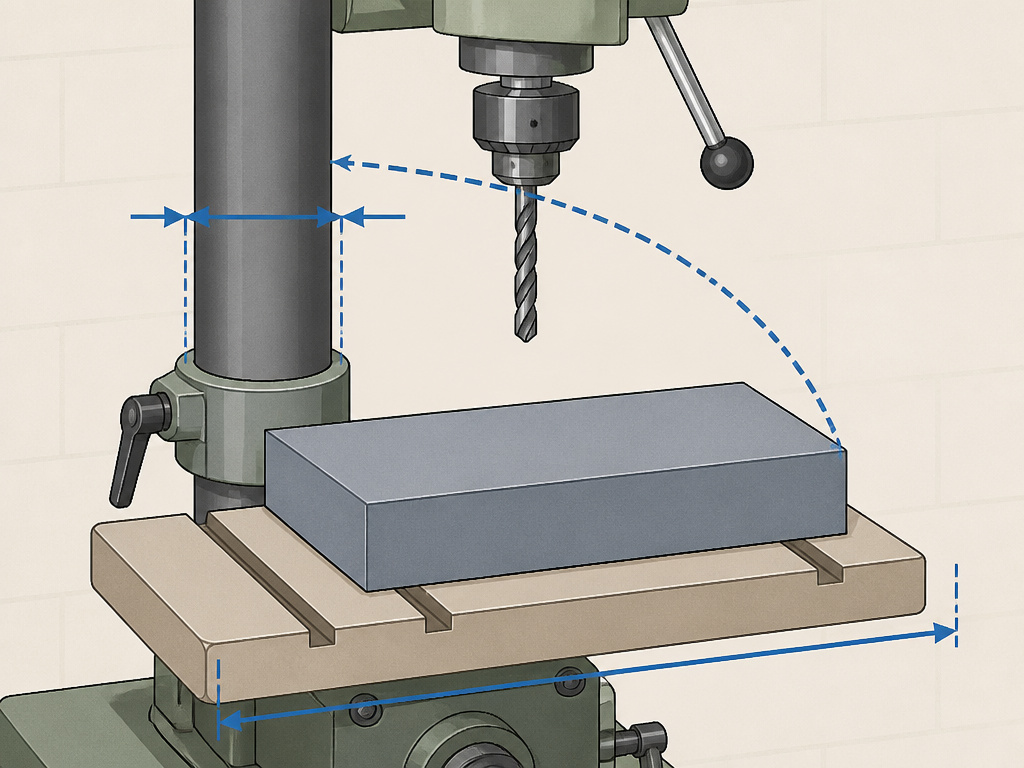
Swing doesn’t exist in a vacuum. It directly influences, and is influenced by, other key specifications. You can’t have a large swing on a spindly column.
Column Diameter: This is the backbone. A 10-inch swing press might have a 2-inch column. A 17-inch swing press, like the Rikon 30-230, requires an 80mm (3-1/8 inch) column. The longer the lever arm (the swing distance), the thicker the column must be to prevent vibration and deflection under load. A wobbly column makes drilling straight holes impossible.
Table Size: The table must be large enough to support the big workpieces the swing allows. A 17-inch disk needs a stable platform. That’s why the table on the Rikon 30-230 measures 13-3/4″ square. A small table on a large-swing machine is dangerous—the workpiece can tip.
Chuck to Table Distance: This is the throat depth, or maximum height of a workpiece. Swing gives you width; this gives you height. They work together to define the volumetric capacity of your machine. You need both to know if a large, tall block will fit.
Understanding how a drill press works involves seeing how these specs interact. The swing determines the lateral working envelope, which dictates the necessary stiffness (column) and support (table) the machine must provide.
The Real-World Impact of Getting Swing Wrong
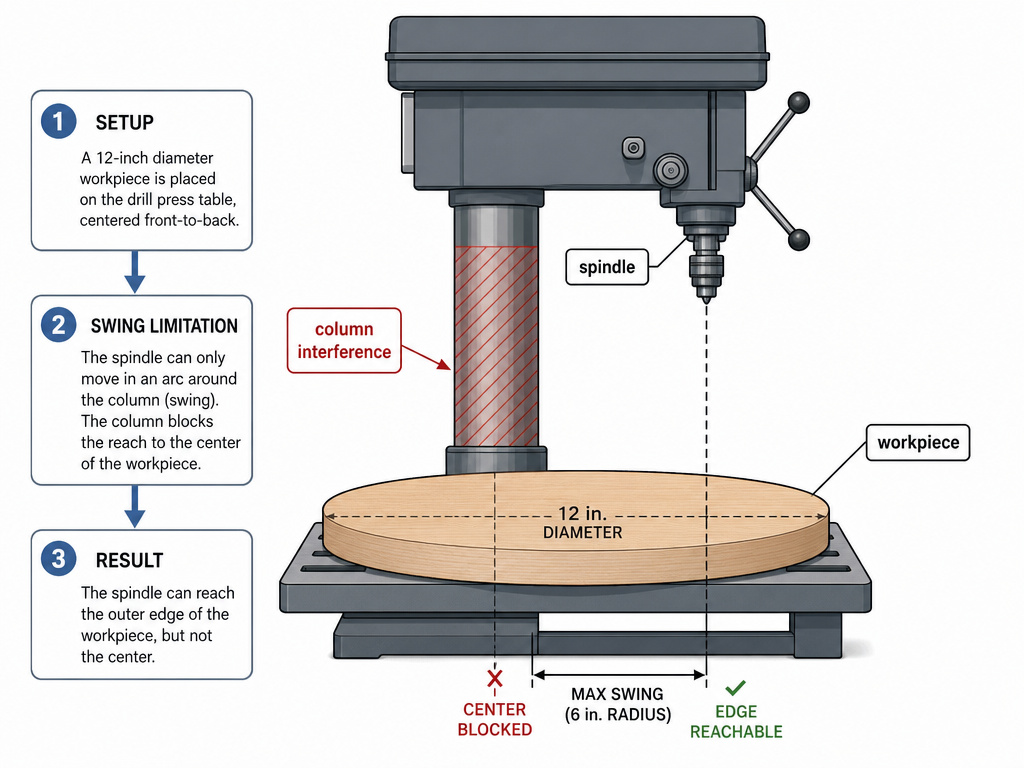
Ignore the swing spec, and you buy the wrong tool. The failure is immediate and absolute.
You bring home a 10-inch swing drill press for a project that requires a hole in the center of a 12-inch wooden wheel. You loosen the table, swing it out of the way, and lower the workpiece onto the base. You slide it under the chuck and try to center it. The chuck lines up over the edge of the wheel, not the center. You cannot physically move the wheel far enough to the left or right to get the center under the spindle because the column is in the way. The project is dead.
This isn’t a limitation you can overcome with skill or a different drill press chuck. It’s a geometric wall. The only solutions are to cut your workpiece down to a smaller diameter (defeating the purpose) or to buy a drill press with a larger swing.
Easy to miss: The stated swing is for a cylindrical workpiece. A square block’s “swing” is measured corner-to-corner (the diagonal). A 14-inch swing can center-drill a 10-inch square block (diagonal ~14.1 inches) only if you angle it slightly. The practical limit for square stock is smaller than the swing number.
Before you buy, measure the largest diameter you ever plan to center-drill. Add a two-inch margin for future projects. That’s your target swing.
Frequently Asked Questions
Is a bigger swing always better?
Not necessarily. A larger swing means a larger, heavier, more expensive machine that takes up more floor space. If you only drill small parts, a 17-inch floor model is overkill. Match the swing to your actual workpiece sizes.
Can I increase the swing of my drill press?
No. Swing is fixed by the distance from the spindle to the column. You cannot move the column or the spindle. Modifying this would require remanufacturing the main head casting, which is not feasible.
How does swing relate to a milling machine?
This is a key difference. A milling machine has a movable table on both the X and Y axes, allowing you to position a workpiece anywhere under the spindle. Drill press swing is a fixed, radial capacity centered on the column. A mill doesn’t have a “swing” spec in the same way; its capacity is defined by table travel.
Does a magnetic drill have a swing?
magnetic drill works differently. It clamps to the workpiece itself, so the concept of swing doesn’t apply. Its capacity is stated as maximum drilling diameter and depth in the material it’s attached to.
I have a 12-inch swing press. Can I drill off-center on a larger piece?
Yes, but with major limitations. You can drill holes near the edge of a large piece by positioning the area under the chuck. However, you cannot drill a hole at the precise center of anything wider than your swing. For off-center holes, support becomes critical to prevent the workpiece from rotating.
Before You Go
Swing is the gatekeeper spec. It tells you what fits on the machine before you ever consider motor power or speed settings. Measure your potential projects, understand that an 8-inch benchtop and a 14-inch floor model live in different worlds, and buy the swing that matches your largest common part. For most home workshops that handle furniture repair and general fabrication, a 14-inch swing is the sweet spot. It handles 90% of projects without the footprint of a 17-inch industrial unit. Check the column diameter and table size on any model you consider—they must be proportional to the swing to guarantee a rigid, usable tool.
