How to Know What Drill Bit to Use | Match Type & Material
This post contains affiliate links. As an Amazon Associate, we earn from qualifying purchases.
To know what drill bit to use, match three things: the material you’re drilling, the required hole size, and the type of drill or rig you’re using. A Bosch HSS-G twist bit works for steel and wood, but a carbide-tipped masonry bit is mandatory for concrete. In mineral drilling, ground hardness on the Mohs scale dictates the diamond matrix, as outlined in Epiroc’s core bit guide.
That material-match rule sounds simple. It fails when the bit’s geometry, the flute angle, point angle, and carbide configuration, doesn’t align with the physical behavior of the stock. Drilling soft aluminum with a bit designed for hard steel produces long, stringy swarf that jams the flutes. The bit binds, snaps, or ruins the workpiece.
What follows breaks down the decision into a workable system. We’ll cover the universal three-step process, decode bit markings and geometries, and explain how industrial drilling for water wells or mineral exploration follows the same logic, just with bigger stakes and more expensive mistakes.
Key Takeaways
- The primary selector is material hardness. Use the Mohs scale for rock; for shop work, match the bit’s tip material (HSS, carbide, diamond) to the workpiece.
- Bit geometry is not optional. A 135-degree split point bit starts cleaner in metal and prevents walking; a 118-degree point is for wood and general use.
- Carbide configuration trades speed for life. More, smaller carbide buttons drill faster but wear out quicker, fewer, larger buttons last longer but cut slower.
- Your drill’s power and rotation matter. A high-RPM hydraulic rig needs a turbo bit configuration; a low-power gear-driven rig needs a standard bit to avoid stalling.
- Flushing clears waste or cooks the bit. In coring, a triple deep waterway bit is for fractured rock; a standard waterway clogs and burns the matrix.
The 3-Step Drill Bit Selection Process
Start here for any drilling task, from hanging a picture to planning a borehole. Skipping a step guarantees a bad outcome.
Step 1: Identify the Material and Its Hardness.
This is the non-negotiable first filter. Drilling steel with a wood bit blunts the cutting edges on first contact. Drilling soft sandstone with a bit designed for hard granite will glaze the diamond matrix, stopping progress within inches.
For metal and wood, use this cheat sheet: * Softwood, Plastic, Aluminum: Standard High-Speed Steel (HSS) twist bits. * Hardwood, Steel, Stainless Steel: HSS bits with a cobalt alloy (marked HSS-Co) or titanium nitride coating. * Masonry, Brick, Concrete: Carbide-tipped masonry bits. The tip is a distinct, brazed-on wedge. * Tile, Glass: Diamond-grit core bits or spear-tipped glass bits. You must use water as a coolant. * Hardened Steel, Ceramic: Solid carbide bits or diamond-plated bits.
For rock and mineral drilling, you need a hardness number. The Mohs scale runs from 1 (talc) to 10 (diamond). As noted in Epiroc’s guide, a pocket knife blade sits at about 6.0–6.5. If your rock scratches the knife, it’s softer than 6.5. If the knife won’t scratch it, the rock is harder. This number directly chooses your bit’s matrix hardness.
Step 2: Determine the Exact Hole Size You Need.
The hole diameter and depth dictate the bit’s shank size and length. Using a 1/2-inch bit in a 3/8-inch chuck is impossible. A bit that’s too short won’t reach through the material.
Common mistake: Assuming a #8 screw needs an 8/64-inch (1/8-inch) pilot hole. Most #8 wood screws need a 3/32-inch pilot in softwood and 7/64-inch in hardwood. The threads need wood to bite into.
For screw pilot holes, use a drill bit slightly smaller than the screw’s shank diameter (the non-threaded core). For bolts or anchors, the hole must match the anchor’s specified size exactly, check the packaging. For plumbing or electrical runs, the hole must accommodate the pipe or conduit plus the required clearance.
Step 3: Match the Bit to Your Drill’s Capability.
A hand-held drill driver lacks the torque for large-diameter auger bits in hardwood. It will stall. Conversely, a high-torque low-speed rotary hammer will shatter a delicate glass bit.
| Drill Type | Best Bit Types | What Happens If You Mismatch |
|---|---|---|
| Cordless Drill/Driver | Twist bits, spade bits, small hole saws, masonry bits (with hammer function) | Stalls, overheats motor, strips chuck gears on large bits. |
| Rotary Hammer | SDS-Plus or SDS-Max masonry bits, core bits | Standard round-shank bits will spin in the chuck and ruin it. |
| Drill Press | Forstner bits, large hole saws, precise twist bits | Hand-held bits can catch and cause severe injury. |
| Industrial Core Rig | Diamond core bits, impregnated bits | Wrong matrix hardness grinds away the bit without cutting. |
Bottom line: Your drill bit is one half of a system. The drill is the other.
Decoding Drill Bit Geometry and Markings
Bits are labeled with coded information. Reading it tells you exactly what the bit is for.
Point Angle: 118 vs 135 Degrees
This is the angle ground at the very tip. It controls how aggressively the bit starts cutting. * 118-Degree Point: The standard. It’s a sharper angle suitable for wood, plastic, and soft steel. It can wander on hard metal surfaces. * 135-Degree Point: A flatter, “split-point” tip. It’s designed for harder metals and stainless steel. It bites immediately with less pressure, preventing the “walking” that dulls bits and ruins workpiece surfaces.
The differences between 118 and 135 degree drill bits come down to starting force and material. If you drill metal often, the 135-degree is worth the hunt.
Flute Design and Coating
The flutes are the spiral grooves that pull swarf out of the hole. * Slow Spiral (Low Helix): Better for hard metals and plastics. Ejects short chips quickly. * Fast Spiral (High Helix): Better for soft wood and aluminum. Moves long, stringy chips out fast to prevent binding. * Black Oxide Coating: Reduces friction and offers mild corrosion resistance. Good for general-purpose use. * Titanium Nitride (TiN) Gold Coating: Much harder, reduces heat, and dramatically extends bit life. Best for hard metals and production work.
Carbide Button Configuration (For Rock Bits)
This is where industrial and DIY logic converge. The Rockmore International handbook states a direct trade-off: More, smaller carbide buttons yield faster penetration but shorter bit life. Fewer, larger buttons drill slower but last longer.
| Carbide Profile | Best For | Compromise |
|---|---|---|
| Hemispherical | General hard rock, abrasive conditions | Balanced wear and penetration. |
| Semi-Ballistic / Conical | Fast penetration in softer rock | Less resistant to abrasion, can fracture in hard, fractured ground. |
| MultiPoint (Rockmore) | Smooth rotation, longer insert life | Specialized, often a custom order. |
The vibration also increases with fewer, larger buttons. If your rig or drill can’t dampen that shake, you’ll break shanks.
Matching Specialty Bits to the Task
Some bits are built for one job. Using them correctly is the difference between a clean result and a disaster.
Forstner Bits
These cut flat-bottomed, precise holes with a clean rim. They’re for hinge cups in doors, recessed hardware, and decorative inlays. The center spur starts the hole, and the outer rim scores the circumference for a tear-out-free edge. They require a drill press or a very steady hand; side pressure will snap the center spur.
Step Bits (Unibits)
A cone-shaped bit with graduated steps. They are the only good choice for drilling thin sheet metal, electrical boxes, and PVC. The stepped design means one bit makes multiple hole sizes, and the geometry shears cleanly without grabbing and deforming thin stock. They are not for wood or deep holes.
Masonry and Concrete Bits
The carbide tip is brazed on. It’s a crushing tool, not a cutting tool. You must use the hammering action of a hammer drill or rotary hammer. Using it in a standard rotary mode just polishes the tip. The shank must match your tool: round shank for standard chucks, SDS-Plus or SDS-Max for rotary hammers.
Where this goes sideways: Using a standard masonry drill bit in a rotary hammer without the SDS shank. The bit will spin inside the chuck, generating intense friction heat that ruins both the bit and the chuck jaws in under a minute.
Tile and Glass Bits
These use an abrasive grit (diamond or tungsten carbide) to grind, not cut. You must run them at slow speed with no hammer action and use constant water cooling. Pressure is light, let the grit do the work. A drill bit for tile will have a spear point to prevent skating on the glazed surface.
Industrial and Coring Bit Selection
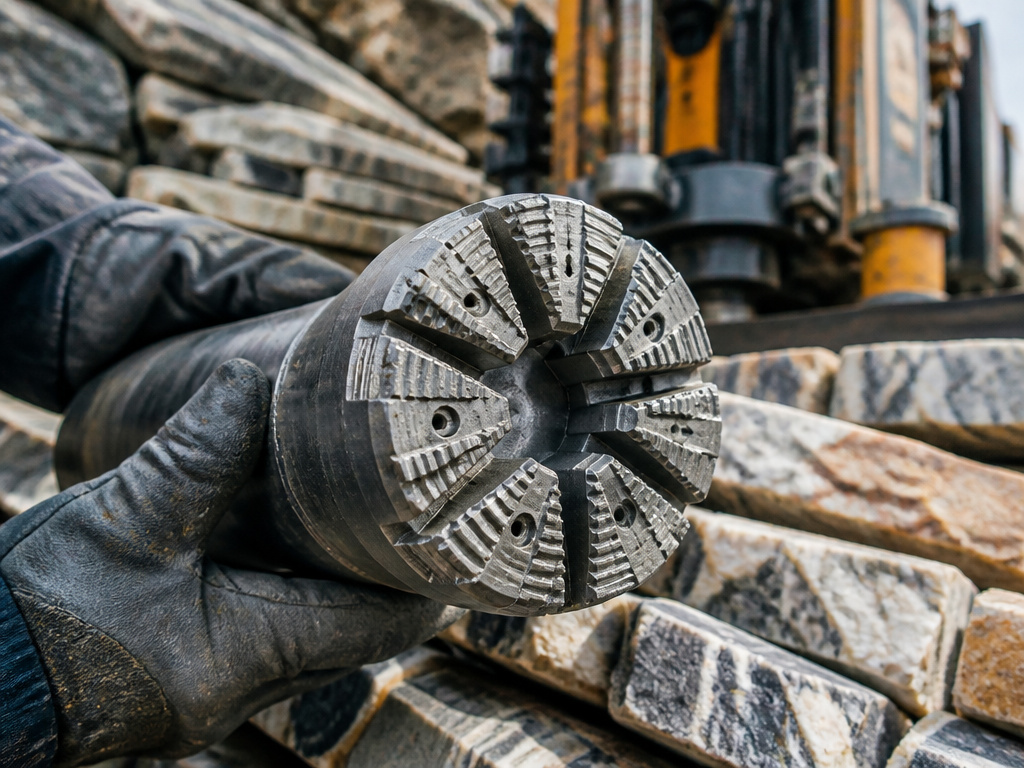 The principles scale up. The cost of a mistake scales up faster.
Ground Conditions Dictate Everything
An Epiroc core bit guide breaks ground into categories: hardness, abrasiveness, and fracturing. Each demands a specific bit design. * Abrasive Ground (High Silica): Requires bits from special alloy lines like Epiroc’s HERO abrasive series, with wider waterways to flush cuttings before they grind the matrix. * Fractured Rock: Needs a triple deep waterway configuration. Standard waterways clog, causing the bit to overheat and lose diamonds (“burn the matrix”). * Variable Ground (Soft to Hard): A series like the Epiroc VIKING™ covers a Mohs range of 3–9.5 with six bits. You switch the matrix as the rock changes.
Drill Rig Type Changes the Bit
The rig isn’t just a power source. It defines the bit’s mechanical configuration. * Older, Gear-Driven Rig (High Torque, Low RPM): Use a bit with a standard configuration. It can handle the torque. * High-Powered Hydraulic Rig (High RPM, Lower Torque): A turbo pie-shaped configuration is correct. It’s designed for faster rotation. * Low-Powered Underground Rig: A thin-walled, turbo pie-shaped bit minimizes friction and power demand.
From Epiroc’s guide: “Always consider changing the type of bit if you encounter issues. It is much easier to change a drill bit than to change your drill rig.”
Core Barrel and Bit Sizing
This is about precision. A Royal Eijkelkamp Single Wall Core Barrel Standard Bit, like the CB3 model (Part D018870), has an outer diameter (OD) of 104 mm and an inner diameter (ID) of 78 mm. It must match the rod size (fits through EM5 1/2). Using a bit with an OD larger than the rod provides an “overcut,” reducing friction on the drill string, critical in deep rock holes.
The Most Common Mistakes and How to Avoid Them
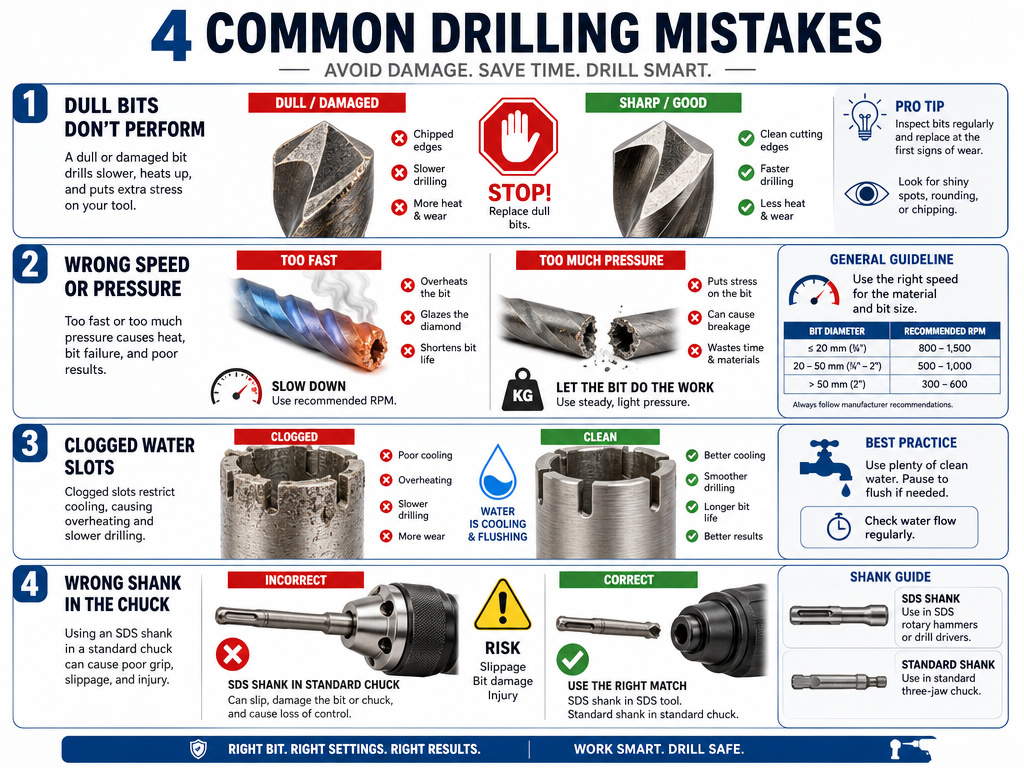 These aren’t minor errors. They break bits, workpieces, and tools.
1. Using a Dull Bit
A dull bit requires more pressure, generates extreme heat, and produces a rough, out-of-spec hole. In metal, the workpiece work-hardens, making it impossible to drill even with a new bit. The tell-tale sign is a high-pitched squealing and the smell of burnt metal or wood. Stop and sharpen or replace the bit.
2. Incorrect Speed and Pressure
- Too Fast in Metal: The bit overheats, loses its temper (softens), and turns blue. It’s now trash.
- Too Slow in Wood: The bit gums up with resin and burns the wood.
- Too Much Pressure: The bit snaps, especially small-diameter bits (like the Bosch 1mm HSS-G) or brittle carbide tips.
- Too Little Pressure: The bit spins without cutting, creating friction heat and dulling the edges.
3. Ignoring Flushing and Cooling
In handheld drilling, this means pulling the bit out frequently to clear chips. In coring or deep drilling, it’s about water flow. A clogged waterway turns a $2,000 diamond core bit into a smooth, useless cylinder in minutes. The Royal Eijkelkamp guide emphasizes water slot design for this exact reason.
4. Mismatching Shank and Chuck
Forcing a large shank into a small chuck damages the chuck’s integrity. Using an SDS bit in a standard chuck is ineffective and dangerous. The basic drill bit use starts with a secure, correct fit.
Frequently Asked Questions
Can I use a wood bit on metal?
No. The cutting geometry is wrong. A wood bit has a sharp central spur and aggressive flutes for fast chip removal. On metal, the spur will snap, the edges will instantly dull, and the bit will likely bind and break. Use a metal bit marked HSS or HSS-Co.
How do I know what size drill bit I used?
Measure it. Use a drill bit size gauge, which is a metal plate with graduated holes. Alternatively, measure the bit’s diameter at its widest point (not the shank) with digital calipers for precision.
What’s the difference between a drill bit for concrete vs wood?
Everything. A concrete vs wood bits comparison shows a concrete bit has a brazed carbide tip for crushing aggregate and requires hammer action. A wood bit has sharp cutting edges for slicing through fibers and requires only rotary motion. They are not interchangeable.
When should I use a step drill bit?
Use a step drill bit when you need a clean, burr-free hole in thin material (up to ~1/4 inch) like sheet metal, plastic, or electrical enclosures. It’s also perfect when you need multiple hole sizes but want to carry only one bit.
How do I choose a drill bit for a wall anchor?
The packaging for the plastic sleeve anchor or toggle bolt will state the required hole size. For example, a 1/4-inch anchor often needs a 3/8-inch hole. Match this exactly. Our guide on determining the right drill bit for a wall anchor covers the specifics for common anchor types.
Before You Go
Choosing the right drill bit is a diagnostic process, not a guess. Identify the material first, that’s your non-negotiable filter. Then match the hole size and your tool’s capability. For shop work, understand that a 135-degree split point bit is for hard metals, and a Forstner bit needs a drill press. For serious coring, the rock’s hardness on the Mohs scale picks the matrix, and your rig’s RPM dictates a standard or turbo configuration. The wrong bit doesn’t just drill poorly. It wastes time, ruins stock, and breaks things. Start with the material, and the rest of the choice falls into line.
