What Is a Carbide Drill Bit? How It Works & Why It’s Hard
This post contains affiliate links. As an Amazon Associate, we earn from qualifying purchases.
A carbide drill bit is a cutting tool made from a composite of tungsten carbide powder (70–97% of its weight) and a metallic binder, usually cobalt. This material, created by powder metallurgy, is about three times stiffer than steel and approaches diamond in hardness. It drills hardened metals, lasts far longer than high-speed steel, and is the standard for CNC precision, but it is brittle and requires rigid setups, high-pressure coolant for deep holes, and specific feed rates to avoid chipping.
That composition is what separates a $60 bit from a $15 one marked “carbide-tipped.” The grade of tungsten carbide, the cobalt percentage, and the grain size decide whether it cuts 500 holes or 50 before failing. Most articles talk about hardness. The real conversation is about the three things that break a carbide bit: impact, heat, and poor chip evacuation.
What follows: a breakdown of what “carbide” actually means, how to spot the real thing, the non-negotiable rules for using it, and when you should pick a cobalt or titanium-coated bit instead. By the end, you’ll read a spec sheet and know exactly what job that bit is built for.
Key Takeaways
- Carbide’s extreme hardness comes with extreme brittleness. It chips on impact, not wears down. A loose hand drill or a wobbly collet will shatter the cutting edge in seconds.
- For holes deeper than three times the bit’s diameter, you need a coolant-fed drill. Non-coolant “twist” style bits overheat and thermal-crack past that point, a limit printed in OEM manuals but missing from most DIY guides.
- The braze joint on a carbide-tipped bit is a hidden failure point. Overheating from dry drilling or high feed rates in steel can weaken the silver solder, popping the tip off inside your workpiece.
- Solid carbide bits are one piece of the composite material. Carbide-tipped bits have a small carbide insert brazed onto a steel body. The solid version is for precision; the tipped version is for abrasion, like in masonry.
- You don’t always need carbide. For most home drilling in wood, soft steel, or plastic, a cobalt or titanium nitride-coated high-speed steel bit is cheaper, tougher, and just as fast.
What “Carbide” Actually Means (It’s Not Just a Coating)
Cemented carbide is a cermet, a ceramic-metal composite. Tungsten carbide powder provides the hardness. A cobalt (or sometimes nickel) binder acts as a metallic glue, holding the microscopic grains together. The General Carbide design guide defines it as a material manufactured by powder metallurgy: the powder mix is compacted in a die and then sintered in a furnace.
This structure gives it a unique set of properties. It has a transverse rupture strength high enough to handle massive compressive loads, but almost no ductility. Technically, it’s a brittle material. It doesn’t bend or deform before failing; it cracks.
The term “cemented” refers to the tungsten carbide particles being captured in the metallic binder material and “cemented” together, forming a metallurgical bond in the sintering process. Without the binder, tungsten carbide would be a pure ceramic, too brittle for most tools.
That brittleness is the trade-off for its legendary hardness. On the Mohs scale, it sits around 9 to 9.5, with diamond being a 10. A high-speed steel bit might be a 7.5. This lets it cut materials that would instantly dull a standard bit, like stainless steel, cast iron, or hardened tool steel.
| Property | Carbide Drill Bit | High-Speed Steel (HSS) Bit |
|---|---|---|
| Core Material | Tungsten carbide + cobalt binder | Iron-based alloy (with tungsten, molybdenum) |
| Hardness | Extremely high (9-9.5 Mohs) | High (7.5-8 Mohs) |
| Toughness | Low (brittle, chips on impact) | High (ductile, bends before breaking) |
| Best For | Hard metals, production runs, CNC precision | Soft metals, wood, plastic, general DIY |
| Failure Mode | Cutting edge chips | Cutting edge wears down and dulls |
The industry shortens “cemented tungsten carbide” to just “carbide.” But when you’re buying, you need to know which of the two main constructions you’re getting.
Solid Carbide vs. Carbide-Tipped: A Construction Divide
This is the first major fork in the road. Their jobs are different.
Solid carbide drill bits are made entirely from the cemented carbide composite. They’re one piece from shank to tip. This gives them maximum rigidity and precision, which is why they’re the default for CNC machining. Brands like Sandvik Coromant and YG-1 make these for industrial use. They’re also used for micro-drills down to 0.03mm diameters.
Carbide-tipped drill bits have a small insert or “tip” of carbide brazed onto a steel body. The steel provides shock absorption and lowers cost. The carbide tip handles the abrasive cutting. This is what you find in most consumer masonry bits, concrete drills, and some wood boring bits.
The braze joint is a potential failure point. Overheating can weaken the silver solder. If you’ve ever seen a masonry bit where the tip disappeared inside a brick wall, that’s a failed braze joint.
- Pick solid carbide for: Precision holes in metal, CNC work, small diameters (<3mm), and any job where runout (wobble) must be under 0.02mm.
- Pick carbide-tipped for: Drilling masonry, concrete, tile, or abrasive composites. The steel body handles the hammer drill impact the solid version would shatter under.
For a deeper dive into how carbide stacks up against other common materials, our comparison of cobalt vs carbide drill bits breaks down the toughness-versus-hardness trade-off by material type.
How to Visually Identify a Carbide Drill Bit
You can’t trust packaging alone. Here’s how to tell what you’re holding.
Look at the color and finish. A solid carbide bit has a distinctive, uniform silver-grey color. It looks almost like a polished gunmetal. A high-speed steel bit is darker, often with a black oxide or gold (titanium nitride) coating. A cobalt bit has a bluish-grey tint.
Check the weight. Pick it up. Tungsten is dense. A 1/4″ carbide bit will feel noticeably heavier than a same-size steel bit. This heft is a dead giveaway.
Read the shank markings. Many manufacturers laser-etch the material code near the shank. Look for “WC” (tungsten carbide), “Solid Carbide,” or a grade like “K10” or “UFS.” If it only says “Carbide Tipped,” you know it’s a brazed construction.
Inspect the tip geometry. Solid carbide bits have impeccably ground, sharp flutes and a precise point angle, often 118° or 135°. Carbide-tipped masonry bits have a chisel-like, spade-shaped tip made of a single carbide piece brazed into a grooved steel shaft.
Common mistake: Assuming a gold-colored bit is carbide. That gold color is almost always a titanium nitride (TiN) coating on a high-speed steel bit. It’s a hard coating, not a carbide core. A true carbide bit is silver-grey.
If you’re trying to figure out a bit for a specific material, our guide on how to know what drill bit to use walks through the identification process step-by-step.
The Scratch Test (And When to Skip It)
The classic test is to try and scratch glass. A genuine carbide bit will score a visible line. A steel bit will not. This works, but with a big caveat.
Don’t do this on a bit you plan to use. The test itself can micro-chip the ultra-sharp cutting edge. You might pass the test but ruin a $40 bit before it ever touches metal. Use it only on a discarded bit you’re trying to identify.
For identifying other specialty bits, the same visual principles apply. Learn the markers for a masonry drill bit vs regular bit to avoid using the wrong tool and damaging your workpiece.
The Critical Role of Coolant (The 3x Diameter Rule)
This is the most overlooked spec in carbide drilling. Heat is carbide’s enemy. Unlike steel, which can lose temper and soften, carbide can suffer from thermal cracking, small fractures from rapid heating and cooling.
Manufacturer data is specific. Hannibal Carbide’s technical notes state: “Non-coolant fed drills (conventional twist drills) are generally effective in holes up to 3 tool diameters deep.”
That means a 1/4″ (6.35mm) bit should only drill about 3/4″ deep without coolant. After that, you need to use a “pecking” cycle, drilling a little, then pulling out to clear chips, or, better yet, use a coolant-fed drill.
| Drill Type | Max Depth Without Coolant | Solution for Deeper Holes |
|---|---|---|
| Non-coolant (Twist) | 3 x Drill Diameter | Peck cycles (in/out to clear chips) |
| Coolant-fed (Internal) | 10–30 x Drill Diameter | Continuous high-pressure coolant flow |
Coolant-fed drills have channels running through the body to pump coolant directly to the cutting edge. This does three things: it cools the bit, lubricates the cut, and, most importantly, flushes chips out of the hole. Packed chips create friction heat and can snap the bit.
Where this goes sideways: Running a solid carbide bit dry in steel at full depth. The bit gets hot, chips weld to the flutes, and the next thing you hear is a ping, a $50 bit broken off below the surface of your part.
For production drilling, the rule is absolute. The Sandvik Coromant guide for its CoroDrill series emphasizes that coolant pressure must be high enough to break the vapor barrier at the drill point. No coolant, no deep holes.
This principle is universal for hard materials. Whether you’re drilling steel or tile, the right bit and technique prevent disaster. For example, using the correct drill bits for tile also requires managing heat and pressure to avoid cracking the ceramic.
When to Use a Carbide Drill Bit (And When to Walk Away)
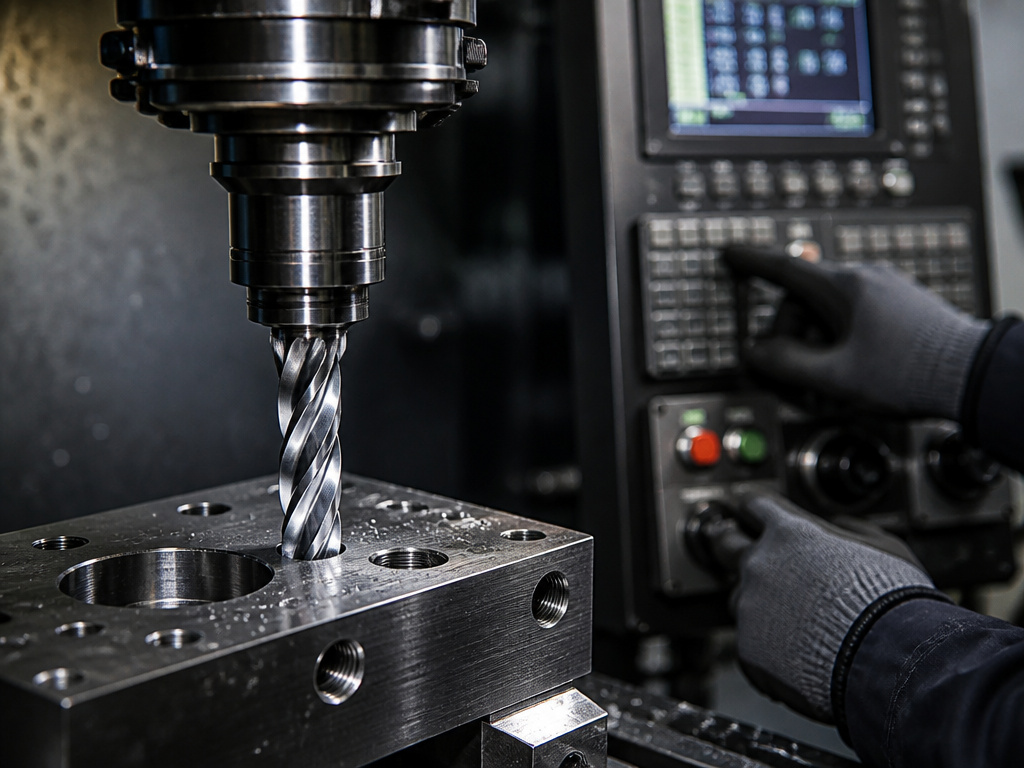
Carbide isn’t always the right answer. It’s a specialist.
Use a carbide drill bit for:
- Hardened metals: Stainless steel, tool steel, cast iron, chrome-moly. This is its home turf.
- Abrasive non-metals: Fiberglass composites, carbon fiber, hard ceramics.
- High-volume production: Where tool life and reduced changeover time justify the cost.
- Precision CNC machining: Where minimal runout and perfect hole geometry are required.
Avoid a carbide drill bit for:
- Hand drilling: The inherent wobble and impact of a hand drill will chip the edges. It needs the rigidity of a drill press or CNC.
- Soft materials: Wood, plastic, aluminum. The bit will “grab” and chip out material, and a sharp HSS bit is faster and cheaper.
- Hammer drilling (solid carbide): The impact will shatter it. Only carbide-tipped masonry bits are designed for hammer action.
- Low-rigidity setups: A worn collet or a loose spindle will cause chatter and immediate failure.
The choice often comes down to a head-to-head with other premium bits. For instance, when working with hardened steel, the debate between tungsten carbide vs carbide drill bits is largely semantic, they’re the same thing. But the choice between titanium vs carbide drill bit is stark: titanium nitride is just a coating on a softer steel core.
Feed, Speed, and the Sound of a Good Cut
Running a carbide bit requires dialing in your machine. The settings are different from steel.
Speed (RPM): Start lower. Carbide can handle higher surface speeds, but without perfect cooling, heat builds fast. For a 1/4″ bit in mild steel, try 1500-2000 RPM on a drill press.
Feed Rate (Pressure): Use a consistent, firm feed pressure. Letting the bit “rub” without cutting generates heat. Forcing it too hard can exceed its compressive strength and snap it.
Listen. A good carbide cut makes a consistent, high-pitched squealing or ringing sound. A chattering, irregular noise means the bit is bouncing, check runout and feed pressure. A change in pitch to a lower groan means it’s getting hot and clogged.
Getting these parameters right is a skill that applies to all drilling. Our article on the purpose of a drill bit covers the fundamentals of how cutting geometry interacts with material.
Troubleshooting: Why Carbide Drill Bits Fail
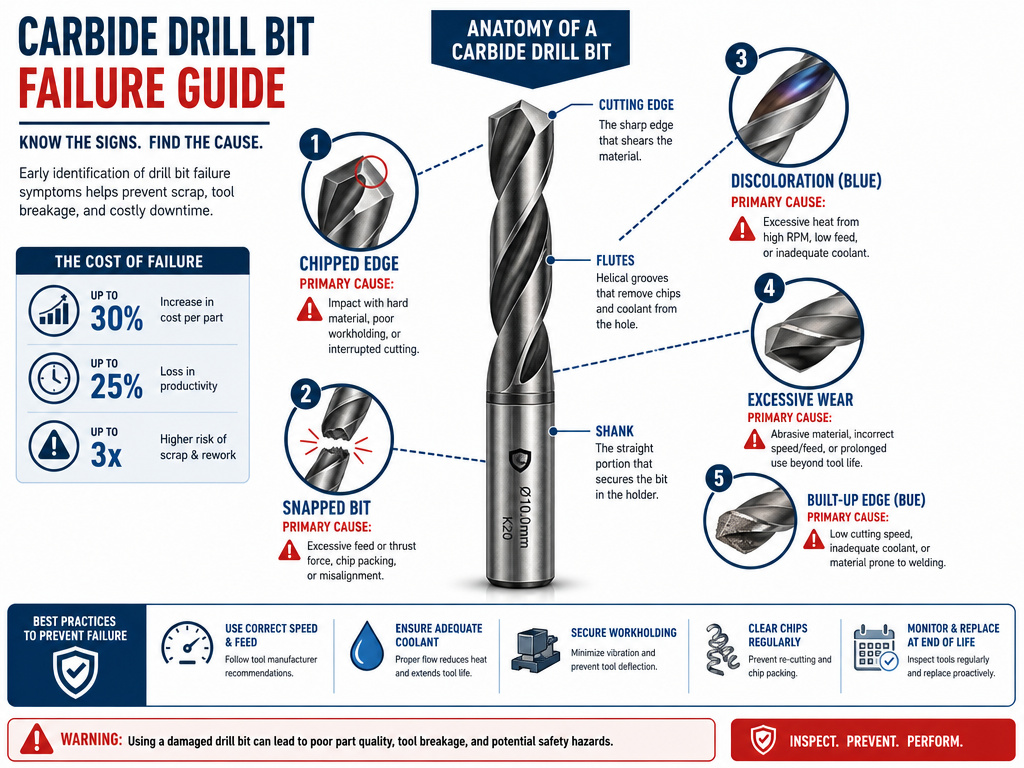
They don’t wear out; they break in predictable ways. Here’s a diagnostic table.
| Failure Symptom | Most Likely Cause | The Fix |
|---|---|---|
| Cutting edge chips immediately | Runout (wobble) > 0.02mm, loose collet, hand drilling. | Use a drill press. Replace worn collet. Check spindle tolerance. |
| Bit snaps in the hole | Excessive feed force, packed chips, or drilling deeper than 3x diameter without pecking. | Reduce feed pressure. Use peck cycles. Ensure chip clearance. |
| Flutes are discolored (blue/brown) | Overheating from lack of coolant, too high RPM, or dry drilling. | Use cutting fluid. Reduce RPM. Apply steady, firm feed. |
| Carbide tip detaches (tipped bits only) | Brazed joint failed from overheating or impact in steel. | Use proper coolant. Do not use masonry bits on metal. |
| Hole is oversize or bell-mouthed | Dull bit being forced, or severe machine chatter. | Replace bit. Increase machine rigidity and check runout. |
Many of these failures stem from using the wrong bit type for the base material. Using a bit designed for concrete on steel is a recipe for joint failure, just as using a wood bit on concrete will destroy it. Understanding the difference between concrete drill bits vs wood bits is essential for longevity.
Frequently Asked Questions
Can you sharpen a carbide drill bit?
Technically yes, practically no. You need a diamond grinding wheel and a precise jig to maintain the complex geometry. Hand sharpening will ruin it. For solid carbide bits, professional resharpening services are the only viable option, and it often costs 40-60% of a new bit. For carbide-tipped masonry bits, most people just replace them.
Are all carbide drill bits the same?
No. The quality varies wildly based on the tungsten carbide grade, cobalt content (6-12% is common), and grain size. Fine-grained carbide is harder and more wear-resistant for precision work. Coarse-grained carbide is tougher for impact. A premium bit from a brand like Mitsubishi or Seco uses a higher grade than a generic hardware store bit.
What’s better for stainless steel: cobalt or carbide?
For a one-off hole in stainless, a good cobalt bit like a DeWalt Pilot Point or a Milwaukee Red Helix will work fine. For multiple holes or production work, carbide is better. It stays sharp longer and maintains a consistent cut. The cobalt bit will eventually dull and work-harden the stainless, making it even harder to drill. Our focused guide on drill bits for steel details the best choices for different grades.
Why is my new carbide bit not cutting?
The most common culprit is runout, the bit isn’t spinning true. Even 0.05mm of wobble at the tip is enough to make the bit bounce off the material instead of biting. Check your drill press spindle or CNC collet for wear. Second culprit: trying to drill a material that’s been work-hardened. You may need to start with a fresh spot or use a punch to break through the hardened surface.
How can I tell a masonry bit from a regular carbide bit?
Look at the tip. A masonry drill bit has a flat, chisel-like carbide tip brazed onto a spiraled steel shaft. A regular solid carbide bit for metal has sharp, ground flutes that continue all the way to a pointed tip. The masonry bit is designed to crush and hammer; the metal bit is designed to slice and shear.
The Bottom Line
A carbide drill bit is a precision instrument, not a blunt-force tool. Its superpower, extreme hardness, comes with a critical weakness: brittleness. You buy it for a specific job, drilling hardened metal, running a CNC machine, or powering through abrasive composites, not for your general DIY kit.
Remember the three rules. Match the bit type (solid vs. Tipped) to your material. Respect the 3x diameter coolant limit. And never run it in a loose or handheld setup. When those conditions are met, nothing else lasts as long or cuts as clean. When they’re not, a cobalt or titanium-coated bit will save you money and frustration every time.
For your next project, start with the material. If it’s hard metal, reach for carbide. For everything else, there’s a more forgiving and cost-effective option already in your drill bit selection arsenal.
