
Cobalt vs Carbide Drill Bits | The 3 Facts That Decide It
This post contains affiliate links. As an Amazon Associate, we earn from qualifying purchases.
Cobalt vs carbide drill bits comes down to three facts: the binder, the brittleness, and the break-even point on holes drilled. Cobalt bits are high-speed steel (HSS) alloyed with 5-8% cobalt for hot hardness, trading some toughness for the ability to cut stainless steel and titanium without immediately annealing. Carbide bits are a composite of tungsten carbide particles bound by a cobalt metal matrix, delivering extreme wear resistance at the cost of impact tolerance, they snap where cobalt bits bend.
That binder is the whole game. In cobalt bits, the cobalt is dissolved into the steel. In carbide bits, the cobalt is the glue holding the hard particles together, and that glue softens around 500°C. Get a carbide bit hotter than that, and the edge doesn’t just dull, it disintegrates as particles pull free.
What follows: the exact shop-test numbers that separate marketing from reality, the two failure modes that kill each type prematurely, and the simple rule that tells you which one to pull off the shelf for your next job.
Key Takeaways
- Carbide wins on pure hole count in hard materials. Shop tests show carbide drilling 620 holes in 304 stainless before edge dulling, versus 95 for HSS.
- Cobalt’s limit is 500°C. The binder that holds tungsten carbide particles together loses integrity at this temperature, causing catastrophic wear, not gradual dulling.
- Solid carbide tolerates almost zero runout. For an 8mm bit, a radial runout exceeding 0.02mm on the spindle can cause brittle fracture at the cutting edge.
- Choose cobalt for hand drills and unpredictable setups. Its steel body flexes under shock. Choose solid carbide for CNC machines and production jigs where vibration is controlled.
- The cost per hole favors carbide in volume. A higher upfront price is offset by 5-10x longer life in continuous drilling of steel and titanium.
How a Cobalt Drill Bit Is Actually Made
Cobalt drill bits are not a mysterious, separate material. They are a specific grade of high-speed steel, known as M35 or M42, where cobalt is added to the alloy melt. The typical range is 5% to 8% cobalt by weight. This isn’t a coating or a tip. The cobalt is dissolved uniformly throughout the steel, altering its fundamental metallurgy.
The cobalt atoms increase the steel’s red hardness, its ability to retain hardness at elevated temperatures. Standard HSS begins to soften around 600°F (315°C). The added cobalt pushes that threshold closer to 1,000°F (540°C). This is why you can drill stainless steel or titanium with a cobalt bit without the tip instantly turning to putty. The heat from friction stays in the chip, not the tool.
The part nobody mentions: That same cobalt addition makes the steel more brittle. A cobalt bit is harder but less tough than standard HSS. Under extreme lateral force, like when a hand drill catches and torques, a cobalt bit is more likely to snap cleanly where an HSS bit might bend.
Manufacturing follows the same process as any HSS bit: the alloy is rolled into round bar stock, the flutes are ground or rolled, and the point geometry is cut. The final hardness typically lands between 65-68 HRC. For most home shops tackling metal, a set of cobalt bits like the Bosch C208 or the DeWalt DW1361 is the practical upgrade from basic hardware-store HSS.
How a Carbide Drill Bit Is Actually Made (It’s Not Solid Metal)
The term “carbide” is shorthand for tungsten carbide, a ceramic-metallic composite. It starts as a fine powder of tungsten carbide particles. This powder is mixed with a cobalt binder, usually 6% to2% by weight, and sometimes other metals like tantalum or titanium. The mixture is pressed into a green form under immense pressure, then heated to around 2,550°F (1,400°C) in a furnace. This process, called sintering, causes the cobalt binder to melt and flow around the hard tungsten carbide particles, fusing them into a solid, dense blank.
This creates a material with a hardness of 90+ HRC, but with almost no ductility. There is no “give.”
Where this goes sideways: Using a fine-grain, high-hardness carbide grade in a high-impact application. If the workpiece flexes, the bit binds, or you have even slight spindle runout, the cutting edge experiences a shear force it cannot absorb. The result is a small, clean chip missing from the edge, a brittle fracture. The bit isn’t worn out; it’s mechanically damaged.
There are two main constructions. Solid carbide drills are milled from a single sintered blank. They are the choice for high-precision CNC work. Carbide-tipped drills have a small carbide insert brazed onto a steel body. The steel shank absorbs vibration, making them more suitable for hand drills or older machinery, though the brazed joint can be a failure point. For drilling hardened steel, many pros start by looking at the best bit for hardened metal, which is often a specific geometry of solid carbide.
Carbide vs Cobalt Drill Bits: A Side-by-Side Comparison Table
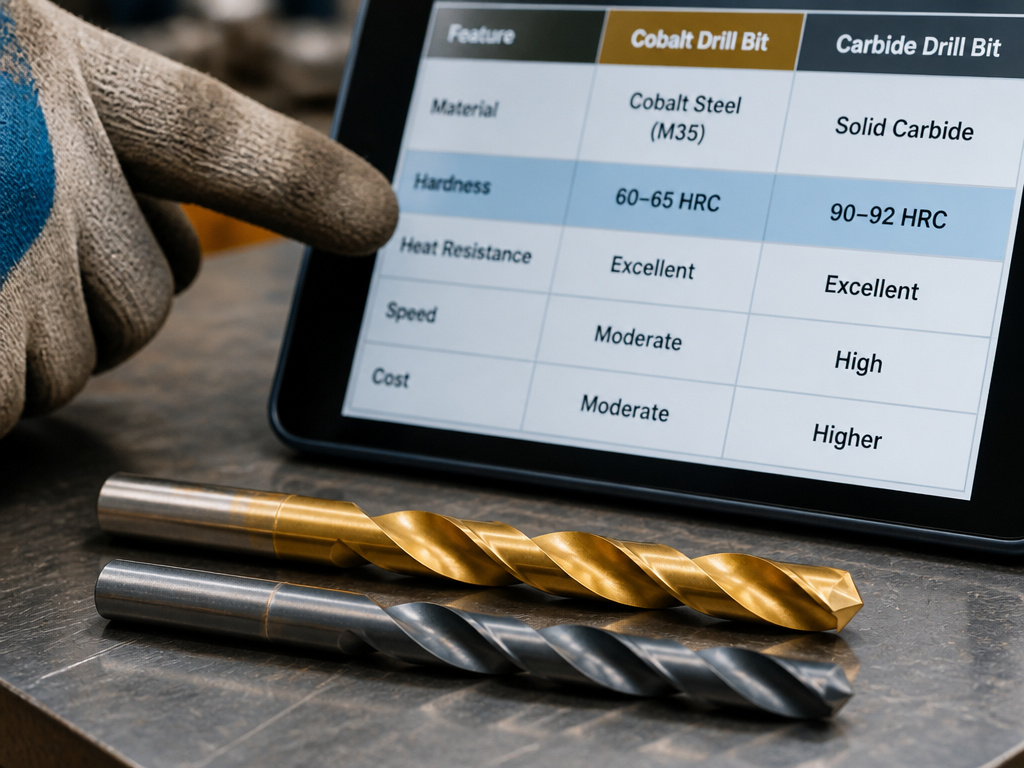
| Factor | Cobalt (M35/M42 HSS) | Solid Carbide | Who Wins & Why |
|---|---|---|---|
| Core Material | Steel alloy with 5-8% cobalt dissolved in matrix | Tungsten carbide particles in a cobalt binder matrix | Different species. Carbide is a cermet; cobalt HSS is a metal alloy. |
| Typical Hardness | 65-68 HRC | 90+ HRC | Carbide, by a large margin. It’s closer to diamond than to steel. |
| Heat Resistance | Softens around 540°C (1,000°F) | Binder softens ~500°C (930°F); particles remain hard | Draw. Cobalt HSS has higher hot hardness for a steel, but carbide runs cooler. |
| Primary Failure Mode | Gradual wear, edge rounding; can snap under extreme torque | Brittle fracture (chipping); catastrophic binder failure if overheated | Cobalt wears predictably. Carbide fails suddenly if misused. |
| Best Machine Context | Hand drills, drill presses, setups with some vibration | CNC mills, rigid drill presses, precision jigs | Cobalt for flexibility; carbide for rigidity and high RPM. |
| Cost Per Hole (Steel) | Lower upfront, higher long-term in volume | High upfront, lowest long-term in high-volume production | Carbide wins on total cost of ownership when drilling more than ~100 holes per day. |
The Real-World Test Results: How Many Holes Before They Dull?
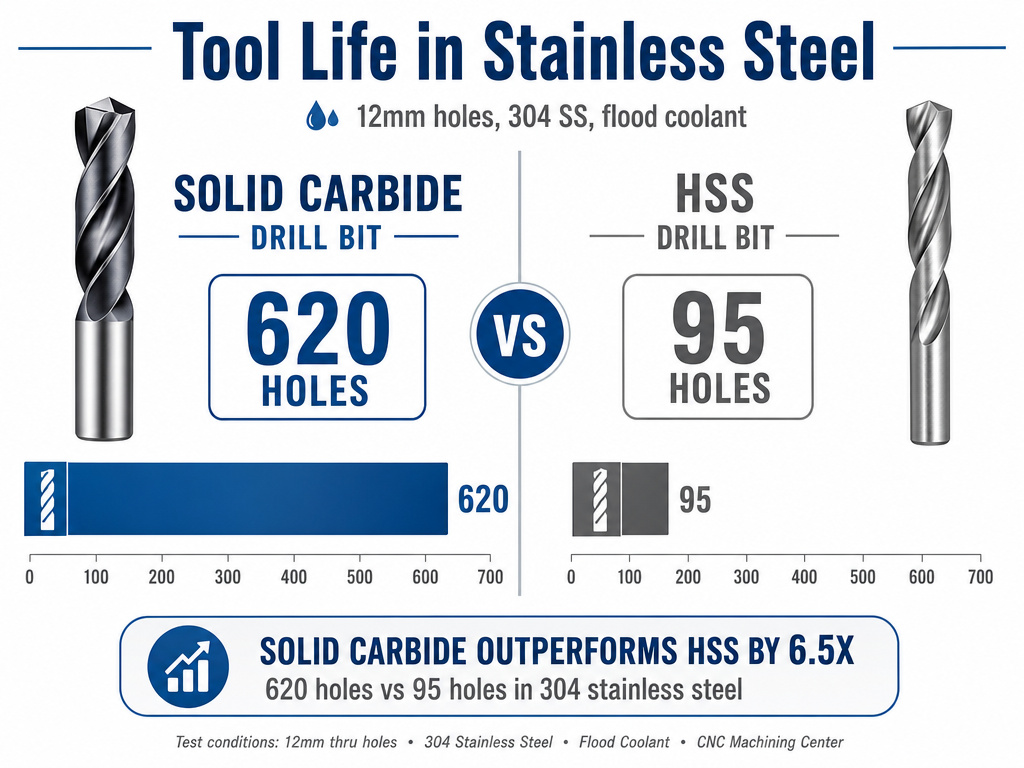
Benchmarks cut through the speculation. One published shop test drilled 12mm holes in 304 stainless steel plates. The setup used flood coolant and an 1800 RPM spindle speed. The endpoint was measured as the point where surface finish degraded (Ra >2.0 μm).
The solid carbide drill bits averaged 620 holes before reaching that dulling threshold. The HSS drill bits (the standard against which cobalt is compared) managed 95 holes. That’s a 6.5x lifespan advantage for carbide in this controlled, coolant-fed scenario. In another test on titanium, the carbide lasted 8 times longer.
Technical Snippet: In high-volume production drilling of 45# steel at 2000 RPM, industry data places carbide tool life at 5-10x that of HSS. Carbide maintains a sharp edge for 500+ holes where HSS may dull after 50-100. This disparity drives the ROI calculation for machine shops.
For the home gamer, the translation is simple. If you’re drilling a few holes in a steel bracket, the cobalt bit is faster to grab and cheaper to replace if you hit a hidden nail. If you’re building a trailer and need fifty clean holes in angle iron, the carbide bit will finish the job without a mid-project change, saving time and delivering consistent quality. The choice between cobalt vs titanium drill bits is a different trade-off, largely about coating versus bulk material.
When Carbide is the Undisputed Choice (and When It’s a Mistake)
Carbide demands a stable marriage between machine, material, and method. Its victory is total in the right context.
Choose carbide for:
- CNC Production: The rigidity and coolant systems of CNC machines provide the stable, predictable environment carbide requires.
- Hardened Materials: When you need to drill into hardened steel (>45 HRC), carbide is often the only option that won’t immediately burn up.
- High-Volume Identical Holes: The consistency and long life pay off the initial investment. This is the realm of solid carbide bits.
- Non-Ferrous Metals & Abrasives: Carbide excels in aluminum, composites, and abrasive plastics where HSS would wear rapidly.
Avoid carbide for:
- Handheld Drilling: The inherent vibration and potential for lateral shock invite chipping.
- Unstable Setups: Any setup with workpiece flex, poor clamping, or a worn spindle will punish carbide.
- Low-Volume or Mixed Materials: The high cost isn’t justified for a handful of holes in different materials.
- Without Coolant: Drilling dry, especially in steel, risks hitting the 500°C binder-softening point. The bit doesn’t gradually dull; it rapidly erodes.
The strongest drill bits on paper are solid carbide. But strength in a drill bit context means resistance to abrasive wear, not resistance to impact. For impact resistance, a tough cobalt bit is stronger. Knowing the specific drill bits for steel you need means matching this brittleness balance to your actual setup.
When Cobalt Makes More Sense (It’s Not Just About Price)
Cobalt HSS is the pragmatic expert’s choice for the messy, real world. It bridges the gap between the softness of standard HSS and the brittleness of carbide.
Its advantages are all about forgiveness and adaptability. The steel body can flex and absorb the shock of a hand drill catching on a burr. It can handle the minor runout of a decades-old drill press. You can sharpen it on a standard bench grinder with a bit of practice, restoring it many times over. This makes it ideal for drilling stainless steel in situ, where perfect setup is a fantasy.
Common mistake: Using a cobalt bit at the same high RPM as carbide. While it handles heat better than HSS, it still generates heat. For a 1/4″ bit in stainless, start at 850 RPM with firm, steady pressure. Speed burns it; pressure cools it by making thick, heat-carrying chips.
Cobalt is your bit for repair work, fabrication where tolerances are measured in millimeters not microns, and any situation where the workpiece might move. It’s the default for a reason. If your work involves mostly drilling into steel that isn’t hardened, a quality cobalt set will handle 90% of your needs without the heartbreak of a shattered $40 carbide bit.
Cost Per Hole: The Math That Changes Your Mind
Viewing drill bits as a consumable cost per hole reframes the decision from product price to process economics.
The Calculation:
(Cost of Bit) / (Number of Holes Drilled Before Failure) = Cost Per Hole
Example from Test Data:
- Assume a cobalt bit costs $8 and drills 100 holes in stainless before needing replacement or sharpening. Cost per hole: $0.08.
- Assume a solid carbide bit costs $40 and drills 600 holes in the same material. Cost per hole: ~$0.067.
The carbide bit has a lower cost per hole after 600 holes. But the cobalt bit crossed into profitability after its first hole. The carbide bit requires a volume threshold to break even.
For a professional shop running two shifts, hitting that volume is a Tuesday. The reduced downtime for tool changes and the improved throughput easily justify carbide. For a homeowner building one piece of furniture a month, the cobalt bit’s low upfront cost and versatility win. The differences between cobalt and HSS are smaller on a cost basis, making cobalt the premium upgrade within the steel family.
The Safety and Handling Difference No Manual Mentions
The material science dictates the safe handling rules.
For Carbide:
- Never drop it. Store carbide bits in a dedicated case or rack. A drop onto a concrete floor can cause microfractures that lead to catastrophic failure under load.
- Use rigid clamping. The workpiece must be secured. Any movement that side-loads the bit will chip it.
- Employ coolant religiously. This isn’t just for lifespan; it’s to prevent the thermal runaway that destroys the binder. A mist system is the minimum for dry-capable machines.
For Cobalt:
- Mind the snap point. Its brittleness means it can break without the twisting warning a standard HSS bit gives you. Use steady, increased pressure, not jabs.
- Wear eye protection always. A snapping cobalt bit can send sharp steel shrapnel flying.
- Let it cool. Even with its hot hardness, let it air-cool between holes in thick material. Forcing a red-hot bit to continue work accelerates wear.
Both materials produce fine metallic dust. Use a respirator when drilling dry, especially with carbide, as the dust includes cobalt. The OSHA cobalt exposure limits exist for a reason, primarily for industrial grinding, but good shop hygiene is a universal practice. The ATSDR ToxGuide for cobalt provides the public health context for these materials.
Frequently Asked Questions
Can I sharpen a carbide drill bit?
Technically yes, but it requires a diamond grinding wheel and extreme skill to maintain the complex geometries. For most users, sending them to a professional sharpening service or treating them as disposable inserts is more economical. Cobalt bits can be sharpened on a standard aluminum oxide grinding wheel with a simple jig.
Which is better for aluminum, cobalt or carbide?
Carbide is generally better for aluminum in production settings because it can run at higher surface speeds, improving finish and reducing built-up edge. However, for intermittent use, a dedicated cobalt bit with a high helix and polished flutes (like those for aluminum) often works perfectly and is less prone to chip-loading issues.
Why did my new carbide bit break on the first hole?
The most likely cause is lateral movement or shock. This could be from workpiece flex, a misaligned drill chuck, spindle runout exceeding 0.02mm, or an irregularity in the material (like a hard inclusion). Carbide fails by brittle fracture, not gradual wear. The techniques for stainless steel drilling, low speed, high feed, secure clamping, are doubly important for carbide.
Is a “carbide-tipped” masonry bit the same as these?
No. A masonry drill bit uses a coarse, crushed tungsten carbide tip brazed onto a soft steel body, designed for the abrasive impact of concrete. Its composition and geometry are entirely different from the precision, sintered carbide used in metal drilling bits. Using a masonry bit on metal will destroy it instantly.
How do I choose between cobalt and carbide for my home shop?
Start with a full set of quality cobalt bits (like Milwaukee Cobalt or DeWalt Cobalt). They will handle 95% of your metal drilling needs. Then, buy individual solid carbide bits in the specific sizes you use most often for drilling steel, specifically for your drill press or mill. Let volume and precision guide the carbide purchase, not the hope that it will magically make your hand drill better.
Before You Go
The cobalt vs carbide debate isn’t about which is universally better. It’s about matching a tool’s inherent physics to your machine’s capability and your job’s requirements. Carbide is a precision instrument for a controlled lab. Cobalt is a hardened hand tool for the active job site.
For the majority of home workshops and general fabrication, a set of cobalt drill bits is the correct, versatile foundation. Invest in individual solid carbide bits only when you have a rigid machine (a good drill press or mill) and a repetitive task that justifies their cost and demands their wear resistance. Let the work choose the tool, not the other way around.
