Masonry Drill Bit vs Regular | Carbide Tip vs Steel Flute
This post contains affiliate links. As an Amazon Associate, we earn from qualifying purchases.
A masonry drill bit is built around a tungsten carbide tip brazed onto a fluted steel body, designed to pulverize brittle materials like brick and concrete under hammering action. A regular drill bit, a twist bit, is made from a single piece of hardened steel (HSS or carbon) with a sharp cutting edge, designed to slice through fibrous materials like wood and metal. Swap them and the regular bit’s tip dulls on contact with masonry; the masonry bit’s blunt carbide tip tears and splinters wood.
That distinction is about force transfer, not just material. The carbide tip on a masonry bit is a blunt hammer. The sharp flute on a twist bit is a slicing chisel. Putting a hammer in a lathe or a chisel in a jackhammer breaks the tool every time.
What follows: the three physical specs that dictate the swap, the one tolerance standard that decides anchor strength, and the two drill types that make the choice non-negotiable.
Key Takeaways
- The carbide tip is non-negotiable for masonry; a regular high-speed steel (HSS) bit dulls in under 30 seconds on concrete.
- Shank type dictates your drill: round shanks fit standard chucks; SDS-plus or SDS-max shanks require a rotary hammer and transfer impact energy efficiently.
- Diameter tolerance matters for anchors: A hole drilled just a few thousandths oversize with a standard bit can reduce anchor pull-out strength by 20% or more.
- There is a dedicated bit for drilling through embedded rebar (Relton’s Rebar Eater) that requires rotary-only, no-hammer action.
- Using a masonry bit on wood or metal splinters the material and produces a ragged, oversized hole.
The Core Difference: Anatomy of a Masonry Bit
Look at the business end. A masonry bit ends in a flat, spade-shaped plate of tungsten carbide brazed onto the steel body. This isn’t a cutting edge. It’s a crushing surface. Under the percussive blows of a hammer drill or rotary hammer, that carbide tip pulverizes the crystalline structure of brick, block, and concrete into dust. The fluted steel body behind it then acts as an auger, spiraling that dust out of the hole to prevent binding.
A regular twist bit is a unified tool. Made from high-speed steel (HSS) or cobalt, its entire tip is ground to a sharp, angled point with two cutting flutes. This design shears material, the flutes lift and eject chips as the bit rotates. It needs a clean, continuous cut. The moment you introduce hammer action, those fine cutting edges chip and fail.
Technical Snapshot: Per the ISO 5468:2017 standard for rotary masonry bits, working length is measured as the minimum length protruding from the chuck, and diameters are specified between cutting edges. This standardization ensures that a 1/4″ bit from Bosch and a 6mm bit from Hilti produce consistently sized holes for mechanical anchors.
The carbide tip is the whole game. Tungsten carbide is a sintered composite, tungsten carbide particles in a cobalt binder, that scores around 90 on the Rockwell C scale. HSS tops out around 65 HRC. When HSS meets silica aggregate in concrete, it loses. Every time.
What a “Regular” Drill Bit Actually Is
“Regular” covers three common types, and none of them belong in a masonry wall. The classic jobber twist bit is for wood and light metal. A brad point bit has a central spur for precise woodworking. A titanium nitride or cobalt twist bit is for hard metals. Their common thread is a slicing action.
Their failure mode in masonry is immediate and sensory. You’ll hear a high-pitched screech as the tip skates on the surface. You’ll smell the acrid scent of overheated steel. The bit’s tip will visibly glow orange within 30 seconds of continuous pressure on a concrete block. At that point, the temper is drawn from the metal, and the bit is permanently softened, useless even for its intended material.
| Bit Type | Primary Material | Designed For | Failure in Masonry |
|---|---|---|---|
| HSS Twist Bit | High-Speed Steel | Wood, Soft Metal | Tip rounds over in <30 sec; overheats and loses temper. |
| Brad Point Bit | HSS with central spur | Precision Woodworking | Spur snaps off; hole placement is destroyed. |
| Cobalt Twist Bit | Cobalt Steel Alloy | Stainless Steel, Hard Metal | Cutting edges micro-chip; binds and snaps under hammer force. |
| Masonry Bit | Steel Body + Brazed Carbide Tip | Brick, Block, Concrete | Correct tool. Blunt tip crushes material; flutes clear dust. |
Choosing the correct bit starts with knowing your material, but it ends with matching the bit to the drill’s action. That’s the next layer.
Tool Compatibility: Your Drill Dictates the Bit
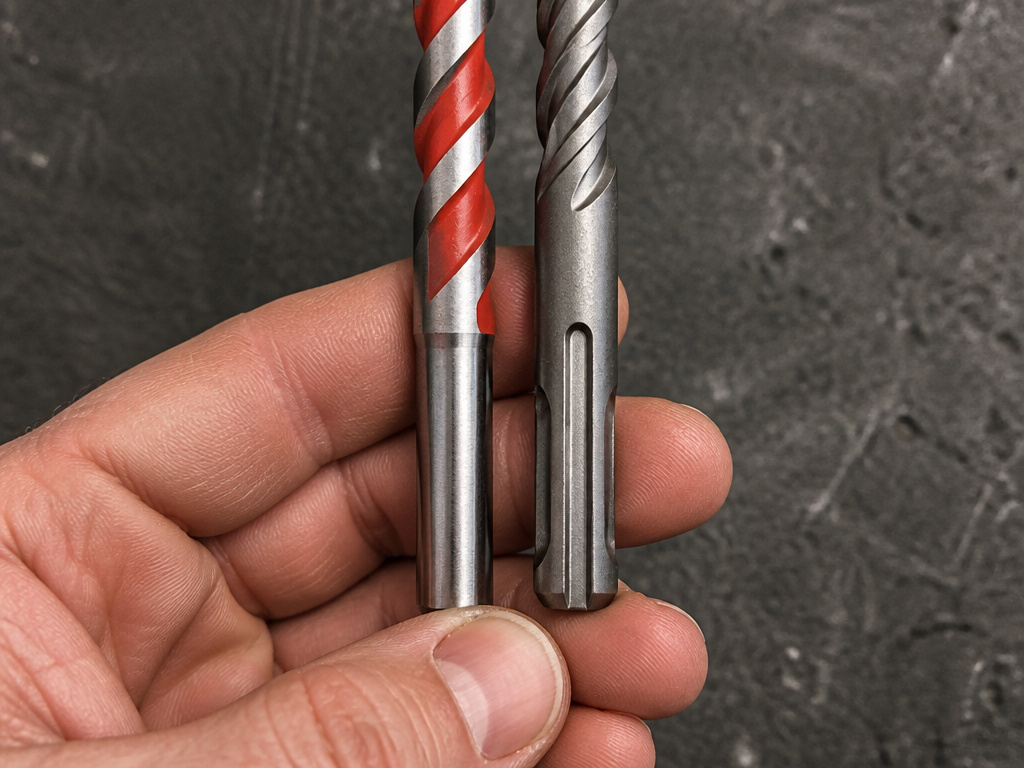
You cannot separate the bit from the tool. The shank is the interface, and it tells you what kind of force the bit is built to handle.
A round shank or 1/4-inch hex shank fits your standard cordless drill or drill press. These bits are for rotation-only or the high-frequency, low-impact vibration of a basic hammer drill setting. They rely on RPM, not brute force. The Bosch Fast Spiral Rotary Masonry bits are classic examples, they work in a rotary drill for brick and block but will stall in poured concrete.
An SDS-plus (TE-C) or SDS-max (TE-Y) shank is for a rotary hammer. These shanks have grooves that lock into a specialized chuck, allowing the bit to slide back and forth slightly. This sliding action lets the tool’s pneumatic hammer deliver its energy directly to the bit’s tip, not through the chuck bearings. It’s exponentially more efficient for concrete.
Where this goes sideways: Chucking an SDS-plus bit into a standard drill with an adapter. You’ve defeated the sliding mechanism, all the impact energy is now absorbed by your drill’s chuck, and you’ll burn out the drill’s hammer mechanism in two or three holes. The adapter is a path to a repair bill.
If you have a standard drill, you’re limited to round-shank masonry bits for soft brick and block. If you’re drilling concrete, you need a rotary hammer and the correct SDS bit. This isn’t a recommendation. It’s a mechanical fact.
What Happens When You Swap Them (The Failure Modes)
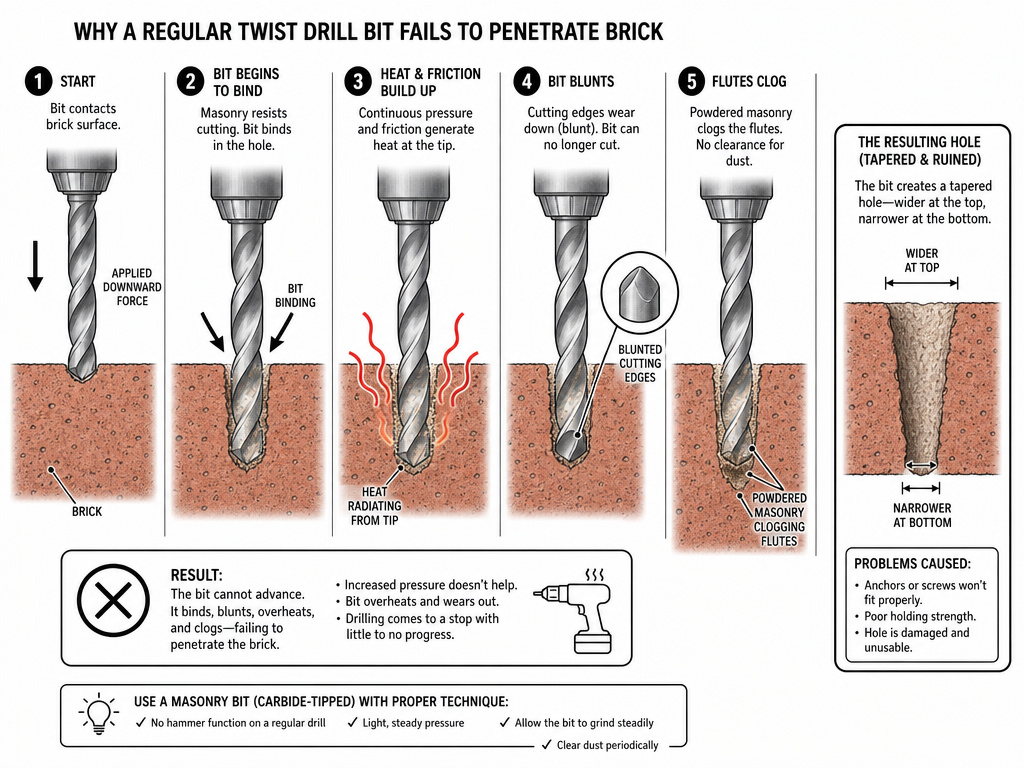
Using a Regular Bit on Masonry
The sequence is predictable. The sharp point makes a tiny dent. You increase pressure. The cutting edges start to rub, not cut, generating intense heat. The bit blunts within 20 seconds. As it dulls, you push harder, causing the flutes to clog with powdered masonry. The bit binds, transfers torque to your wrist, and either snaps or strips the drill’s chuck. The hole is now a ruined, tapered mess, often too wide for any anchor to grip.
Using a Masonry Bit on Wood or Metal
The blunt carbide tip doesn’t cut. It crushes and tears. In wood, it will splinter the exit side badly, creating a ragged, oversized hole that offers no grip for a screw. The bit will also wander more easily at the start. In metal, the carbide tip can skate dangerously, and the lack of a sharp cutting edge will work-harden the surface, making it impossible to penetrate with any bit afterward. You’ll also prematurely dull the carbide’s corners against the metal’s toughness.
When “Masonry Bit” Isn’t Enough: Specialized Types
Not all masonry bits are the same. The general-purpose bit you use for hanging a shelf in a brick wall is a different tool from the one you’d use to set a structural anchor.
- General Purpose (Groo-V Tip): Bits like the Relton RELGRT are round-shank workhorses for through-holes in block or brick. They’re fine for lag shields or plastic anchors.
- Anchor-Setting Bits: For wedge or sleeve anchors, you need precision. The Relton REL207 SDS-plus bit is manufactured to ANSI B212.15 tolerance. This means the hole diameter is controlled to within a few thousandths of an inch. An oversized hole from a standard bit reduces anchor pull-out strength by 20% or more.
- Rebar Eaters: Hitting rebar is a common surprise. Forcing a standard masonry bit through it will shatter the carbide. Dedicated bits like the Relton RELRB (round shank) or RELSRB (SDS-plus) are rotary-only tools. Their carbide cutters are designed to shear through rebar under pure rotation. You must turn the hammer action off.
- Tile & Hard Masonry Bits: For vibration-sensitive materials like porcelain tile, a “Tip-Top” style bit (Relton RELTT) is designed for rotary-only drilling. Hammer action will crack the tile.
This is why knowing your masonry bit uses matters. The right sub-type saves the bit, the anchor, and the material.
How to Choose: Your Decision Flowchart
Stop guessing. Follow this sequence.
- Identify the Material. Is it brick/block, poured concrete, or concrete with possible rebar? Is it wood, steel, or plastic?
- Select the Tool. Brick/block with a standard drill? Use a round-shank masonry bit. Poured concrete? You need a rotary hammer and an SDS-plus bit (like a Hilti TE-C).
- Match the Bit to the Task. Hanging a picture in brick? A general-purpose bit is fine. Installing a safety railing anchor in a concrete patio? You need an ANSI-tolerance anchor-setting bit.
- Check the Shank. Does it fit your tool’s chuck? If it’s SDS and your tool is a standard chuck, stop. You have the wrong bit or the wrong tool.
Common mistake: Assuming a “concrete drill bit” is just a stronger masonry bit. For reinforced concrete, you need a bit with a robust head design like the Hilti TE-Y, which is built to withstand rebar hits. A standard two-cutter bit will snap.
If you’re ever unsure, the rule is simple: when in doubt, start with a smaller pilot hole in the hardest material you expect to encounter. Test the bit’s performance. Better to waste a 1/8″ bit than ruin a 1/2″ hole and a $25 bit.
Frequently Asked Questions
Can I use a masonry bit without a hammer drill?
You can, but only in soft brick or cinder block, and it will be slow. The bit relies on hammer action to pulverize the material. In rotary-only mode, you’re just grinding with the carbide, which will overheat the bit and drastically shorten its life. For any meaningful work, use the hammer function.
What does a concrete drill bit look like?
Dedicated concrete drill bit for a rotary hammer typically has an SDS-plus shank, a robust body with deep flutes, and a four-cutter carbide head for dealing with aggregate and incidental rebar. Its concrete bit appearance is heavier-duty than a standard two-cutter masonry bit meant for brick.
Why does my masonry bit keep getting stuck?
It’s usually one of three things. You’re not clearing the dust (pull the bit out frequently). You’re using a blunt bit (the crushed material has nowhere to go). Or you’ve hit rebar and are trying to hammer through it with a standard bit. Stop, clear the hole, and assess.
Are all masonry bits carbide tipped?
Virtually all modern, quality masonry bits are. The carbide tip is the defining feature. Some cheap, all-steel “masonry” bits exist; they are worthless and will fail immediately. Look for the distinct brazed-on tip.
How can I tell a masonry bit from a regular bit?
Look at the tip. A masonry bit has a flat, wide, spade-like tip made of a different, grainier-looking material (carbide) welded to the steel. A regular twist bit has a pointed, unified tip ground from the same metal as the body. Here’s a full guide on how to identify masonry drill bits.
Before You Go
The divide between a masonry drill bit and a regular bit is a canyon, not a crack. It’s the difference between a hammer and a scalpel. For brick and block with a standard drill, get a set of Bosch Fast Spiral bits. For concrete, invest in a rotary hammer and a Hilti TE-C SDS-plus bit. If anchors need to hold, spend the extra on a tolerance-controlled bit like the Relton REL207.
Using the wrong bit doesn’t just waste time. It ruins tools, materials, and your confidence in the job. Match the tip to the task, match the shank to the tool, and pull the trigger.
