
Concrete vs Wood Drill Bits: The Crucial Shape Differences
This post contains affiliate links. As an Amazon Associate, we earn from qualifying purchases.
Concrete drill bits use a flat, multi-cutter tungsten carbide tip and a deep, aggressive flute for hammer drilling into masonry, while wood bits use a sharp, pointed tip and a wide, shallow flute for clean, fast chip ejection in rotary drilling. Using a wood bit on concrete rounds the tip within three holes and can burn out a standard drill motor.
The difference isn’t academic. It’s a physical mismatch between the material’s hardness and the tool’s geometry. A concrete bit’s blunt-looking head is designed to pulverize aggregate; a wood bit’s sharp point slices through fibers. Swap them, and you get a ruined bit, a stalled project, and a drill that smells of burnt windings.
What follows: the three specs that tell them apart at a glance, the two power tools each demands, and the one mistake that strips a chuck or burns a motor before you finish the first hole.
Key Takeaways
- Concrete bits have a flat, multi-cutter tungsten carbide tip designed to crush, not cut. A wood bit’s sharp, pointed tip will round over on concrete within seconds.
- Match the shank to the drill. SDS-Plus or SDS-Max shanks are for hammer drills only; hex or round shanks for standard chucks. Forcing an SDS bit into a regular chuck strips the chuck jaws.
- Flute design dictates chip removal. Concrete bits have a tight, deep helix to lift fine dust; wood bits have a wide, shallow flute to eject large chips. Using the wrong one clogs the hole and overheats the bit.
- RPM matters. Run a concrete bit at wood-drilling speeds (2000+ RPM) and the tungsten carbide tip overheats, losing its hardness. The bit goes dull on the fourth hole.
- For small concrete anchors without a hammer drill, use a DIN 8039-rated carbide bit like the Metabo Carbide Pro series. They’re designed for the lower impact of light hammer drills or even rotary drills in soft masonry.
The Head Shape: Multi-Cutter vs. Pointed Tip
Look at the business end. A concrete bit looks blunt, almost unfinished. A wood bit looks surgical. That visual tells you everything about how each one works.
Concrete drill bits use a head shape with multiple tungsten carbide cutters arranged to crush masonry, while wood drill bits use a sharp, centered point and cutting spurs to slice cleanly through wood fibers.
Concrete bits crush. The tip is a flat plate of tungsten carbide, often with two or four separate cutters (called a multi-cutter or 4-cutter design). The Hilti TE-CD bit uses this for reinforced concrete. It doesn’t slice; it hammers and pulverizes the aggregate into dust. The side cutters on a SDS Max bit keep the hole straight when you hit rebar.
Wood bits slice. A brad point bit has a sharp, centered spur that plunges in to prevent wandering, and two sharp outer spurs that score the circumference of the hole before the main cutting edges lift the chips. It’s a slicing action. A spade bit is even more aggressive—it’s basically a chisel on a stick, designed for speed in rough work, not precision.
The wrong head fails fast. Drive a brad point into concrete. The sharp point rounds over on first contact. The outer spurs snap. You’re left with a blunt nub spinning uselessly, making heat instead of a hole. The reverse—using a concrete bit on wood—doesn’t break the bit, but it tears the wood. The crushing action splinters the exit side and leaves a rough, burnt-looking hole. For any finish work, that’s a discard piece.
| Bit Type | Tip Material | Cutting Action | Result in Wrong Material |
|---|---|---|---|
| Concrete (e.g., Hilti TE-CD) | Tungsten Carbide Plate | Hammer & Crush | Rounds tip, snaps spurs, zero progress. |
| Wood (Brad Point) | Hardened Steel Point | Score & Slice | Tears wood, splintered exit, rough hole. |
| Wood (Spade Bit) | Flat Steel Chisel | Chisel & Scoop | Extreme tear-out, unusable hole. |
Flute Design: Dust Removal vs. Chip Ejection
The spiral running up the bit is called the flute. It’s not for decoration. It’s the highway that removes debris. Concrete and wood produce completely different debris, so the highways are built to different specs.
Concrete bits have a tight, deep helix. The spiral is steep and the channels are deep. This is engineered to lift fine, abrasive dust out of a deep hole quickly. Dust left in the hole acts like grinding paste, wearing down the bit and increasing friction. Bits like the Metabo SDS-max Pro 4 emphasize “large-volume dust channels” for this reason. The dust is heavy, so the flute needs to be aggressive.
Wood bits have a wide, shallow flute. The spiral is gentler, and the channel is broad. This gives large, curly chips of wood a clear path to escape. If the flute were too tight, like a concrete bit’s, the chips would jam. A clogged flute stops cutting, overheats the bit, and can burn the wood.
Where this goes sideways: Using a wood bit’s wide flute in concrete. The fine concrete dust doesn’t engage with the shallow spiral. It packs into the bottom of the hole, turning into a hard, abrasive plug. Your drill works harder, the bit overheats, and you’ll smell the acrid scent of burning tungsten carbide before the hole is halfway done.
The mechanics of clogging are simple. Concrete dust is granular. It needs a steep, continuous spiral to be conveyed upward. A wood flute is a series of open shelves; the dust settles on them and stays. Once packed, the bit is just rubbing, not cutting.
For clean, fast drilling into wood, you need that chip-clearing capacity. For a concrete drilling guide that works, the dust must move.
Shank & Power: Hammer Drills vs. Rotary Drills
The shank is the end that goes into your drill. It’s the connection between the power and the cut. Get this wrong, and you damage the tool, not just the bit.
Concrete demands a hammer drill. The action is a rapid pounding (hammering) combined with rotation. The shanks for this are SDS-Plus (TE-C) or SDS-Max (TE-Y). They have grooves that allow the bit to slide back and forth in the chuck while transferring torque. You cannot use an SDS bit in a standard chuck. The chuck jaws cannot grip the grooved shank securely, and the hammering action will destroy a regular drill’s internal gears.
Wood uses a rotary drill. The shank is almost always a smooth, round shank or a hex shank designed to be gripped tightly by a standard 3-jaw chuck. The action is pure rotation. There’s no back-and-forth movement.
| Shank Type | Tool Required | Primary Use | Risk if Misused |
|---|---|---|---|
| SDS-Plus / SDS-Max | Hammer Drill | Concrete, Masonry, Stone | Strips chuck jaws, destroys rotary drill gears. |
| Round / Hex Shank | Drill/Driver, Rotary Drill | Wood, Metal, Plastic | Bit slips in hammer drill chuck, holes are inaccurate. |
What if you only have a regular drill? For small-diameter holes in soft brick or very old, soft concrete, you can sometimes get away with a specialized bit. The Metabo Carbide concrete drill bit pro series is rated DIN 8039 and is explicitly listed as “also suitable for light hammer drills with a three-jaw chuck.” These bits have a specially heat-resistant carbide insert (130°) to handle the friction. It’s a compromise, but it’s the only sanctioned one. For true drilling holes in concrete, you need the right hammer action.
The chuck is the casualty. Forcing the wrong shank type is how you strip a chuck. A stripped chuck won’t hold any bit tightly again. It’s a $50 repair on a $100 drill. Not worth the gamble.
Speed & Heat: The RPM Mismatch That Ruins Bits
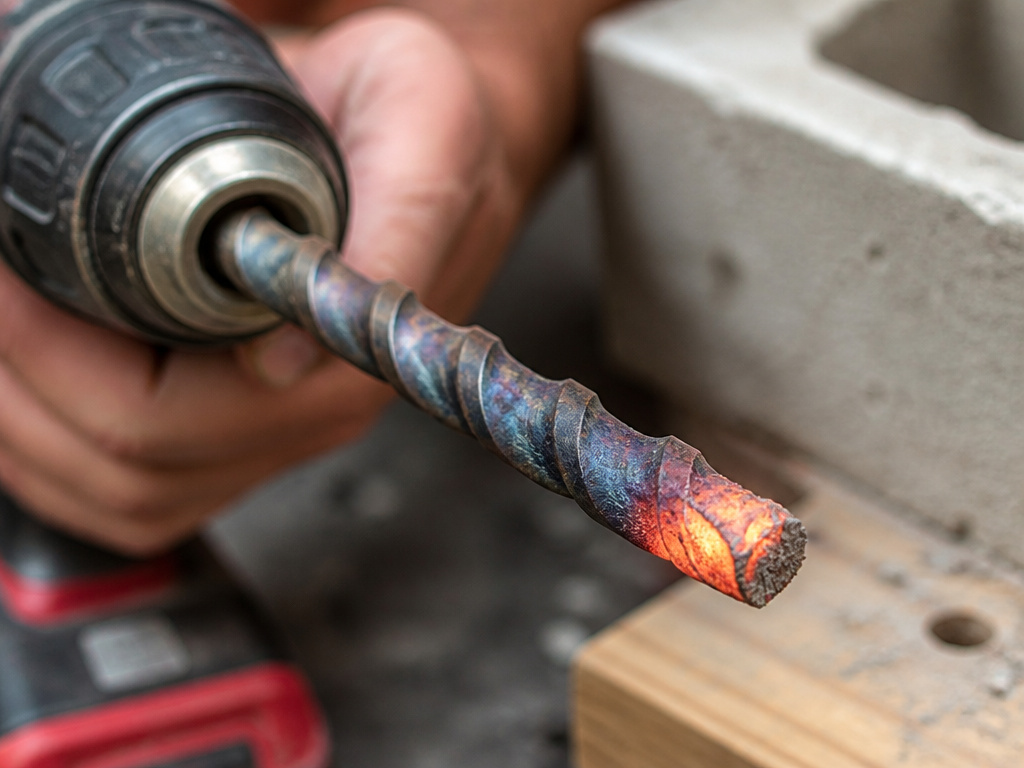
Drill speed isn’t just about going fast or slow. It’s about matching the bit’s cutting action to the material’s resistance. Run a concrete bit at the high RPM you’d use for wood, and you cook the tip.
Wood drilling is high RPM. You might run a 1/4″ wood bit at 2000-3000 RPM. The material is soft, the chips are large, and the bit can shed heat into the ejected material. Speed is your friend for a clean hole.
Concrete drilling is low RPM with high impact. A hammer drill might spin at only 800-1200 RPM, but it delivers thousands of impacts per minute. The tungsten carbide tip is hard but brittle; too much rotational speed generates friction heat faster than the bit and material can dissipate it.
The part nobody mentions: Tungsten carbide loses its legendary hardness at temperatures above about 600°C. A red-hot tip is a soft tip. You can overheat a concrete bit on your fourth hole if you lean on the drill and run it too fast. The telltale sign is blueing or discoloration on the steel behind the tip.
The Bosch drilling guide from our sources recommends specific cutting speeds based on diameter and material. For a 10mm concrete bit, the ideal speed might be under 1000 RPM. For a 10mm wood bit in softwood, it could be over 2500 RPM. That’s a 2.5x difference. Your drill’s trigger setting matters.
Coolant is for metal, not masonry. You never use cutting oil or coolant when drilling concrete. It creates a muddy paste that clogs the flute and reduces the hammer action’s effectiveness. The only “coolant” is pulling the bit out frequently to clear dust and let air in.
If you’re selecting a drill bit and see a speed recommendation on the package, heed it. It’s there because the engineers know the thermal limits of their carbide.
When To Use Which: A Decision Matrix
You’re holding a concrete block and a 2×4. You need to anchor a ledger board. Which bit goes in the drill first? Your choice decides the next thirty minutes.
Use a concrete drill bit for:
- Anchoring into masonry walls (for shelves, TVs, handrails).
- Installing concrete screws or sleeve anchors.
- Drilling for rebar or chemical anchors in structural work (the Hilti TE-CD is literally marketed for “post-installed rebar”).
- Penetrating brick, stone, or poured foundation walls.
Use a wood drill bit for:
- Pre-drilling for screws in any wood-to-wood joinery.
- Creating clearance holes for bolts or dowels.
- Boring for wiring or plumbing runs through studs.
- Any project where a clean, splinter-free hole matters.
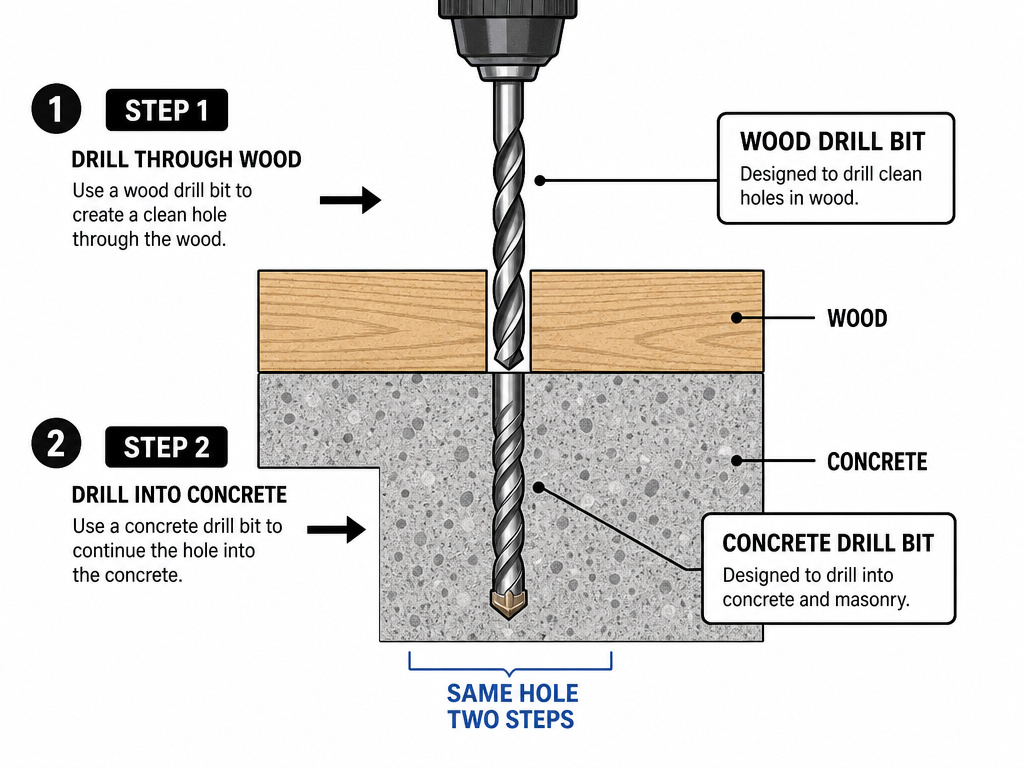
The hybrid scenario: drilling through wood into concrete. This is common for deck ledgers or sill plates. The technique is two-step. First, use a wood drill bit to drill a clean hole through the wood only. Then, without moving the drill, switch to a concrete drill bit of the same diameter and continue into the masonry. This prevents the concrete bit from tearing the wood on its way in.
Common mistake: Using one bit for both materials. A concrete bit will maul the wood entry point. A wood bit will be instantly destroyed the moment it touches concrete. Two bits, two steps.
For a deeper dive on material matchups, see our masonry vs wood drill bit comparison. The principles extend to other pairings, like choosing between wood and metal drill bits.
Product Spot: The Bits That Actually Work
A category name isn’t a recommendation. These are the specific models that deliver on the promises above.
For Concrete & Masonry:
- Hilti TE-CD (SDS-Plus): The benchmark for reinforced concrete drilling. The multi-cutter head and optimized flute are why pros use it for structural anchors. Check availability for the diameter you need.
- Metabo SDS-max Pro 4: For larger diameter holes (up to 52mm per the spec sheet), the aggressive S-blade and dust channels on this SDS Max bit keep the cut moving. It’s for heavy-duty rotary hammers.
- Metabo Carbide concrete drill bit pro: This is your answer for “I don’t have a hammer drill.” The DIN 8039 rating and 130° carbide insert are designed for the lower impact of a three-jaw chuck drill on softer masonry. Keep the RPMs low.
For Wood:
- Brad Point Bits (any reputable brand): For joinery and finish work, a set of brad point bits is non-negotiable. They leave a cleaner hole than twist bits.
- Spade Bits (Irwin Speedbore): For rough, fast boring through framing lumber where the hole won’t be seen, a spade bit is brutally effective. It’s the right tool for a wrong-looking job.
Bottom line: Buy bits for the material you drill most. If you’re a DIYer putting up shelves, a set of Metabo Carbide Pro bits and a set of brad points will cover 95% of your needs. If you’re building a deck or a shed, add spade bits to the list. For foundational work, you’re into Hilti or similar professional-grade territory.
Frequently Asked Questions
Can I use a wood drill bit on concrete?
No. The sharp tip and cutting spurs of a wood bit are made of hardened steel, which is softer than the tungsten carbide in concrete. On contact with concrete or brick, the tip will round over and the spurs will chip, rendering the bit useless within seconds. You will not make a usable hole.
What happens if I use a concrete drill bit on wood?
It will work, but poorly. The crushing action of a concrete bit will tear and splinter the wood, especially on the exit side. The hole will be rough and oversized. For any project where appearance matters, this is unacceptable. For rough construction where the hole is hidden, it might get the job done—but a wood bit is faster and cleaner.
How can I tell a concrete drill bit from a wood bit by looking at it?
Look at the tip. A concrete bit has a flat, blunt tip often made of a silver-gray tungsten carbide plate. A wood bit (like a brad point) has a sharp, pointed center spur and often two sharp outer spurs. Also look at the flute: concrete bits usually have a tighter, more aggressive spiral.
Do I need a special drill for concrete bits?
Yes, for true concrete bits (SDS-Plus or SDS-Max shanks), you need a hammer drill or rotary hammer. The drill must provide a hammering action in addition to rotation. For smaller holes, some carbide-tipped bits (like the Metabo Carbide Pro) are designed for use in standard drills on softer masonry, but performance and bit life are reduced.
What’s the best drill bit for drilling into a wood stud that has concrete behind it?
Use two bits. First, drill through the wood with a sharp wood drill bit (brad point or twist bit) to create a clean pilot hole. Then, without moving the drill, switch to a masonry drill bit of the same diameter and continue drilling into the concrete. This two-step method protects the wood from tear-out and prevents destroying the wood bit.
Before You Go
The line between a concrete drill bit and a wood bit is a line between crushing and slicing. It’s drawn in tungsten carbide and hardened steel. Crossing it costs you a bit, burns out a drill, or ruins your workpiece.
Remember the three markers: a blunt, multi-cutter tip for concrete; a sharp, pointed tip for wood. A deep, tight flute for dust; a wide, shallow flute for chips. An SDS shank for a hammer drill; a round shank for a chuck.
For the occasional concrete anchor, a set of DIN-rated carbide bits and a steady hand might suffice. For real masonry work, you rent the hammer drill and buy the bit meant for it. For everything made of wood, from framing to fine furniture, keep your brad points sharp and your speed high. Match the tool to the task, and the only thing you’ll drill is the hole you wanted.
