
What CFM Means for Air Compressors: Match Flow to Your Tools
This post contains affiliate links. As an Amazon Associate, we earn from qualifying purchases.
CFM in an air compressor is the volume of air it can deliver per minute, measured in cubic feet. It’s the flow rate that determines whether your air tools will run continuously or stall. The key is understanding that CFM is not a single number, it changes with pressure, temperature, and altitude, which is why terms like SCFM (Standard CFM) and ACFM (Actual CFM) exist to standardize comparisons and size systems correctly.
Matching your tools’ air consumption to your compressor’s CFM output is the whole game. Get it wrong, and the tool bogs down, the compressor cycles endlessly, and you burn out motors.
What follows breaks down the three flow measures that matter. SCFM, ACFM, and ICFM, with the conversion math, the real-world impact of altitude and heat, and how to use these numbers to choose a compressor that won’t leave you short.
Key Takeaways
- SCFM is the comparison spec, ACFM is the real flow in your pipes. Always compare compressor models using SCFM, but size your piping and dryers using ACFM, which is about 7.8 times smaller at 100 PSI.
- Altitude cuts your mass flow. A compressor rated for 100 SCFM at sea level delivers only about 83 SCFM-worth of air in Denver. You must apply an altitude correction factor before buying.
- Heat and humidity reduce delivered air. Hot inlet air is less dense, so each cubic foot contains fewer air molecules to do work. A dirty air filter can drop inlet pressure by 0.3 PSI or more, choking the compressor before it even starts.
- CFM demand is cumulative. Your compressor’s SCFM output must meet or exceed the sum of all tools running simultaneously at their rated consumption, not just the highest single tool.
- Horsepower is a rough guide, not a rule. A 5 HP compressor might deliver 15-20 SCFM, but the exact figure depends on pump efficiency and design. Never buy on HP alone.
SCFM vs CFM: The Critical Distinction
The label “CFM” by itself is meaningless for comparison. It’s an unqualified term that only tells you volume at some unknown condition. This is why standards were created.
SCFM (Standard Cubic Feet per Minute) is a corrected flow rate. It answers: “If I took this air and brought it to a specific, agreed-upon set of conditions, what volume would it occupy?” This lets you compare compressors from different manufacturers on a level playing field. The most common standard in North America, per the CAGI (Compressed Air & Gas Institute), uses 14.7 PSIA of pressure, 60°F temperature, and 0% relative humidity.
ACFM (Actual Cubic Feet per Minute) is the physical volume of air moving through your pipes at that moment, at the actual local pressure and temperature. This is the number that determines pipe velocity and dryer sizing.
SCFM to ACFM Conversion Insight: At 100 PSIG and standard temperature, 1 SCFM compresses to about 0.128 ACFM. A “100 SCFM” compressor delivers only roughly 13 ACFM of compressed air at pressure. Using SCFM for pipe sizing will oversize your lines by a factor of nearly 8.
ICFM (Inlet Cubic Feet per Minute) is the flow rate of air entering the compressor’s intake. For a clean, cool, sea-level intake, ICFM and SCFM are similar. The gap widens with hot, humid, or high-altitude inlet air.
| Term | What It Measures | Primary Use | Key Condition |
|---|---|---|---|
| SCFM | Flow corrected to standard reference (14.7 PSIA, 60°F, 0% RH) | Comparing compressor specs & rating tool demand | Standardized, consistent |
| ACFM | Actual volume flowing at local pressure & temperature | Sizing pipes, dryers, & system components | Changes with system PSI & temp |
| ICFM | Volume of air drawn into the compressor intake | Diagnosing intake restriction & compressor health | Affected by filter condition & ambient air |
The difference between SCFM and CFM isn’t academic. It’s the difference between a system that works on paper and one that works in your shop.
Why CFM Matters More Than PSI for Runtime
PSI (Pounds per Square Inch) is the force behind the air. It’s what makes the impact wrench hit hard. CFM is the amount of air. It’s what keeps the wrench spinning.
Think of it like a garden hose. PSI is the water pressure. CFM is how much water is coming out. You can have high pressure from a tiny hose, but you can’t fill a bucket quickly. A high-CFM compressor is like a fire hose, it delivers a large volume continuously.
A tool like a die grinder might need 90 PSI to operate, but it consumes 5 SCFM while running. Your compressor must provide both: it must reach 90 PSI and deliver 5 SCFM continuously, or the tool will stall. This is where matching tools to compressor becomes critical. A small “pancake” compressor can hit high PSI for a nailer’s short burst, but it can’t sustain the CFM for a sander that runs for minutes.
Common mistake: Buying a compressor based only on its maximum PSI rating. The CFM output at your working pressure (e.g., 90 PSI) is the number that actually matters for runtime.
How to Calculate Your Actual CFM Needs
You don’t need complex formulas to start. You need a list and simple arithmetic.
First, find the SCFM consumption rating for every air tool you plan to use. This is usually stamped on the tool or in its manual. Then, apply this rule: Your compressor’s SCFM output must meet or exceed the sum of all tools that could run at the same time.
For a home garage, you might only run one tool at a time. So, your compressor needs to match your highest-CFM tool, plus a small buffer. A professional shop running multiple sanders and impacts needs to add them all up.
Here’s a basic formula for CFM demand:
Total Required SCFM = (SCFM of Tool A) + (SCFM of Tool B) + ...
For a more precise calculation, factor in duty cycle. A tool rated for 10 SCFM with a 50% duty cycle averages 5 SCFM. But your compressor still needs to supply the peak 10 SCFM when the tool kicks on.
| Common Air Tool | Typical SCFM @ 90 PSI | Notes |
|---|---|---|
| Framing Nailer | 2-3 | Short bursts, low average demand |
| Impact Wrench (1/2″) | 4-6 | High intermittent demand |
| Die Grinder | 4-8 | Continuous use, high CFM |
| Orbital Sander | 6-12 | Highest common demand; runs continuously |
| Sandblaster | 10-20 | Requires a large industrial compressor |
This list is why a typical 30-gallon reciprocating compressor might handle an impact wrench but choke on a sander. The sander’s continuous 10 SCFM demand exceeds the compressor’s 7-8 SCFM output, causing constant cycling and pressure drops.
The Altitude and Heat Problem
 Air is a compressible fluid. Its density, how many air molecules are in a cubic foot, changes with atmospheric pressure and temperature. This directly changes the mass flow your compressor can pull in.
Altitude reduces atmospheric pressure. At 5,000 feet, pressure is about 12.2 PSIA compared to 14.7 PSIA at sea level. Your compressor’s piston or screw still moves the same volume (ICFM), but that volume contains less dense air, so it compresses fewer molecules into the tank. The result is less usable air, or SCFM.
Where this goes sideways: Installing a sea-level-rated 100 SCFM compressor in Denver. It will deliver only about 83% of its rated mass flow. If your tools need 100 SCFM, you’re short 17 SCFM from day one.
| Altitude (feet) | Approx. Atmospheric Pressure (PSIA) | Correction Factor (Multiply Sea-Level SCFM) |
|---|---|---|
| Sea Level | 14.7 | 1.00 |
| 2,500 | 13.4 | 1.10 |
| 5,000 | 12.2 | 1.20 |
| 7,500 | 11.1 | 1.32 |
Heat has a similar effect. Hot air is less dense than cold air. A compressor intake drawing in 100°F summer air gets significantly fewer molecules per cubic foot than if it were drawing in 60°F air. The published SCFM rating assumes standard 60°F inlet temperature. Install the compressor in a hot corner of your shop, and you lose capacity.
This is why understanding compressor size requires knowing your local conditions, not just the catalog number.
SCFM, ACFM, and ICFM in the Real System
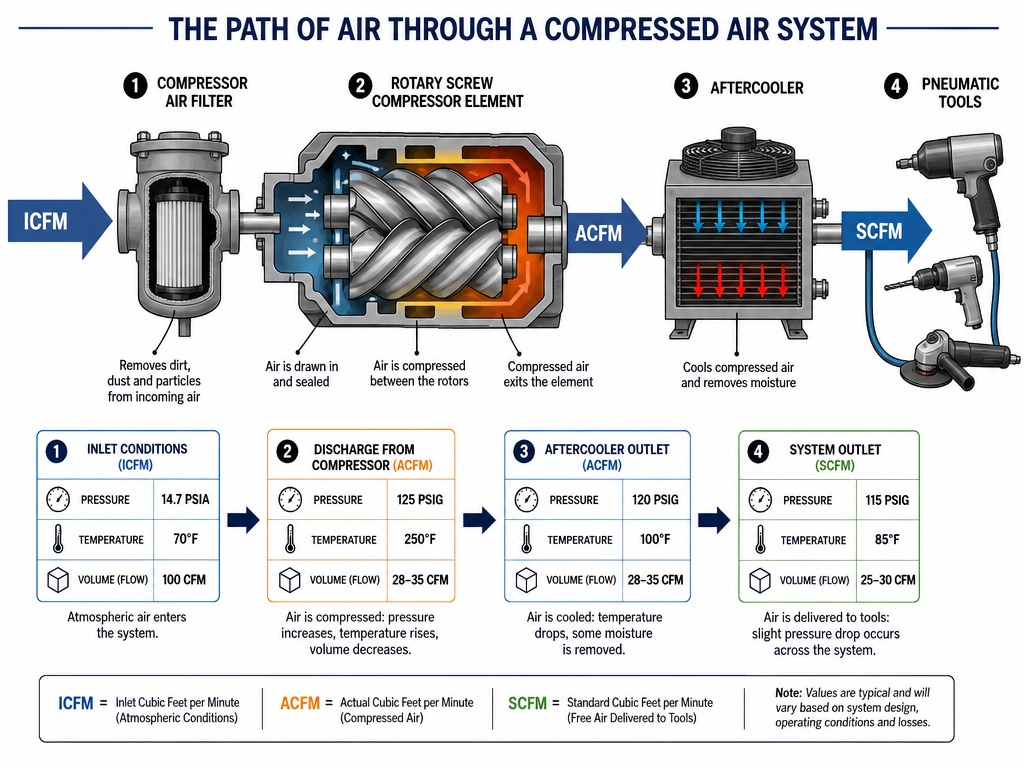 Let’s trace the path of air to see how these three terms interact in your shop.
- ICFM: Air at ambient conditions is drawn through the filter into the rotary screw compressor or piston pump. A dirty filter adds restriction, lowering the inlet pressure and reducing ICFM.
- Compression: The pump squeezes this air, dramatically increasing its pressure and temperature. The mass of air (molecules) stays the same, but its volume shrinks.
- ACFM: This compressed, hot air leaves the pump. Its volume is now the ACFM, much smaller than the ICFM that entered. This ACFM flow enters your pipes.
- Aftercooling & Drying: The air cools in the aftercooler or dryer. As it cools, its volume decreases slightly further (Charles’s Law). Any removed water vapor also reduces the volume of usable air.
- SCFM (The Reference): Throughout this process, the system’s capability is described in SCFM, the mass flow everyone agreed to use for specs. Your tools are rated in SCFM. Your compressor is rated in SCFM. The SCFM rating is the anchor that makes the conversation possible.
Choosing a Compressor: Translating CFM into a Purchase
Armed with your total SCFM requirement and an understanding of altitude, you can now evaluate compressors. Ignore the horsepower hype. Look at the manufacturer’s stated SCFM at your desired pressure (usually 90 PSI).
For a home shop running a single high-demand tool like a sander, a quality 30-gallon two-stage compressor is often the minimum. Its two-stage pump delivers higher CFM more efficiently than a comparable single-stage model. For a busy auto shop, a 60-gallon or larger compressor for air tools is a baseline.
Remember the receiver tank (the gallon rating) gives you a buffer for short, high-CFM demands, but it doesn’t increase your compressor’s continuous CFM output. For tasks longer than a minute, the pump’s SCFM rating is all that matters.
If you find your existing compressor is constantly cycling and can’t keep up, there are methods to increase CFM like adding a secondary receiver tank or ensuring your intake air is as cool and clean as possible. But these are mitigations, not miracles. The best fix is usually a compressor with a higher SCFM output.
Frequently Asked Questions
Can I use a tool with a higher CFM than my compressor?
Yes, but not for continuous operation. The tool will start, quickly drain the tank, and then stall as pressure drops. The compressor will run constantly trying to catch up, leading to overheating. For brief, intermittent use (like a few seconds with an impact wrench), it’s workable. For a sander or grinder, it’s impossible.
What’s more important, CFM or tank size?
CFM for runtime, tank size for peak demand. The pump’s CFM determines how much air you have for continuous work. The tank size provides a reservoir for short, high-CFM bursts, letting the pump catch up during pauses. For continuous tools, a large tank with a low-CFM pump is useless, it will empty and stay empty.
How does a two-stage compressor affect CFM?
two-stage air compressor compresses air in two steps, which is more efficient. This efficiency often translates to a higher SCFM output per horsepower compared to a single-stage unit. It’s a design that delivers more usable air, not just higher pressure.
Do I need to convert SCFM to CFM for pipe sizing?
Absolutely. You must use ACFM (the compressed air volume in the pipe) to calculate velocity. Using SCFM will suggest massively oversized pipes, which can lead to poor air quality from condensation and slower system response.
Why does my compressor’s CFM drop as pressure increases?
This is normal and shown on the compressor’s performance curve. Compressing air to a higher pressure requires more work from the pump, which often reduces its volumetric efficiency. Always check the SCFM rating at your intended working pressure (e.g., 90 PSI), not just the maximum pressure rating.
The Bottom Line
CFM isn’t a marketing number. It’s the physical limit of your compressed air system. SCFM lets you compare compressors honestly. ACFM tells you what’s actually in your pipes. And ICFM reminds you that a hot, dirty intake strangles performance before the pump even turns.
The rule is simple: add up your tools’ SCFM demands, apply an altitude correction, and buy a compressor whose SCFM output meets that number at your working pressure. Skip the horsepower debates and the tank-size trap. Focus on flow. Your air tools will thank you by actually working.
