
End Mill vs Drill Bit: The Key Differences for Better Cuts
This post contains affiliate links. As an Amazon Associate, we earn from qualifying purchases.
An end mill cuts sideways with its flutes; a drill bit bores straight down with its chisel point. Using one for the other’s job snaps the tool or ruins the workpiece within seconds.
That’s the short answer, and it’s the one that stops a $50 mistake before you turn on the spindle. The confusion happens because both are cylindrical tools that go into a chuck. But their jobs are opposites.
The rest of this guide walks through the three differences that matter: cutting geometry, machine motion, and material compatibility. By the end, you’ll be able to look at a job and know instantly which tool to pull from the rack, and why the other one would fail.
Key Takeaways
- End mills cut laterally. Their flutes are on the side for milling slots, pockets, and contours. A drill bit’s primary cutting edges are at the tip for axial drilling.
- Drill bits require downward force. They are designed for a drilling machine’s pecking or constant feed motion. An end mill needs lateral movement from a milling machine.
- Swapping them breaks things. Putting a drill bit in a mill for a slotting operation will snap the bit. Using an end mill to drill a hole will burn up the flutes and likely break the tool.
- Flute count signals purpose. Two-flute end mills clear chips aggressively for aluminum; four-flute versions provide a smoother finish in steel. Drill bits have two helical grooves regardless.
- Material dictates the substrate. For hard metals, reach for a solid carbide end mill like the Kennametal GOmill GP. For masonry, you need a carbide-tipped SDS-plus drill bit.
The 3 Core Differences: Geometry, Motion, and Material
The mix-up between an end mill and a drill bit isn’t about looks. It’s about physics. One is built to push chips out of a hole; the other is built to shear material from a wall.
Technical Snapshot: An end mill’s cutting edges (flutes) run along its sides and often at the tip, allowing it to cut in lateral (X/Y) and axial (Z) directions. A twist drill bit’s primary cutting edges are concentrated at its chisel-point tip, designed for axial penetration. The helical grooves on a drill bit are for chip evacuation, not for side-cutting.
Let’s break down the three pillars.
1. Cutting Geometry: Flutes vs. Helical Grooves
Look at the business end of each tool. An end mill has distinct, sharp flutes machined into its body. These are the actual cutting edges. A four-flute end mill, like the Kennametal GOmill GP series, has four separate edges that can engage material.
A standard twist drill bit has two deep, spiral grooves running up its length. These are for chip removal. The cutting happens at the very tip, where two angled faces meet to form a chisel point.
Why it matters: A flute is designed to take a shearing cut along its entire length. A helical groove has no sharp edge along its side—it’s a channel. If you try to move a drill bit sideways in a milling machine, the soft side of the groove rubs against the workpiece, generates intense heat, and either snaps or welds itself into the cut.
2. Machine Motion: Milling vs. Drilling
This is the non-negotiable difference. The machine’s movement decides the tool.
A drilling operation is fundamentally axial. The tool spins, and the machine (or your arm) feeds it straight down into the workpiece. The chisel point does the work, and the flutes lift the chips out. This is true whether you’re using a hand drill, a drill press, or a CNC machining center in drill mode.
A milling operation is lateral. The tool spins, but the cutting action comes from moving it sideways across the workpiece (peripheral milling) or across its face (face milling). The end mill’s side flutes are doing the cutting. Any downward movement (plunging) is secondary and uses the end of the tool, which may or may not be center-cutting.
Common mistake: Putting a drill bit into a milling machine vise and programming a slotting operation. The first lateral move will either snap the bit or produce a ragged, burned slot. The machine doesn’t care what you call the tool—physics does.
3. Material & Construction: What They’re Made to Cut
You wouldn’t use a butter knife to split logs. Tool materials are optimized for their primary missions.
Drill bits are built for penetration. Their substrates prioritize heat resistance and toughness at the tip. A Bosch PRO Metal HSS-G Impact Twist Drill Bit is made from ground high-speed steel to withstand the impact and friction of punching into metal. A Metabo SDS-Plus Carbide Drill Bit Pro 4 uses a carbide tip to grind through concrete and masonry; its reinforced core handles the percussive blows of a hammer drill.
End mills are built for shear. They need to maintain a razor-sharp edge along a much longer cutting surface. For steel and stainless steel, a solid carbide end mill with a coating like KC633M (a PVD multilayer coating) is standard. The Kennametal GOmill GP series uses this grade for its balance of hardness and wear resistance during side-cutting.
| Aspect | End Mill | Drill Bit |
|---|---|---|
| Primary Cutting Edges | On the side (flutes) | At the tip (chisel point) |
| Primary Machine Motion | Lateral (milling machine) | Axial (drill press, hand drill) |
| Typical Operation | Slotting, profiling, facing | Drilling holes |
| Critical Spec | Number of flutes, coating (e.g., KC633M) | Point angle, helix angle, tip material (e.g., carbide) |
| Material Focus | Machining metals, plastics (shearing) | Penetrating masonry, metal, wood (boring) |
When You Must Use an End Mill (And When You Must Not)
The rule is simple: if the cut is primarily on the side of the tool, you need an end mill. If the cut is primarily at the tip of the tool, you need a drill bit.
Jobs for an End Mill
- Slotting: Cutting a channel or groove.
- Profiling: Cutting the outside contour of a part.
- Pocketing: Clearing out a shallow cavity.
- Face milling: Skimming the surface off a workpiece.
- Plunging: Only with a center-cutting end mill, and even then, depth is limited.
A center-cutting end mill has flutes that extend to the center of its tip, allowing it to drill a shallow hole. A non-center-cutting end mill has a small dead zone in the middle—it cannot drill at all.
Jobs for a Drill Bit
- Drilling holes: From a pilot hole to a through-hole.
- Counterboring/Countersinking: With specialized bits that follow a pilot hole.
- Reaming: Slightly enlarging a hole for precision (using a reamer, a specialized drill bit).
Where this goes sideways: Trying to enlarge a hole by “walking” a drill bit sideways. The bit will grab, snap, or produce a horrifically out-of-round hole. To enlarge a hole, you drill a new, larger one, or you use an end mill in a milling machine.
The “Can’t I Just…” Scenarios
- Can I drill a hole with an end mill? Technically, if it’s center-cutting and the hole is shallow (depth less than the diameter). It’s inefficient and wears the fragile end corners of the flutes. Use a drill bit.
- Can I mill a slot with a drill bit? No. See above. The bit will break.
- Can I use a drill bit in my router? Only if you enjoy shrapnel. Routers are milling machines. Use a router bit.
Anatomy Deep Dive: Reading the Tool Specs
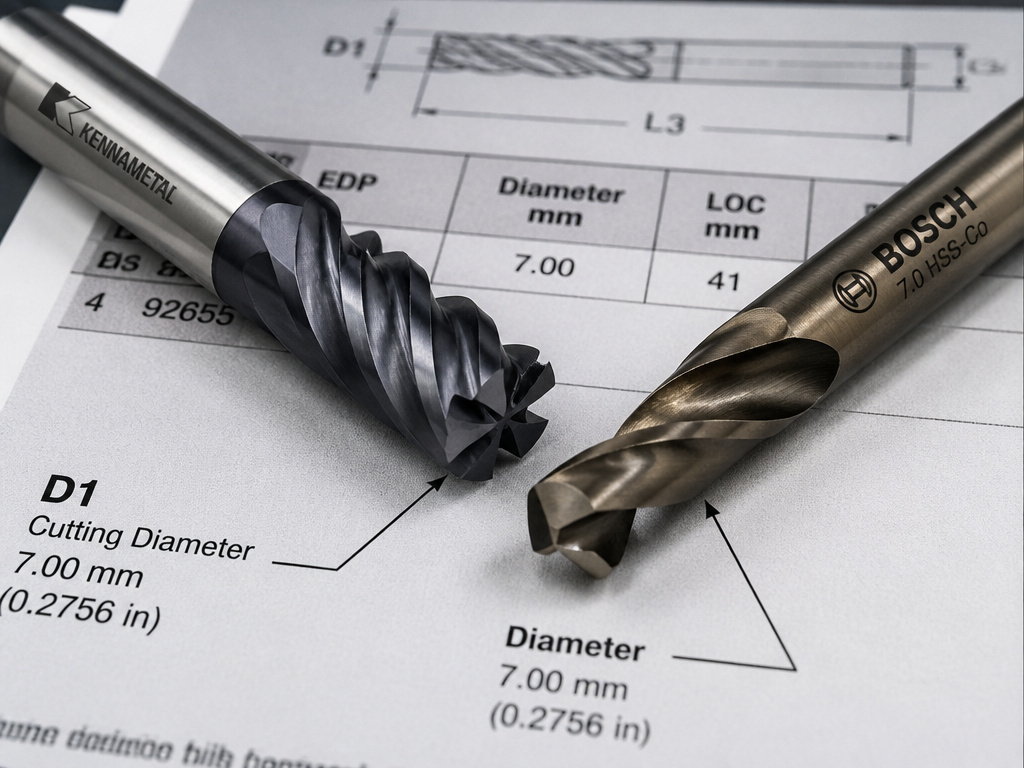
Choosing the right tool means speaking its language. Here’s what to look for on the package or spec sheet.
Decoding an End Mill Spec
Take the Kennametal GOmill GP Square End 4 Flutes (6086546). Its spec sheet tells you: – D1 (Effective Cutting Diameter): 22.225 mm (0.875 in). This is the width of the cut it will make. – AP1MAX (Max Cutting Depth): 57.15 mm (2.25 in). The deepest axial cut it’s designed for. – Flutes: 4. More flutes mean a smoother finish in harder materials but less room for chip ejection in gummy ones. – Grade: KC633M. This is the coating, indicating it’s for general-purpose steel, stainless, and cast iron.
For aluminum, you’d drop down to a two-flute version (like the Kennametal GOmill GP 2 Flutes, 6086460) for better chip clearing.
Decoding a Drill Bit Spec
Look at the Metabo SDS-Plus Carbide Drill Bit Pro 4 Design (674908000): – Diameter: 1/4″. The size of the hole. – Working Length: 9″. How deep it can drill. – Tip Design: “Chisel-shaped head for rapid penetration.” This is for masonry. – Shank: SDS-Plus. This locks into a hammer drill.
A Bosch PRO Metal HSS-G Impact Twist Drill Bit spec will highlight its split point (reduces “walking”) and hex shank (for impact driver use).
| Specification | End Mill (e.g., Kennametal GOmill GP) | Drill Bit (e.g., Bosch HSS-G) |
|---|---|---|
| Defining Measurement | Cutting diameter (D1) | Drill diameter |
| Critical Length | Maximum cutting depth (AP1MAX) | Working length / Overall length |
| Key Feature | Number of flutes, coating grade | Point angle (118° vs 135°), helix (fast vs slow) |
| Shank Type | Weldon, cylindrical (for milling collets) | Round, hex, SDS (for drill chucks) |
| Material Suitability | Defined by coating (KC633M for steel) | Defined by substrate (HSS for metal, carbide for masonry) |
Drill Bit vs End Mill: The Material Decision Table
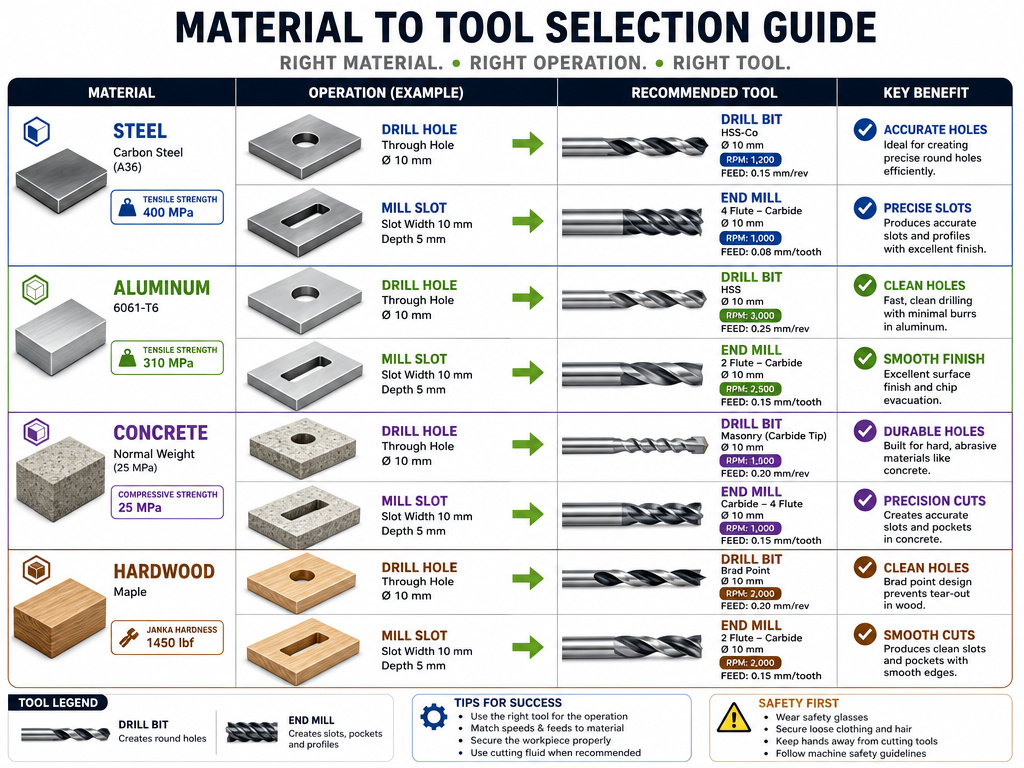
Your workpiece material narrows the choice instantly. This table removes the guesswork.
| Workpiece Material | Primary Operation | Correct Tool Type | Example Tool | Why It Wins |
|---|---|---|---|---|
| Steel Plate | Drilling a bolt hole | Drill Bit | Bosch HSS-G Split Point | HSS steel handles metal heat; split point prevents walking. |
| Steel Plate | Cutting a slot | End Mill | Kennametal GOmill GP 4 Flute | Carbide substrate and coating withstand shearing forces. |
| Aluminum Block | Drilling a hole | Drill Bit | High-helix HSS drill bit | Sharp point and fast helix clear gummy chips quickly. |
| Aluminum Block | Milling a pocket | End Mill | 2-Flute Carbide End Mill | Two flutes provide maximum chip clearance to prevent welding. |
| Concrete Wall | Drilling an anchor hole | Drill Bit | Metabo SDS-Plus Carbide Drill Bit | Carbide tip crushes aggregate; SDS shank transfers hammer blows. |
| Hardwood | Drilling a clean hole | Drill Bit | Brad point bit | Center spur prevents wandering; sharp edges cut clean wood fibers. |
| Hardwood | Milling a mortise | End Mill | Solid carbide end mill | Sharp flutes shear wood cleanly without tear-out on the sides. |
The short version: For holes, think drill bit. For shapes, slots, or finished edges, think end mill. The material tells you which specific variety of each.
The One Tool That Blurs the Line: The Spot Drill
There’s a hybrid that acknowledges the confusion: the spot drill. It’s a short, rigid drill bit with a very precise point angle (often 90° or 120°). Its sole job is to start a hole perfectly located for a following twist drill bit, especially on curved or angled surfaces.
You could use a center-cutting end mill for this, but a spot drill is tougher, cheaper, and more accurate for the task. It’s a drill bit that serves a milling-adjacent purpose—positional accuracy. After spotting, you follow with your standard twist drill bit to complete the hole.
Frequently Asked Questions
Can an end mill be used as a drill bit?
Only a center-cutting end mill can plunge to create a shallow hole, and it’s a last resort. It’s inefficient, hard on the tool, and can’t achieve the depth or cleanliness of a proper drill bit. For any dedicated hole-making, use the right bit.
Why are drill bits cheaper than end mills?
Drill bits have a simpler geometry focused on the tip. End mills require precision grinding of multiple cutting edges along the length and often use more expensive solid carbide substrates. You’re paying for complexity and performance over a larger cutting surface.
How do I know if my end mill is center-cutting?
Look directly at the tip. If the flutes run all the way to the very center, it’s center-cutting. There will be no small flat or dimple in the middle. If there’s a tiny dead spot (often on older or roughing end mills), it is not center-cutting and cannot plunge.
What happens if I put a drill bit in a milling machine?
The machine will spin it. When you command a lateral move (like cutting a slot), the drill bit’s unsupported side will flex. The soft steel of the flute channel will rub, heat up instantly, lose hardness, and either snap or melt into a ruined workpiece. Don’t do it.
Can I sharpen an end mill like a drill bit?
No. Drill bit sharpeners work on the simple chisel point geometry. End mill flutes have complex radial and axial relief angles. Sharpening an end mill requires a specialized (and expensive) tool grinder or sending it out to a reconditioning service.
Before You Go
Stick to this hierarchy and you’ll save money, time, and frustration: 1. Hole? Pick a drill bit. Match its material (HSS, carbide) and point to your workpiece. 2. Shape, slot, or surface? Pick an end mill. Match its flute count and coating to your material. 3. Machine? A drill bit belongs in a drill press or hand drill. An end mill belongs in a milling machine or router.
The tools are not interchangeable. Their designs are answers to different physical questions—one to
