
What Air Compressor Do I Need? Match CFM, PSI & Duty Cycle
This post contains affiliate links. As an Amazon Associate, we earn from qualifying purchases.
You need an air compressor that delivers more CFM (cubic feet per minute) than your highest-demand tool requires at your working PSI (pounds per square inch), with a duty cycle that matches your runtime, intermittent use fits a piston compressor, while running tools more than 4–6 hours daily demands a 100% duty cycle rotary screw model.
The CFM number on the tool’s spec sheet is the starting point, but the compressor’s actual delivered CFM, its SCFM or FAD, is what matters. A 5 CFM impact wrench needs a compressor rated for at least 5.5 SCFM at 90 PSI, not one whose peak CFM is 5 at 40 PSI. Miss that difference and the tool bogs down on the third lug nut.
What follows: how to read tool labels, why tank size is a secondary concern, the piston-versus-screw decision that locks in your operating cost, and the electrical specs that prevent a tripped breaker on first use.
Key Takeaways
- Match the compressor’s SCFM at your working PSI to the tool’s CFM requirement, adding a 20-30% margin for simultaneous use or hose loss.
- Duty cycle is the runtime limit. A 50% duty cycle means run 5 minutes, cool 5 minutes. Exceed it and the motor burns out.
- Rotary screw compressors are for shops running tools more than 4–6 hours a day; reciprocating pistons handle intermittent garage and DIY work.
- Oil-less compressors are lighter, maintenance-free, and louder. Oiled models run quieter and last longer under heavy use but require fluid checks.
- Extension cords must be 12-gauge or thicker for runs over 50 feet on a 15-amp circuit, per Husky and Craftsman manuals. Thinner wire overheats.
The 3 Numbers That Decide Everything: CFM, PSI, and Duty Cycle
Forget horsepower and tank size at first. Your tool’s performance hinges on three ratings: the volume of air (CFM), the pressure (PSI), and how long the compressor can sustain it (duty cycle). Get one wrong and the project stalls.
CFM, or Cubic Feet per Minute, is the volume of air flow. It determines whether your tool can sustain operation. PSI, or Pounds per Square Inch, is the pressure that forces that air through the tool. A compressor must meet or exceed both the CFM and PSI requirements listed on your pneumatic tool’s specification plate.
CFM: The Make-or-Break Flow Rate
A tool’s CFM requirement is not a suggestion. It’s the minimum airflow needed to generate rated torque on an impact wrench or maintain atomization on a spray gun. The catch is that a compressor’s CFM output drops as pressure rises.
Most compressor brands advertise a high SCFM (Standard Cubic Feet per Minute) at a low pressure, like 40 PSI. Your tools likely need 90 PSI. You must find the compressor’s SCFM rating at your working pressure. This spec is buried in the manual, not on the box.
For example, a Husky 27-gallon compressor delivers 6.0 SCFM at 40 PSI but only 5.0 SCFM at 90 PSI. If your framing nailer needs 4 CFM at 90 PSI, this compressor can barely keep up solo. Add a blow gun and the nailer starves.
| Common Tool | Typical CFM @ 90 PSI | Compressor SCFM Needed (with margin) |
|---|---|---|
| Framing Nailer | 2 – 4 CFM | 2.5 – 5.0 SCFM |
| 1/2″ Impact Wrench | 3 – 5 CFM | 353 – 6.5 SCFM |
| Die Grinder | 4 – 6 CFM | 5 – 8 SCFM |
| HVLP Spray Gun | 8 – 12 CFM | 10 – 15 SCFM |
| Sandblaster (small) | 10 – 15 CFM | 12 – 18 SCFM |
Add a 25–30% margin to the total CFM of tools running simultaneously. Hose friction, coupler leaks, and filter restriction can steal that much flow. Running at the compressor’s absolute limit also overheats the pump.
PSI: More Than Just a Maximum Number
Your compressor’s maximum PSI, 165 PSI on many home models, is a tank safety limit, not a working pressure. You’ll regulate down to your tool’s required PSI, typically 90 PSI for impact wrenches and nail guns, 40-50 PSI for some blow guns.
The critical check is the cut-in pressure. This is the PSI at which the compressor restarts after the tank pressure drops. If your tool’s demand drops the tank pressure below the regulator’s output, you get a pulsating, weak airflow.
Most home compressors have a wide pressure band (e.g., cut-in at 120 PSI, cut-out at 150 PSI). For constant-flow tools like sanders or spray guns, a tighter band or a larger tank is necessary to avoid “cycling” during use.
Duty Cycle: The Hidden Runtime Governor
Duty cycle is the percentage of time a compressor can run without overheating. A 50% duty cycle means it can run for 5 minutes, then must cool for 5. A 100% duty cycle (like rotary screw models) runs indefinitely.
Where this goes sideways: Assuming a “2 HP” compressor can run all afternoon. The motor might be rated for continuous duty, but the piston pump is not. It needs cool-down periods defined by its duty cycle, often omitted from store signage. Exceed it and the pump head warps, the valves carbon up, and the repair cost exceeds a new unit.
For a home garage running a nailer intermittently, a 50-60% duty cycle is fine. For a shop running a die grinder or sander for hours, only a 100% duty cycle rotary screw compressor avoids thermal shutdown.
Piston vs. Screw: The Technology Fork in the Road
This is the first real decision after sizing CFM. The technology dictates your upfront cost, operating cost, noise, and maintenance for the next decade.
Reciprocating (Piston) Compressors: The DIY Default
Piston compressors use a motor-driven crankshaft to move pistons in a cylinder, drawing in and compressing air in strokes. They fill a tank, shut off, and restart when pressure drops. This cycle works perfectly for intermittent use.
They dominate the home market because they’re cheaper upfront. The Husky 20-gallon, Craftsman 15-gallon, and smaller portable “pancake” compressors are all piston units.
Choose a piston compressor if:
- Your air tool use is sporadic, a few nails, inflating tires, occasional blowing.
- You need portability (models under 30 gallons).
- Your budget is under a few hundred dollars.
- Your runtime is less than 4-6 continuous hours per day.
Their limitation is the duty cycle. Even a well-built two-stage piston compressor maxes out at about 60-70% duty cycle. For a production shop, that’s a bottleneck.
Rotary Screw Compressors: The Shop Workhorse
Rotary screw compressors use two intermeshing helical screws to continuously compress air. They are designed for 100% duty cycle, they run non-stop, matching air output to demand, often with a variable-speed drive.
They are the standard in auto shops, cabinet shops, and any business where air tools are in constant use. Brands like Ingersoll Rand and General Air Products make industrial-grade screw models.
Choose a rotary screw compressor if:
- You run tools more than 4-6 hours a day.
- You need consistent pressure without pulsation (critical for spray painting).
- You want lower long-term energy costs and less noise.
- Your CFM need is above 20-25 SCFM.
The upfront cost is higher, and they are typically stationary. But for continuous operation, a piston compressor will fail prematurely, making the screw model the cheaper long-term choice.
Oil vs. Oil-Less: The Maintenance Trade-Off
Inside the pump, metal parts need lubrication to prevent wear. How that lubrication is provided splits compressors into two maintenance camps.
Oiled Compressors have a crankcase filled with petroleum or synthetic lubricant, like the Ingersoll Rand TS4 which holds 40 oz. The oil bathes the bearings, cylinder walls, and piston rings. – Pros: Much quieter operation (often under 75 dBA). Longer lifespan under daily use. Better heat dissipation. – Cons: Require regular oil level checks and changes (every 500 hours for petroleum, 2000 for synthetic, per the Trisoft manual). Must be operated level to avoid oil starvation. Can contaminate air lines if a seal fails, a problem for painting.
Oil-Less Compressors use permanently lubricated bearings or Teflon-coated rings. The Keiser 1030 series and many California Air Tools models are oil-less. – Pros: Virtually zero maintenance, no oil checks or changes. Can be operated at any angle. Delivers oil-free air, good for painting straight from the tank. – Cons: Significantly louder (often 80+ dBA). Shorter service life under heavy cyclic use. The Teflon coating eventually wears, and the pump is not rebuildable.
For a homeowner using it a few hours a month, oil-less is fine. For a busy garage, the quiet longevity of an oiled pump pays off.
Tank Size: Why It’s the Last Thing to Worry About
A larger tank doesn’t increase your CFM. It simply stores more compressed air, allowing the compressor to shut off longer between cycles. This reduces motor starts per hour, which reduces wear and heat.
For a piston compressor, a larger tank smooths out demand spikes. If you’re using a tool with short, high-CFM bursts (like an impact wrench), a 20-gallon tank might let the compressor keep up without cycling on every lug nut. For continuous-use tools (sanders, grinders), the tank size is almost irrelevant, the pump must match the CFM demand directly.
The General Air Products manual states that compressors 2 HP and larger should be tank-mounted to prevent overpressure and motor overheating. This is a stability and safety issue, not a capacity one.
Common mistake: Buying a 30-gallon tank with a tiny pump because “bigger is better.” If the pump’s SCFM is too low, the tank will empty quickly under tool demand and the motor will run continuously, hitting its duty cycle limit and failing early. Size the pump first, then pick a tank that supports its cycle.
Electrical Realities: Amps, Circuits, and Extension Cords
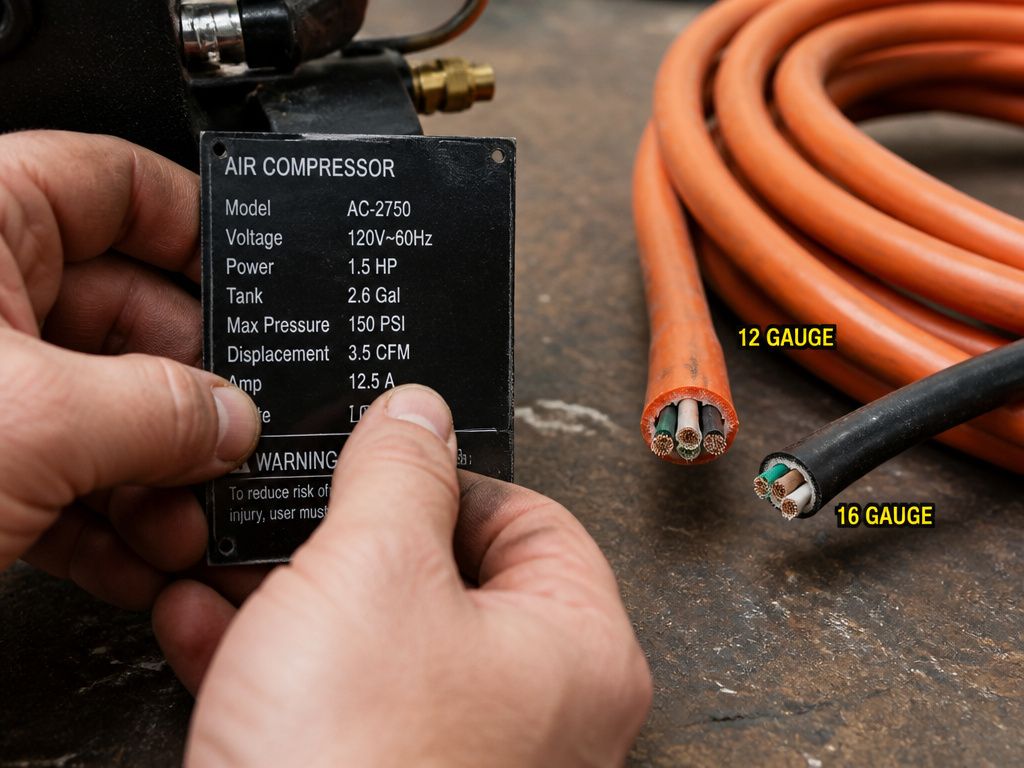 The specs plate on the compressor tells you the hard electrical requirements. Ignoring them trips breakers and burns out motors.
Most 120V home compressors in the 1.5–2 HP range draw 12–15 amps. They require a dedicated 15- or 20-amp circuit. Sharing that circuit with shop lights or a battery charger guarantees a trip when the compressor starts.
Extension cords are a major point of failure. The Husky manual provides a clear chart: for a 12-amp compressor, a 50-foot cord must be at least 14-gauge; a 100-foot cord must be 12-gauge. Using a 16-gauge cord causes voltage drop, the motor draws more amps to compensate, and the windings overheat.
| Compressor Amp Draw | Cord Length 50 ft | Cord Length 100 ft |
|---|---|---|
| Up to 12 Amps | 14 AWG | 12 AWG |
| 12–15 Amps | 12 AWG | 10 AWG |
If you need more reach, buy a longer air hose instead. Your compressor will last years longer.
Environmental Edge Cases: Humidity, Dust, and Cold
 Your garage or shop environment directly affects compressor longevity. Manuals call out specific risks.
The Ingersoll Rand manual warns that moisture can form inside the pump in humid areas or unheated spaces with large temperature swings. You’ll see external condensation and the oil turning milky. The fix is to relocate the compressor, increase ventilation, or run it for longer intervals so the heat drives off moisture.
The Trisoft manual advises a shorter lubricant change interval, more frequent than the standard 500 hours, in humid or dusty conditions. Dust ingestion clogs air filters faster and abrasive particles can accelerate cylinder wear.
For cold climates, remember that compressed air holds water vapor that freezes in lines below 32°F. Drain tanks daily and consider an aftercooler or air dryer if using air tools outdoors in winter.
The 5-Step Selection Checklist
Before you buy, walk through this sequence.
- List Your Tools & Their CFM at Working PSI. Find the spec plate on each tool. Note the highest single tool CFM and the total if running multiple.
- Find a Compressor’s True SCFM at That PSI. Dig into the product manual or spec sheet. Ensure it meets your peak demand plus a 25% margin.
- Match Duty Cycle to Your Runtime. Intermittent DIY = piston. All-day professional use = rotary screw.
- Choose Oil vs. Oil-Less Based on Maintenance. Want quiet and long life with periodic checks? Oiled. Want set-and-forget? Oil-less.
- Verify Electrical Compatibility. Check amp draw, ensure a dedicated circuit, and use only heavy-gauge extension cords.
Following this order prevents the classic mistake of buying a compressor for its tank or horsepower, then discovering it can’t run your sander for more than two minutes.
Frequently Asked Questions
What size air compressor do I need for a home garage?
For typical home garage tasks, inflating tires, running a brad nailer, occasional impact wrench use, a portable oil-less compressor in the 4–6 gallon range like a California Air Tools model is sufficient. If you plan on framing or using a die grinder, step up to a 20–30 gallon oiled piston compressor delivering at least 5–6 SCFM at 90 PSI.
Can I use a small compressor for a paint spray gun?
You can, but the results are poor. HVLP spray guns need 8–12 CFM continuously. A small compressor will cycle constantly, causing pressure fluctuations that create an uneven finish. For painting, you need a compressor with a CFM rating above the gun’s requirement and preferably a large tank (30+ gallons) or a continuous-duty screw compressor.
Is a 6-gallon air compressor enough for an impact wrench?
For a single lug nut or bolt, yes. For removing a full set of lug nuts sequentially, probably not. A ½” impact wrench needs 3–5 CFM. A 6-gallon compressor’s pump is likely too small to replenish the tank fast enough. The wrench will work initially, then lose power as tank pressure drops. A 20-gallon model is a safer match.
How do I know if my compressor is too small for my tools?
The symptoms are clear: the tool starts strong but quickly loses power, the compressor motor runs continuously without shutting off, and the tank pressure gauge drops steadily while the tool is operating. The compressor is unable to deliver the required CFM.
What’s more important, CFM or PSI?
CFM is more important for tool operation. PSI is the force, but CFM is the volume sustaining the action. A compressor with high PSI but low CFM will register adequate pressure in the tank but won’t be able to deliver enough air volume to keep the tool running under load. Always match CFM first.
Before You Go
Skip the marketing horsepower. Find your tools’ true CFM demands and match them to a compressor’s verified SCFM at your working pressure. For a weekend garage, a Husky 20-gallon oiled piston compressor covers most needs. If you’re running a die grinder or spray gun for hours, the investment in a quiet, oiled rotary screw compressor pays off in consistency and longevity. Remember the electrical specs, that 12-gauge cord isn’t a suggestion, and drain the tank after every use. Air tools are only as good as the supply behind them.
