
What Is a Reciprocating Air Compressor? A Complete Guide
This post contains affiliate links. As an Amazon Associate, we earn from qualifying purchases.
A reciprocating air compressor is a positive-displacement compressor that uses one or more pistons driven by a crankshaft to draw in, trap, and compress air into a storage tank. It is the mechanical equivalent of a car engine, built for high pressure and intermittent duty, making it the default choice for workshops, auto shops, and serious DIY.
That engine-like design is the whole story. It explains the machine’s strengths, its limits, and the specific maintenance it demands. Forget abstract categories; the decision to use a reciprocating compressor comes down to matching its pulsed, high-pressure output to tools that run in bursts, not continuously.
What follows is the anatomy of a workhorse: the key parts, the four-stroke cycle that turns air into power, and the concrete specs, like the Ingersoll Rand 2340N5‘s 14.4 CFM at 175 PSI, that separate a garage-ready unit from a toy. You’ll also get the manufacturer’s own maintenance timeline and the one environmental factor that kills these pumps faster than anything else.
Key Takeaways
- Operates like an internal combustion engine, using pistons in cylinders to compress air in distinct pulses, not a steady stream.
- Delivers higher pressures (up to 175 PSI or more) but lower continuous airflow (CFM) compared to screw compressors, making it ideal for intermittent tool use.
- Requires strict adherence to oil-change intervals (every 500 hours or 3 months, per Ingersoll Rand) and daily tank draining to prevent catastrophic moisture damage.
- Choosing between single-stage (up to ~135 PSI) and two-stage (up to ~175+ PSI) is the first major decision, dictated by your highest-pressure tool.
- Its noise, vibration, and duty-cycle limits make it a workshop fixture, not a site tool for all-day, every-day use.
How a Reciprocating Air Compressor Works: The 4-Stroke Cycle
The basic operating principle of a reciprocating compressor mirrors a four-cylinder car engine, but instead of combusting fuel, it compresses air. Each cylinder executes four distinct strokes: intake, compression, discharge, and expansion. This cycle repeats for each revolution of the crankshaft.
The compression cycle in a reciprocating air compressor is a sealed, mechanical process. A piston moves within a cylinder, driven by a crankshaft via a connecting rod. On the downstroke, a vacuum opens the intake valve, drawing in atmospheric air. On the upstroke, the intake valve closes, and the piston reduces the chamber volume, increasing air pressure until it forces open the discharge valve, sending compressed air to the tank.
Intake Stroke. The piston moves downward. This increases volume inside the cylinder, creating a pressure lower than the atmosphere. The difference forces the spring-loaded intake valve open, pulling air through the filter and into the chamber. The discharge valve stays shut.
Compression Stroke. The piston reverses and moves upward. The intake valve snaps closed, sealing the air inside. The piston reduces the chamber volume, squeezing the trapped air. Its pressure and temperature rise sharply according to Boyle’s Law.
Discharge Stroke. When pressure inside the cylinder exceeds the pressure in the discharge line (leading to the tank), it overcomes the spring tension on the discharge valve. The valve opens, and the piston continues its upward travel, pushing the now-compressed air out of the cylinder and toward the storage tank.
Expansion Stroke. At the top of the stroke, a small gap remains between the piston and cylinder head, the clearance volume. As the piston begins its next downstroke, this high-pressure air expands into the growing chamber. Only when cylinder pressure drops below atmospheric pressure will the intake valve open again to start a new cycle. This clearance is critical; too little causes piston-to-head contact, too much reduces efficiency.
The process is intermittent. Air is delivered in distinct pulses, which is why a storage tank is mandatory to smooth out supply for tools.
Key Components of a Reciprocating Compressor
A reciprocating compressor is a system of simple, robust parts. Understanding each one tells you what to monitor and what eventually wears out.
Electric Motor. Provides the rotational power. It turns the crankshaft directly (direct-drive) or via belts (belt-drive). Direct-drive is simpler and has fewer moving parts; belt-drive allows for speed adjustment and easier motor replacement.
Crankshaft, Connecting Rod & Piston. The conversion assembly. The motor spins the crankshaft, which uses connecting rods to translate rotational motion into the linear, back-and-forth motion of the pistons inside the cylinders.
Cylinder & Cylinder Head. The compression chamber. Pistons move within these precision-bored tubes. The head houses the valve plates for intake and discharge. Two-stage compressors have a large-diameter low-pressure cylinder and a smaller-diameter high-pressure cylinder.
Valves. The one-way gates. Thin, spring-steel reed valves or plate valves control airflow. The intake valve only opens inward; the discharge valve only opens outward. Valve failure, bending, cracking, or fouling with carbon, is a leading cause of lost pressure and efficiency.
Intercooler (Two-Stage Only). A vital heat exchanger. After the first stage of compression, air travels through a series of fins or tubes (the intercooler) where it sheds heat before entering the second-stage cylinder. This cooling increases efficiency and reduces the load on the second stage.
Receiver Tank. The pressure buffer. This steel tank stores compressed air, allowing the compressor to cycle off and cool down while tools draw from the reserve. Daily draining of condensate from the tank’s drain valve is non-negotiable to prevent internal rust.
Pressure Switch & Safety Valve. The brain and the fail-safe. The pressure switch automatically starts the motor when tank pressure falls below a set minimum and stops it at a maximum. The safety relief valve is a mechanical backup that will physically vent air if the switch fails, preventing tank over-pressurization.
Lubrication System. The lifeblood. Most units are oil-lubricated reciprocating compressors. A pump or splash system delivers compressor oil to bearings, crankshaft journals, and cylinder walls. This oil reduces friction, seals the piston rings, and carries away heat. The wrong oil or low oil levels cause rapid, catastrophic wear.
Single-Stage vs. Two-Stage: The Pressure Trade-Off
The first major fork in the road is compression stages. This isn’t a minor upgrade; it changes the machine’s fundamental capability and typical price tier.
| Aspect | Single-Stage Compressor | Two-Stage Air Compressor |
|---|---|---|
| Max Operating Pressure | Typically 125-135 PSI | Typically 175-200 PSI |
| Compression Process | Air compressed once, directly to tank pressure. | Air compressed to an intermediate pressure, cooled, then compressed a second time to final pressure. |
| Efficiency & Heat | Less efficient; all compression heat stays in the air. | More efficient; intercooler reduces heat before final compression. |
| Best For | Common DIY tools: nailers, staplers, inflation, blowguns. | High-demand tools: impact wrenches, sandblasters, industrial paint sprayers. |
| Example (Ingersoll Rand) | Model SS5L5: 18.1 CFM @ 135 PSI, 5 HP | Model 2475N7.5: 24.3 CFM @ 175 PSI, 7.5 HP |
A single-stage compressor is simpler. Air is drawn into a cylinder, compressed in a single piston stroke, and sent to the tank. It’s the right choice for a home garage compressor running a nail gun compressor or a brad nailer. The Ingersoll Rand SS3L3 is a classic 60-gallon single-stage model.
Where this goes sideways: Buying a single-stage unit for a tool that needs 150 PSI. The tool will run weak or stall, and you’ll burn out the motor trying to keep up. Check your impact wrench’s manual first.
A two-stage compressor is for serious pressure. Air gets compressed in a large cylinder (first stage), cooled in the intercooler, then compressed again in a smaller cylinder (second stage). This allows much higher final pressures with less heat and better efficiency. The Ingersoll Rand 2340 series are benchmark two-stage models.
If your project list includes automotive repair with an impact wrench compressor or running a die grinder, the two-stage’s higher pressure and better duty cycle are worth the investment.
Reciprocating vs. Rotary Screw: Choosing the Right Technology
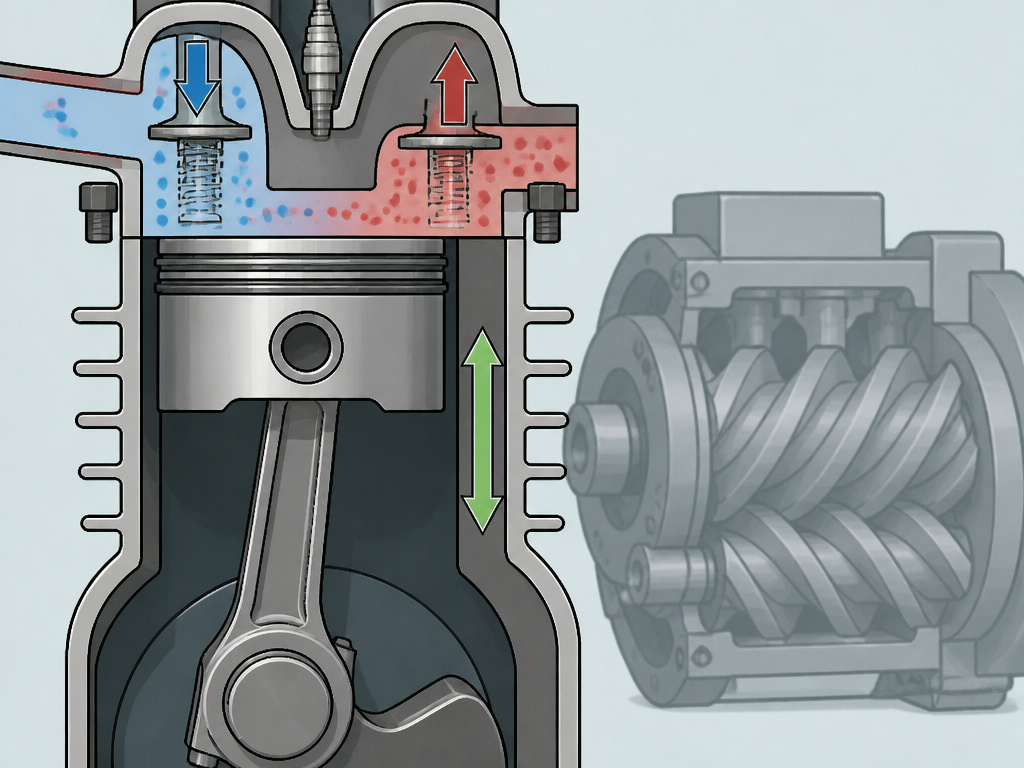 The reciprocating vs rotary screw debate defines professional shop layouts. It’s a choice between a pressure specialist and an endurance athlete.
A rotary screw air compressor uses two meshing helical screws to compress air in a continuous, smooth flow. It’s designed for constant operation. The comparison of reciprocating and rotary screw compressors breaks down to duty cycle and airflow quality.
| Factor | Reciprocating Compressor | Rotary Screw Compressor |
|---|---|---|
| Duty Cycle | 50-70%. Must rest 30-50% of the time to cool down. | 100%. Can run continuously. |
| Airflow Delivery | Pulsating, intermittent. Requires a large tank. | Constant, steady. Can often use a smaller tank. |
| Noise & Vibration | Loud and high vibration. | Quieter and minimal vibration. |
| Initial Cost | Lower initial investment. | Higher initial investment. |
| Best Application | Intermittent, high-pressure tool use (auto shop, woodshop). | Continuous demand (manufacturing, sandblasting, large body shops). |
For a typical workshop running pneumatic tools in bursts, drilling, fastening, inflating, the reciprocating compressor’s high pressure and lower cost win. Its 50-70% duty cycle is a feature, not a bug, for this use. The rotary screw is the choice when air demand is constant, like in an assembly line or a large commercial paint booth.
Critical Specifications: CFM, PSI, HP, and Duty Cycle
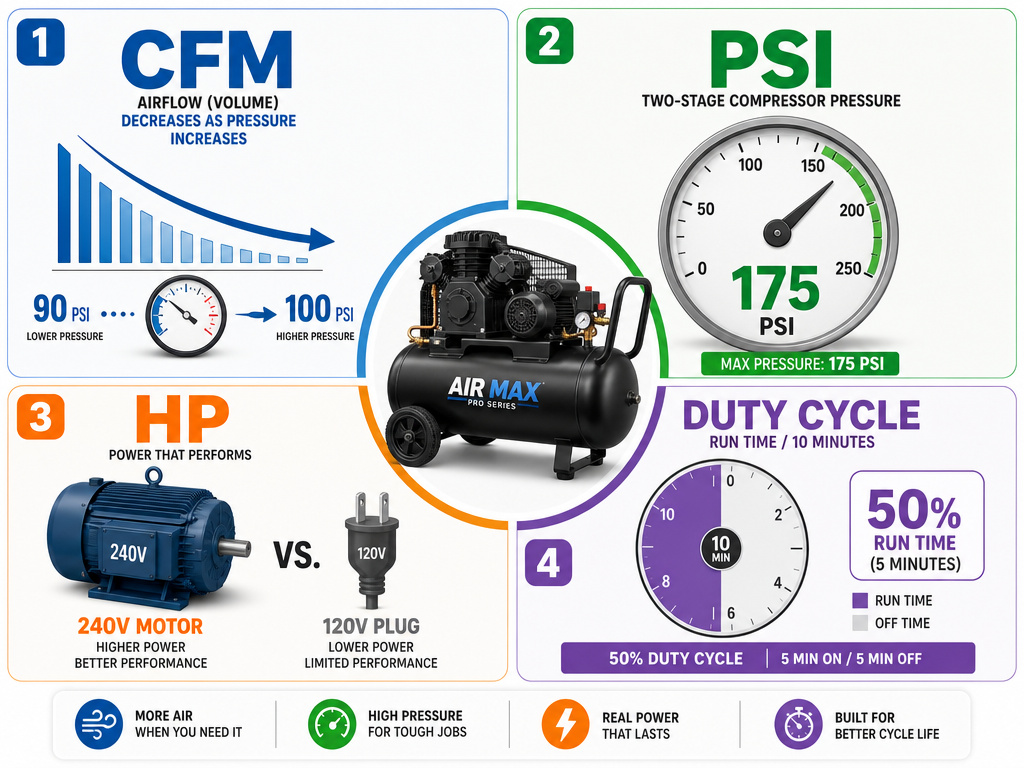 Shopping by brand alone is a mistake. You must match four hard numbers to your tools.
CFM (Cubic Feet per Minute). This is airflow volume. It’s the most important spec. Your compressor’s CFM output (measured at a specific PSI, usually 90 PSI) must meet or exceed the CFM requirement of your highest-demand air tool. A typical 1/2″ impact wrench might need 4-5 CFM at 90 PSI. Add a 20% buffer. The Ingersoll Rand 2340N5 delivers 14.4 CFM at 175 PSI.
PSI (Pounds per Square Inch). This is pressure force. Your compressor’s maximum pressure must exceed your tool’s required operating pressure. Most shop tools run at 90-100 PSI, but some, like certain sandblasters, need 150+ PSI. This is where a two-stage compressor pulling 175 PSI becomes necessary.
Horsepower (HP). A rough indicator of potential output, but marketing hype is common. Focus on CFM and PSI. A genuine 5 HP motor on a 240V circuit will produce far more usable air than a “5 HP peak” motor on 120V.
Duty Cycle. The percentage of time a compressor can run within a 10-minute period without overheating. A 50% duty cycle means it can run for 5 minutes, then must cool for 5. Exceeding this burns out the pump. Reciprocating compressors are built for intermittent duty.
The part nobody mentions: Manufacturers rate CFM at 90 PSI for a reason. As your tool’s required pressure (PSI) goes up, the compressor’s delivered CFM goes down. If your tool needs 4 CFM at 100 PSI, your compressor must deliver more than 4 CFM at 100 PSI, not at 90 PSI. Check the pump curve.
Essential Maintenance & Common Failure Points
A reciprocating compressor isn’t a buy-it-and-forget-it tool. Its piston-and-valve mechanics demand a schedule. The Ingersoll Rand manual for its 2000-series models gives a non-negotiable timeline.
Daily: Drain the tank condensate. Check the oil level via the sight glass. Listen for unusual noises.
Every 3 Months or 500 Hours: Change the petroleum-based compressor lubricant while the crankcase is warm. Clean the drain valve filter screen. In humid climates, do this more often.
Every 6 Months or 1000 Hours: Replace the oil filter (if equipped). Drain and clean the oil sight glass.
Every 2 Years or 2000 Hours: Change synthetic lubricant. Replace the air filter element. Inspect valve plates for wear or carbon buildup.
The most common failures are moisture-related. Water in the tank causes rust, which weakens the steel and can lead to catastrophic rupture. Water in the pump mixes with oil to form sludge, starving bearings and cylinders of lubrication. The pump seizes.
Worth knowing before you start: In frequently humid areas, moisture forms in the pump and produces sludge in the lubricant, causing running parts to wear out prematurely. That’s a direct quote from the Ingersoll Rand owner’s manual. A quality air dryer or more frequent oil changes are your only defense.
Valve failure is next. Worn or bent reed valves prevent proper sealing, causing the compressor to struggle to reach pressure, run longer cycles, and overheat. Rebuilding the head with a valve kit is a standard repair.
Applications: Where a Reciprocating Compressor Excels
This tool has a specific home. It dominates environments where air use comes in powerful, short bursts.
Automotive & Repair Shops. Powering impact wrenches, ratchets, die grinders, and air hammers for tire changes, brake work, and engine repair. The high PSI is critical here.
Woodworking & Carpentry. Driving framing nailers, finish nailers, staplers, and brad nailers. The intermittent duty cycle perfectly matches the pace of fastening.
Metalworking & Fab Shops. Running air plasma cutters, needle scalers, and small sandblasters. The two-stage models provide the steady, high pressure these tools demand.
DIY & Home Garages. The quintessential garage air compressor for inflation, cleaning, painting, and running a basic set of air tools. A quality 60-gallon single-stage unit often lasts a homeowner decades.
General Industrial. Used as a supplemental “point-of-use” compressor to provide higher pressure at a specific workstation than the main shop line, or as a backup during maintenance of a larger rotary screw compressor.
Its limitations are just as clear. Don’t try to run it for continuous operations like large-scale sandblasting or to feed multiple workers in an assembly line. That’s a job for the screw-type compressor.
Frequently Asked Questions
What’s the main advantage of a reciprocating air compressor?
High pressure at a lower initial cost. No other compressor technology delivers 175+ PSI as affordably for intermittent use. It’s the straightforward, mechanical solution for high-force pneumatic tools.
How loud are reciprocating compressors?
They are loud, often between 80-90 dB. The piston slamming back and forth, combined with the electric motor and cooling fan, creates significant noise. They belong in a workshop or dedicated compressor room, not a quiet office space.
Can I use a reciprocating compressor for painting?
Yes, for smaller jobs like automotive touch-up or furniture. You must add a high-quality air filter and regulator at the tool to remove oil and water vapor. For large, continuous painting (e.g., a car body), a rotary screw or piston compressor with a much larger air dryer is better suited due to its steady, clean airflow.
What does “two-stage” mean?
It means air is compressed twice. The first, larger piston compresses air to an intermediate pressure (e.g., 70 PSI). The air is cooled in an intercooler, then a second, smaller piston compresses it again to the final, higher pressure (e.g., 175 PSI). This process is more efficient and generates less heat than a single-stage compressing directly to 175 PSI.
How big of a tank do I need?
Tank size (in gallons) determines your air reserve, not your compressor’s power. A larger tank lets the compressor cycle less frequently, which reduces wear and allows you to run a tool longer before the motor kicks on. For a 1/2″ impact wrench, a 30-gallon tank is a practical minimum. For a shop running multiple tools, 60-80 gallons is standard.
Why must I drain the tank every day?
Atmospheric air contains water vapor. When compressed, the vapor condenses into liquid water at the bottom of the tank. If not drained, this water causes rust from the inside out, dramatically weakening the tank over time. A rusted tank can fail explosively.
The Bottom Line
A reciprocating air compressor is the definitive power tool for burst-mode air. Its piston-and-cylinder design is simple, strong, and repairable. Choose a single-stage compressor for pressures up to 135 PSI for general DIY and finish work. Step up to a two-stage compressor for 175+ PSI when running high-torque impact tools or sandblasters.
Your success hinges on three numbers: the CFM demand of your biggest tool, the PSI it requires, and the duty cycle of the compressor you pick. Match them. Then commit to the maintenance, especially the oil and the tank drain, with religious consistency. Do that, and a model like the Ingersoll Rand 2340N5 will outlive the shop it’s in.
