
Defining the Rotary Screw Air Compressor & Its Industrial Role
This post contains affiliate links. As an Amazon Associate, we earn from qualifying purchases.
A rotary screw air compressor is a positive-displacement machine that uses two intermeshing helical rotors to continuously compress air. It is the industrial standard for applications requiring a constant, high-volume supply of compressed air, capable of a 100% duty cycle and operating in ranges from 5 to 500 HP and up to 600 PSIG.
That definition covers the basics. The real decision is whether this machine fits your air demand. An oversized screw compressor “simply will not run enough,” according to Atlas Copco’s sizing guide. Underuse leads to its own set of problems, like moisture buildup and wasted energy.
What follows is a breakdown of the screw compressor’s mechanics, the critical choice between oil-injected and oil-free models, and the specific shop scenarios where this technology pays for itself versus where a simpler piston compressor is the smarter buy.
Key Takeaways
- Rotary screw compressors are built for continuous operation, they have no duty cycle limitation, unlike piston compressors.
- The core choice is oil-injected for general use (lubricates, seals, cools) versus oil-free for critical air purity (food, pharma, painting).
- Oversizing is a common, expensive mistake. Size the compressor’s CFM output as close to your actual air demand as possible.
- They are inherently quieter and vibrate less than piston compressors due to the balanced, rotary motion of the screws.
- While the upfront cost is higher, the total cost of ownership is often lower for high-use applications due to energy efficiency and durability.
How Does a Rotary Screw Air Compressor Work?
Forget the up-and-down pounding of a piston. A screw compressor works on a sweeping, rotary principle. Imagine two precisely machined screws, a male rotor with convex lobes and a female rotor with concave cavities, meshing together inside a sealed chamber.
Air enters through an intake valve and fills the pockets created between the rotors. As the screws rotate, these pockets travel from the intake end to the discharge end. The key is the chamber’s design: the space for these air pockets gets progressively smaller. This reduction in volume is what compresses the air, increasing its pressure without any valves opening or closing during the compression stroke itself.
The rotary screw compressor’s defining characteristic is the presence of two counter-rotating screws (the male and female rotors). In oil-injected models, the male rotor drives the female; in oil-free models, a timing gear drives both to prevent contact. The length, pitch, and discharge port design determine the final pressure ratio.
The process is continuous. There’s no pulsation or surge in airflow, which is why these units run so smoothly and quietly. Once the air reaches the designed pressure at the end of the screw chamber, it’s discharged directly into your air system or a receiver tank.
Why does this matter for your shop? The continuous flow means tools get steady pressure, which is critical for sandblasters, plasma cutters, or any automated manufacturing equipment. The lack of violent vibration also means less wear on the unit’s foundation and surrounding structures.
Rotary Screw vs. Reciprocating Compressor: Which Fits Your Shop?
This isn’t an academic comparison. Your weekly air usage decides the winner. The fundamental difference is the duty cycle, the percentage of time a compressor can run without needing to cool down.
| Aspect | Rotary Screw Compressor | Reciprocating (Piston) Compressor |
|---|---|---|
| Duty Cycle | 100% – Designed for continuous operation. | 50-70% – Requires rest cycles to prevent overheating. |
| Air Delivery | Steady, pulse-free flow. | Pulsating, intermittent flow with each piston stroke. |
| Noise & Vibration | Low (can start at 67 dBA). Much quieter. | High. Loud pounding and significant vibration. |
| Maintenance | Longer intervals, but requires systematic schedule. | Shorter intervals, more frequent part replacement. |
| Ideal Use Case | Continuous demand: manufacturing, auto body shops, large woodshops. | Intermittent demand: home garages, small repair shops, inflating tires. |
A rotary screw compressor is an energy asset. A piston compressor is a utility player. If your air tools run for more than 30 minutes straight multiple times a day, the screw compressor’s ability to run all day pays off in productivity and tool performance. For a detailed breakdown, see our reciprocating compressor vs rotary screw comparison guide.
If your work is stop-start, like in a typical home garage where an impact wrench runs for 30 seconds at a time, the piston compressor’s lower initial cost makes more sense. You can explore specific models in our guide to the best air compressor for automotive shops.
Oil-Injected vs. Oil-Free Screw Compressors
This choice is about air purity, not just lubrication. Both types use the same screw mechanism, but what happens inside the compression chamber is completely different.
Oil-Injected (Oil-Flooded) Rotary Screw Compressors
This is the most common type for general industrial work. Oil is injected directly into the compression chamber. It serves four critical jobs: 1. Lubricates the rotors, preventing metal-on-metal contact. 2. Seals the microscopic gaps between the rotors and the housing, boosting efficiency. 3. Cools the air during compression, which significantly reduces the work of downstream air dryers. 4. Dampens noise.
The oil is then separated from the compressed air, cooled, filtered, and recirculated. Trace amounts of oil can carry over into the air stream, which is why these systems use coalescing filters. For this system to last, using the correct air compressor oil is non-negotiable.
Oil-Free Rotary Screw Compressors
Here, no oil enters the compression chamber. The male and female rotors are synchronized by timing gears and never touch. This guarantees 100% oil-free air, critical for industries where contamination would ruin a product or process: * Food and beverage packaging * Pharmaceutical manufacturing * Electronics and semiconductor fabrication * Spray painting (where oil vapor can cause fisheyes in paint)
Where this goes sideways: Using an oil-injected compressor for spray painting without adequate filtration. PAG oils, common in many compressors, can dissolve certain paints. Even with filters, the risk of a ruined finish is real.
Oil-free compressors are more expensive, less energy-efficient at smaller scales, and often require two compression stages to reach the same pressure. But when air purity is the non-negotiable requirement, they are the only choice. For a deep dive into the technology, the Wikipedia entry on rotary-screw compressors provides a thorough technical overview.
Critical Specs: HP, CFM, PSIG, and Stages
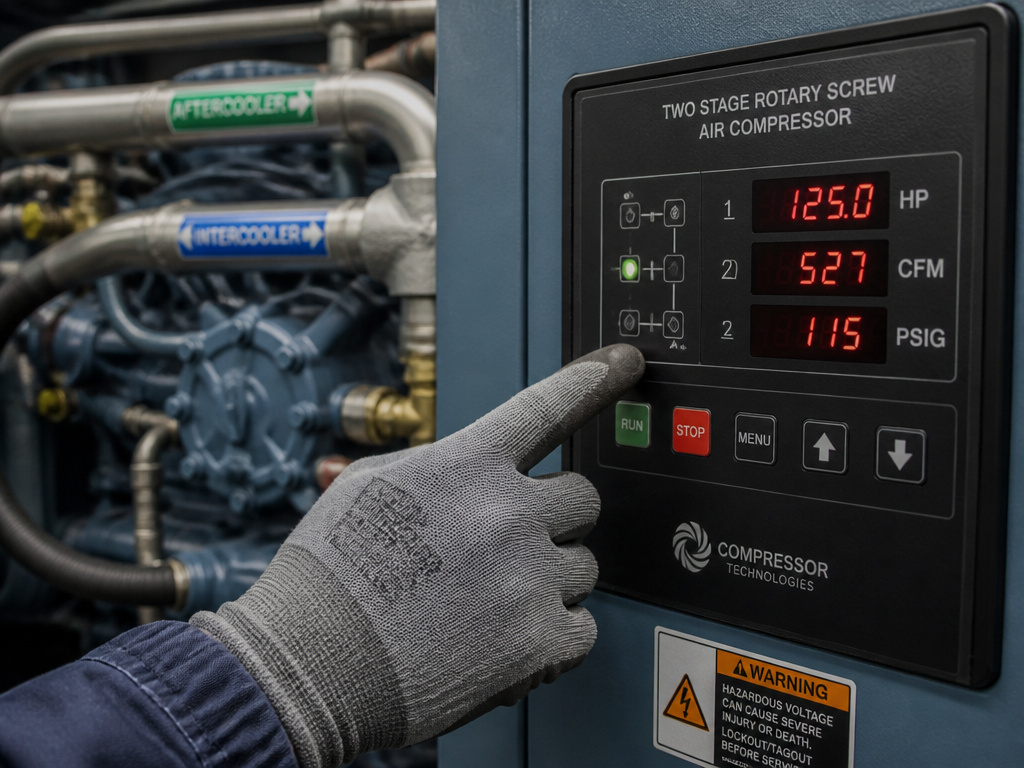
You don’t need to be an engineer, but you must speak this language to avoid a costly mismatch.
- Horsepower (HP): Indicates the motor’s power. Rotary screw compressors commonly range from 5 to 500 HP. More HP generally means more air (CFM), but it’s not a direct 1:1 relationship due to design efficiency.
- Cubic Feet per Minute (CFM): The volume of air delivered. This is the most important number. You must calculate your total air demand (add up CFM requirements for all tools that could run simultaneously) and choose a compressor that meets or slightly exceeds it.
- Pounds per Square Inch Gauge (PSIG): The pressure of the delivered air. A single-stage screw compressor is typically limited to 250 PSIG. For higher pressures, you need a two-stage screw compressor, which can deliver up to 600 PSIG by compressing the air in two steps with inter-cooling.
- Stages: Single-stage is sufficient for most workshop tools (90-150 PSIG). Two-stage is for high-pressure applications like industrial testing or running certain large sandblasting setups. Our guide on the best 2-stage air compressor for garages covers when you might need that extra pressure.
The Real Cost: Upfront Price vs. Total Ownership
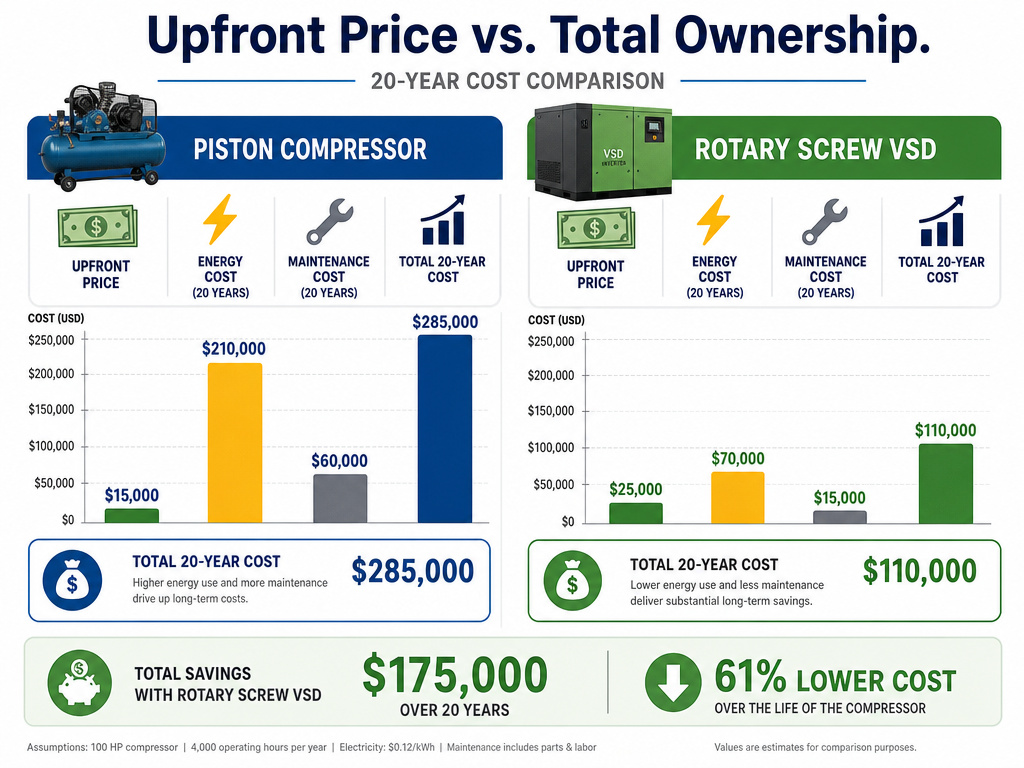
The sticker shock is real. A rotary screw compressor costs significantly more than a comparable piston compressor. But that’s only the first line on the ledger.
Energy is 80% of the lifetime cost. Rotary screw compressors, especially models with a Variable Speed Drive (VSD), are far more energy-efficient. A VSD compressor adjusts its motor speed to match air demand exactly, avoiding the “load/unload” cycling of a fixed-speed unit. In a shop with variable demand, this can cut electricity bills by 30% or more.
Maintenance is predictable, not constant. You won’t be changing piston rings or valves. Instead, you follow a strict schedule for oil changes, air/oil separator elements, and inlet air filters. Neglect this schedule, and you will trade low upkeep for a catastrophic, four-figure airend rebuild. An automatic drain valve for the condensate tank is a cheap upgrade that prevents water-related corrosion.
Longevity is measured in decades. With proper care, a rotary screw compressor is a 20-year asset. A piston compressor in the same continuous-duty application might be rebuilt or replaced two or three times in that period.
Essential Accessories and Installation
The compressor is just the start. To build a reliable system, you need the right supporting gear.
- Air Dryer: Compressed air is hot and saturated with moisture. An air dryer (refrigerated or desiccant) is mandatory to prevent rust in your lines and water damage to your tools.
- Filtration: After the dryer, a series of filters (particulate, coalescing, activated carbon) polish the air to the purity level your tools and processes require.
- Hoses and Piping: Use the right size. Undersized hose creates pressure drop, making your tools weak. Invest in a quality air compressor hose rated for your working pressure.
- Intake Air Quality: Place the compressor where it can draw in clean, cool air. A dusty, hot environment makes it work harder and shortens filter life.
- Noise Control: While quieter than pistons, they still produce noise. For indoor installations, consider a compressor silencer or a dedicated, ventilated enclosure.
Before you start: Ensure your electrical service can handle the compressor’s amp draw. Most units over 5 HP require 3-phase power or a dedicated 240V circuit. Wiring it to an undersized circuit is a fire hazard and will trip breakers constantly.
Frequently Asked Questions
What maintenance does a rotary screw compressor need?
Maintenance is schedule-based, not breakdown-based. The core tasks are changing the compressor oil and oil separator element every 1,000-8,000 hours (check your manual), replacing the air intake filter regularly, and draining condensate from the tank and dryers daily. Letting oil run too long leads to sludge that damages the expensive screw airend.
Can I use a rotary screw compressor in my home garage?
You can, but it’s often overkill. Unless you’re running a small manufacturing operation or a high-volume auto restoration shop, the cost is hard to justify. The space, electrical requirements, and noise (even reduced) are substantial. For most home shops running an impact wrench compressor and other intermittent tools, a large, high-quality two-stage piston compressor is a better fit.
How long do rotary screw compressors last?
With proper maintenance and correct sizing, 15 to 20 years of service life is a realistic expectation for the major components. The screw airend itself is incredibly durable. Failure usually comes from ancillary systems, neglected oil changes, clogged coolers, or contaminated intake air.
Are variable speed drive (VSD) compressors worth it?
If your air demand fluctuates significantly throughout the day, yes. A VSD compressor can save a massive amount on electricity by precisely matching motor speed to demand. If your demand is flat and continuous, a fixed-speed model is simpler and cheaper to purchase.
What’s the biggest mistake people make when buying one?
Oversizing. Buying a 50 HP compressor for a 20 HP demand feels safe, but it’s wasteful. The unit will short cycle, never reaching proper operating temperature, which leads to moisture accumulation and inefficient operation. Always size for your actual CFM needs.
The Bottom Line
A rotary screw air compressor isn’t just a bigger air compressor. It’s a different class of machine for a different type of work. It answers the need for constant, reliable, high-volume air power.
If your business depends on compressed air for hours of continuous operation, the investment in a rotary screw models from a reputable manufacturer like Atlas Copco or CompAir pays back in productivity, tool life, and lower energy bills. Understand your true air demand, commit to the maintenance schedule, and it will be the silent workhorse in your shop for decades.
If your air use is intermittent, respect the duty cycle of a good piston compressor and save the capital. The right tool is the one that matches your actual workload, not the one with the most impressive specs.
