What is an SDS Drill | The System That Stops Bits Slipping
This post contains affiliate links. As an Amazon Associate, we earn from qualifying purchases.
An SDS drill is a heavy-duty rotary hammer that uses a Slotted Drive System (SDS) to lock specialized bits into the chuck. This design allows the bit to slide back and forth freely, delivering powerful hammer blows directly into concrete, brick, and masonry without the bit slipping—the fatal flaw of a standard hammer drill. You need one for drilling anchor holes, running conduit, or any task involving reinforced concrete.
That sliding action is the whole game. It turns a brute-force pounding into a controlled, efficient transfer of energy. Where a standard drill relies on friction from a three-jaw chuck, an SDS bit is mechanically locked in by sprung ball bearings riding in grooves.
What follows is a breakdown of the mechanism, the hard specs that matter, and the clear line between the two main types: SDS-Plus and SDS-Max. By the end, you’ll know exactly which system matches the holes you need to make.
Key Takeaways
- The Slotted Drive System (SDS) uses grooves and ball bearings to lock the bit, allowing it to slide for direct impact transfer. This prevents slippage and chuck wear.
- SDS-Plus (10mm shank) handles holes up to about 1-1/4 inch in diameter for anchors and light duty. SDS-Max (18mm shank) is for core drilling, demolition, and holes beyond 2 inches.
- Impact energy, measured in Joules (J), is the critical power spec. A 6.0J SDS-Plus drill punches through concrete; a 12J SDS-Max model breaks it apart.
- Manufacturer manuals explicitly warn that inferior quality SDS bits will break and jam in the chuck under the tool’s powerful forces.
- You must disable the hammer function if you use a standard chuck adapter for wood or metal bits. The hammer action will destroy the adapter and the bit.
How an SDS Drill Actually Works
Forget the rotary motion for a second. The primary job of an SDS drill is to hammer. The genius is in how it couples that hammer to the bit.
A piston inside the tool drives a striker forward. In a standard hammer drill, that impact is transmitted through the chuck jaws to the bit—a lossy, inefficient transfer that heats the chuck and wears it out. The SDS system sidesteps the chuck entirely.
The SDS bit shank has two open grooves and two closed grooves. Sprung ball bearings inside the drill’s chuck drop into the closed grooves, locking the bit in place rotationally and against pull-out, while allowing it to slide back and forth freely in the open grooves. This direct coupling delivers over 90% of the piston’s impact energy straight to the drill tip.
That sliding freedom is why you hear a distinct “clack-clack-clack” instead of a grinding roar. The bit is moving independently, hammering cleanly. This also means the chuck sees almost no hammering stress, which is why SDS chucks last for years where a standard keyless chuck on a hammer drill might fail in months of masonry work.
The part nobody mentions: This system demands high-quality bits. The ROKTOR AB743 manual states its powerful forces “may cause inferior quality SDS bits to break and jam in the chuck.” A cheap bit’s grooves can deform, the bearings can’t seat, and the next time you pull the trigger, the bit snaps off inside the tool holder. It’s a repair bill that costs more than a good bit.
SDS-Plus vs. SDS-Max: Choosing the Right Hammer
This isn’t about brand preference. It’s a question of shank size, which dictates the tool’s entire scale of power and the work it’s built to do.
| Specification | SDS-Plus | SDS-Max |
|---|---|---|
| Shank Diameter | 10 mm | 18 mm |
| Typical Use Case | Drilling anchor holes (1/4″ to 1-1/4″), light chiseling, general masonry. | Core drilling, heavy demolition, drilling for rebar (>1-1/2″), continuous professional use. |
| Impact Energy Range | 1.5J – 6.0J | 8J – 20J+ |
| Tool Weight | 4 – 8 lbs (cordless to corded) | 15 – 30+ lbs |
| Bit Cost & Availability | Lower cost, widely available. | Higher cost, specialized suppliers. |
SDS-Plus is your default for 95% of masonry tasks. Think installing a TV mount, running electrical boxes in a block wall, or setting deck anchors. A tool like the corded ROKTOR AB743 delivers 6.0J of impact energy at 4200 blows per minute—enough to sink a 1/2-inch bit through poured concrete in seconds. For cordless flexibility, a rotary hammer drill like the Sealey CP20VSDS runs on a 20V battery and hits 5000 BPM, perfect for overhead work or sites without power.
Move to SDS-Max when the concrete is thick, reinforced, or the hole is large. The 18mm shank and massive internal components handle sustained, high-impact work. The Sealey SDSMAX40, for example, delivers 12J of impact energy. That’s not just for drilling; it’s for driving heavy-duty SDS Max rotary hammers through foundation walls or using a clay spade to trench. The tool is heavier, more expensive, and the SDS Max drill comparisons start in the professional grade.
If you’re drilling a few holes for a shelf, rent an SDS-Plus. If you’re breaking a basement floor for plumbing, rent an SDS-Max. Buying one depends on your annual hole count.
Critical Specs Beyond the Name
When you look at a spec sheet, three numbers tell you everything about performance. Ignore the rest.
Impact Energy (Joules): This is the single best measure of power. It tells you how hard the hammer hits. A 1.5J drill struggles with old brick. A 3.0J model handles most block and concrete. The 6.0J found in prosumer SDS hammer drills like the ROKTOR is the sweet spot for serious DIY. It’s the difference between drilling a hole and making a hole.
Blows Per Minute (BPM): This is speed. Higher BPM means faster drilling in less dense material like brick or soft concrete. Most SDS-Plus drills range from 4,000 to 5,000 BPM. Note that impact energy and BPM often have an inverse relationship in a given tool class; a ultra-high BPM tool might sacrifice some joules per blow.
Chuck Type: It’s binary. SDS-Plus or SDS-Max. They are not interchangeable. An SDS-Plus bit will rattle uselessly in an SDS-Max chuck, and an SDS-Max bit simply will not fit into an SDS-Plus tool. This is the first check before you buy any bit.
Where this goes sideways: Assuming a “1-inch capacity” means you can drill a 1-inch hole through a 12-inch foundation wall. That capacity is usually for depth in a single material under ideal conditions. For deep, large-diameter holes, you need a drill with a higher rated capacity and a hammer-only function to clear dust.
SDS Drill vs. Standard Hammer Drill
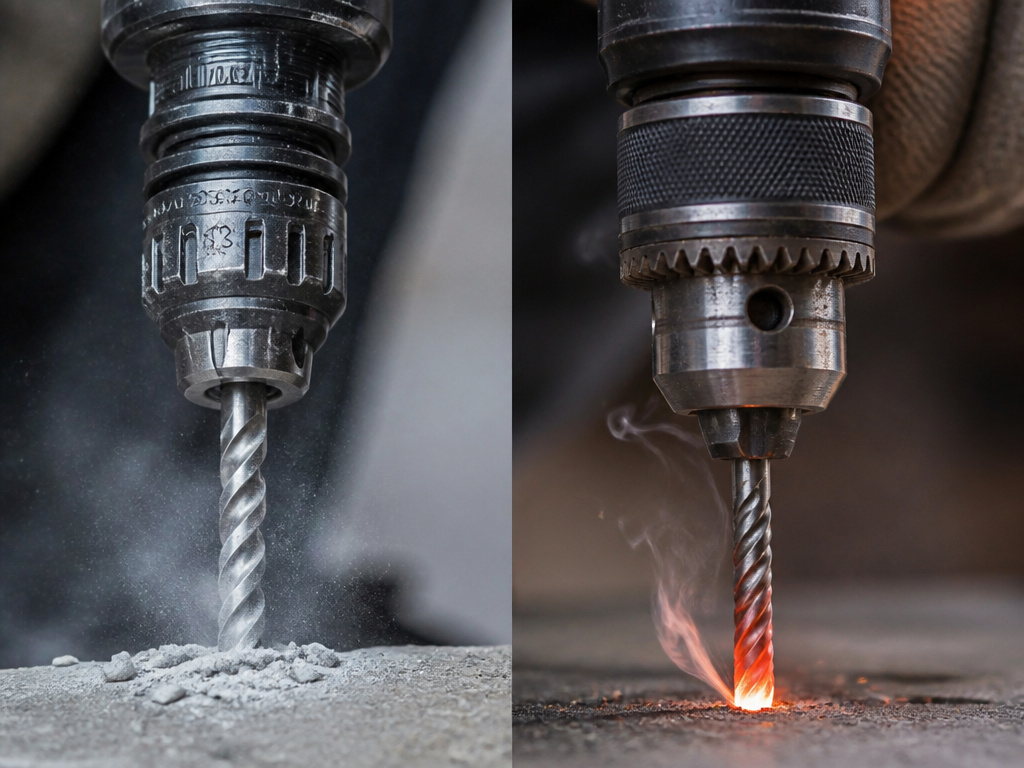
This is the most common point of confusion. Both tools have a “hammer” setting, but they are engineered for different worlds.
An SDS vs hammer drill comparison comes down to force and design. A standard hammer drill uses a cam-and-clutch mechanism to produce a rapid, short-travel vibration. It’s effective for drilling a few 1/4-inch holes in brick for a mailbox. It’s useless against poured concrete.
| Aspect | SDS Rotary Hammer | Standard Hammer Drill |
|---|---|---|
| Mechanism | Pneumatic or electro-pneumatic piston. | Mechanical clutch or cam plate. |
| Impact Energy | High (1.5J – 20J+). | Very Low (<1J). |
| Best For | Concrete, reinforced masonry, prolonged drilling. | Soft brick, block, occasional small holes. |
| Bit Retention | SDS chuck (grooves & ball bearings). | Keyed or keyless 3-jaw chuck. |
| Chiseling Function | Yes (hammer-only mode standard). | Rare, and not recommended. |
The mismatch is in the chuck. A hammer drill’s chuck absorbs the hammering action, leading to wear, heat, and eventual failure. The SDS system isolates the chuck from this stress. This is why you can’t just put an SDS drill bit in a standard drill, even with an adapter, and expect it to work. The adapter becomes the failure point.
If your project involves more than ten holes or any material harder than soft brick, the SDS hammer drill design is the only tool that finishes the job without burning up.
Safety and Maintenance Non-Negotiables

The power in an SDS drill demands respect. The manuals are not suggestions.
Before you start: Wear safety glasses, a dust mask, and hearing protection. Concrete dust is crystalline silica—a known respiratory hazard. The tool noise exceeds 85 dB(A) instantly. Secure your workpiece. Inspect your bit for cracks or worn carbide.
Power Disconnect: This is the golden rule from every OEM manual. For corded models, unplug the drill. For cordless, remove the battery. Do this before changing bits, clearing a jam, or any inspection. The forces are high enough to cause severe injury if the tool activates accidentally.
Bit Care: Keep the bit shank clean and lightly greased. Wipe off concrete dust and grit before inserting it into the chuck. That grit grinds down the ball bearings and scores the grooves, leading to poor retention and wobble. A worn bit is a broken bit waiting to happen.
Tool Longevity: After heavy use, blow out the air vents with compressed air. For tools with a grease port like some SDS Max models, use the specified grease at the recommended interval. Store the tool in a dry place. For cordless models, store batteries at room temperature.
Common mistake: Using the hammer mode with a standard bit adapter for wood or metal. The hammer action will destroy the adapter’s internal mechanism, often welding it to the bit. Always switch the tool to “drill-only” or “rotation-only” mode when not drilling masonry.
Frequently Asked Questions
Can I use regular drill bits in an SDS drill?
Yes, but only with a dedicated SDS-to-jacob’s-chuck adapter, and only with the hammer action turned off. The adapter fits into the SDS chuck like a bit. You then tighten your standard drill bit types into the adapter’s chuck. Engaging the hammer function will ruin the adapter and the bit.
What’s the difference between SDS-Plus and SDS-Max bits?
The shank size and the tool they fit. SDS-Plus has a 10mm shank with two grooves. SDS-Max has an 18mm shank with three grooves. They are not interchangeable. The concrete bit design for each is scaled to handle the different impact forces of their respective tools.
How do I remove a stuck SDS bit?
First, ensure the tool is unplugged or the battery is removed. Pull the chuck collar back firmly and hold it. Sometimes a bit can jam if debris gets behind it. Try tapping the end of the bit gently with a mallet while holding the collar back. If it’s truly seized, you may need to disassemble the chuck—consult the manual or a service center.
Is a corded or cordless SDS drill better?
Corded models (like the 1500W ROKTOR) deliver consistent, maximum power for long sessions and are often less expensive. Cordless models (like the 20V Sealey) offer unmatched portability and are ideal for overhead work, finished spaces, or sites without easy power. The best hammer drill for concrete for you depends on your access to outlets and your need to move around.
Can an SDS drill be used as a regular drill?
Yes, but it’s overkill. In “drill-only” mode, an SDS drill functions as a slow-RPM, high-torque rotary drill. It’s cumbersome for drilling drill bits for wood due to its size and weight. It’s better to own a separate standard drill for everyday tasks and reserve the SDS for masonry.
The Bottom Line
An SDS drill isn’t just a more powerful hammer drill. It’s a different machine built around a slotted drive system that solves the fundamental problem of bit slippage. For drilling into concrete, block, or stone, it’s the only tool that combines speed, power, and longevity.
For most homeowners and serious DIYers, a corded SDS-Plus rotary hammer in the 5-6 Joule range is the permanent solution. It will handle every concrete and masonry task a residential project throws at it for a decade or more. Before you buy any bit, check the shank and match it to your chuck. And always, always unplug the tool before you touch the business end.
