Defining the Rotary Hammer Drill: What Makes It Special
This post contains affiliate links. As an Amazon Associate, we earn from qualifying purchases.
A rotary hammer drill is a heavy-duty power tool designed for drilling and chiseling in hard materials like concrete and masonry. It uses an electro-pneumatic hammering mechanism to deliver high impact energy with minimal user force, requires specialized SDS (Slotted Drive System) shank bits, and operates in multiple modes including hammer drilling, drilling only, and chiseling. It is not a precise tool and should not be used for general wood or metal drilling.
That definition covers the basics. The real question is what that mechanism actually does for you on a jobsite or a DIY project. A standard drill spins. A hammer drill spins and taps. A rotary hammer spins and drives a piston.
The piston is the whole game. It turns electrical power into a pneumatic punch, and that punch is what separates demolition gear from construction gear. What follows is a breakdown of that mechanism, the three modes you’ll use, and the specs that tell you whether a model can handle your wall or will just burn out.
Key Takeaways
- The electro-pneumatic mechanism uses a piston to drive a hammer, delivering significantly more impact energy (1.5–3+ Joules) than a standard hammer drill’s mechanical gears.
- You must use SDS shank bits (SDS-Plus or SDS-Max); standard round-shank bits will not lock in and can be ejected dangerously.
- Rotary hammers have three core modes: drill-only for wood/metal, hammer-drill for concrete, and chisel-only for demolition or slotting.
- They are imprecise and overpowered for fine work; using one on soft materials like drywall or thin brick often causes cracking and blow-out.
- Impact energy (Joules) is the critical spec, not wattage or RPM; for drilling holes over 1/2″ in concrete, look for at least 2.0 J.
How Does a Rotary Hammer Drill Work?
A standard drill converts electricity into rotational force. A hammer drill adds a mechanical, cam-driven tapping action to that rotation. A rotary hammer drill replaces the mechanical tap with an internal air compressor.
The electro-pneumatic hammering mechanism consists of a piston driven by a crankshaft. As the piston moves back in its cylinder, it creates a vacuum that draws a free-floating “hammer” back. On the forward stroke, the piston compresses the air in front of it, propelling the hammer forward to strike the back of the drill bit’s shank or a chisel. This cycle repeats thousands of times per minute, delivering consistent, high-energy impacts directly to the tool.
This system accomplishes two things a mechanical hammer drill cannot. First, it transfers the impact energy more efficiently, so less vibration travels back into your hands. Second, it allows for a much heavier hit. A top-tier hammer drill might deliver 1.0 to 1.5 Joules of impact energy. A mid-range rotary hammer like the Hilti TE 7-C hits 2.6 Joules. That extra force isn’t about speed—it’s about breaking through rebar-filled concrete or hard aggregate without stalling.
The mechanism also dictates the chuck. A standard Jacobs chuck can’t handle the back-and-forth motion. That’s where the SDS chuck comes in. The Slotted Drive System uses grooves on the bit shank that match splines inside the chuck. This allows the bit to slide freely in and out (the reciprocating motion) while being locked firmly against rotation. You insert the bit, give it a twist until it clicks, and it’s locked. No key, no tightening.
Where this goes sideways: Using a standard drill bit in an SDS chuck, even with an adapter. The adapter can’t secure the bit against the hammering action. The bit will wobble, wear out the chuck, and can be ejected under force. If you need to drill wood or metal with a rotary hammer, you must switch to drill-only mode and use a keyed chuck adapter designed for your specific model.
Rotary Hammer vs. Hammer Drill: The Force Gap
This is the most common point of confusion. People buy a hammer drill for a concrete patio project and are stunned when progress is slow and the tool overheats. The difference isn’t minor. It’s a fundamental gap in capability.
A hammer drill is a drill first, with a secondary hammer function. Its mechanism uses two ribbed metal discs (called “cams” or “plates”) that click past each other as the drill rotates. This produces a rapid, jarring tapping action. It works for drilling small anchors (1/4″ or 6mm) into brick or soft concrete block. The impact energy is low—often below 1.0 Joule—and a significant portion of the force vibrates back into the tool and your arms.
A rotary hammer is a hammer first, with a secondary drilling function. Its electro-pneumatic system, as described above, is in another league. The force is directed straight into the material. For a clear rotary hammer vs hammer drill comparison, look at the spec sheets. The Bosch GBH 18V-26 cordless rotary hammer delivers 2.6 J of impact energy. A high-end corded hammer drill might list “Blows Per Minute” but rarely publishes a Joule rating, because it would be a fraction of that.
| Feature | Rotary Hammer Drill | Standard Hammer Drill |
|---|---|---|
| Primary Mechanism | Electro-pneumatic piston | Mechanical cam plates |
| Typical Impact Energy | 1.5–3.0+ Joules | 0.5–1.5 Joules (often unrated) |
| Chuck Type | SDS-Plus or SDS-Max | Keyed or keyless Jacobs chuck |
| Best For | Drilling holes >1/2″ (12mm) in concrete, chiseling, core drilling | Drilling small holes (<1/2″) in brick, block, mortar |
| User Fatigue | Lower (vibration is dampened) | High (direct vibration feedback) |
The short version: If your project involves more than a dozen 3/8″ holes in concrete, or any hole larger than 1/2″, you need a rotary hammer. The hammer drill will burn out its gears, and you’ll burn out your patience.
The 3 Main Rotary Hammer Modes (and When to Use Each)
Every rotary hammer has a function selector switch. Ignoring it is the fastest way to break a bit or damage the tool. The modes are not suggestions; they change the internal gearing and clutch.
- Drill-Only Mode (⌀ symbol). This disengages the hammer mechanism entirely. The tool acts like a standard rotary drill. Use this only when you have installed a keyed chuck adapter and are drilling into wood, metal, or plastic. The chuck adapter cannot withstand hammering forces. Using hammer mode with an adapter will destroy it.
- Hammer Drill Mode (⌀+ hammer symbol). This is the default for masonry work. The tool rotates and hammers simultaneously. Use this for all drilling into concrete, brick, stone, or block. This is where the tool’s power is fully utilized.
- Chisel-Only Mode (hammer symbol). This locks the rotation. The tool delivers only a hammering action in a straight line. Use this for light demolition: breaking tile, removing old mortar, slotting walls for wiring, or driving a flat chisel. Many models allow you to rotate the chisel to different positions (e.g., the Hilti TE 7-C offers 18 positions) for horizontal or vertical chiseling.
Common mistake: Leaving the tool in hammer-drill mode when changing bits or when it’s not in contact with material. The free-spinning, hammering action causes unnecessary wear on the hammer mechanism and the bit’s carbide tip. Switch to drill-only or off when the bit is out of the hole.
Critical Specs: What the Numbers Actually Mean
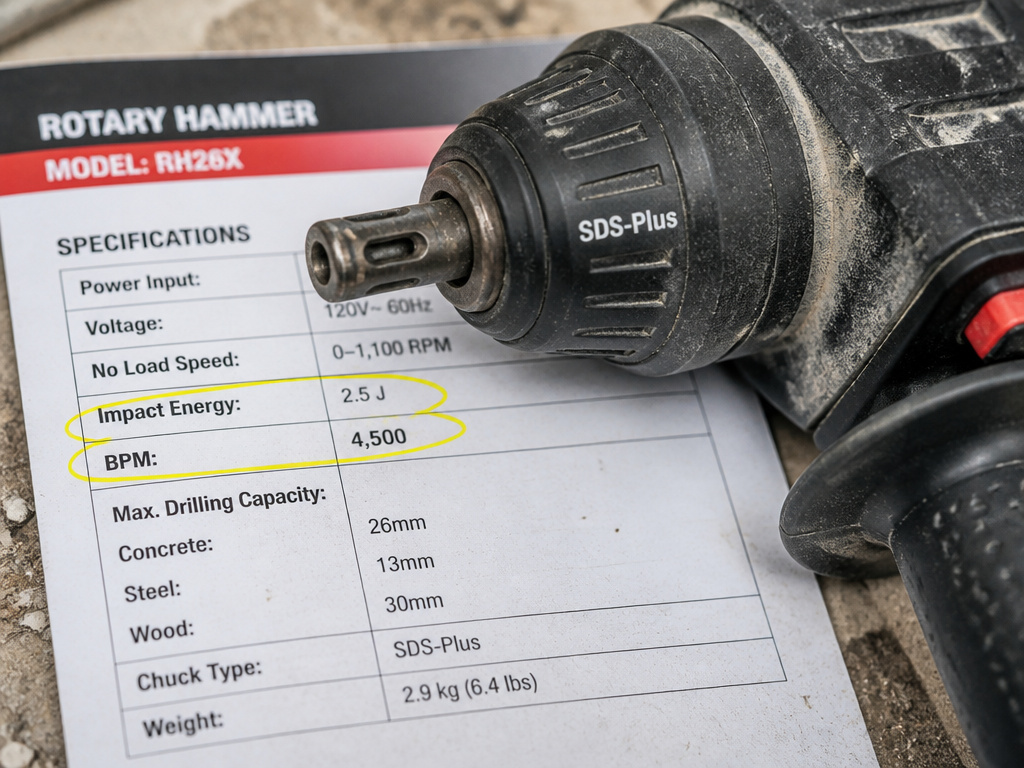
Power tool marketing loves big wattage numbers. With rotary hammers, wattage (or volts for cordless) tells only part of the story. You need to read the spec sheet for three specific figures.
Impact Energy (Joules): This is the king. It measures the force of a single hammer blow. More Joules means faster drilling in harder materials and the ability to handle larger diameter bits. For most homeowner tasks (1/2″ anchors), 1.5–2.0 J is sufficient. For professional or frequent use, or holes over 3/4″, look for 2.5 J and above like the Bosch model mentioned.
Blows Per Minute (BPM): This is how many of those hammer blows occur. A higher BPM paired with high impact energy means faster material removal. Don’t prioritize BPM over Joules. A tool with 30,000 BPM but 1.0 J will be slower than a tool with 4,000 BPM and 3.0 J on hard concrete.
Amperage (Corded) or Battery Voltage (Cordless): This is the power input. For corded models, 7-10 amps is common. For cordless, 18V is the standard professional platform (like the Hilti TE 2-A18), and 36V/40V models exist for extreme duty. The battery’s Amp-hour (Ah) rating determines runtime, not power. A 5.0Ah battery will last longer than a 2.0Ah on the same tool, but both deliver the same voltage and impact energy.
| Spec | What It Measures | Why It Matters | Good Range for DIY |
|---|---|---|---|
| Impact Energy | Force per blow (Joules) | Determines ability to drill large holes and hard aggregate | 1.5 – 2.5 J |
| BPM | Hammer blows per minute | Affects drilling speed, especially in softer masonry | 2,000 – 5,000 |
| Chuck Type | Bit holding system (SDS-Plus, SDS-Max) | Dictates bit compatibility and maximum bit size | SDS-Plus (up to 1-1/4″) |
| Single-Handed Use | Tool weight and balance | Crucial for overhead work or long sessions; cordless models are easier to manage. | Under 8 lbs (3.6 kg) |
SDS Chucks and Bit Compatibility: A Non-Negotiable System
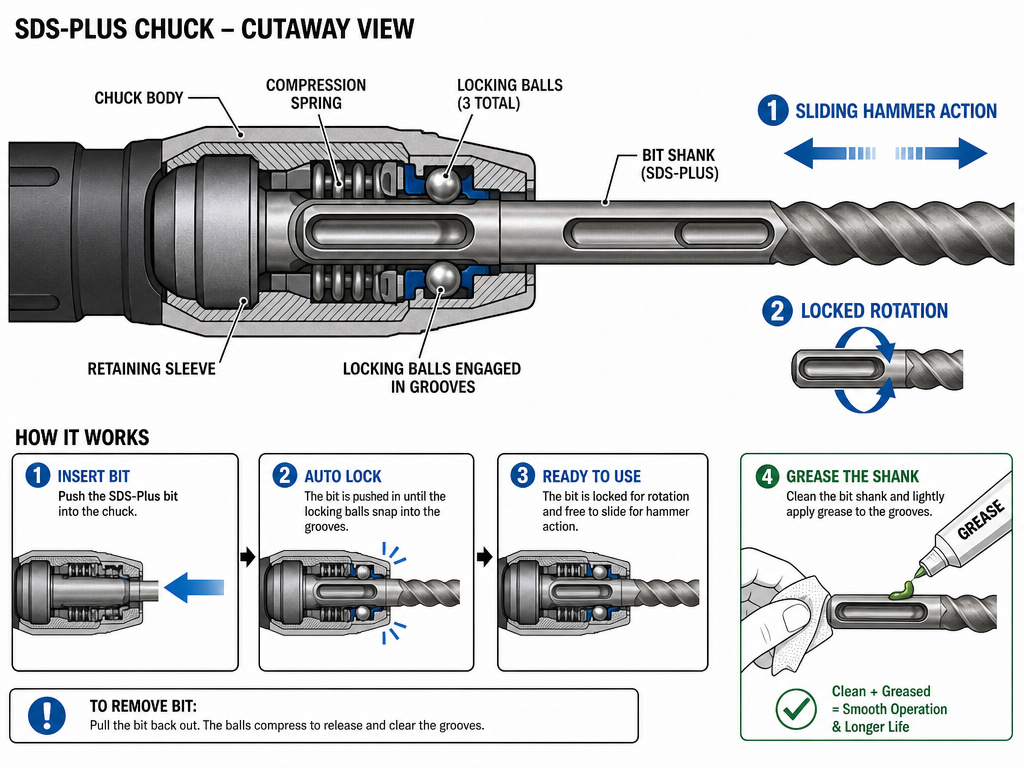
You cannot use the bits from your old drill. The SDS chuck is a specialized, keyless system built for the hammering action. “SDS” stands for Slotted Drive System (or Steck-Dreh-Sitz in German). The bit shank has grooves that fit over spring-loaded balls or rollers inside the chuck. This allows the bit to slide back and forth freely while being locked tightly against rotation.
There are two main types: * SDS-Plus: The most common for light to mid-duty tools. Accepts bits typically from 1/4″ to 1-1/4″ in diameter. This is what you’ll find on models like the Ryobi P222 or most homeowner-grade rotary hammers. * SDS-Max: For heavy-duty, high-impact professional tools. Used for larger diameter core bits (for holes 2″ and up) and demolition work. The shank is much larger.
Worth knowing before you start: Always apply a small amount of masonry bit grease to the clean shank of an SDS bit before inserting it. This reduces friction and wear inside the chuck, prevents the bit from seizing, and helps dissipate heat. A dry shank in a dry chuck is a recipe for premature failure.
Attempting to use a standard round-shank bit, even with a brute-force adapter, is dangerous. The connection cannot withstand the hammering forces. The bit will slip, spin erratically, and can be shot out of the chuck. For drilling into wood or metal, you must use the correct keyed chuck adapter for your model and switch the tool to drill-only mode.
When You Need One (And When You Absolutely Don’t)
A rotary hammer is a specialist. It solves specific, high-force problems. Using it outside its lane creates new problems.
You need a rotary hammer drill if:
- You are drilling multiple holes larger than 3/8″ in concrete or reinforced concrete.
- The project involves core drilling (creating large-diameter holes for pipes or conduits).
- You need to do light chiseling, tile removal, or chase out channels in masonry for wiring.
- You’re installing heavy-duty anchors (wedge anchors, sleeve anchors) that require a clean, precise hole.
Do not use a rotary hammer for:
- General woodworking or metal drilling. It’s overpowered and imprecise. The hammer action, even if disengaged, and the tool’s weight will lead to ragged holes and poor control.
- Driving screws. It lacks a clutch and will destroy screw heads and material.
- Soft materials like drywall, thin brick, or cinder block. The high impact energy will crack and blow out the back side of the material. A standard hammer drill or even a regular drill is better here.
- Any task requiring finesse. This is a demolition and heavy construction tool.
For a comprehensive look at the top models on the market, our guide to the best rotary hammer drills breaks down corded, cordless, and pro-grade options.
Safety and Maintenance: The Two Rules That Prevent Costly Repairs
This isn’t a drill you can just grab and go. The forces involved demand respect and basic upkeep.
Before you start: Always use the side handle and secure it tightly. The torque from a bound bit can twist the tool violently. Wear safety glasses, a dust mask (concrete silica dust is a serious health hazard), and hearing protection. The noise from the hammer mechanism exceeds safe levels quickly.
Maintenance is simple but non-negotiable:
- Clean the chuck. After each use, remove the bit and blow out any dust or debris from the chuck with compressed air. Grit inside the chuck accelerates wear on the bearings and the bit shank.
- Grease the bit shank. As mentioned, a light coat of the grease provided with the tool (or a commercial SDS bit grease) on a clean shank reduces wear.
- Check for wear. If bits start to feel loose or don’t “click” in positively, or if you see metal shavings around the chuck, the internal springs or retainers may be worn. This is a sign for service.
- Store it properly. Keep the tool in a dry place. For cordless models, store batteries at room temperature. The Hilti TE 2-A18 manual notes the tool will not run if the battery is too hot or cold, indicated by a blinking LED.
The part nobody mentions: Let the tool do the work. You do not need to lean into it. Applying excessive pressure does not make it drill faster; it increases the risk of binding the bit, overloading the motor, and causing kickback. Guide it firmly, but let the hammer mechanism deliver the force.
Frequently Asked Questions
Can a rotary hammer drill be used as a regular drill?
Yes, but only in its drill-only mode and only after you install the correct keyed chuck adapter. The adapter replaces the SDS chuck, allowing you to use standard round-shank drill bits for wood, metal, or plastic. Never use hammer mode with the adapter installed.
What’s the difference between SDS Plus and SDS Max?
SDS-Plus is for light to medium-duty tools, handling bits up to about 1-1/4″ in diameter. SDS-Max is for heavy-duty professional tools and larger diameter core bits, typically 1-1/2″ and up. The shanks are physically incompatible; an SDS-Plus bit will not fit an SDS-Max chuck, and vice-versa.
Is a rotary hammer better than a hammer drill for concrete?
For any significant concrete work, yes, unequivocally. A rotary hammer drill uses a more powerful and efficient electro-pneumatic mechanism, delivering higher impact energy with less user fatigue. A hammer drill is sufficient only for a few small holes in soft concrete or brick.
How do I choose the right rotary hammer?
Focus on impact energy (Joules) first. For most DIY, 1.5–2.5 J is ideal. Then decide between corded (unlimited runtime, slightly more power) and cordless (ultimate portability). Finally, ensure it uses the common SDS-Plus chuck for the widest bit availability. Our reviews of the best cordless rotary hammer drills can help narrow the field.
Why is my rotary hammer drill not hammering?
First, check that the function selector is set to hammer-drill or chisel mode, not drill-only. If the mode is correct, the issue could be mechanical. For cordless models, a weak or incompatible battery may not provide enough power for the hammer mechanism. For all types, internal failure of the piston mechanism or clutch requires professional service.
The Bottom Line
A rotary hammer drill isn’t just a bigger hammer drill. It’s a different class of tool built around an electro-pneumatic hammer that turns brute force into manageable work. You need it for concrete, masonry, and light demolition. You’ll regret using it for anything else.
Remember the three pillars: the SDS chuck that holds the specialized bits, the multiple modes that protect the tool and match the task, and the impact energy rating that tells you what it can really punch through. For a one-off project, a mid-range corded model like the Makita HR2475 is a reliable workhorse. For serious DIY or professional use, stepping into an 18V cordless system like Bosch’s Professional or Hilti’s line changes the game entirely.
Choose based on the hardest material you plan to face, not the average. It’s the tool you reach for when everything else has said no.
