What Is an Impact Drill? Understanding Its Function and Specs
This post contains affiliate links. As an Amazon Associate, we earn from qualifying purchases.
An impact drill is a hand-held electric tool defined by international safety standard IEC 62841-2-1. It delivers rotary drilling with an optional forward hammering action for masonry, operates within a rated voltage of 250V (single-phase) or 480V (three-phase) and a maximum input of 3700W, and is explicitly distinguished from a rotary hammer even if that hammer can be used to drill.
That definition comes from the rulebook, not marketing. The standard draws lines that change how you buy, use, and test the tool in your hand. It classifies a tool based on its primary design and its mode of use, a detail that turns a hand-held drill into a transportable tool the moment you bolt it to a stand.
What follows: the two electrical specs that cap every impact drill’s power, the new 2025 rule that limits no-load speed, and the clear, mechanical reason a rotary hammer is not an impact drill even when it’s drilling a hole.
Key Takeaways
- The international safety standard IEC 62841-2-1 defines an impact drill’s scope, power limits (250V/480V, 3700W max), and explicit exclusions, most notably, rotary hammers.
- A tool’s classification can shift from “hand-held” to “transportable” if you mount it on a manufacturer’s stand without altering the tool, changing the applicable safety rules.
- Effective June 1, 2025, certified impact drills must have a no-load spindle speed no higher than 120% of their rated speed, verified after a 5-minute run.
- Impact drills are tested under load with an 8mm masonry bit, as specified by the manufacturer, while standard drills are tested at no-load.
- The hammering mechanism in an impact drill produces rapid, axial impacts to chip masonry; a rotary hammer uses a heavier piston-driven strike, making them different tools under the standard.
What the Official Safety Standard Says
Forget the box copy. The real definition of an impact drill lives inside the IEC power tool safety standard, publication 62841-2-1:2017. This is the technical document that testing bodies like Intertek and UL use to certify that a tool won’t electrocute you, overheat, or disintegrate under normal use.
IEC 62841-2-1:2017+A1:2021 applies to hand-held drills and impact drills, including diamond core drills. The standard also applies to drills that can be used for driving screws by attaching screwdriver bits. The rated voltage is not more than 250 V for single-phase a.c. Or d.c. Tools, and 480 V for three-phase a.c. Tools. The rated input is not more than 3 700 W.
That paragraph does three jobs. First, it sets the voltage ceiling: your common corded impact drill runs on household current up to 250V. Industrial three-phase models tap out at 480V. Second, it caps the power draw at 3700 watts, about five horsepower. Any drill claiming more than that falls outside this standard’s scope and into a different category. Third, it acknowledges these tools often double as drivers, which is why your impact drill has a clutch.
The standard’s scope clause carries a critical exclusion. It states: “This standard does not apply to rotary hammers, even if they can be used as a drill.” That’s not a minor detail. It’s a legal and engineering line in the sand. A rotary hammer uses a different, heavier impact mechanism (usually a piston-driven hammer) and is covered under a separate standard, IEC 62841-2-6. Calling a rotary hammer an impact drill is like calling a pickup truck a motorcycle because they both have wheels.
The Two Things That Define an Impact Drill
An impact drill is defined by its dual-mode operation and its regulated safety envelope. The first is what you use; the second is what keeps you safe while using it.
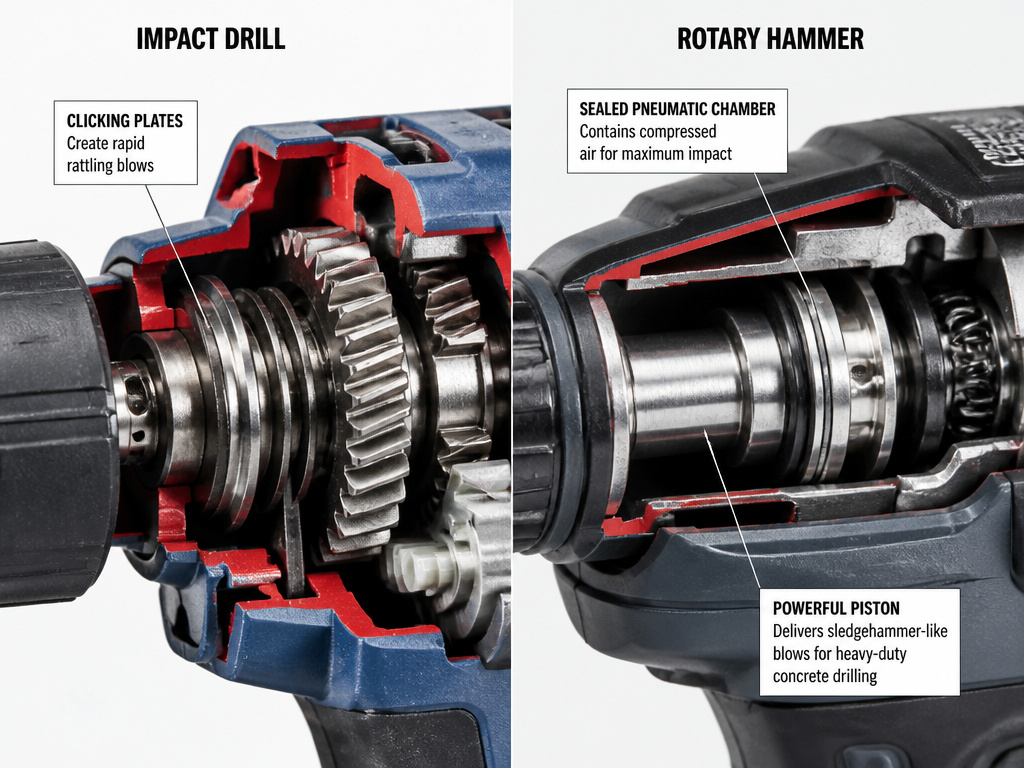
Mode one is standard rotary drilling. The motor spins the chuck and bit. This is for wood, metal, and plastic. The clutch adjusts torque for driving screws. Mode two engages the impact mechanism. Inside the gearbox, two ribbed metal plates (a hammer and an anvil) click past each other as the tool spins. This converts some rotational force into thousands of small, forward hammer blows per minute. These axial impacts help a masonry bit’s carbide tip pulverize brick or concrete instead of just grinding against it.
The safety envelope is built from the specs in the standard. The 250V/480V limit ensures the motor insulation and internal wiring can handle the electrical stress. The 3700W input cap prevents the armature windings from overheating under sustained load, a real risk when you’re leaning on a 1/2-inch bit in dense concrete. These are the calculated thresholds where the most common failure modes (insulation breakdown, thermal overload) become statistically likely.
Where this goes sideways: Using an impact drill on steel or hard tile. The hammering action doesn’t help. It just work-hardens the metal surface, dulling the bit instantly, and can shatter tile on the first impact. You’ll smell the motor insulation heating up within thirty seconds.
The standard also governs how the tool is used, not just built. If you take a hand-held impact drill and mount it on the manufacturer’s optional stand to use as a fixed drill press, the combination is now considered a “transportable tool.” That moves it from Part 2-1 of the standard to Part 3, which has different guarding and stability requirements. The tool didn’t change. Its classification did.
Impact Drill vs. Rotary Hammer: The Standard Draws the Line
This is the most common point of confusion, and the standard is blunt. An impact drill is not a rotary hammer. The difference is mechanical, not semantic.
| Aspect | Impact Drill | Rotary Hammer |
|---|---|---|
| Primary Mechanism | Rotary force with optional, light axial hammering via clicking plates. | Rotary force with a dedicated piston mechanism that delivers a powerful percussive blow. |
| IEC Standard | IEC 62841-2-1 (Hand-held drills and impact drills) | IEC 62841-2-6 (Rotary hammers) |
| Best For | Drilling into brick, block, and light concrete; general-purpose drilling/fastening. | Drilling into reinforced concrete, rock, and heavy masonry; demolition chiseling. |
| Bit Connection | Standard keyed or keyless chuck (accepts round-shank masonry bits). | SDS-Plus, SDS-Max, or splined shank system for positive lock and hammer transfer. |
| Impact Energy | Low; relies on high frequency (thousands of BPM) to pulverize material. | High; delivers fewer, more powerful blows (hundreds to thousands of joules). |
The internal mechanism tells the story. An impact drill’s hammering is a byproduct of its gear train. A rotary hammer has a separate, sealed pneumatic or electro-pneumatic hammer chamber. That’s why a rotary hammer feels like it’s hitting with a sledgehammer while an impact drill sounds like a rapid rattle.
The testing protocol in the standard underscores this. For certification, an impact drill is tested under load with the speed setting the maker recommends for an 8 mm bit in concrete. A rotary hammer follows a completely different test procedure under its own standard. They are engineered, tested, and certified as distinct tools.
New Rules for 2025: The No-Load Speed Cap
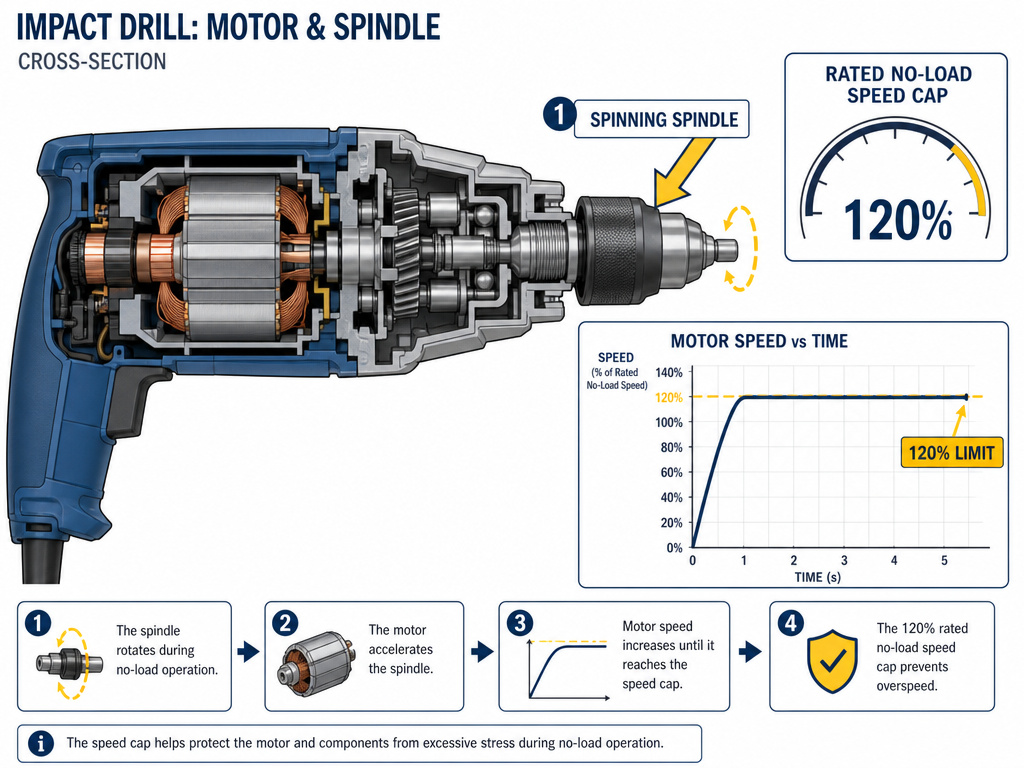
Standards evolve. A May 2024 Intertek Standards Update Notice (SUN) for UL 62841-2-1 introduces a new rule effective June 1, 2025. It states: “The no-load speed of the spindle at rated voltage shall not exceed 120 % of the rated no-load speed.”
Here’s what that means for your next drill. Manufacturers must now design their variable speed triggers or selectors so that, even at the highest setting, the motor cannot spin more than 20% faster than the speed printed on the nameplate. Compliance is checked by running the tool for five minutes and then measuring the spindle speed.
This rule exists because a motor spinning significantly over its design speed risks catastrophic failure. The rotor can become unbalanced, bearings overheat, and in extreme cases, the armature can come apart. The 120% cap is a safety buffer. It’s also a guarantee that the speed you read on the box is the speed you’ll get within a known margin.
For impact drills, this testing gets specific. The standard mandates that impact drills be tested under load, not at no-load like a standard drill. The test simulates real use: the tool is set to the speed the manufacturer says to use for an 8mm masonry bit in concrete, and then it’s run against a test medium. This ensures the hammer mechanism and motor can handle the stress of actual masonry drilling, not just free-spinning.
What an Impact Drill Is Actually Used For
Grounded in its standard definition and mechanical limits, an impact drill has a clear job. It’s a bridge tool. In standard rotary mode, it handles all the tasks of a basic cordless drill vs impact driver: drilling pilot holes in wood, driving screws into decking, or boring through thin-gauge metal. When you hit brick or block for a wall anchor, you flip the collar to impact mode.
Its sweet spot is light to medium-duty masonry. Think brick facades, cinder block walls, or non-reinforced concrete patios. It will struggle and burn out on thick, rebar-filled foundation walls, that’s rotary hammer territory. Understanding these impact drill uses prevents the most common owner mistake: overworking the tool.
The internal mechanism of an impact drill is why it’s mediocre for driving long lag screws. The hammering action is designed to be axial (straight forward), not rotational. For high-torque fastening, you need the rotational impacts of an impact driver, a tool covered under a different standard (IEC 62841-2-2). This is the core of the impact driver vs drill distinction.
Choosing the Right Tool: Impact Drill or Something Else?
Your material list decides. If your project is 80% wood/metal work and 20% drilling into brick for anchors, an impact drill is your single-tool answer. If you’re fastening decks or assembling furniture, a standard drill or impact driver is better. If you’re breaking up a sidewalk or drilling into poured foundation walls, you need a rotary hammer vs impact drill.
Here’s a quick diagnostic list: * Drill pilot holes and drive screws into wood: Use a standard drill. * Drive many long, thick screws or bolts: Use an impact driver. * Drill into brick, block, or light concrete: Use an impact drill. * Drill into reinforced concrete or use a chisel function: Use a rotary hammer. * Remove lug nuts or large bolts: Use an impact drill vs impact wrench, which is designed for high rotational torque.
Common mistake: Buying a hammer drill vs impact driver combo kit when you only do woodwork. You pay for a hammer mechanism you’ll never use, and the tool is often heavier and more expensive than a standard drill driver.
For most homeowners, a quality cordless impact drill from a major brand like DeWalt, Makita, or Milwaukee covers the bases. The key is matching the battery voltage (18V or 20V Max is standard) to the task and respecting the tool’s limits as defined by the very standards that allow it to be sold.
Frequently Asked Questions
What is the main difference between an impact drill and a hammer drill?
They are the same thing. “Impact drill” and “hammer drill” are interchangeable terms for a tool that combines rotary drilling with a forward hammering action. The international standard uses “impact drill.” Some brands use “hammer drill” on the box. There is no technical distinction.
Can I use an impact drill as a regular drill?
Yes. Every impact drill has a mode selector. For drilling wood, metal, or plastic, or for driving screws, you set it to the standard “drill” or “drive” icon (usually a single drill bit). This disengages the hammer mechanism, so it operates exactly like a standard rotary drill.
Why does my impact drill struggle with concrete?
You’re likely using it on material that’s too dense. Impact drills are for light concrete, like cinder block or patio stones. Dense, poured concrete with aggregate (rocks) and rebar requires the higher impact energy of a rotary hammer. Also, check your bit. A worn or low-quality masonry bit will spin without cutting.
Is an impact drill better than a regular drill?
It’s not better; it’s more specialized. For drilling into masonry, it is far superior to a regular drill. For everything else (wood, metal, driving screws), a regular drill is often lighter, quieter, and less expensive. An impact drill is “better” only if your project mix includes masonry work.
How do I maintain my impact drill?
Blow out the vent slots with compressed air after heavy use to remove concrete dust. Check the brushes if the motor sparks excessively (on brushed models). For the hammer mechanism, a drop of light grease on the chuck threads and anvil interface once a year prevents wear. Avoid submerging the tool or using it in heavy rain.
The Bottom Line
An impact drill is a hand-held electric tool certified to drill into masonry, defined by strict international voltage and power limits. Its hammering action is a specific, regulated mechanism that distinguishes it from both standard drills and heavier rotary hammers. The rules governing its safety, from its 3700-watt power cap to its upcoming 2025 speed limit, are the engineering guardrails that determine what the tool can do and how long it will last. Choose one when brick or block is on your list, use it within its rated limits, and you’ll own a bridge tool that actually bridges the gap.
