
Different Types of Drill Bits | The 10 You Actually Need
This post contains affiliate links. As an Amazon Associate, we earn from qualifying purchases.
The different types of drill bits are defined by their tip geometry, flute design, and material coating, each engineered for a specific job. A standard twist drill bit works for general-purpose holes in wood, plastic, and soft metal. For clean wood holes, use a brad point bit. For masonry, you need a carbide-tipped masonry bit, and for metal, a 135° split-point HSS or cobalt bit. Matching the bit to the material isn’t optional—it’s the difference between a clean hole and a broken tool.
That geometry determines everything: how fast the bit cuts, how it clears debris, and how long it lasts before the edge dulls. A bit designed for soft wood will overheat and chip on steel. One made for concrete will tear through wood fiber and leave a ragged mess.
What follows: the ten bits that cover 95% of jobs, the specs that matter (point angles, flute spirals, coatings), and the two common mistakes that burn out bits in under a month.
Key Takeaways
- Point angle is the first spec to check. Use 118° for general-purpose drilling in wood and soft metal; switch to 135° for harder steels. The wrong angle skids, overheats, and dulls fast.
- HSS (High Speed Steel) handles 500°C, but cobalt lasts longer. For stainless steel or frequent metalwork, the extra cost of a cobalt bit pays off in reduced heat wear and fewer resharpening sessions.
- Never use a center drill bit in a hand-held drill. It’s a lathe tool. In a portable drill, the slender tip snaps under side pressure, usually within the first three holes.
- Coolant extends bit life up to 6x, but hand-held drills can’t use it. Bosch notes this limitation outright. The fix: use bits with aggressive flute designs for fast chip removal and pause every 10-15 seconds to prevent heat buildup.
- For one bit to rule them all, get a set of DeWalt DW1361 Titanium Pilot Point bits. The 135° split point starts cleanly on curved surfaces, the titanium nitride coating reduces friction, and the jobber length provides the right balance of reach and rigidity for most home shop tasks.
The Drill Bit Anatomy Decoder
Look past the shape. Three specs decide whether a bit works or wanders: the point angle, the flute spiral, and the shank type. Get these wrong and you fight the tool every time.
The point angle is the included angle ground at the very tip of the bit. A 118° angle is the default for general-purpose drilling in wood, plastic, and mild steel. A 135° angle is for harder materials like stainless steel; the flatter angle puts more metal behind the cutting edge and reduces “walking” on curved surfaces.
The spiral rate controls chip removal. A fast spiral (high twist rate) pulls long, stringy chips out of soft materials like aluminum and wood. A slow spiral (low twist rate) is for hard, brittle materials like cast iron or masonry; it gives the chips a shorter path to exit so they don’t clog and overheat the bit.
The shank is the non-negotiable link between bit and tool. A round shank fits a standard keyed or keyless chuck. An SDS shank (Slotted Drive System) is for hammer drills—it slides into a specialized chuck that allows for hammering action while rotating. A hex shank, usually 1/4″, locks into impact drivers and quick-change chucks without slippage.
| Anatomy Part | What It Does | Consequence If Wrong |
|---|---|---|
| Point Angle | Determines cutting aggression and material suitability. | 118° on stainless steel skids, work-hardens the metal, and ruins the bit edge in seconds. |
| Flute Spiral | Evacuates chips from the hole. | Slow spiral in aluminum packs the flute, seizes the bit, and can snap it off at the shank. |
| Shank Type | Transfers torque from the tool. | A round shank in an SDS hammer drill simply won’t fit—the tool is useless for masonry. |
The 10 Drill Bit Types You’ll Actually Use (And When to Skip Them)
Forget the fifty-bit garage-sale set. You need about ten. Here’s what each one does, the material it’s for, and the job where it’s a waste of money.
1. Twist Drill Bits
This is your universal soldier. A twist drill bit has spiraling flutes that pull chips up and out of the hole. It comes in jobber length (the most common), screw-machine length (shorter and stiffer), and aircraft extension (long reach with shorter flutes for strength).
- Best For: General-purpose holes in wood, plastic, soft metal (aluminum, mild steel).
- Skip It For: Hardened steel, concrete, glass, or when you need a perfectly clean, splinter-free hole in wood.
- Default Pick: The DeWalt DW1361 21-piece Titanium Nitride set. The 135° split point starts without a pilot hole, and the coating adds lubricity.
2. Masonry Drill Bits
You recognize these by the chisel-like carbide tip brazed onto a steel shaft. They’re designed for the hammering action of a hammer drill. According to the ISO 5468:2017 standard, which specifies dimensions for rotary impact bits with hardmetal tips, these are a distinct class from standard twist drills.
- Best For: Brick, concrete, cinder block, stone.
- Skip It For: Any material where you don’t use hammer action. In a standard drill, they’ll just polish the surface.
- Pro Tip: Always use a hammer drill setting. Drilling concrete drill bits in rotary-only mode grinds the carbide tip away in minutes.
3. Brad Point Bits
These are wood brad point bits, engineered for one job. A sharp central spur pulls the bit into the wood, and two outer spurs score the circumference of the hole before the cutting lips engage. This prevents tear-out on the backside of the workpiece.
- Best For: Precision woodworking, dowel holes, furniture making.
- Skip It For: Metal, masonry, or composite boards. The spurs will snap.
- Why-Layer: The outer spurs cut the wood fibers cleanly before the main cutting lips lift out the waste. This eliminates the splintering you get with a standard twist bit blowing out the back of a board.
4. Spade Bits
Also called paddle bits, these are for speed, not beauty. A spade bit has a sharp center point and a flat blade with two cutting edges. They hog out material fast but leave a rough, often splintered hole.
- Best For: Running electrical cable, plumbing, or any rough-in work where hole appearance doesn’t matter.
- Skip It For: Fine woodworking or finished surfaces.
- Size Range: Commonly from 1/4″ up to 1 1/2″ or more. Bosch lists their wood flat bits with a capacity up to 40 mm.
5. Forstner Bits
These are the cabinetmaker’s choice. A Forstner bit cuts a flat-bottomed, exceptionally clean-sided hole. It has a central spur for guidance and a circular rim with cutting teeth. It can bore overlapping holes and works on edges without wandering.
- Best For: Hinge cups, decorative inlays, any flat-bottom hole in wood.
- Skip It For: Through-holes where speed is the priority. They’re slower than spade or auger bits.
- Capacity: Bosch catalogs show Forstner bit capacities up to 50 mm.
Common mistake: Using a Forstner bit in a hand-held drill at high speed. They’re designed for the steady pressure and lower RPM of a drill press. In a hand drill, they can grab and twist your wrist violently.
6. Step Drill Bits
A cone-shaped bit with graduated steps, each step drilling a larger diameter. Step drill bits are fantastic for thin sheet metal, as they don’t grab and deform the material like a twist bit can.
- Best For: Enlarging existing holes, drilling in thin-gauge steel, aluminum, or plastic.
- Skip It For: Deep holes or thick material. They have limited reach.
- Specific Model: The Klein Tools QRST03 has 9 steps in 1/16″ increments, drilling from 1/4″ to 3/4″. Its spiral flute pulls chips out efficiently in sheet metal.
7. Countersink Bits
These create a conical recess so a screw head sits flush with or below the workpiece surface. They often come combined with a pilot drill in one tool. Using a dedicated countersink bit after drilling the pilot hole gives you more control over the depth and finish.
- Best For: Preparing holes for flat-head wood screws, creating a clean finish.
- Skip It For: Drilling the initial pilot hole (unless it’s a combo bit).
- Why-Layer: The included angle of the cone (usually 82° or 90°) must match the screw head angle. A mismatch leaves the screw head proud or creates a gap under the head that weakens the joint.
8. Auger Bits
Think of these as a drill bit for a hand brace, but they work in power drills too. They have a long, deep flute like a corkscrew and a sharp screw tip. They pull themselves through the wood with minimal effort and clear chips incredibly well.
- Best For: Deep holes in timber, post drilling, green wood.
- Skip It For: Sheet goods or shallow holes. The aggressive self-feed can be hard to control in a power drill.
- Size Note: Bosch lists auger bits available in 235 mm and 450 mm lengths, with diameters up to 32 mm.
9. Hole Saws
A cylindrical saw blade with a pilot drill bit in the center. It cuts the perimeter of a large hole and leaves a solid core. They fit onto a standard drill via an arbor.
- Best For: Cutting holes for door knobs, plumbing pipes, or conduit (2″ to 6″ diameters).
- Skip It For: Very thick material unless you have a deep-cut version. Standard hole saws are typically only about 1″ deep.
- Pro Tip: Use a lubricant like cutting oil when sawing through metal. It keeps the teeth cool and prevents the bimetal blade from losing its temper.
10. Cobalt Drill Bits
Not a shape, but a material upgrade. These are twist bits made from high-speed steel alloyed with 5-8% cobalt. The Ruko jobber length spec sheet confirms this: HSS-Co5 bits have a 135° point angle and are “ideally suited for materials that are especially difficult to drill such as stainless steel.”
- Best For: Stainless steel, hardened steel, cast iron, titanium.
- Skip It For: Softwood or plastic. They’re expensive overkill and can be brittle.
- The Stakes: HSS bits are heat-resistant to about 500°C. Cobalt bits withstand more heat, letting you run them faster and longer in tough materials without annealing (softening) the cutting edge.
The Material Match-Up: What Goes Where
Drilling the wrong material doesn’t just give a bad hole. It changes the metallurgy of the bit itself. Here’s the match, with the physical reason why.
| Material | Best Bit Type | Critical Spec | What Happens If You Mismatch |
|---|---|---|---|
| Softwood (Pine, Cedar) | Brad Point, Twist | 118° point, sharp spur | Twist bit tears fibers; splintered exit hole. |
| Hardwood (Oak, Maple) | Brad Point, Auger | Slow speed, high torque | Overheats bit, creates burn marks, glazes the hole. |
| Mild Steel | HSS Twist, Cobalt | 135° split point, cutting oil | 118° point skids, work-hardens surface, ruins edge. |
| Stainless Steel | Cobalt Twist | 135° point, consistent pressure | HSS bit dulls instantly, overheats, discolors metal. |
| Aluminum | HSS Twist | Fast spiral flute, high RPM | Slow spiral packs with gummy chips, seizes bit in hole. |
| PVC/Plastic | HSS Twist | Sharp 118° point, low speed | Dull bit melts plastic, creates a fused, messy hole. |
| Concrete/Brick | Carbide Masonry | SDS or round shank, hammer action | Rotary-only drilling dusts the carbide tip. |
Where this goes sideways: Using a wood bit on metal. The cutting lip geometry on a wood bit is more aggressive, designed to scrape and lift fibers. On metal, it digs in, grabs, and either snaps the bit or twists the drill right out of your hands. The opposite—a metal bit in wood—just gives a rough cut. It’s a one-way danger.
The Two Rules That Break Most Drill Bits
Manufacturer specs are one thing. Field reality is another. These two oversights account for most premature bit failures.
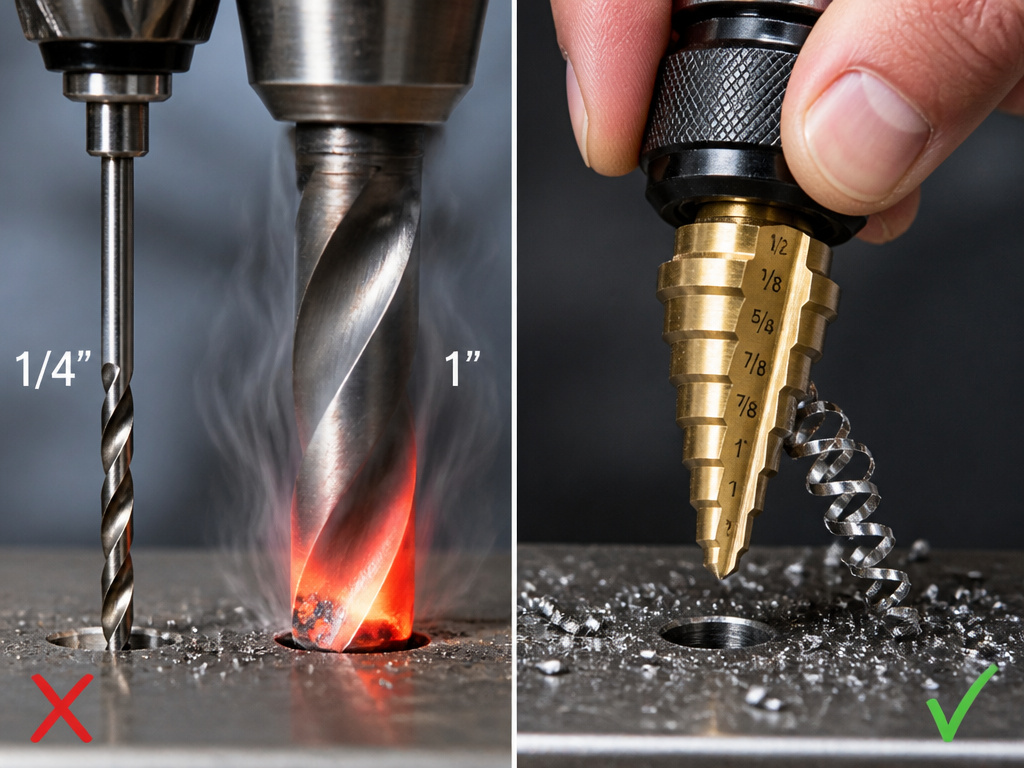
Rule 1: RPM Matters More Than You Think. A bit’s optimal surface speed is determined by its diameter and material. A 1/4″ bit in steel needs about 3000 RPM. That same RPM on a 1″ bit is far too fast—it overheats the edge in seconds. Small bits need high RPM; large bits need low RPM and high torque. If your drill has variable speed, use it. Start slow to engage the point, then ramp up.
Rule 2: Pressure and Clearing Are a Dance. Push hard enough to make the bit cut, but not so hard that the flutes clog. For deep holes, use a pecking motion: drill about one bit diameter deep, pull out completely to clear chips, then go back in. This is non-negotiable in metal and critical when using step drill bits for metal. A packed flute generates friction heat, which softens the bit’s cutting edge. That edge then wears away instead of cutting.
SDS vs. Round Shank: The Hammer Drill Mandate
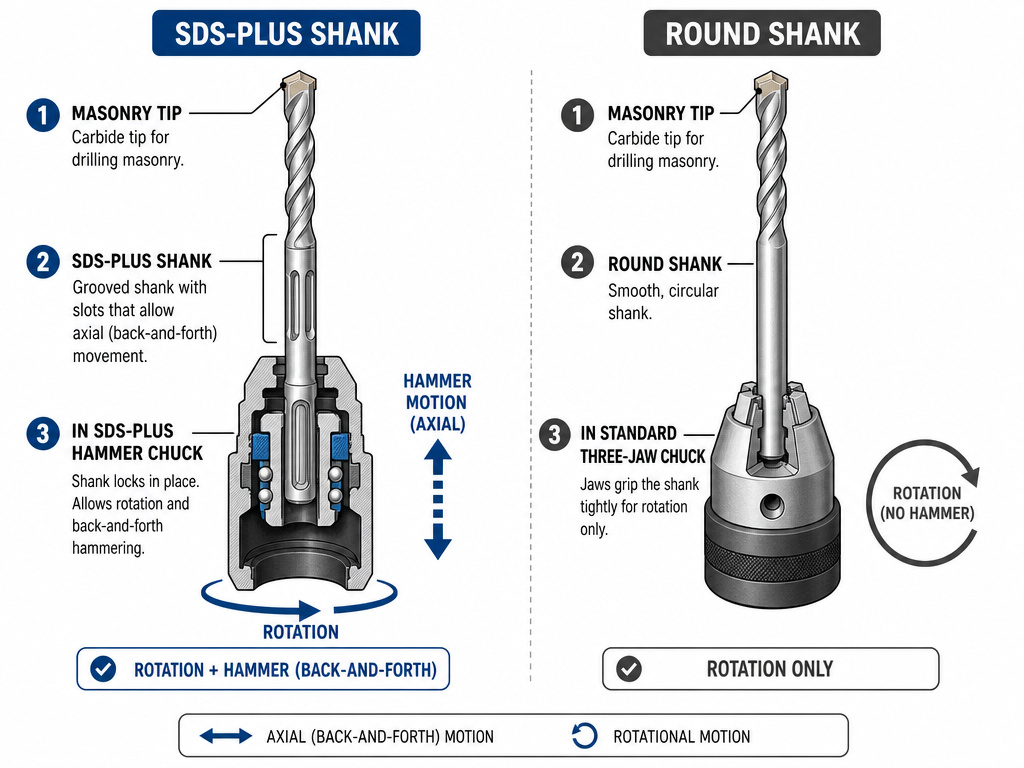
This is a fitment and function lock. An SDS shank has grooves that allow it to slide into a special chuck. This chuck lets the bit move forward and back (the hammer action) while the drill rotates it. A round-shank masonry bit in a standard chuck gets only rotation. In concrete, rotation alone just grinds the tip into dust.
- SDS-Plus: The most common for mid-duty hammer drills. Accepts bits typically up to about 1″ in diameter.
- SDS-Max: For large, professional-grade rotary hammers. Bigger shank, more hammering energy.
- Round Shank: For use in a standard chuck, but only if your drill has a “hammer” setting that creates a percussive action within the chuck itself. It’s less efficient than SDS.
If you own a hammer drill, your masonry bits must match its shank type. There is no adapter that works safely under load.
Frequently Asked Questions
What is the most versatile drill bit type?
135° split-point HSS twist drill bit in jobber length. The split point reduces walking, the 135° angle handles a wider range of materials than 118°, and jobber length offers the best balance of stiffness and reach. The DeWalt Titanium Pilot Point series is the benchmark here.
Can I use a wood drill bit on metal?
You can, but you shouldn’t. The cutting geometry is wrong. It will cut poorly, overheat rapidly, and likely grab and cause an injury. For occasional metal drilling, a proper HSS twist bit is the bare minimum. For anything frequent, step up to cobalt.
How do I stop a drill bit from wandering when starting a hole?
Use a center punch to make a small dent in metal. For wood, use a brad point bit or a dedicated center drill (in a drill press only). For twist bits in any material, a piece of masking tape over the spot can give the point initial purchase. The real solution is the right point geometry: a 135° split point wanders far less than a standard 118° point.
What’s the difference between HSS and cobalt bits?
HSS (High Speed Steel) is the standard, heat-resistant to about 500°C. Cobalt bits (HSS-Co) are alloyed with 5-8% cobalt, which increases hot hardness and wear resistance. They cost more but last significantly longer in hard materials like stainless steel. For the home shop drilling mostly wood and soft metal, HSS is fine. For automotive or metal fabrication, cobalt is worth it.
Why did my new drill bit get dull so fast?
Three likely culprits: drilling a material too hard for the bit (e.g., masonry with a HSS bit), running it at the wrong speed (too slow for small bits, too fast for large ones), or failing to clear chips. Heat is the enemy. A bit that turns blue has been annealed—its hardness is gone, and it’s now softer than the material you’re trying to drill.
Before You Go
Skip the giant, cheap set with two hundred pieces. You’ll use ten of them. Invest instead in a quality 15-20 piece set of titanium-coated HSS twist bits, a separate set of brad point bits for woodworking, and a few dedicated masonry bits that match your hammer drill’s shank. Add a step bit for sheet metal and a Forstner bit set if you do cabinetry.
The bit is the only part of your drill that touches the work. A dull or wrong bit makes even the best drill feel useless. Match the geometry to the material, respect the speed and pressure, and clear the chips. Your bits will last years, not weeks.
