What Does a Concrete Drill Bit Look Like? 4 Key Physical Signs
This post contains affiliate links. As an Amazon Associate, we earn from qualifying purchases.
A concrete drill bit looks like a thick, sturdy cylinder with a blunt, flat head made of grey carbide, not a sharp metal point. It has deep, wide flutes (grooves) spiraling up its body for dust removal, a distinct wear mark near the tip, and typically ends in an SDS-plus shank, a smooth, grooved cylinder, not a standard three-jaw chuck end. The whole design is built for pounding, not slicing.
That description covers the silhouette. The real story is in the four specific physical features that tell you this tool is made to eat through aggregate and rebar, not wood or metal. Get one of those details wrong, and you’re buying a bit that will dull on the first hole or snap under hammer force.
What follows: a breakdown of those four non-negotiable signs, the engineering reasons behind each one, and a head-to-head comparison of what the top brands (Bosch, Hilti, Stanley) actually put on their bits that makes the difference between a clean anchor hole and a ruined afternoon.
Key Takeaways
- The head is solid carbide, not just coated. A concrete bit’s entire cutting face is a single piece of tungsten carbide alloy, identifiable by its uniform dark grey color and lack of a separate steel tip.
- Look for the wear mark. A painted ring or laser-etched line near the tip is a calibration mark. When it wears away, the bit is drilling undersized holes and must be replaced for proper anchor grip.
- The shank decides the tool. An SDS-plus shank (smooth with grooves) is for hammer drills and rotary hammers. A cylindrical shank is for standard chucks but demands a hammering function.
- Flute design is about debris, not chips. Deep, wide U-shaped or steep spiral flutes are engineered to eject concrete dust quickly. Slow, narrow flutes clog and overheat the bit in seconds.
The 4 Physical Signs That Scream “Concrete Bit”
You can identify a masonry drill bit from ten feet away by checking these four features. Miss one, and you’re holding something else.
1. The Carbide Head & Tip Geometry
Forget “carbide tipped.” A true concrete bit has a full carbide head. The cutting face is a single, homogeneous piece of tungsten carbide alloy brazed or diffusion-bonded to the steel body. It looks uniformly dark grey, almost graphite-colored, with no visible seam between the tip and the body. This isn’t a coating; it’s the entire working end of the tool.
The tip itself is blunt and flat, designed to crush and pulverize aggregate under impact. You’ll see specific geometries: * Centric Conical Tip: Common on bits like the Bosch Bulldog Xtreme. It’s a cone shape that self-centers in the hole, reducing walk and producing rounder holes for anchors. * Four-Cutter or Multi-Cutter Head: Brands like Hilti TE-CD use this. It looks like a cross or star pattern engraved into the carbide face, with multiple cutting edges that slice rebar while the hammer action handles the concrete.
A standard twist bit has a sharp, pointed tip for slicing. A concrete bit has a blunt, crushing tip for pounding. The difference is in the first millisecond of contact.
2. The Flute Design: U-Shape vs. Steep Spiral
The grooves spiraling up the bit are flutes. Their job isn’t to curl chips; it’s to evacuate abrasive concrete dust at high speed before it grinds the bit to death.
| Flute Type | What It Looks Like | Best For | Risk If Wrong |
|---|---|---|---|
| U-Shape / 2-Flute | Wide, deep, rounded grooves. Looks like a deep channel. | Fast dust removal in standard concrete. Keeps the bit cool. | Clogs in wet or clay-heavy concrete. Slower in deep holes. |
| Steep Spiral | Tight, aggressive spiral angle. Grooves are closer together. | Deep hole drilling. Pulls dust up and out efficiently over long distances. | More expensive. Can be overkill for shallow anchor holes. |
The Peugeot PPA0023 uses a tri-zone helix, a hybrid that changes the flute angle along its length for better dust control. If the flutes look shallow or narrow, like on a wood auger bit, they will pack with dust in under 30 seconds. The bit will then overheat, lose its temper, and become useless.
3. The Non-Negotiable Wear Mark
This is the most overlooked identifier. Near the carbide head, you’ll find a painted ring or a laser-etched line. This is the wear mark. According to the Stanley FATMAX product sheet, this mark indicates the bit is drilling to its correct diameter. As the carbide wears down from abrasion, the bit effectively gets smaller. When this mark is gone, the bit is drilling an undersized hole.
Where this goes sideways: Using a bit after the wear mark vanishes. Your 1/4″ anchor will spin in a 6.0mm hole instead of a true 6.35mm (1/4″) hole. The holding power drops by half, and the fixture will pull out under load.
This mark is a built-in replacement indicator. No other common drill bit type has this feature.
4. The Shank: SDS-Plus or Cylindrical
The end that goes into your drill tells you what kind of force the bit is built for. * SDS-Plus Shank: The professional standard. It’s a smooth, cylindrical end with two large grooves and several ball grooves. It slides into a hammer drill or rotary hammer with a simple push and click, allowing for a back-and-forth “hammer” motion of up to 1-2 inches. This is what a Hilti TE-CD or Bosch SDS-plus bit uses. * Cylindrical Shank: A smooth, round shank for a standard three-jaw chuck. It requires a drill with a “hammer” setting. The chuck transfers the impact, which is less efficient and harder on the tool. Common on smaller diameter bits like the Bosch CYL-3 set.
If the shank has a twist-drill’s three flat sides or a taper, it is not a concrete bit. It cannot handle the axial hammer forces.
Carbide Head & Tip Geometry Explained
Why a blunt, crushing tip? Concrete isn’t cut; it’s fractured. A hammer drill delivers thousands of short, rapid impacts per minute. The carbide tip transfers that energy directly into the material, micro-fracturing the cement paste and crushing the aggregate (the sand and stone) inside.
The centric conical tip on a Bosch Bulldog Xtreme serves two mechanical purposes. First, the cone shape finds center and reduces “bit walk” on uneven surfaces. Second, it applies force radially outward, helping to keep the hole round. A standard chisel-like tip can oblong the hole, especially in softer brick or block.
Multi-cutter heads, like on the Hilti TE-CD, address rebar. When the tip encounters steel reinforcement, the hammer action alone isn’t enough. The carbide cutting edges are oriented to actually shear the steel fibers as the bit rotates. Without this geometry, you’ll spin on the rebar for minutes, overheating and destroying the bit’s edge.
The part nobody mentions: The carbide grade itself. It’s a specific blend for abrasion resistance, not pure hardness. A bit that’s too hard will splinter on aggregate; too soft will wear down in one hole. Brands like Bosch and Hilti develop their own proprietary blends, which is why a generic bit rarely lasts as long.
Flute Design & Dust Removal
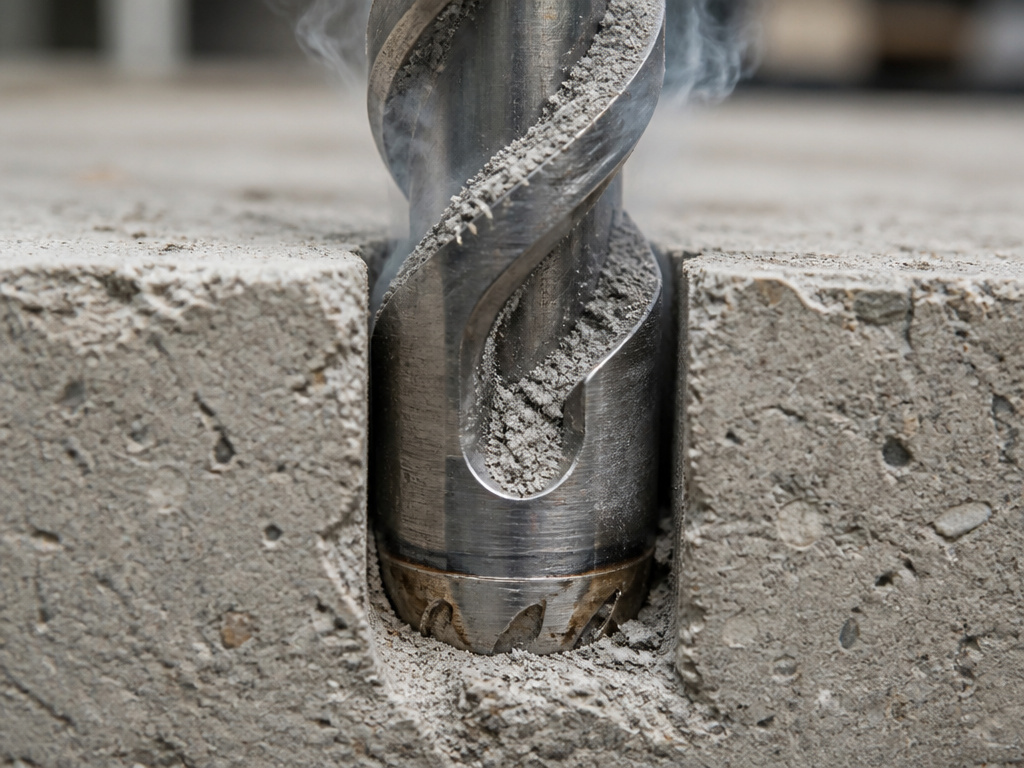
Concrete drilling generates a fine, abrasive powder. If this powder isn’t ejected immediately, it acts like grinding paste between the bit’s steel body and the wall of the hole. This creates intense friction heat.
- Heat is the enemy. Temperatures above 400°C can draw the temper (soften) the high-quality steel behind the carbide head. Once softened, the steel deforms under impact, causing the carbide head to loosen or fall off.
- The why-layer: Deep U-flutes create a large volume for dust to occupy. As the bit rotates, the dust is carried up this channel by centrifugal force and the drilling action. A steep spiral increases the “conveyor belt” effect, actively pulling debris upward. This is why drilling a deep hole with a shallow-flute bit is impossible, the dust has nowhere to go but compact at the tip, stalling progress.
The Stanley SDS-PLUS 20 x 460mm bit touts an “optimized flute design” for this exact reason. It’s not marketing. It’s a calculated channel size to match the expected debris volume of a 20mm hole.
The Critical Wear Mark & Shank Types
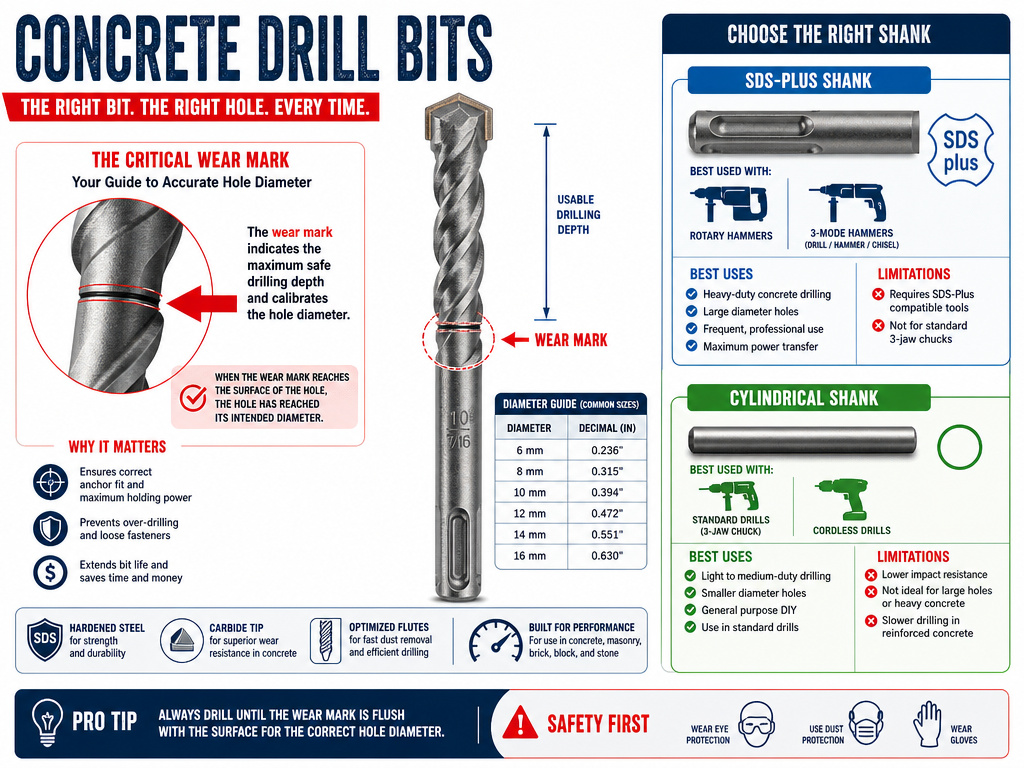
Let’s link the wear mark to a real consequence. Anchor installation specs are written with precise hole diameters in mind. A Hilti Kwik Con+ concrete drill bit is a “matched tolerance” bit, its diameter is calibrated to their specific anchors for maximum pullout strength. If the wear mark is gone, that calibration is void. You’re no longer drilling a hole for a Hilti Kwik Con anchor; you’re drilling a hole that’s too small, forcing the anchor to over-expand and potentially crack the concrete, or too large, giving it zero grip.
Shank Type Decision Table
| Shank Type | Tool Required | Best For | Limitation |
|---|---|---|---|
| SDS-Plus | Rotary Hammer or SDS-Plus Hammer Drill | All professional work, deep holes, daily use. | Requires a compatible tool. Won’t fit a standard drill chuck. |
| Cylindrical | Standard Drill with Hammer Function & 3-Jaw Chuck | Light DIY, small holes (under 10mm), occasional use. | Inefficient power transfer. Wears out the drill’s chuck mechanism faster. |
The SDS-plus connection isn’t just about convenience. It allows a significant axial hammer stroke that a three-jaw chuck physically cannot accommodate. This means more power per blow and faster drilling. Using a cylindrical shank bit in a true SDS-plus tool requires an adapter, which introduces play and reduces efficiency, a sure sign you’re using the wrong bit for the job.
Concrete Bit vs. Other Drill Bits
Visual identification is easiest by direct comparison. A masonry vs regular bit difference is stark when you know what to look for.
- Concrete Bit vs. Twist Drill (Metal): A twist bit has a sharp, pointed 118-degree tip for slicing metal. Its flutes are narrow and sharp-edged to curl a continuous chip. It’s made of HSS (high-speed steel), often with a gold (titanium nitride) or black oxide coating. It will snap if used in hammer mode.
- Concrete Bit vs. Masonry Bit: This is subtle. A general-purpose masonry bit is often just a concrete drill bit of lower quality. It may have a softer carbide grade or less robust brazing. It works for brick and block but will disintegrate in high-strength poured concrete or material with heavy aggregate.
- Concrete Bit vs. Wood Spade or Auger: No contest. Wood bits have a central screw point (auger) or a sharp spade shape. They are designed for fast, clean removal of soft material. In concrete, the screw point would snap instantly.
The confusion often lies with the masonry drill bit vs twist bit. If the bit has any kind of sharp, defined point and shiny, spiraled flutes, put it down. You need the blunt, grey, workmanlike tool.
How to Choose the Right Concrete Drill Bit
You’ve identified it. Now, which one do you buy? Your choice hinges on your project scope and tool.
- For the Occasional DIYer (a few shelf anchors): A small set like the Bosch CYL-3 Concrete Drill Bit Set (4mm-8mm) with cylindrical shanks is sufficient. Use it with a quality hammer drill, not an impact driver.
- For Serious Home Renovation (deck footings, tapcons): Invest in individual SDS-plus bits. For 1/4″ anchors, a Bosch Bulldog Xtreme 1/4″ x 6“ bit. For 3/8″ anchors, a Hilti TE-CX 10mm bit. Buy them as you need them; they last.
- For Professionals or Frequent Use: Stick with a system. Hilti TE-CD bits for dust-controlled drilling, or Bosch Speed Clean if your rotary hammer supports it. The cost per hole is lower due to dramatically longer life.
Skip this if: You only need to drill into brick or cinder block once. A cheap, single general-purpose masonry bit will suffice. Save the investment for actual concrete.
The process of drilling into concrete is a partnership between the bit, the tool, and technique. The finest bit in the world will fail in a drill without a hammer function. Understanding how to use a hammer drill on concrete, firm pressure, no rocking, clearing the hole, is the final step.
Frequently Asked Questions
What’s the difference between a concrete bit and a masonry bit?
All concrete bits are masonry bits, but not all masonry bits are for concrete. A general masonry bit is designed for softer materials like brick, block, and mortar. It may use a lower-grade carbide and lighter construction. A dedicated concrete bit, like a Bosch Bulldog Xtreme or Hilti TE-CD, is engineered for the abrasiveness and compressive strength of poured concrete and aggregate. Using a light-duty masonry bit in concrete will result in extremely slow progress and rapid wear.
Can I use a concrete drill bit without a hammer drill?
No. The bit’s design is predicated on a hammering (percussion) action to fracture the material. Using it in a standard rotary-only drill mode will just spin the tip against the concrete surface, generating immense heat and dulling the carbide almost immediately. You might mar the surface, but you will not drill a hole.
Why does my new concrete bit have a painted tip?
The painted tip on a new bit often serves two purposes. First, it’s a protective coating to prevent corrosion on the shelf. Second, and more importantly, it frequently contains the wear mark. That colored ring is your visual gauge. Once it’s ground off from use, the bit’s effective diameter has reduced, and it’s time for replacement to ensure proper anchor fit.
How do I know if my drill bit is SDS-plus?
Look at the shank. An SDS-plus shank is approximately 10mm in diameter and 40mm long. It will be smooth and cylindrical with two large, open grooves (for torque) and several smaller indentations (for the locking balls). It will not have any flats or twists. It inserts into the tool with a simple push and locks with a twist or click; no chuck key is involved.
Can a concrete drill bit go through rebar?
Yes, but it depends on the bit. Standard concrete bits will eventually grind through thin rebar but will sustain significant damage. Bits designed for reinforced concrete, like the Hilti TE-CD with its multi-cutter head or dedicated SDS-Plus Carbide Rebar Hammer Bits, have carbide geometries that shear the steel more efficiently. The process will still slow down considerably when you hit metal.
The Bottom Line
A concrete drill bit doesn’t just look different; it is different, from its molecular carbide bond to the shape of its flutes. You can identify it by its blunt, full-carbide head, its deep U-shaped or steep spiral flutes, the critical wear mark near the tip, and its SDS-plus or cylindrical shank. These features exist for one reason: to turn immense impact force into a clean hole while surviving an incredibly abrasive environment.
For most homeowners tackling occasional projects, a small set of cylindrical-shank bits like the Bosch CYL-3 and a decent hammer drill will cover 90% of needs. For anything more, drilling into foundation walls, setting multiple anchors, or professional work, skip the sets and buy individual, high-quality SDS-plus bits from Bosch or Hilti in the exact size you need. They cost more upfront but outlast a bucket of cheap bits, saving time, frustration, and money on failed fixtures.
