Choosing Between an Impact Drill and an Impact Wrench Guide
This post contains affiliate links. As an Amazon Associate, we earn from qualifying purchases.
An impact drill hammers forward to pulverize masonry while it spins. An impact wrench delivers high-torque rotary impacts to loosen or tighten fasteners. The Bosch GSB 24-2 impact drill hits 51,000 blows per minute (bpm) into concrete. The Ingersoll Rand 2235TiMAX impact wrench delivers 1,300 ft-lb of nut-busting torque. Using one for the other’s job strips threads, burns out motors, or fails completely within minutes.
That 51,000 bpm versus 1,300 ft-lb split is where the real decision lives. It’s not about power; it’s about the direction of force. A drill’s impact is a linear, percussive hammering along the bit’s axis. A wrench’s impact is a rotational, concussive blow around the anvil.
What follows: the OEM specs that prove the split, a head-to-head comparison of where each tool wins and loses, and the seven-question checklist that stops you from buying the wrong one.
Key Takeaways
- Impact drills are for making holes. Their hammering action (measured in blows per minute, bpm) pulverizes masonry and brittle materials as the bit rotates. The Bosch GSB 24-2 hits 51,000 bpm.
- Impact wrenches are for breaking fasteners. Their high-torque rotary impacts (measured in ft-lb or Nm) shock stubborn bolts and nuts loose. The Ingersoll Rand 2235TiMAX delivers 1,300 ft-lb.
- The chucks are incompatible. Impact drills use a geared keyless chuck (typically 1.5–13 mm). Impact wrenches have a fixed square drive (1/2″, 3/4″, or 1″).
- Cross-use destroys tools. Putting a drill bit in an impact wrench shatters the bit. Using an impact drill on a lug nut strips the nut and stalls the motor.
- Vibration is a real factor. Prolonged use of an impact wrench transmits high vibration to the hand and arm, measured under the ISO 28927 standard.
What’s the Core Mechanical Difference?
The word “impact” is the problem. In a drill, it describes a hammer. In a wrench, it describes a hammering twist. The mechanisms look similar on a parts diagram but their jobs are opposites.
A 50–60 word, third-person, pronoun-free technical overview of the impact mechanism distinction: The impact drill employs a pair of ridged steel discs (hammer and anvil) that disengage and re-engage during rotation, generating a rapid, axial hammering force along the drill bit. The impact wrench uses a rotating hammer mass that strikes a fixed anvil within the tool head, converting linear momentum into high-torque rotary impacts around the drive square. The drill mechanism prioritizes blow frequency; the wrench mechanism prioritizes rotational force.
An impact drill needs to hit hard and fast in a straight line. The Bosch GSB 24-2’s 51,000 bpm rating means its internal hammer slams into the anvil over 800 times per second while the chuck spins. This is a scraping, pulverizing action. It’s why you use a masonry bit: the carbide tip chips away material with each blow.
An impact wrench needs to deliver a sudden, rotating jolt. The Ingersoll Rand 2235TiMAX’s mechanism accelerates a weighted hammer inside the tool head, then releases it to slam into the anvil connected to the square drive. That transfer of momentum is what creates its 1,300 ft-lb of nut-busting torque. It’s a concussive twist, not a scrape.
The wrong choice here isn’t just inefficient. It’s destructive. Feed a concrete screw with an impact wrench, and the high torque will snap the screw’s head off before it seats. Try to remove a truck lug nut with an impact drill, and the drill’s clutch will disengage or the motor will stall—the hammering force is linear, not rotational, so it can’t overcome the friction.
Impact Drill Specs & Real-World Jobs
Look at the manufacturer’s stated purpose. Bosch lists the GSB 24-2 for “drilling in masonry, stone, wood, and metal.” That’s it. Not for fasteners. Not for lug nuts. The spec sheet tells you why.
| Model | Rated Power | Max Impact Rate | Chuck Capacity | Primary OEM Stated Use |
|---|---|---|---|---|
| Bosch GSB 24-2 | 1,100 W | 51,000 bpm | 1.5 – 13 mm | Drilling in masonry, stone, wood, metal |
| Metabo SBE 800-2 | 800 W | 51,200 bpm | 1.5 – 13 mm | Universal drilling into almost all materials |
| Bosch GSB 162-2 RE | 1,500 W | 30,600 bpm | Not specified (core cutter) | Diamond dry-drilling up to 162 mm diameter |
The common thread is the chuck. Every impact drill uses a geared, keyless chuck that accepts round-shank drill bits and driver bits. The 13 mm maximum is a hard limit. The chuck is designed to clamp and transmit rotational force while allowing for the axial hammering motion. It is not built to handle the sudden, high-torque shocks an impact wrench delivers.
Where an impact drill earns its keep:
- Drilling anchor holes in concrete, brick, or block.
- Boring large-diameter holes in masonry with a core bit (like the GSB 162-2 RE).
- Drilling into steel or wood when you need the hammer function off.
- Light screw driving when used with a clutch setting (but an impact driver is better suited).
Common mistake: Using the hammer function on metal or wood. The hammer mechanism is for brittle materials only. Engaging it on steel dulls bits instantly, and on wood it splinters the grain. Switch the collar to “drill only.”
The vibration you feel is different, too. Drilling into concrete with a heavy-duty model like the GSB 24-2 transmits a high-frequency chatter through the handle. It’s tiring over long periods, but it’s a localized vibration. The hammer drill vs impact driver comparison gets into more detail on that specific match-up.
Impact Wrench Specs & Real-World Jobs
Here, the numbers shift from blows per minute to torque. The Ingersoll Rand 2235TiMAX sheet doesn’t bother listing bpm at the top; it leads with 1,300 ft-lb nut-busting torque. The Atlas Copco LMS series manual states a general rule: if the wrench impacts longer than 5 seconds, you need a larger model.
These tools are measured by their ability to overcome friction, not to pulverize.
| Model | Drive Size | Nut-Busting Torque | Impacts per Minute | Primary OEM Stated Use |
|---|---|---|---|---|
| Ingersoll Rand 2235TiMAX | 1/2″ | 1,300 ft-lb (1,760 Nm) | 1,220 | Vehicle repair, heavy trucks, industrial MRO |
| Ingersoll Rand 2146MAX | 3/4″ | 2,000 ft-lb | 1,075 | Heavy machinery, oil and gas, construction |
| Bosch GDS 18V-1600 HC | 3/4″ (cordless) | 2,200 Nm breakaway | Not specified | Structural steel, pipe fitting, construction vehicles |
The fixed square drive is the giveaway. It accepts only impact-rated sockets. There is no chuck, no ability to hold a drill bit. The connection is solid and direct to handle the torsion. This design is why a cordless impact wrench can’t drill a hole, even with an adapter—the anvil isn’t designed for lateral bit pressure.
Where an impact wrench is non-negotiable:
- Removing corroded lug nuts on cars, trucks, and trailers.
- Assembling or disassembling structural steel with large bolts (M16 and up).
- Driving large lag screws or concrete anchors where final torque matters.
- Any production or maintenance task involving dozens of similar fasteners.
Where this goes sideways: Using an undersized wrench. The Atlas Copco rule exists because a tool working at its limit for more than 5 seconds builds dangerous heat in the mechanism and strains the motor. It also increases the vibration exposure for the operator, which is measured under ISO 28927.
Speaking of vibration, holding an impact wrench after a long job leaves a distinct numbness in the palm and fingers. That’s the rotational shock being transferred up the handle. It’s a different, deeper fatigue than a drill’s chatter.
The 7-Step Match-Your-Task Decision Chart
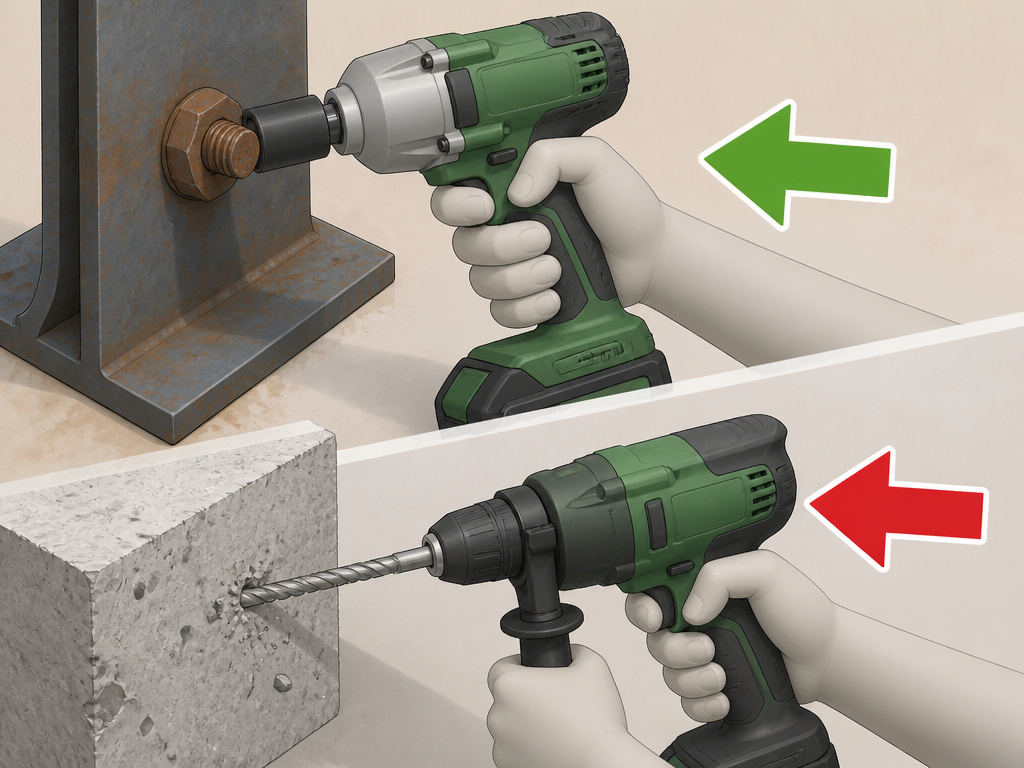
Don’t guess. Run through this list. If you answer “yes” to any of the first three questions, you need an impact wrench. If you answer “yes” to any of the next three, you need an impact drill. The last question is the tiebreaker for your wallet.
- Is the primary task loosening or tightening a bolt, nut, or lag screw? Yes → Impact Wrench.
- Is the fastener size M10 (approx. 3/8″) or larger, or is it likely rusted/seized? Yes → Impact Wrench.
- Will you be doing more than 10 of the same fastener in a row? Yes → Impact Wrench (for speed and consistency).
- Is the primary task making a hole in concrete, brick, or stone? Yes → Impact Drill.
- Do you need to use a drill bit, hole saw, or core cutter? Yes → Impact Drill.
- Is the material wood or metal, requiring the hammer function to be turned off? Yes → Impact Drill (though a standard cordless drill may suffice).
- Do you already own a robust hammer drill or a heavy-duty impact driver? Maybe → Your existing tool might handle the lighter end of the other’s spectrum. A hammer drill vs impact wrench article covers that gray area.
This chart works because it starts with the job, not the tool. Most home gamers hit a wall at question 2. They have a rusted trailer hitch to remove, but they only own a drill. That’s when you either buy the right tool or accept a long, frustrating afternoon with a breaker bar.
Can You Use an Impact Drill as a Wrench (or Vice Versa)?
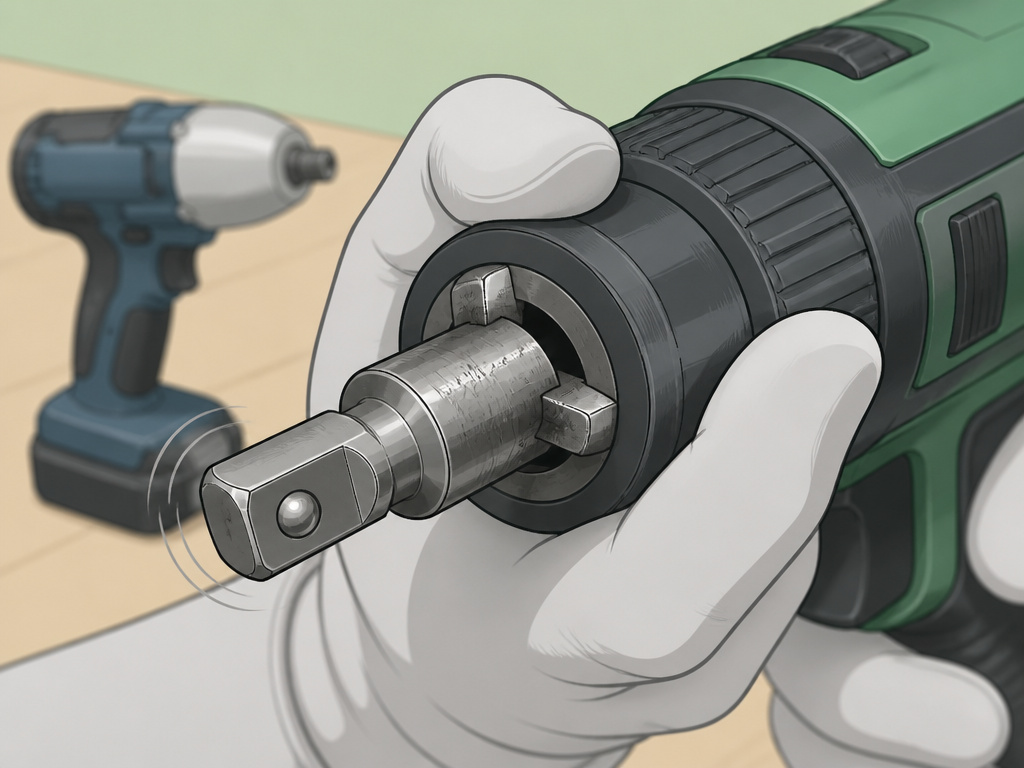
You can force it. You shouldn’t. The damage ranges from immediate failure to gradual, expensive wear.
Putting a socket adapter in an impact drill:
- The problem: The drill’s chuck cannot grip a square drive adapter securely enough for high torque. It will slip.
- The result: On low-torque fasteners, you might succeed slowly. On anything tight, the adapter spins inside the chuck, scoring both parts. The drill’s clutch disengages or the motor stalls. You achieve nothing but wear.
- The exception: Very light, pre-threaded fasteners in soft wood. Even then, a standard drill mode is better.
Putting a drill bit into an impact wrench:
- The problem: The bit’s round shank has nothing for the wrench’s square drive to grip. You need a jacob’s chuck adapter, which introduces a weak, flexible connection.
- The result: The combined runout and flex cause the bit to wobble violently. It will bend or snap. Any attempt to hammer-drill concreteshatters the bit’s carbide tip. The wrench’s mechanism isn’t designed for axial load, so internal parts wear prematurely.
- The exception: None. There is no good reason to do this. If you need to drill, use a drill.
The takeaway is mechanical. These tools are optimized for one type of force transfer. Adapters are a workaround for emergencies, not a solution. Investing in the right tool is cheaper than replacing a burned-out motor or a shattered bit that flies back at you.
Gear & Safety: What You Actually Need for Each
Your tool choice dictates your accessory list and your safety prep. They don’t overlap much.
For the Impact Drill:
- Bits: Masonry bits for concrete/brick, HSS bits for metal, spade or auger bits for wood. Quality matters—a poor bit dulls fast and increases vibration.
- Chuck Key: Keep it handy. A keyless chuck can loosen under hammering.
- Safety Gear: ANSI-rated safety glasses, hearing protection (drills like the Metabo SBE 800-2 emit 108 dB(A)), and a dust mask for masonry.
- Workspace: Secure clamping for the workpiece. Hammer drilling tries to walk the bit.
For the Impact Wrench:
- Sockets: Impact-rated sockets only. Standard chrome sockets can shatter. A deep socket set is more versatile.
- Drive Size: Match it exactly (1/2″, 3/4″, 1″). Using a reducer weakens the connection.
- Safety Gear: Heavy-duty gloves to protect against pinched skin and vibration, impact-resistant glasses (fasteners can break), and hearing protection (many models exceed 95 dB(A)).
- Workspace: Ensure the workpiece is braced. The high torque can spin unsecured items violently.
Note the hearing protection requirement for both. Prolonged exposure above 85 dB(A) causes permanent hearing loss. The best impact tools are powerful, but they are loud. Protect yourself accordingly.
Before you start: Always verify your socket is fully seated on the anvil and the fastener. A cross-threaded or half-seated connection can strip the drive or launch the socket. Let the tool do the work—don’t lean on it.
Frequently Asked Questions
Can an impact wrench drill a hole in concrete?
No. An impact wrench delivers rotational impacts, not the axial hammering needed to pulverize masonry. Even with a masonry bit and a jacob’s chuck adapter, the bit will not penetrate effectively and will likely break. You need an impact drill or a rotary hammer.
What happens if I use an impact driver instead of an impact wrench?
An impact driver is for driving screws and smaller bolts (typically up to 1/4″ or M10). It has higher torque than a drill but far less than an impact wrench. Using it on a truck lug nut will likely stall the tool or round off the fastener. For automotive work, you need a true impact wrench.
Is a hammer drill the same as an impact drill?
In common parlance, often yes. Technically, a “hammer drill” usually refers to a tool that combines rotation with a hammering action for masonry. An “impact drill” is the same type of tool. However, a “rotary hammer” is a different, more powerful class of tool for serious concrete work. The hammer drill and impact driver comparison clarifies this.
Why are impact wrenches so loud?
The sound comes from two places: the high-speed motor and the metal-on-metal impacts inside the hammer mechanism. Models with “Quiet Technology,” like some Ingersoll Rand series, use baffling and airflow redesigns to reduce noise by 4-10 dB(A), which is significant.
Can I use regular sockets with an impact wrench?
You should not. Standard chrome sockets are hardened but can be brittle under the sudden, high-torque impacts. They can crack or shatter. Always use sockets marked “impact-rated.” They are made from a different alloy and are designed to flex slightly and absorb the shock.
Do I need a special compressor for an air impact wrench?
Yes. You must match the tool’s air consumption (CFM) and inlet size. The Ingersoll Rand 2161P requires a 1/2″ minimum hose size and 10 CFM on average. An undersized compressor or hose will starve the tool, reducing power and causing it to run longer, which increases wear.
The Bottom Line
If you’re making holes, buy an impact drill. The Bosch GSB 24-2 is a benchmark for heavy-duty corded work. If you’re breaking fasteners, buy an impact wrench. The Ingersoll Rand 2235TiMAX series defines the professional 1/2″ class.
Don’t get trapped by the shared word “impact.” One is a hammer. The other is a twist. Your project’s materials define the tool, not the other way around. Keep the drill for the masonry, the wrench for the bolts, and your impact driver bits for everything in between. That’s how you avoid the stripped threads, stalled motors, and broken bits that come from forcing a square peg into a round hole—literally.
