
Hammer Drill vs Impact Driver: What’s the Real Difference?
This post contains affiliate links. As an Amazon Associate, we earn from qualifying purchases.
A hammer drill makes holes, primarily in masonry, by combining rotation with a forward hammering action. An impact driver drives screws and bolts, using sudden rotational impacts to overcome resistance. They are not interchangeable; one bores, the other fastens.
That distinction is mechanical, not just marketing. The confusion starts because both tools deliver a “hit,” but the direction and purpose of that hit are entirely different. A hammer drill’s hammering is axial, pounding the bit forward into the material. An impact driver’s impacting is rotational, twisting the fastener with immense, sudden torque.
What follows: the two mechanical actions explained with OEM specs, the specific project each tool wins, and the one combination that covers 95% of home workshop needs.
Key Takeaways
- Buy the tool for the job: A hammer drill is for drilling holes (especially in concrete/brick). An impact driver is for driving screws, lag bolts, and other fasteners.
- They are not substitutes: Using a hammer drill to drive screws strips heads. Using an impact driver to drill holes ruins bits and delivers poor results.
- Torque numbers lie: An impact driver’s 1,800 in-lbs is for overcoming friction on a fastener. A hammer drill’s 2,100 in-lbs is for boring resistance, they are not comparable.
- The combo kit is the default: For most DIYers, a hammer drill/driver and impact driver combo kit from one battery platform is the correct starting point.
- Skip the hammer drill if you never touch masonry: If your projects are 100% wood and drywall, a standard drill/driver and an impact driver is a better pair.
The Core Mechanical Difference
Forget voltage and battery color. The real divide is in the mechanism. A hammer drill incorporates a percussive hammering mechanism that acts along the axis of the drill bit. An impact driver uses a rotational impacting mechanism that acts around the axis of the fastener.
Technical Snippet: In a hammer drill, two ribbed discs (a cam and an anvil) interact as the motor turns. One disc rides the ribs of the other, forcing the chuck and bit forward and back thousands of times per minute (BPM). This axial pounding, combined with rotation, fractures masonry. In an impact driver, a spring-loaded hammer rotates and strikes a stationary anvil attached to the output shaft. Each strike delivers a burst of rotational torque (measured in IPM, impacts per minute) to loosen or tighten a fastener.
This is why you can’t swap them. The hammer drill’s force is linear, designed to pulverize. The impact driver’s force is torsional, designed to break friction.
Why-Layer: The Physics of the “Hit”
The hammer drill’s forward strike works because brittle materials like concrete and brick fail under concentrated point pressure. The bit’s carbide tip focuses the axial blows to micro-fracture the material, and the rotation clears the dust. The impact driver’s rotational strike works because a threaded fastener’s main enemy is static friction. The sudden, high-torque impacts overcome that “stuck” point without transferring the reactive force back to your wrist, which is why you can drive a 4-inch lag bolt with one hand.
The Hammer Drill: When You Need a Hole
A hammer drill’s job is singular: create a hole in hard, brittle material. Its performance is measured in beats per minute (BPM) and torque. The BPM (often 25,000–31,500) dictates how efficiently it fractures masonry. The torque (often 500–2,100 in-lbs) determines how large a hole it can bore and how well it powers through tough spots without stalling.
| Hammer Drill Model | Max Torque | Max BPM | Best-For Use Case |
|---|---|---|---|
| DeWalt DCD1007B | 2,100 in-lbs | Not specified | Large-diameter holes in wood, metal, concrete. OEM states “up to 275 holes per charge” with a 7/8″ auger. |
| Bosch GSB18V-975C | 975 in-lbs | 31,500 | General masonry drilling and precision driving (25 clutch settings). Weighs 3.4 lbs for overhead work. |
| RIDGID R86115B | 800 in-lbs | 31,500 | Versatile drilling/driving in wood, metal, masonry. 35% more compact than previous model. |
| Bosch GSB12V-300 | 300 in-lbs | 26,250 | Light masonry tasks in tight spaces. Weighs 2.2 lbs with battery, head length 6.7 inches. |
The DeWalt DCD1007B represents the high-torque end for heavy framing and concrete work. The Bosch GSB12V-300 is the specialist for installing electrical boxes in brick or hanging shelves where a full-size drill is overkill.
Common mistake: Using a hammer drill on its “hammer” setting to drill into wood or metal. The setting engages the cam mechanism, which provides no benefit in ductile materials and will cause excessive bit wear, a rough hole, and premature motor strain. Always switch back to standard drill mode for non-masonry materials.
When You Must Have a Hammer Drill
You need one if your project list includes: – Installing concrete anchors for a shed base or handrail. – Drilling into brick or block for masonry screws. – Setting tapcons for basement framing. – Any task where the word “masonry bit” appears.
If your world is only wood, drywall, and metal, you can defer this purchase. A standard drill/driver will handle pilot holes in wood, and for the once-a-year concrete job, you can rent a hammer drill or use a rotary hammer for more serious work.
The Impact Driver: The Fastener Specialist
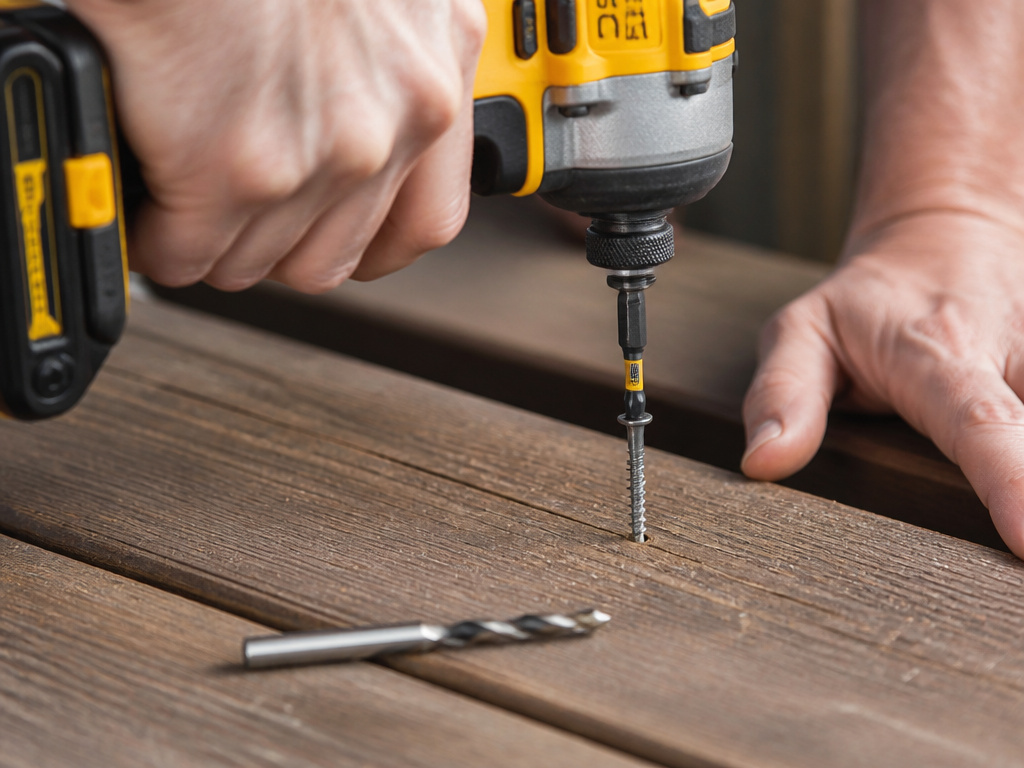
An impact driver exists to install and remove threaded fasteners. Its key specs are torque (in-lbs) and impacts per minute (IPM). The high torque (1,800–2,500 in-lbs is common) is delivered in rapid, concussive bursts, not continuous rotation. This prevents the tool from kicking back and allows it to seat long screws or loosen rusty bolts that would stall a standard drill.
| Impact Driver Model | Max Torque | Max IPM | Key Feature |
|---|---|---|---|
| Bosch GDR18V-1860C | 1,860 in-lbs | 4,100 | Preset modes for self-drilling metal and wood screws to prevent damage. |
| Hilti SID 4-A22 | 1,717 in-lbs (gear 3) | 3,500 | 3-speed gearbox for control; suited for medium-duty apps in wood/metal. |
| Ryobi PBLID04B | 2,300 in-lbs | 4,200 | 3 speeds + assist mode; most powerful in Ryobi’s ONE+ HP line. |
| Bosch GDX 18V-200 | ~1,770 in-lbs | Not specified | Dual-mode: accepts 1/4″ hex bits AND 1/2″ square drive sockets. |
The Ryobi PBLID04B shows how homeowner-grade tools now reach professional torque levels. The Bosch GDX 18V-200 is the niche pick for someone who regularly switches between driving screws and socket-fastened nuts, like in deck building or light automotive work.
Where this goes sideways: Using an impact driver to drill holes with a standard drill bit. The bit’s shank isn’t designed for the hammer-anvil impacts. The result is a quickly ruined bit, a sloppy, oversized hole, and metal shavings in the tool’s collet. Impact drivers are for driving. Use impact-rated driver bits only.
The Impact Driver’s Superpower: Wrist Protection
The reason professionals reach for an impact driver for decking or framing isn’t just speed. It’s fatigue. When a standard drill/driver encounters high resistance, the torque reacts back into your hand and wrist. An impact driver’s mechanism absorbs that reactive force internally. You can drive a 6-inch ledger bolt with a light grip.
Side-by-Side: Project Decider
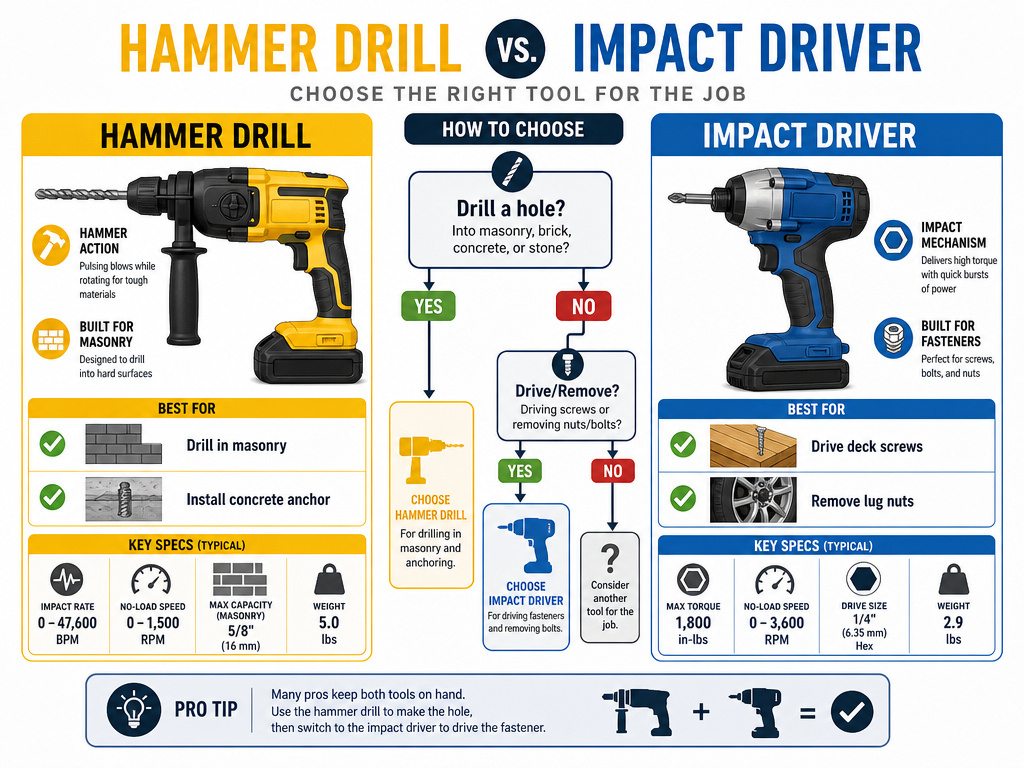
Still unsure which tool to grab? This table removes the guesswork.
| Task | Hammer Drill | Impact Driver | Why |
|---|---|---|---|
| Drill a 1/4″ hole in a concrete block | Yes – Hammer mode required | No – Will not drill effectively | Impact driver lacks axial hammering action to fracture masonry. |
| Drive 3″ deck screws | Possible, but not ideal | Yes – Ideal tool | Impact driver delivers high torque without stripping the screw head or straining your wrist. |
| Assemble furniture with machine screws | No – High risk of stripping | Yes – Use low-speed setting | Impact driver’s controlled bursts seat screws without over-tightening; drill’s continuous torque often strips soft furniture fasteners. |
| Install a concrete anchor (wedge or sleeve) | Yes – Drill the pilot hole | No – Cannot drill the hole | Drill the hole with the hammer drill, then use the hammer drill in standard mode or a wrench to set the anchor. |
| Remove a rusted lug nut | No – Wrong chuck type | Yes, with socket adapter – High torque ideal | Impact driver with a 1/2″ square drive adapter can break frozen fasteners; a drill lacks the concussive torque. |
TL;DR: If the task starts with “drill a hole in…,” the hammer drill is your tool. If it starts with “drive” or “remove,” the impact driver is your tool.
Which One Should You Buy First?
This isn’t a specs contest. It’s a project list audit. Your first purchase should be the tool that matches your most immediate and frequent need.
For most homeowners and DIYers, the answer is an impact driver. Why? Because the majority of weekend projects involve fastening: building a deck, assembling shelving, installing subfloor, putting up a fence. An impact driver excels at these tasks and will save you time and frustration immediately. You can still drill pilot holes with a standard drill/driver, a tool you likely already own.
Buy the hammer drill first if your next project is concreted-anchored. If you’re building a shed base, installing a mailbox in brick, or mounting anything substantial to a foundation wall, the hammer drill is non-negotiable. For everyone else, it’s the second tool you add.
The part nobody mentions: The best value is almost always a combo kit. Manufacturers bundle a hammer drill/driver and an impact driver because they are complementary. You get both tools, two batteries, and a charger for often less than buying them separately. This is the default path for anyone setting up a workshop.
The Professional’s Combo: Hammer Drill + Impact Driver
This pair covers nearly every task on a residential job site. The hammer drill/driver handles all hole-making (with the hammer function for masonry). The impact driver handles all fastener driving and removal. They share batteries. This is the core of every major brand’s pro-grade kit for a reason.
Frequently Asked Questions
Can an impact driver be used as a drill?
No. An impact driver lacks a chuck designed for drill bits and does not provide the stable, continuous rotation needed for clean, accurate holes. Attempting to drill with one will damage bits and produce poor results. Use a drill for drilling.
Do I need a hammer drill for concrete?
Yes, for any meaningful drilling into concrete, brick, or block. A standard drill will struggle, overheat, and dull bits instantly. The hammer drill’s axial pounding action is necessary to fracture the masonry. For many small holes (like for plastic anchors), a hammer drill is sufficient; for larger or more frequent work, a rotary hammer is more efficient.
What is more useful, a drill or impact driver?
For general fastening and construction, the impact driver is more useful day-to-day. For a fully equipped workshop, you need both. If you can only have one tool that also drills holes, get a hammer drill/driver. It can drive screws (though not as well as an impact driver) and drill into anything.
Can I use an impact driver to mix paint or mortar?
It’s not recommended. The sudden impacts are harsh on the mixing paddle’s connection and can splash the material. A standard drill/driver in low gear provides smoother, more controlled rotation for mixing tasks.
Why does my impact driver seem louder than my drill?
The impacting mechanism, metal hammer striking metal anvil thousands of times per minute, creates a distinct, sharp sound. Always wear hearing protection when using an impact driver for extended periods.
Before You Go
The hammer drill versus impact driver debate ends with a simple rule: one makes holes, the other drives fasteners. Trying to force one to do the other’s job wastes time, ruins bits and fasteners, and risks damaging the tool.
For the vast majority, starting with a capable impact driver like the Ryobi PBLID04B or the Bosch GDR18V-1860C delivers immediate utility. Then, add a hammer drill like the RIDGID R86115B or DeWalt DCD805B when your project list hits masonry. Or, skip the decision and buy a quality combo kit, it’s the most practical path to a complete, versatile toolset.
Choose the tool for the job you have today, not the one you imagine someday. Your wrists and your projects will thank you.
