What Is an Impact Drill Used For? Its Primary Applications
This post contains affiliate links. As an Amazon Associate, we earn from qualifying purchases.
An impact drill is used for boring holes in concrete, brick, and masonry, plus drilling wood, metal, and plastic. International standard IEC 62841-2-1 defines it as a tool with a built-in percussion system for axial hammering on a rotating spindle, designed for concrete and stone. It works on softer materials when you disengage the impact function.
That definition from the standards body is the only one that matters. It’s not marketing copy. It’s a safety and performance specification that every manufacturer’s design team has to meet before they can legally sell you the tool.
What follows is the breakdown the manual skips: the three material categories the tool is actually rated for, the one job it physically can’t do well, and the noise and vibration numbers that tell you how long you can safely run it before your hands go numb.
Key Takeaways
- The international standard IEC 62841-2-1 defines an impact drill’s purpose: boring holes in concrete, stone, and similar hard materials using a combined rotating and axial percussion action.
- Manufacturer manuals, like the one for the FERM PDM1060P-K, specify its use for “hammer drilling in brick and concrete” and standard drilling in wood, metal, and plastics.
- Impact drills generate significant vibration, over 10 m/s² when drilling concrete, and noise over 93 dB(A), requiring hearing protection and limiting continuous use.
- The tool fails in very hard, reinforced concrete because its hammering mechanism lacks the force of a dedicated rotary hammer; it’s for light masonry, not heavy construction.
- For driving screws or working with dense hardwoods, a standard cordless drill or an impact driver is often a better, more controlled choice.
The Official IEC Definition of an Impact Drill
Forget what the box says. The legally recognized definition comes from the International Electrotechnical Commission. IEC 62841-2-1, the consolidated standard current as of 2021, puts it in engineering terms.
According to clause 3.102 of IEC 62841-2-1, an impact drill is a “tool equipped with a chuck specifically designed to bore holes in concrete, stone and other materials, being similar in appearance and construction, to a drill, but which has a built-in percussion system which gives an axial percussion movement to rotating output spindle.”
That’s the featured-snippet answer. It’s a drill first, with a hammering mechanism bolted onto the spindle’s rotation. The “axial percussion movement” is a forward-and-back thumping action along the same line as the bit’s rotation. This combo chips away brittle material as the bit turns.
The standard also draws a bright line between tools. It explicitly states that this document does not apply to rotary hammers, screwdrivers, impact wrenches and ratchet drivers even if they can be used as a drill. Understanding what an impact drill is means knowing what it isn’t. A rotary hammer uses a different, more powerful piston mechanism. An impact driver delivers rotational concussive blows for driving fasteners, not axial ones for drilling.
The older IEC 60745-2-1 standard adds a critical detail: an impact drill “may have a device for rendering the percussion system inoperative, so that it may be used as a conventional drill.That switch on the side functions as the toggle between its two identities.
The 3 Material Categories in the Manufacturer’s Manual
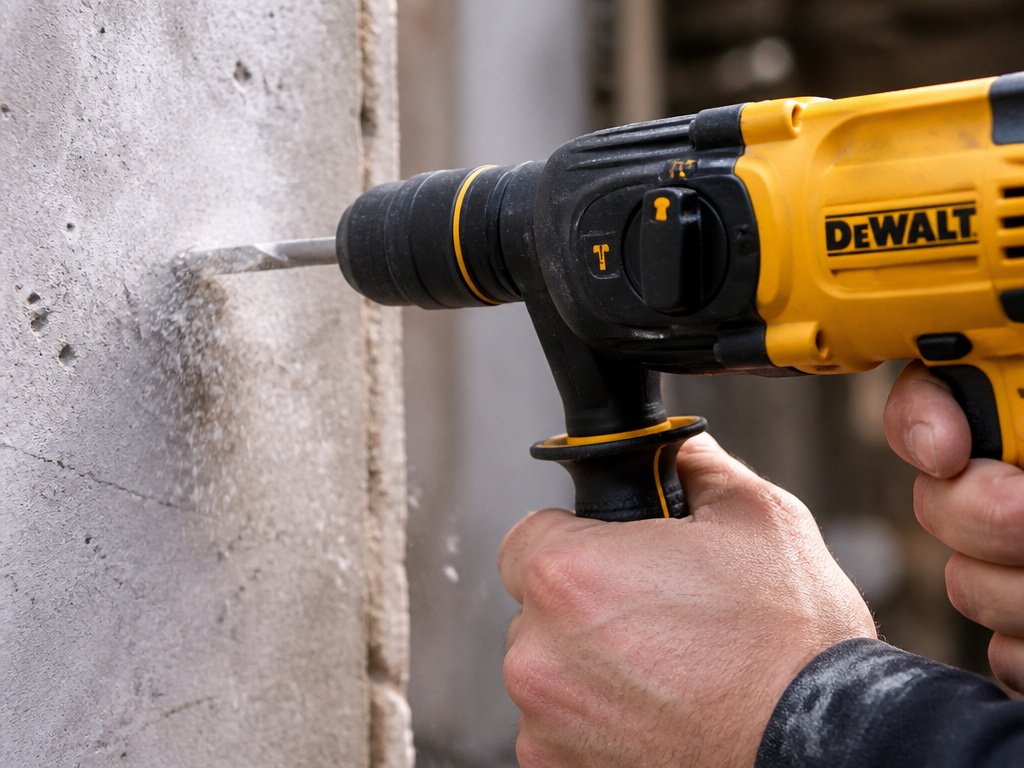
The FERM PDM1060P-K instruction manual states the intended use plainly: “for drilling holes in wood, metal and plastics and for hammer drilling in brick and concrete.” That’s the whole list. It splits your projects into three clear buckets.
| Material Category | Impact Function | Bit Type | Operator Pressure |
|---|---|---|---|
| Concrete, Brick, Masonry | ON (Hammer Drilling) | Carbide-tipped masonry bit | Very light – let the tool do the work |
| Wood, Metal, Plastic | OFF (Standard Drilling) | Twist drill (HSS, brad point, etc.) | Firm, steady pressure to maintain bite |
| Tile, Glass, Ceramic | OFF (if possible) | Diamond or carbide spear point | Extremely light, no hammering |
The manual includes a non-negotiable warning: “Impact drills require very little operator pressure. Excessive pressure on the tool can lead to unnecessary overheating of the motor, and burning of the driven tool.” Lean on it, and you’ll smell the insulation cooking inside a minute. The hammer mechanism needs to cycle freely.
Common mistake: Forcing an impact drill into concrete. You stall the mechanism, overheat the motor, and blunt the bit. The tool is designed to chip with rapid, light blows, not brute force.
For drilling metal or hardwood, you flip the switch. Now you’re running a standard power drill. The process for using an impact drill on steel is identical to any other drill: center punch, slow speed, cutting fluid, and clean, continuous chips.
The FERM PDM1060P-K Spec Sheet Tells the Real Story

The numbers on a spec sheet serve as warnings and limits. The FERM model’s data, declared per the EN 60745 standard, shows why this tool has a specific job.
- Power Input: 850W
- No-load Speed: 0–3,000 /min
- Impact Rate: 0–48,000 /min
- Max. Drill Diameter: Concrete 16 mm, Steel 13 mm, Wood 25 mm
- Sound Pressure: 93.5 dB(A)
- Vibration (Drilling Metal): 5.4 m/s²
- Vibration (Hammer Drilling Concrete): 10.3 m/s²
The vibration figure is the one that dictates your workday. At 10.3 meters per second squared, you hit the exposure limit value defined by health and safety regulations in under two hours of continuous use. Your hands will tell you first, tingling, then numbness. That’s why the IEC standard mandates a specific warning on the tool or in its manual: “Wear ear protectors with impact drills. Exposure to noise can cause hearing loss.”
The 16 mm maximum for concrete marks the point where the tool’s hammer energy is spread over too large an area to be effective. For a hole bigger than a pencil in hard aggregate, you need a rotary hammer.
Where an Impact Drill Fails (And What to Use Instead)
Its mechanism is its ceiling. The internal percussion system in an impact drill is typically two ribbed metal discs (a hammer and an anvil) that click in and out of engagement. It’s fast but relatively weak.
It fails in very hard or reinforced concrete. The hammering force is insufficient to fracture dense aggregate or cut through rebar. You’ll burn out bits and overheat the tool. For that, you need a rotary hammer with its pneumatic or electro-pneumatic piston mechanism. The hammer drill vs impact driver debate is settled here: for serious masonry, the hammer drill wins.
It’s mediocre for driving long screws or lags. The axial hammering is useless for turning fasteners and can damage screw heads. For that job, an impact driver delivers sudden rotational torque pulses. The functional differences between impact driver and drill are fundamental: one drills holes, the other drives fasteners.
It’s overkill for most basic wood and metal tasks. The extra weight and vibration are unnecessary. A standard cordless drill offers more control, finer speed adjustment, and is often cheaper. For detailed work, a compact drill provides better balance and access.
| Task | Impact Drill | Better Tool Choice |
|---|---|---|
| Drilling 1/2″ hole in cinder block | Good | Best |
| Drilling 1/2″ hole in poured foundation | Poor | Rotary Hammer |
| Driving 3″ deck screws | Acceptable (impact off) | Impact Driver |
| Drilling pilot holes in pine | Acceptable (impact off) | Cordless Drill |
| Mixing thin-set mortar | Bad (high vibration) | Mixer or Heavy-Duty Drill |
Knowing when to use an impact driver or a standard drill instead will save your project and your tool.
How the Axial Percussion Mechanism Actually Works
The internal mechanism of an impact drill is mechanical simplicity. It doesn’t have a separate motor or piston.
- The motor turns the main shaft.
- A helical gear or ribbed plate (“hammer”) on the shaft is spring-loaded against a matching plate (“anvil”) connected to the chuck.
- As resistance increases (like when hitting concrete), the hammer plate cams back against the spring, then snaps forward to strike the anvil.
- This delivers a sharp, axial blow to the bit while it continues to rotate.
- The cycle repeats thousands of times per minute (up to 48,000 bpm on the FERM model).
The force of each blow is modest. It’s the high frequency that does the work, chipping away material like a miniature jackhammer. This is fundamentally different from the impact drill’s mechanism in an impact wrench, which uses rotating weights to deliver torsional impacts.
The part nobody mentions: This mechanism works because concrete and brick are brittle. They fail under repeated, localized stress. Try the same action on ductile steel, and you’ll just work-harden the surface and destroy the bit’s cutting edges. That’s why the hammer function stays off for metal.
Safety and Maintenance Non-Negotiables
The standards aren’t just about design. They mandate specific user warnings because the hazards are predictable.
Hearing and Hand-Arm Vibration (HAVS) are the two biggest risks. The IEC standard requires the ear protection warning. The high vibration level means you must take regular breaks. Grip the tool firmly with both hands, use the auxiliary handle. The manual warns: “Hold the machine firmly with 2 hands. Be aware the drill can jam and because of that machine might suddenly turn.”
Bit selection is a safety issue. Use only sharp, undamaged bits. For masonry, that means carbide-tipped. For large holes in hard concrete, the manual advises: “start using a smaller bit for pilot drilling first, then drill to nominal size.” A pilot hole guides the larger bit and reduces binding.
Let it cool. The endurance testing in IEC 60745-2-1 runs the tool for 24-hour cycles under load. That’s a test of its design limits, not an instruction. In real use, the motor and gears will heat up. If the housing is too hot to touch, stop.
Clean the chuck jaws and vents. Concrete dust is abrasive and will jam the chuck over time. It also clogs motor cooling vents, leading to overheating. Blow it out with compressed air after every masonry job.
Frequently Asked Questions
Can you use an impact drill as a regular drill?
Yes. Every impact drill has a switch or collar to disengage the hammering mechanism. In this mode, it functions identically to a standard power drill for wood, metal, and plastic. This dual-purpose design is explicitly noted in the IEC 60745-2-1 standard.
What is the difference between an impact drill and a hammer drill?
This is a common point of confusion. In everyday language, “hammer drill” often refers to an impact drill. Technically, a true hammer drill (or rotary hammer) uses a different, more powerful mechanism, like a piston driving a striker, and is built for heavier, continuous masonry work. An impact drill is for lighter-duty hammer drilling.
Can an impact drill go through concrete?
It can drill holes in concrete block, brick, and relatively soft poured concrete, typically up to about 1/2 inch (13mm) in diameter. For harder, aggregate-rich concrete, larger holes, or reinforced concrete, an impact drill will struggle and may overheat. A rotary hammer is the correct tool for those jobs.
Do you need special bits for an impact drill?
Yes, for hammer drilling. You must use carbide-tipped masonry bits designed to withstand the axial hammering action. Standard high-speed steel (HSS) twist drills will dull almost instantly and can shatter if used with the impact function engaged. For drilling without impact, use the appropriate bit for the material (e.g., HSS for metal, brad point for wood).
Is an impact drill better than a drill?
It’s not better; it’s different. An impact drill is a specialized tool for a specific set of materials (masonry) that can also perform as a standard drill. For a user who only drills wood and metal, a standard drill is lighter, quieter, and offers better control. For someone who occasionally needs to mount something on a brick wall, an impact drill adds necessary capability.
What is the difference between an impact drill and an impact driver?
They are completely different tools. An impact drill is for making holes, using a hammering action along the axis of the bit. An impact driver is for driving screws and bolts, using a rotational hammering action to deliver high torque. They are not interchangeable for their primary tasks.
Before You Go
An impact drill is a masonry tool that can also drill wood and metal. Its job is defined by an international standard, not a sales pitch. It works by delivering thousands of light, axial blows per minute to chip through brittle materials.
Remember three numbers: 16 mm is its realistic concrete limit, 10.3 m/s² is the vibration that will fatigue your hands, and 93 dB is the noise that requires ear protection. For holes bigger than your finger in hard concrete, get a rotary hammer. For everything else in the shop, a standard cordless drill is quieter and easier to control.
The tool has one switch for a reason. Concrete gets the hammer, everything else doesn’t. Keep that straight, and the tool will last for years of light masonry work. Forget it, and you’ll be shopping for a new motor by the end of the season.
