
How Does an Impact Drill Work | The Mechanism in 3 Parts
This post contains affiliate links. As an Amazon Associate, we earn from qualifying purchases.
An impact drill works by combining rotational force from an electric motor with a rapid, axial hammering action. This dual motion is created inside the tool’s head by a three-part mechanism: a spring-loaded clutch, a toothed hammer, and a matching anvil. When engaged, the clutch allows the hammer to slam forward into the anvil thousands of times per minute, driving the drill bit forward while it spins to chip through masonry.
That hammer-and-anvil assembly is where the real work happens. It’s not magic, it’s a precise mechanical dance that turns smooth rotation into percussive blows. The exact force and speed of those blows are defined by international standards, which also set the noise and vibration levels you feel in your hands.
What follows is a breakdown of that internal mechanism, the specs that define its performance, and the clear line between an impact drill and the more powerful tools it’s often confused with.
Key Takeaways
- The hammering action comes from a spring-loaded clutch and two interlocking toothed rings (the hammer and anvil) inside the drill’s head, not from the motor itself.
- Impact rate (measured in blows per minute or BPM) is the critical spec, not just RPM; a tool like the Bosch GSB 20-2 RE delivers 0–48,000 BPM.
- International standard IEC 62841-2-1 defines an impact drill’s testing, including running it under load for 12 hours at varying voltages to ensure durability.
- For drilling into brick or light concrete, use an impact drill. For heavy, continuous concrete work, you need a rotary hammer, they use a different piston mechanism.
- Always switch to impact mode only when the drill is at a complete stop to avoid shearing the teeth off the internal clutch mechanism.
The Core Impact Mechanism: Clutch, Hammer, and Anvil
Forget the motor for a second. The defining part of an impact drill is in its front end. Three components work in sequence to convert rotation into hammer blows.
First, the motor spins a driveshaft. That shaft connects to a spring-loaded clutch assembly. When you’re drilling in standard mode, this clutch is locked, so the shaft’s rotation transfers directly to the chuck. Flip the selector to hammer mode, and the clutch disengages. Now the shaft can move forward and backward slightly as it spins.
Attached to that shaft is the hammer, a steel ring with angled teeth on its front face. Opposite it, fixed to the chuck, is the anvil, a ring with matching teeth.
This is the technical heart of the tool. As the clutch allows axial movement, the spinning hammer’s teeth ride up and over the stationary anvil’s teeth, compressing a spring. At the peak, the teeth slip, and the spring slams the hammer forward to strike the anvil. This transfer of kinetic energy delivers an axial impact to the drill bit. The process repeats with every revolution, creating the rapid hammering pulse.
The speed of this cycle determines the impact rate, measured in blows per minute (BPM). A typical rate like 0–48,000 BPM means the hammer and anvil are engaging and disengaging up to 800 times every second at top speed. This is separate from the rotational speed (RPM).
Where this goes sideways: forcing the mode selector while the drill is spinning. The teeth on the hammer and anvil are precisely aligned. Switching under load grinds them. You’ll hear a nasty crunch, and the hammer action will become weak or stop entirely within a few uses.
Power, Speed, and the Numbers That Matter
You’ll see two critical specs on any box: no-load speed and impact rate. They tell you what the tool can do when it’s not actually drilling anything.
No-load speed (RPM) is how fast the chuck spins with zero resistance. Many models, like the Bosch GSB 20-2 RE, have two gears: a low gear (0–1,100 RPM) for high-torque screw driving and a high gear (3,000 RPM) for fast drilling. The FERM PDM1060P-K lists a no-load speed of 0–3,000 RPM. This number is required by the IEC 62841-2-1 standard for drills and impact drills.
Impact rate (BPM) is the hammering speed. It’s usually proportional to RPM. For example, the same Bosch model has an impact rate of 0–48,000 BPM at its maximum rotational speed.
| Specification | Bosch GSB 20-2 RE | FERM PDM1060P-K | What It Means |
|---|---|---|---|
| No-Load Speed | 0–1,100 / 3,000 rpm | 0–3,000 /min | Maximum chuck rotation speed with no load. |
| Impact Rate | 0–48,000 bpm | 0–48,000 /min | Maximum hammer blows per minute. |
| Rated Power | 800 W | 850 W | Electrical input power under load. |
| Chuck Capacity | 1.5 – 13 mm | 13 mm | Minimum and maximum drill bit shank diameter. |
The part nobody mentions: The “rated speed” on a spec sheet (like the Bosch’s 740 rpm) is the motor’s optimal operating speed under a normal load. Running the tool significantly slower or faster than this for long periods overheats the motor. You smell burning insulation before you see smoke.
These specs aren’t just marketing. The IEC standard mandates rigorous testing, like running the tool with the impact mechanism disengaged for 12 hours at 110% of its rated voltage. That’s a durability check the manufacturer had to pass.
When to Use It (And When to Grab Something Else)
An impact drill is a specialist for brittle materials. Its hammering action is designed to crack and chip, not to crush.
Use an impact drill for:
- Drilling anchor holes in brick, cinder block, or natural stone.
- Light-duty concrete work, like setting a mailbox post in a non-reinforced foundation.
- General drilling in wood, metal, and plastic when you switch it to standard rotary mode.
Its versatility is its strength. But that hammer mechanism has limits.
Skip this if: your project involves daily, deep holes in reinforced concrete or poured foundation walls. That’s rotary hammer territory. They use a piston-driven mechanism that delivers significantly more impact energy with less vibration to the user.
The confusion usually sits in the naming. People hear “hammer drill” and think of the big, dedicated concrete breaker. In practice, “hammer drill” and “impact drill” often refer to the same tool, the one with the clutch-and-hammer mechanism. The true heavyweight is the rotary hammer.
| Tool Type | Core Mechanism | Ideal Material | Key Limitation |
|---|---|---|---|
| Impact Drill | Toothed hammer & anvil clutch | Brick, block, light concrete | Low impact energy; struggles with rebar or thick concrete. |
| Rotary Hammer | Electro-pneumatic piston | Reinforced concrete, masonry | Heavy, expensive, overkill for simple brick. |
| Impact Driver | Rotational hammer & anvil | Driving screws & bolts | Cannot drill a hole; uses hex shank bits only. |
This last distinction is critical. An impact driver is a different tool entirely. It uses a rotational hammer mechanism to deliver sudden twists for driving fasteners. It does not provide the forward, axial blows needed for drilling. Trying to use one with a drill bit will just burn out the bit and the tool.
The Physical Reality: Vibration, Noise, and Your Hands
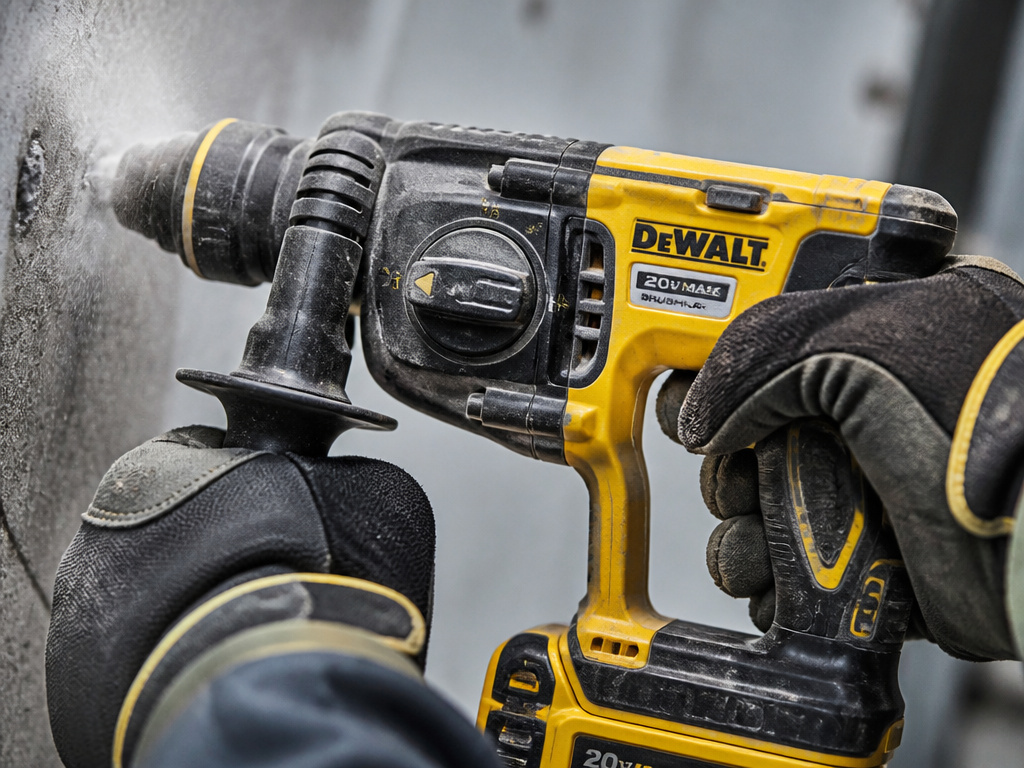 You don’t just hear an impact drill work, you feel it. That buzzing in your palms and the high-pitched rattle are direct outputs of the mechanism.
The IEC 62841-2-1 standard includes test conditions for measuring vibration. One manual for an unspecified model lists a vibration emission value of 23.804 m/s² for hammer drilling into concrete when holding just the main handle. Using the side handle drops that to 15.382 m/s².
Worth knowing before you start: That side handle isn’t a suggestion. It’s a vibration damper and a torque brace. A drill can bind in a deep hole. Without that second handle, the tool can spin violently, and your wrist takes the full impact force.
Noise is the other constant. The same manual reports a sound power level of 109.2 dB(A). That’s in the range where hearing damage is possible with prolonged exposure without protection. The standard requires these figures to be published so you know what you’re dealing with.
These numbers are why pros treat these tools with respect. They’re not gentle. The mechanism that lets them chew through brick also transmits significant shock back through the chassis.
Frequently Asked Questions
What’s the difference between an impact drill and a regular drill?
Regular drill only rotates the bit. An impact drill can rotate and hammer. Inside the impact drill, a clutch lets two toothed rings (a hammer and anvil) slam together, driving the bit forward while it spins. This hammering action is what cracks into masonry.
Can I use an impact drill as a regular drill?
Yes. Every quality impact drill has a mode selector. Switch it from the hammer icon to the drill icon. This locks the internal clutch, turning off the hammer action so the tool operates as a standard power drill for wood, metal, or plastic.
Is an impact drill the same as a hammer drill?
In common DIY parlance, often yes. Technically, “impact drill” is the precise term for the tool with the clutch-based hammer mechanism. “Hammer drill” is sometimes used interchangeably, but it can also refer to the more powerful rotary hammer, which uses a piston system. For the tool in your local hardware store, they’re typically the same thing.
Why is my impact drill not hammering?
The most common cause is a worn or broken hammer and anvil mechanism. If you’ve ever forced the mode switch while the drill was spinning, you may have sheared the teeth off these rings. The tool will still rotate, but the clutch can’t engage to create impacts. Other causes include a failed clutch spring or a damaged mode selector switch.
What size impact drill do I need for home use?
For 90% of home projects, hanging shelves, installing curtain rods, building a deck, a mid-range model with a 13 mm chuck capacity, around 700-850W of power, and a variable speed trigger is perfect. It handles everything from delicate woodwork to punching holes in brick. The step up to a rotary hammer is only necessary for foundational concrete work.
Before You Go
An impact drill’s job is to turn rotation into percussion. That transformation happens in a spring-loaded clutch and two steel rings knocking together thousands of times a minute. It’s a simple, brutal, and effective design for getting into brick and block.
Remember the split. For brittle masonry, the impact drill’s hammer mechanism is your friend. For driving long screws or bolts, you want the rotational force of an impact driver. And for serious concrete, you step up to the piston-driven power of a rotary hammer. Each tool has a mechanism built for a specific type of resistance. Picking the right one is the difference between a clean hole and a stalled motor.
