Rotary Hammer vs Impact Drill | The Tool You Actually Need
This post contains affiliate links. As an Amazon Associate, we earn from qualifying purchases.
A rotary hammer delivers a heavy, piston-driven blow for drilling and chiseling concrete, while an impact drill uses a high-speed cam mechanism to power through masonry and drive screws. The rotary hammer’s measured impact energy (2–12+ joules) cracks hard material; the impact drill’s brute torque (up to 40 Nm) spins through it. For holes in concrete over 1/2 inch (13mm), you need the rotary hammer. For everything else, brick, block, wood, metal, and fastening, the impact drill is the versatile default.
That gap between joules and newton-meters is where the whole decision lives. One spec measures a direct hammer strike, the other measures rotational twisting force. Confuse them and you burn out a motor, snap a bit, or spend three hours on a five-minute hole.
What follows breaks down the internal mechanisms, the hard numbers from manufacturer spec sheets, and the specific jobs where each tool doesn’t just work better, it’s the only thing that works. By the end, you’ll match the tool to the material in ten seconds.
Key Takeaways
- Impact energy in joules is the rotary hammer’s key spec. For drilling into concrete, look for at least 2–3 joules (like the Bosch GBH 18V-26). Under 2 joules, the tool struggles with rebar and thick pours.
- An impact drill cannot replace a rotary hammer for core concrete work. Its mechanism delivers over 50,000 light taps per minute, not the fewer, heavier blows needed to fracture aggregate. Using it on deep concrete holes burns out the drill’s hammering clutch within months.
- The chuck system decides your bit options. Rotary hammers use SDS-plus or SDS-max chucks for secure, slotted bits that handle hammer force. Impact drills use standard keyed or keyless chucks for common twist bits and driver bits.
- Choose based on your hardest planned material. If you ever need to drill a 1-inch hole in a concrete foundation, get a rotary hammer. If your toughest task is 3/8-inch holes in brick or cinder block, an impact drill covers it and all general drilling/driving.
- For most homeowners, a heavy-duty impact drill is the single tool. The Bosch GSB 24-2 handles 90% of masonry tasks. Only invest in a rotary hammer when you have a specific, recurring concrete drilling need.
The Core Difference: Mechanism & Purpose
The internal hammering action separates these tools more than any brand name. One uses a piston, the other uses a pair of cams. That engineering choice dictates every job each tool can and cannot do.
A rotary hammer employs a piston-driven mechanism. An electric motor drives a crank that moves a piston back and forth in a cylinder. This piston compresses air, which in turn drives a striker into the bit shank. This delivers a high-energy, direct blow. An impact drill uses a rotating cam and spring-loaded hammer mechanism. Two ribbed metal discs (cams) ride against each other. As the motor rotates, the cams force the front hammer backward against spring pressure until it slips, snapping forward to strike the rear anvil. This creates rapid, lower-energy impacts.
Rotary Hammer (Piston-Driven)
The piston system is why rotary hammers list impact energy in joules, a unit of force. The Bosch GBH 18V-26 delivers 2.6 joules per blow. This force is transferred directly to the bit via the SDS-plus chuck, which allows the bit to slide back and forth. This mechanism is for fracturing brittle, hard materials. It’s a demolition action packaged for precision drilling. Most rotary hammers offer three modes: rotation only (for drilling wood/metal), hammer drilling (rotation + piston blow), and hammer-only (for chiseling).
Impact Drill (Cam-Driven)
The cam mechanism generates torque, measured in newton-meters (Nm). The Bosch GSB 24-2 produces up to 40 Nm of torque. The impacts are not for breaking material apart but for overcoming friction. As the bit encounters resistance, the cams engage, delivering thousands of micro-impacts per minute to keep the bit turning. This is ideal for powering through masonry where the material can be abraded away, and for driving long screws where the impacts prevent stall.
| Aspect | Rotary Hammer | Impact Drill |
|---|---|---|
| Primary Mechanism | Piston & Air Spring | Rotating Cams & Hammer |
| Force Measurement | Impact Energy (Joules) | Torque (Newton-meters) |
| Impact Rate | Lower (0–4,500 bpm) | Very High (0–51,000 bpm) |
| Best For | Drilling/chiseling concrete, rock, hard masonry | Drilling brick/block, driving fasteners, wood/metal |
| Typical Chuck | SDS-plus or SDS-max | Keyed or Keyless |
When the Wrong Tool Fails (And How Fast)
Using an impact drill where you need a rotary hammer doesn’t just slow you down. It breaks things. The failure has a predictable timeline and specific symptoms.
Common mistake: Drilling a 3/4-inch anchor hole in a concrete foundation with an impact drill. The drill’s clutch will overheat within 90 seconds of continuous pressure. By the third such hole, the hammering mechanism’s springs fatigue and the impacts become inconsistent. The tool will still spin, but it loses all hammering function permanently.
The impact drill’s cam mechanism isn’t built to sustain the pressure needed to drill deep into concrete. The friction generates intense heat. You’ll smell the distinct odor of hot gear grease and burning electrical insulation. The drill’s housing will become uncomfortably hot to the touch near the chuck.
Conversely, using a rotary hammer for general screw driving is clumsy and destructive. The tool is heavy, and its hammer-only mode has no rotation, it’s just a mini-jackhammer. In hammer drill mode, even at its slowest rotation setting, it delivers too much power. You’ll strip screw heads instantly or over-drive them deep into the material. The tool’s weight also causes user fatigue for overhead work.
The 1/2-Inch Rule: If the hole you need to drill in concrete or solid stone is 1/2 inch (13mm) or larger in diameter, or deeper than 3 inches, an impact drill is the wrong tool. The risk of motor damage and bit failure outweighs any temporary cost saving.
Specs That Matter: Reading the Tool Sheet
Forget brand loyalty for a moment. Two numbers on the spec sheet tell you almost everything: impact energy (for rotary hammers) and maximum torque (for impact drills). Wattage is a secondary indicator of overall motor stamina.
Rotary Hammer: Impact Energy & Chuck Type
Impact energy, measured in joules (J) or foot-pounds (ft.-lbs.), is the force of each blow. This is not a marketing term. It’s a standardized test result (like EPTA). For light-duty concrete and block, 2–3 joules is sufficient. For core drilling, chasing channels, or heavy chiseling, look for 3.5 joules and above.
The chuck type dictates your bit selection and the tool’s maximum capacity. * SDS-plus: The standard for most cordless and mid-duty rotary hammers. Accepts bits typically up to 1-1/4 inch (32mm) in diameter. The DeWalt DCH416B uses this system. * SDS-max: For heavy-duty tools. Used for larger diameter drilling (over 1 inch) and demolition work. Bits have a larger, sturdier shank. The Bosch GBH 18V-45 C is an SDS-max tool.
| Rotary Hammer Model | Impact Energy | Chuck Type | Best For |
|---|---|---|---|
| Bosch GBH 18V-26 | 2.6 J | SDS-plus | All-day drilling in concrete block & medium pours |
| DeWalt DCH416B | 4.5 J | SDS-plus | Structural connections, beam anchorage |
| Bosch GBH 18V-45 C | 12.5 J | SDS-max | Core drilling, heavy chiseling, demolition |
Impact Drill: Torque & Impact Rate
Maximum torque, in newton-meters (Nm), tells you the tool’s twisting strength. This matters for driving large lag bolts or drilling wide holes in dense wood. A drill with 25–40 Nm can handle most demanding DIY tasks.
The impact rate, in blows per minute (bpm), indicates how fast the cam mechanism fires. A higher rate helps maintain momentum in hard masonry. The Bosch GSB 24-2 delivers 0–51,000 bpm, which is why it powers through brick so effectively.
What about wattage? Wattage (W) indicates the motor’s power draw. A higher-wattage motor can sustain heavy loads longer without overheating. For an impact drill, 800W–1100W is the sweet spot for robust performance. The 600W class is fine for light work.
Direct Comparison: Which Tool Wins Your Job?
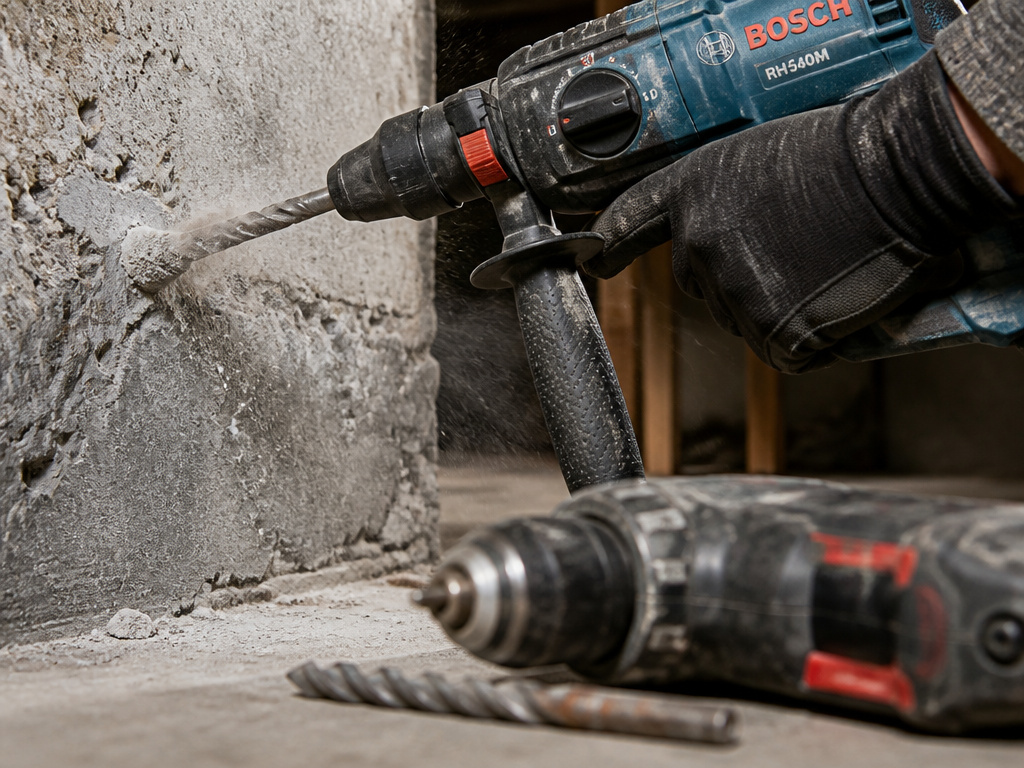 This isn’t about which tool is better. It’s about which tool disappears in your hand because it’s the perfect match for the material. Let’s settle common scenarios.
Scenario 1: Installing a Wall Mount into a Concrete Basement Wall
You need four 3/8-inch holes, 2 inches deep. * Impact Drill: Will do it, but slowly. You’ll lean into the drill with significant pressure for each hole. The drill will get very hot. Expect 4–5 minutes of drilling per hole with a fresh masonry bit. The bit will be extremely worn afterward. * Rotary Hammer: The clear winner. Set it to hammer drill mode, use a 3/8-inch SDS-plus masonry bit. The tool does the work, you just guide it. Each hole is done in under 30 seconds. The bit stays cooler and lasts for dozens more holes. * Verdict: Rotary Hammer.
Scenario 2: Building a Deck, Drilling into Concrete Footings & Driving Lag Bolts
You need to drill pilot holes into concrete pier blocks and then drive large lag bolts into wooden posts. * Impact Drill: Can handle both tasks, but with a swap. Use a masonry bit for the concrete holes (slow, but feasible for small, shallow holes). Then switch to a driver bit to sink the lags. The impact function prevents cam-out and driver fatigue. * Rotary Hammer: Excellent for the concrete holes, useless for driving screws. You would need a second tool. * Verdict: Impact Drill. It’s the single-tool solution for this mixed-material job.
Scenario 3: Removing Old Tile or Chiseling a Doorway in a Masonry Wall
- Impact Drill: Not designed for this. It has no chisel-only mode.
- Rotary Hammer: The only choice. Switch to “hammer only” mode, insert a flat chisel or point chisel, and go to work. The piston mechanism delivers the dedicated, controlled blows needed for demolition.
- Verdict: Rotary Hammer.
Making the Choice: A Simple Decision Matrix
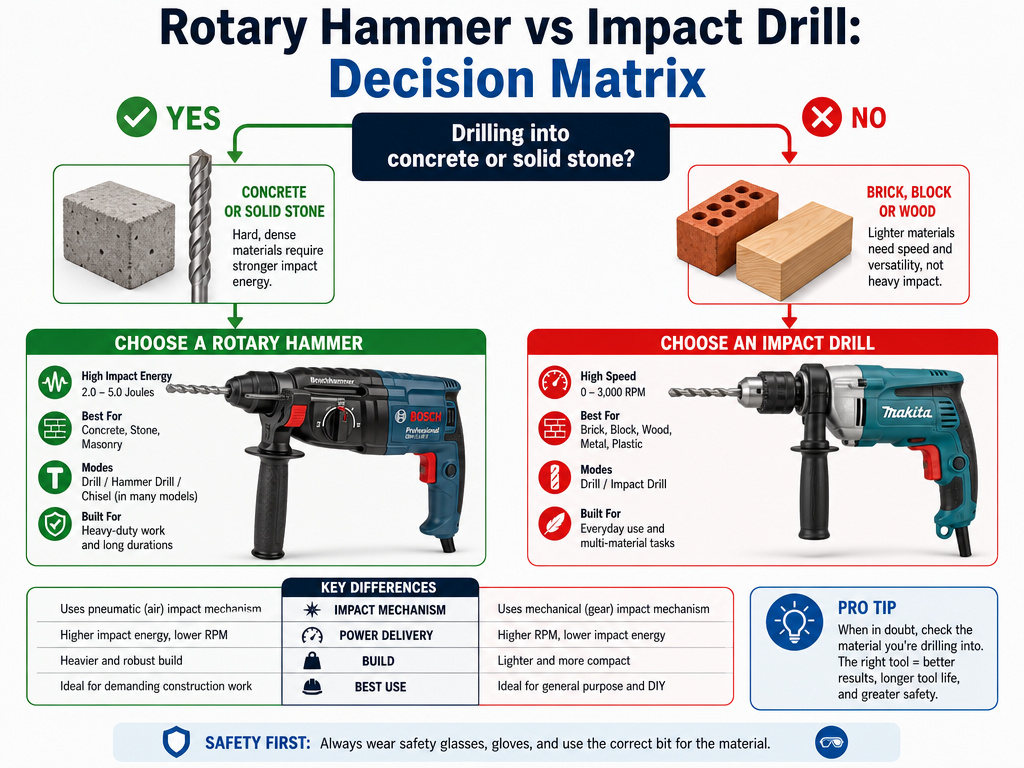 Stop overthinking it. Your next tool purchase should be dictated by the hardest task in your upcoming project queue. Use this matrix.
- List your next 3–5 projects. Be specific about materials.
- Identify the toughest drilling task from that list. Is it drilling into concrete or solid stone?
- Apply the rule: If the answer is YES, and the holes are larger than 1/2-inch or more than a few inches deep, a rotary hammer enters the conversation. If the answer is NO, and your toughest material is brick, block, or dense wood, a robust impact drill is your tool.
For the homeowner with a general workshop: Buy a high-quality impact drill like the Bosch GSB 24-2. It covers 95% of drilling and fastening needs. Rent a rotary hammer the one weekend you need to install a basement safe or hang a garage heater.
For the serious DIYer or light contractor: Invest in a mid-range cordless rotary hammer like the Bosch GBH 18V-26 for your concrete work. Keep your impact drill for everything else. This two-tool combo is the most efficient and cost-effective setup.
For professional concrete work: Your kit must include a heavy-duty rotary hammer. The choice between SDS-plus and SDS-max models depends on daily hole size. The DeWalt DCH416B (SDS-plus) and Bosch GBH 18V-45 C (SDS-max) are industry standards for a reason.
Frequently Asked Questions
Can an impact drill drill into concrete?
It can drill small, shallow holes (under 1/2 inch) in relatively soft concrete or concrete block. It works by abrasion, not fracturing. For any significant concrete work, it is underpowered and risks damaging the tool’s internal hammer mechanism through overheating.
What is the main advantage of a rotary hammer?
Its dedicated piston mechanism delivers significantly more impact energy directly to the bit. This allows it to drill larger, deeper holes in concrete efficiently and enables chiseling and demolition functions that are impossible with an impact drill.
Is SDS-plus better than a regular chuck?
For hammering applications, yes. The SDS (Slotted Drive System) chuck allows the bit to slide back and forth, transferring the hammer blow more efficiently and reducing wear on the tool and bit. It also allows for quick, tool-free bit changes. A regular chuck cannot safely handle this piston-driven force.
Can I use regular drill bits in a rotary hammer?
Only in “rotation only” mode, and you need a chuck adapter (e.g., an SDS-plus to keyless chuck adapter). Using regular twist bits in hammer drill mode will destroy the bits and likely damage the adapter. Always use SDS-shank masonry bits for hammer drilling.
Why is my impact drill not hammering?
The most common cause is a worn or broken cam and hammer mechanism. This is a typical failure mode from using the tool on materials that are too hard, like deep concrete. The rapid, high-frequency impacts fatigue the metal springs and cams. Once broken, the hammering function is usually not economical to repair.
The Bottom Line
You don’t buy a tool for its label. You buy it for the crack of concrete or the set of a screw. The rotary hammer is a specialist, a concrete surgeon. The impact drill is a generalist, a workshop workhorse.
If your projects never leave brick and wood, a powerful impact drill is your only drill. The day you meet a solid concrete wall, you’ll understand why the rotary hammer exists. Its heavy, measured blow changes the work from a battle of attrition to a simple procedure. Keep that distinction clear, and you’ll own tools that last for projects, not just for a weekend.
