What Is a Tap Drill | The 60% Thread Rule That Saves Taps
This post contains affiliate links. As an Amazon Associate, we earn from qualifying purchases.
A tap drill is the specific drill bit used to create the pilot hole before cutting internal threads with a tap. Its size is not the same as the screw’s diameter; it is deliberately smaller to leave enough material for the tap to cut threads into. The goal is a hole that yields between 55% and 75% thread engagement, enough for strong fastening but not so much that it breaks the tap or overheats the workpiece.
That target percentage isn’t arbitrary. It’s the balance point between holding power and tool stress. A hole that’s too small jams the tap. A hole that’s too large leaves threads so shallow they strip under the first real torque. The rest of this guide walks through the three numbers that decide the correct drill: major diameter, pitch, and thread percentage.
What follows: the physics of thread engagement, how to read a chart or do the math yourself, and the material-specific warnings that keep taps from snapping in the hole.
Key Takeaways
- Aim for 60% to 70% thread depth for most metals. This provides strong holding power while drastically reducing tap breakage compared to a 100% thread.
- The drill size is always smaller than the screw’s major diameter. For a 1/4-20 screw (0.250″ major diameter), the common tap drill is a #7 bit (0.201″).
- Softer materials like aluminum need a larger drill. The metal compresses and “springs back,” tightening around the tap. Use a drill for the next lower thread percentage (e.g., 55% instead of 65%).
- Pipe taps are the exception. Never use a percentage rule for them; use only the drill size specified on the tap manufacturer’s chart.
- Drill point angle matters. A 135-degree split-point bit wanders less than a 118-degree bit, giving a more accurate hole diameter for precise threading.
The Core Job of a Tap Drill
A tap doesn’t drill. It only cuts. If you force a tap into solid metal, it will snap before it cuts a single clean thread. The tap drill’s entire purpose is to remove the bulk of the material, leaving just the right amount of metal for the tap’s flutes to shear into helical ridges.
A tap drill creates a pilot hole with a specific minor diameter. The tap then cuts the thread profile between this minor diameter and the screw’s major diameter, leaving the desired percentage of full thread engagement.
Think of it like carving a spiral staircase into a cylinder. The drill makes the central shaft. The tap carves the steps out of the remaining wall. Too thick a wall, and the carving tool jams. Too thin, and the steps crumble under weight.
Thread engagement percentage is the measure of that wall thickness. It’s the ratio of the actual thread depth you cut to the depth of a theoretically perfect, sharp V-thread. A 100% thread means the tap cut all the way to the sharp root of the “V”. This is maximum strength but also maximum friction, heat, and torque on the tap. For most applications, that last 30-40% of material contributes marginal extra strength while multiplying the risk of tap failure.
The OSG-USA Inc. Tapping guide states it plainly: “To minimize tapping problems and lengthen tool life, use the largest drill possible… A minor diameter that provides a 55% to 65% thread is sufficient for most requirements.” That’s the voice of a toolmaker who sees broken taps come back. They’re telling you to back off from the theoretical maximum.
Where This Goes Sideways: The Soft Metal Trap
The standard charts assume you’re tapping mild steel or cast iron. Switch to aluminum or brass, and the rules bend.
Common mistake: Using the same drill size for aluminum as for steel. The soft metal compresses under the tap’s pressure, then springs back inward after the flutes pass. This “material recovery” effectively shrinks the minor diameter, increasing thread engagement beyond what you drilled for.
The tap binds. It squeals. You feel the resistance spike in your wrist. If you don’t reverse immediately, the tap snaps. The fix is to drill a slightly larger pilot hole, effectively planning for the squeeze. For aluminum, drop your target thread percentage by about 10 points. If the chart calls for a 65% thread drill, use the one listed for 55%.
How to Find the Right Tap Drill Size
You have two reliable paths: use a pre-calculated chart, or run the math for your specific needs. Most workshop work lives and dies by the chart. It’s fast. But knowing the math lets you handle oddball threads or material quirks.
The Two-Second Answer: Use a Tap Drill Chart
A good chart cross-references thread size with desired engagement. You look up “1/4-20” and read across to “75% Thread” or “65% Thread” to find the drill bit size. It’s the machinist’s equivalent of a cooking recipe.
| Tap Size (Inch) | Threads Per Inch (TPI) | 75% Thread Drill | 65% Thread Drill | 55% Thread Drill |
|---|---|---|---|---|
| #10-24 | 24 | #25 (0.1495″) | #24 (0.1520″) | #23 (0.1540″) |
| 1/4-20 | 20 | #7 (0.2010″) | 13/64″ (0.2031″) | #3 (0.2130″) |
| 5/16-18 | 18 | F (0.2570″) | 17/64″ (0.2656″) | 9/32″ (0.2812″) |
| 3/8-16 | 16 | 5/16″ (0.3125″) | 21/64″ (0.3281″) | 11/32″ (0.3438″) |
These sizes come from the standard Wikipedia drill and tap chart and manufacturer data. Notice the progression: as you demand less thread engagement (moving right across the table), the recommended drill size gets larger. That larger hole removes more material, leaving less for the tap to cut.
For a 1/4-20 thread in steel, the #7 drill bit is the default. It’s the sweet spot. Want a stronger thread in a tough material? Drop to a #6 drill for ~85% engagement, but be ready for more tapping torque. Working in soft aluminum? Jump to the #3 drill to account for material compression. This is why simply knowing how to tell drill bit size is critical, a #3 isn’t just “smaller,” it’s 0.012″ larger than a #7, which changes everything at the tap.
The Math Behind the Chart
Charts are derived from formulas that relate three variables: the screw’s major diameter, its pitch, and the target thread percentage.
For ISO metric threads (like M6 or M8), the rule is beautifully simple: Major Diameter minus Pitch. An M6x1.0 screw has a 6mm major diameter and a 1mm pitch. 6 – 1 = 5mm. A 5mm drill is the standard starting point for a ~75% thread.
For Unified (inch) threads, the formula from EngineersEdge is:
Drill Size = Major Diameter - (0.01299 × Percent of Full Thread / Threads Per Inch)
Take that 1/4-20 again. For a 75% thread: 0.250 – (0.01299 × 75 / 20) = 0.250 – 0.04871 = 0.2013 inches. That rounds to the #7 drill at 0.2010″. The formula confirms the chart.
Why does this matter? If you need a 50% thread in brittle plastic, you can calculate the exact drill needed, even if it’s a non-standard size. You’re not guessing. You plug in the numbers, get a diameter, and find the nearest drill bit type in your kit.
The 3 Factors That Change the Drill Size
The chart gives you a baseline. Three real-world factors then push you off that number.
1. Material Hardness and “Cutting Action”
We covered the soft-metal squeeze. Hard materials like stainless steel or tool steel behave differently. They work-harden. A dull tap or a drill hole that’s slightly too small can glaze the surface, making it even harder to cut. For these, you might stay at the 65-70% thread range, but you must use a sharp, high-quality tap and ample cutting fluid. A cobalt vs HSS drill bits choice matters here, cobalt holds its edge longer in tough alloys, giving you a cleaner, more consistent pilot hole.
2. Drill Point Geometry and Wander
The hole in your chart is a perfect cylinder. The hole your drill makes is not. A standard 118-degree point has a tendency to “walk” on curved or angled surfaces. If your pilot hole starts off-center, your threads will be off-center. A 135-degree split-point bit bites immediately and drifts less. For critical tapping, the 118 vs 135 drill bit decision isn’t academic. The 135-degree point gives you a truer hole, which means more uniform thread engagement around the entire circumference.
3. Tap Type and Coating
A spiral-point tap pushes chips ahead of it, perfect for through-holes. A spiral-flute tap pulls chips up and out, essential for blind holes. If chips jam in a blind hole, they can increase effective engagement to 100% and snap the tap. Your drill size might need to be on the larger side (lower thread percentage) to give chips more room to escape. Similarly, a black oxide vs titanium drill bits coating affects heat and friction in the drilling stage, which can slightly alter the final hole size due to thermal expansion.
What Happens When You Get the Drill Size Wrong?
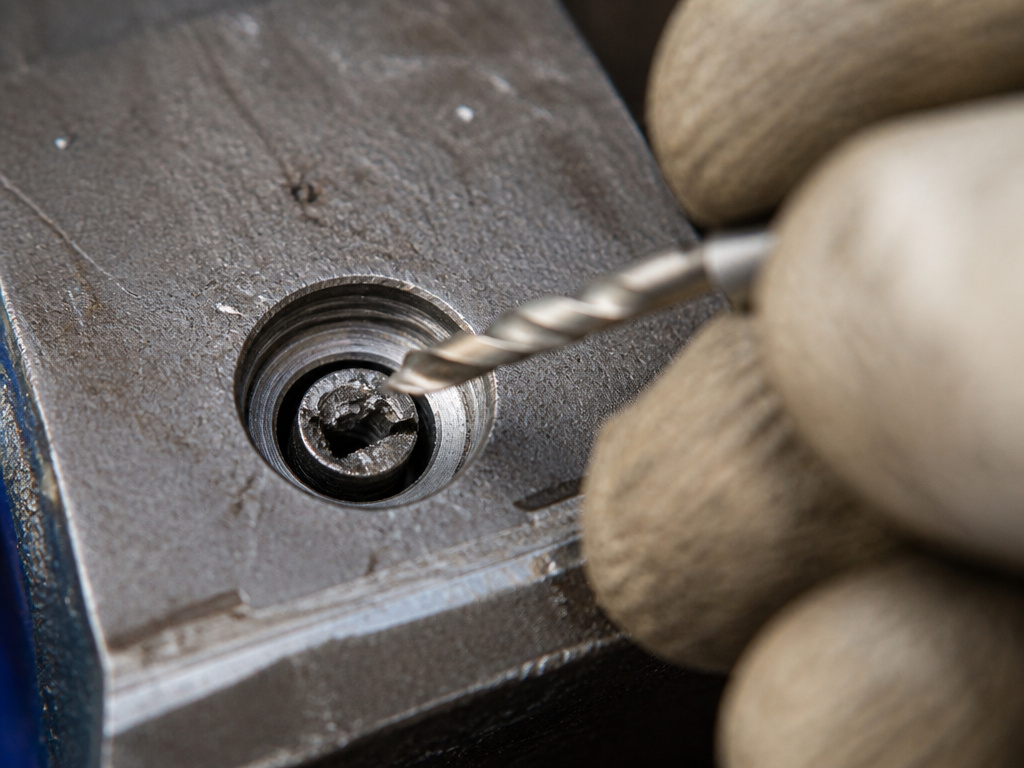
The consequences are physical, immediate, and expensive.
Drill is too SMALL (hole is undersized):
- Increased tapping torque. The tap must cut more metal. Your tap wrench or drill press will strain.
- Excessive heat. Friction from cutting all that metal heats up the tap and workpiece. In steel, this can draw the temper from the tap, softening it.
- Tap breakage. This is the most common outcome. The tap, overloaded, snaps off flush with the workpiece. You now have a hardened steel plug embedded in your part. The next step is drilling out a broken bolt, which is a whole new, frustrating project.
Drill is too LARGE (hole is oversized):
- Reduced thread engagement. The tap cuts shallow, weak threads.
- Stripped threads. The screw seats easily but has little material to grip. Under load, the threads shear right out of the hole. In a metal part, this often means you need to drill and tap for the next larger screw size, or use a threaded insert.
- Loose fastener. The screw may never feel tight, leading to vibration-induced loosening.
Easy to miss: The difference between a #6 (0.2040″) and a #7 (0.2010″) drill for a 1/4-20 tap is only three thousandths of an inch. That tiny difference shifts thread engagement by roughly 10%. Precision isn’t optional.
Special Case: Pipe Taps and Why Percentages Fail
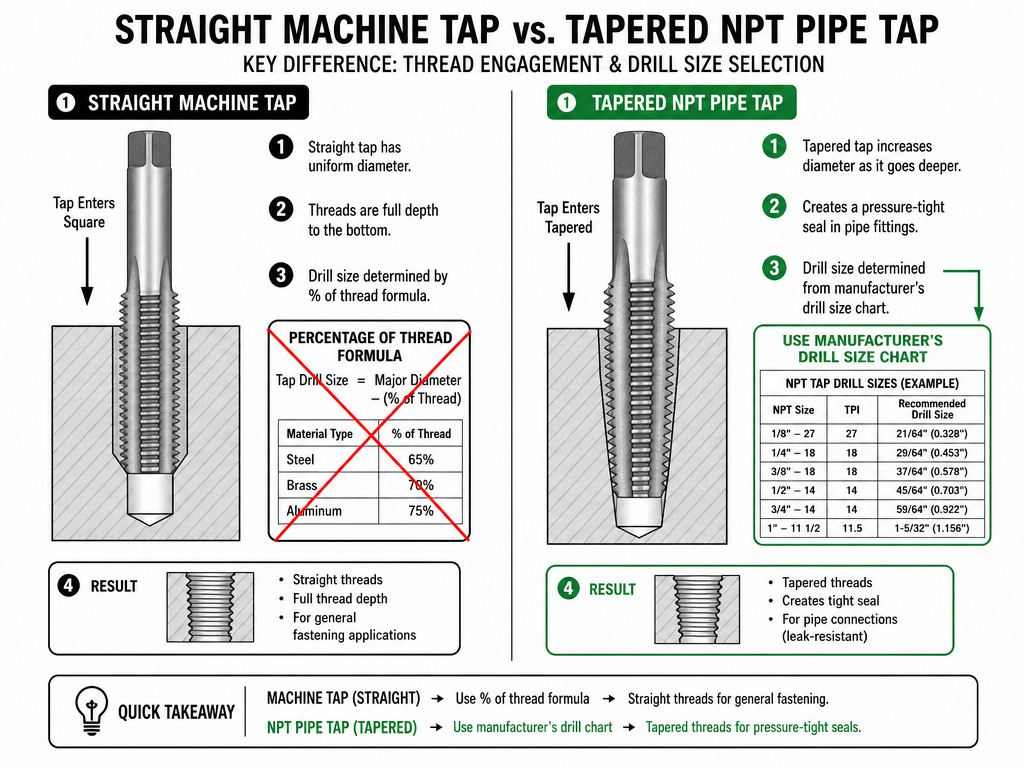
NPT (National Pipe Taper) threads are a different beast. The tap itself is tapered, and the goal is a sealed joint, not just a mechanical fastener. The percentage-of-thread formulas do not apply.
The part nobody mentions: It is not recommended to use varying percentages for finding the proper drill with pipe taps. (Source: ICSCuttingTools.com)
For pipe threads, you must use the drill size specified by the tap manufacturer. This size is calculated to create the correct minor diameter at a specific depth in the taper to ensure a proper seal. Guessing with a standard chart will almost certainly result in a leak.
How to Choose and Use a Tap Drill
- Identify your thread. Is it 1/4-20? M8x1.25? NPT 1/4? Write down the major diameter and pitch/TPI.
- Consult a chart. For standard threads, find the row. For a strong general-purpose thread in steel, select the 65%-75% thread drill column. This is your target size. For a 1/4-20 tap drill bit, that’s the #7.
- Adjust for material. For aluminum, brass, or plastic, move one column to the right (larger drill, lower percentage). For very hard steels, ensure your drill and tap are sharp and lubricated, but you can use the chart size.
- Select the correct drill bit. Match the exact size from the chart. Know your drill bit size system, number, letter, or fraction. A 5/16 tap drill bit is different from a 3/8 inch tap drill bit.
- Drill the pilot hole. Use a center punch, drill perpendicularly, and apply steady pressure. Use cutting fluid for metals. The goal is a clean, round, accurately sized hole.
- Tap the hole. Start the tap square. Use a tapping fluid. Turn forward one full turn, then back half a turn to break chips. Feel the resistance. If it gets excessively hard, stop. Your drill size may be wrong, or your tap is dull.
| Symptom While Tapping | Likely Cause | Immediate Fix |
|---|---|---|
| Sudden, severe resistance | Drill too small / Tap dull | Reverse tap, remove, check drill size. |
| Tap feels loose, cuts no chips | Drill too large | Hole is scrap. May need helical insert. |
| Crooked or difficult start | Hole not perpendicular / No center punch | Stop. Realign or start new hole in correct location. |
| Chips jamming in blind hole | Wrong tap type (spiral point) | Use spiral-flute tap for blind holes. |
Frequently Asked Questions
Can I use a regular drill bit as a tap drill?
Yes, if it’s the exact correct size. A “tap drill” is defined by its diameter, not a special feature. Any drill bit type. HSS, cobalt, titanium, of the right size will work. The critical thing is that it’s sharp and produces an accurate hole.
What’s the difference between a tap drill and a clearance drill?
Tap drill makes a hole smaller than the screw to allow for threads. A clearance drill makes a hole larger than the screw’s major diameter so the screw can pass through freely without threading. Don’t confuse them. Using a clearance drill size for a tap drill leaves you with no threads at all.
Why are there letter and number drill sizes?
Fractional drill bits jump in 1/64″ increments (0.0156″). That’s too coarse for precise tap drill sizing. The number (1-80) and letter (A-Z) series fill in the gaps between fractions, giving machinists the exact diameters needed for threads. A #7 drill at 0.2010″ sits between 13/64″ (0.2031″) and 3/16″ (0.1875″).
How do I tap without a drill press?
You can tap by hand with a guide. The key is starting square. Use a center punch, drill your pilot hole carefully with a hand drill, then use a tap guide or a square to help start the tap straight. Go slow. The lack of rigidity makes it even more critical to have the correct drill bit for 5/16 tap or whatever size you’re using, an oversized hole from drill wander is a bigger risk.
Is a tap drill the same as a drill bit?
In form, yes. In function, no. All tap drills are drill bits, but not all drill bits are tap drills. A tap drill is chosen for a specific threading operation, while other bits are for drilling out a broken bolt, wood boring, or masonry. Understanding the drill bit vs screw bit distinction is also key, they are not interchangeable in a power tool.
The Bottom Line
A tap drill is the first and most important decision in making a strong threaded hole. Its size dictates whether the tap glides through or snaps off. Forget the old idea of “drill a hole slightly smaller than the screw.” That’s how you break tools.
The rule is 60% to 70% thread engagement. For a 1/4-20 thread in steel, that’s a #7 drill bit. For soft aluminum, go one size larger. For pipe threads, ignore percentages and use the manufacturer’s specified drill. Your choice of drill bit materials and coatings affects the quality of the pilot hole, which directly affects the quality of the thread.
Get the drill size right, and tapping becomes a predictable, satisfying process. Get it wrong, and you’ll spend the afternoon extracting broken steel. The chart does the math for you. Use it.
