What Drill Bit for 3/8 Tap? Master the 5/16″ Pilot Hole
This post contains affiliate links. As an Amazon Associate, we earn from qualifying purchases.
The correct drill bit for a 3/8-16 tap is a 5/16″ (0.3125″) bit. That size creates the 75% thread engagement most machinists target for a strong, clean thread in steel. The math is simple: the major diameter of a 3/8″ bolt is 0.375″, and the pitch for 16 threads per inch is 0.0625″. Subtract the pitch from the major diameter, and you get the tap drill size: 0.3125″, which is 5/16″.
That 5/16″ spec is the starting line, not the finish. The material you’re drilling changes the game. Run that bit into stainless steel at the same speed you’d use for pine, and you’ll burn the cutting edge before the hole is halfway through. The bit will skate, the tap will bind, and you’ll snap a $12 tap off in a $50 workpiece. The difference between a clean thread and a ruined part is three variables: the bit’s point angle, the cutting speed, and whether you’re using cutting fluid.
What follows is the breakdown of those three variables, the one-tool alternative that skips the math, and the specs for the tools that actually survive the job.
Key Takeaways
- The universal tap drill size for a 3/8-16 thread is 5/16″ (0.3125″) for a standard 75% thread in most materials.
- For hardened materials like stainless steel, a slightly larger ‘F’ drill bit (0.2570″) or 21/64″ (0.3281″) is often recommended to reduce tap breakage.
- A combination drill/tap bit like the Greenlee DTAP3/8-16 drills, taps, and countersinks in one operation, but is only rated for material up to 10-gauge thickness.
- Always use a split-point 135° drill bit for metal to prevent walking, and a spiral-point tap to push chips forward and avoid reaming the hole.
- The wrong RPM or lack of cutting oil will dull a bit or snap a tap long before the thread is complete.
The 5/16″ Answer and Why It’s Non-Negotiable
A 3/8-16 tap needs a 5/16″ pilot hole. This isn’t a suggestion; it’s the product of a standardized formula. The major diameter (the outer width of the bolt) is 0.375″. The pitch (the distance between threads) for 16 TPI is 0.0625″. For a 75% thread — the standard balance of strength and ease of tapping — you subtract the pitch from the major diameter: 0.375″ – 0.0625″ = 0.3125″, which is exactly 5/16″.
The ISO 3438:2013 standard for subland twist drills, which covers tools for holes prior to tapping, specifies precise dimensions for this pre-tapping operation, underscoring that this isn’t guesswork.
That 75% figure is the sweet spot. Go smaller, say with a ‘Q’ drill bit (0.3320″), and you’re forcing the tap to cut too much material. The torque required skyrockets, the tap is more likely to break, and the threads can work-harden in stainless steel, making them brittle. Go larger, like with a 21/64″ bit (0.3281″), and you get around 60% engagement. The threads will be weaker, but the tap cuts much easier, which is a valid trade-off for hard or abrasive materials.
This is where your material choice dictates the rules. For mild steel, aluminum, or brass, the 5/16″ bit is the direct path. For stainless steel or hardened alloys, that same bit can be a trap. The increased cutting resistance often calls for the slightly larger 21/64″ hole to prevent tap seizure. Your first step in selecting a drill bit should always be identifying the metal grade.
The One-Tool Fix: Combination Drill/Taps
If the two-step drill-then-tap process feels like a chore, a combination drill/tap bit is the alternative. It looks like a drill bit with threads machined into its shaft. You chuck it up and push; it drills the pilot hole and then cuts the threads in a single, continuous motion. The Greenlee DTAP3/8-16 is the classic example — a high-speed steel tool with a 1/4″ hex shank that drills, taps, and even deburrs in one pass.
Where this goes sideways: Using a combination bit on material thicker than its rated capacity. The Greenlee is rated for 10-gauge mild steel (about 0.1345″). Try it on 1/4″ plate, and the tap section binds in the deep hole, snaps the tool, and leaves broken steel embedded in your workpiece.
These tools are brilliant for sheet metal, electrical enclosures, or joining thin brackets where you’re making many identical holes. They eliminate alignment error between the drill and tap stages. But they come with hard limits. The Kent Automotive 1148337 has a stated material capacity of 3/4″, but that’s for softer metals. In practice, for steel, treat anything over 1/4″ as a risk.
| Model | Shank | Max Thickness (Steel) | Best For | Risk If Exceeded |
|---|---|---|---|---|
| Greenlee DTAP3/8-16 | 1/4″ Hex | 10 GA (~0.135″) | Electrical boxes, HVAC duct, thin brackets | Tap binds and snaps, tool ruined |
| Viking 73934 | 1/4″ Hex | Not Specified | General fabrication in stainless/steel | Premature wear, poor thread finish |
| Kent Automotive 1148337 | 11/32″ Round | 3/4″ (soft metals) | Softer metals like aluminum, brass | Increased torque, potential breakage |
The trade-off is speed for precision. For a one-off hole in thick stock, the traditional two-step method with a dedicated tap drill and tap gives you more control and is far less likely to break. For a production run on thin material, the combination tool saves measurable time.
Drill Bit Specs That Actually Matter
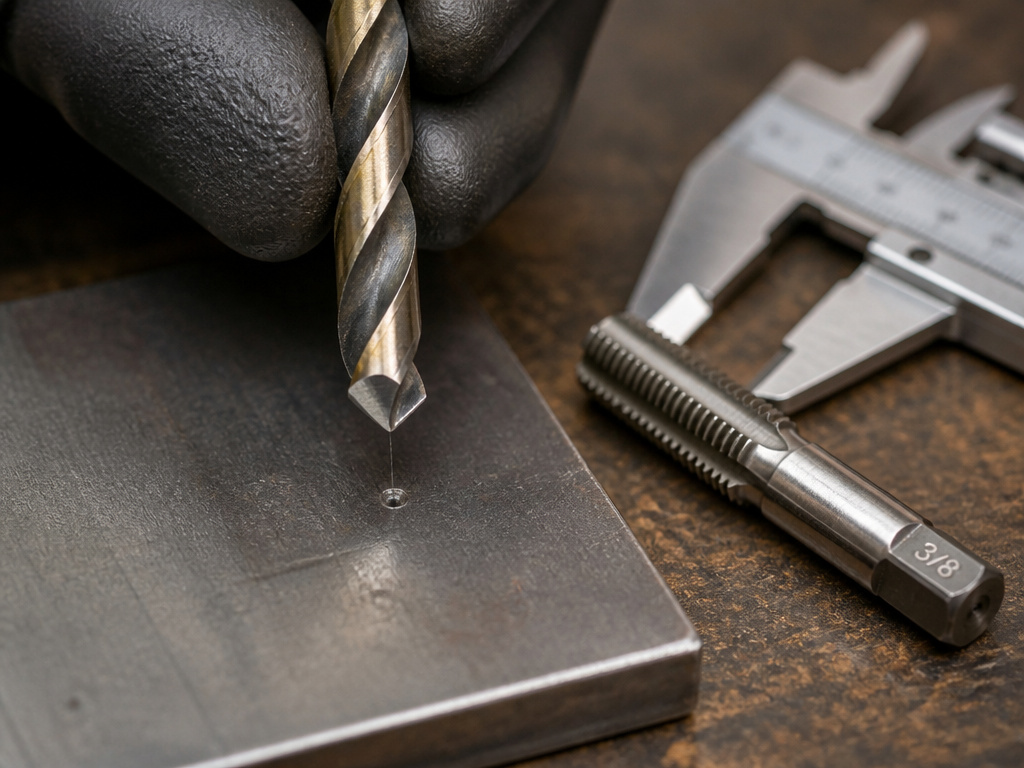
Not all 5/16″ bits are created equal. The wrong point angle or flute design turns a simple job into a fight.
- Point Angle: Use a 135° split point bit for metal. The steeper angle and split tip keep the bit from “walking” off your center punch mark on curved or hard surfaces. A standard 118° point, common on wood bits, will skate and scar your workpiece.
- Flute Length: A jobber-length bit is the default for most through-holes. For deeper holes, you need a longer “aircraft extension” bit. The definition of a jobber drill bit is a flute length about 9-14 times the diameter—for a 5/16″ bit, that’s roughly 3-4.5 inches of cutting flute.
- Material: High-speed steel (HSS) is the minimum for steel. For stainless or frequent use, a cobalt HSS bit resists heat better. For the ultimate in hardness and heat resistance, solid carbide bits like the Haas Tooling 03-0021 exist, but they’re brittle and expensive, meant for CNC machines, not hand drills.
The differences between 118 and 135 degree bits come down to aggression and control. The 118° point cuts faster but is more prone to wander. The 135° point requires more downward pressure but starts exactly where you point it, which is non-negotiable for accurate tapping. If your bit doesn’t have a split point drill bit design, grind a small notch in the chisel edge at the tip before you start. It stops the walking.
Tapping: The Step Everyone Rushes
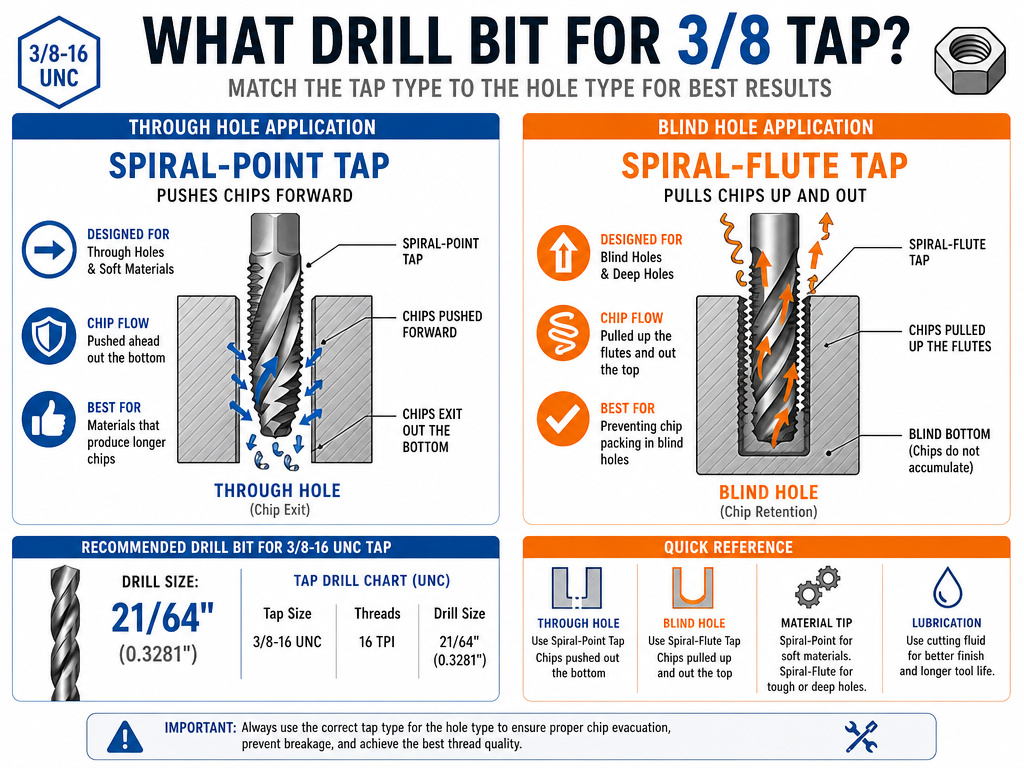
Drilling the hole is only half the battle. Tapping is where threads are made or destroyed. The tool choice here is just as critical.
- Tap Type: For a through-hole (where the bolt passes completely through), use a spiral-point tap. It pushes chips forward and out ahead of the tool, which keeps the flutes clear. For a blind hole (a hole that doesn’t go all the way through), you must use a spiral-flute tap or a gun tap. These pull chips back up and out of the hole. Using a spiral-point in a blind hole packs chips at the bottom and jams the tap.
- Technique: The mantra is “quarter turn forward, half turn back.” After every quarter rotation cutting in, reverse half a turn to break the chip. This prevents the tap from loading up with a single, long, stringy chip that can seize the tool. If you’re using a tap handle, keep the tap as perpendicular to the work as possible. A slight angle will cut an oval, crooked thread.
- Lubrication: This is not optional. For steel, use a heavy-duty cutting oil or paste. For aluminum, use a fluid like WD-40 or kerosene. For stainless, you need a tapping compound specifically formulated for it. The lubricant does three jobs: it cools the tap, reduces friction, and helps flush chips. A dry tap in stainless will gall and weld itself to the workpiece in seconds.
Common mistake: Tapping straight through without backing off. The tap loads up with a continuous metal ribbon, increases torque until it binds, and then snaps at the neck. You’ll hear a sharp ping and feel the handle go slack.
Speed, Feed, and the Physics of Breaking Things
Running your tools at the wrong speed guarantees a bad finish or a broken tool. The rules are different for drilling and tapping.
For drilling the 5/16″ pilot hole in steel with an HSS bit: * RPM: Aim for about 1,000 RPM for a hand drill. The formula is (4 x Cutting Speed) / Diameter. For mild steel, the cutting speed is around 100 surface feet per minute (SFM). (4 x 100) / 0.3125 = ~1,280 RPM. Slightly slower is safer for hand control. * Feed Pressure: Apply steady, firm pressure. Let the bit cut. If you see smoke or hear a high-pitched squeal, you’re going too fast with too little pressure, creating heat instead of chips.
For tapping, especially by hand, speed is your enemy. * RPM: If using a drill press or a very low-speed cordless drill on its lowest torque setting, you might get away with 100-200 RPM. Almost always, you should tap by hand with a T-handle. Feel is everything. * The Breakage Zone: Taps almost always snap during reversal (backing out) or when they hit the bottom of a blind hole. Be extra deliberate with your “half turn back” to clear chips during reversal.
When the Standard Size Doesn’t Fit
The 5/16″ rule has two common exceptions dictated by material and desired thread strength.
- For Harder Materials (Stainless, Tool Steel): Use an ‘F’ drill bit (0.2570″) or 21/64″ (0.3281″). The larger hole reduces the amount of material the tap must cut, lowering the risk of the tap seizing and breaking. You sacrifice some thread strength for a much higher success rate.
- For Maximum Strength in Soft Materials: Use a ‘Q’ drill bit (0.3320″). This creates a tighter, nearer-to-100% thread engagement, which is stronger in soft metals like aluminum or brass where stripping is a concern. The trade-off is dramatically increased tapping torque.
Here’s a quick reference for when to deviate:
| Scenario | Drill Bit Size | Thread Engagement | Reason |
|---|---|---|---|
| Standard 75% Thread (Mild Steel, Brass) | 5/16″ (0.3125″) | ~75% | Balanced strength and tapping ease |
| Hard/Stainless Steel (Reduce Breakage) | 21/64″ (0.3281″) | ~60% | Less material to cut, lower tap stress |
| Soft Metal (Aluminum) for Max Strength | ‘Q’ (0.3320″) | ~65% | Softer metal can handle higher engagement without galling |
| Precision Machine Work | ‘F’ (0.2570″) | Varies | Used with specialized thread-forming taps, not cutting taps |
Choosing the right size is a balance of the material’s hardness, the tap’s fragility, and the required strength of the final joint. When in doubt on stainless, go one size larger.
Tool Checklist: What You Need vs. What You Want
You can get by with a hand drill, a 5/16″ bit, a 3/8-16 tap, and a wrench. Doing it well requires a few more items that prevent frustration.
The Bare Minimum:
- Center Punch & Hammer
- 5/16″ HSS Drill Bit (135° split point)
- Cordless Drill or Drill Press
- 3/8-16 Spiral-Point Tap
- Tap Wrench or T-Handle
- Cutting Fluid (oil for steel, WD-40 for aluminum)
- Safety Glasses
What Makes It Professional:
- Drill Press: Eliminates angle error. Critical for deep or precise holes.
- Tap Guide: A sleeve that holds the tap perfectly vertical in a drill press chuck. This alone prevents more broken taps than any other tool.
- Combination Drill/Tap Bit (Greenlee DTAP3/8-16): For repetitive work in sheet metal under 10-gauge.
- Cobalt HSS Drill Bit: For stainless steel or production runs. Stays sharper longer under heat.
- Thread Gauge: To check your work. A 3/8-16 bolt should screw in smoothly by hand after tapping.
The drill press and tap guide are force multipliers. They turn a skill-based operation into a repeatable process. If you’re doing more than two holes, they pay for themselves in saved taps and time.
Frequently Asked Questions
Can I use a regular 5/16″ wood drill bit?
No. Wood bits have a spur point for grabbing wood and a 118° angle. They will skate on metal, burn up quickly, and produce a rough, oversized hole. You need a metal-cutting bit with a 135° split point.
What if I don’t have a 5/16″ bit?
The closest standard size is 8mm (0.3150″), which is only 0.0025″ larger than 5/16″ (0.3125″). This is an acceptable substitute in most non-precision applications. A 21/64″ bit (0.3281″) is too large for a standard 75% thread.
Why did my tap break even with the right size hole?
The three most common reasons are lack of lubrication, not backing out to clear chips, or the tap hitting the bottom of a blind hole. In stainless steel, even with oil, the tap can work-harden the material and seize if you don’t use a specific stainless tapping compound.
Is a combination drill/tap bit as strong as a separate tap?
No. The tap section on a combination bit is shorter and often has less flute clearance than a dedicated tap. It’s designed for speed in thin material, not for the sustained cutting force needed in thick stock. For holes deeper than 1/4″ in steel, use separate tools.
How do I know if I’m drilling at the right speed?
Listen and look. The sound should be a consistent, medium-pitch cutting noise. You should see steady, curled chips coming out of the hole, not dust or smoke. Dust means the bit is rubbing, not cutting. Smoke means it’s overheating. Slow down and apply more pressure.
The Bottom Line
For a 3/8-16 tap, start with a 5/16″ (0.3125″) high-speed steel drill bit with a 135° split point. That’s the answer. The real work is in the execution: punch your mark, drill perpendicular, flood the hole with cutting oil, and tap with a deliberate quarter-turn forward, half-turn back rhythm. If you’re making more than a few holes in material under 1/8″ thick, buy the Greenlee DTAP3/8-16 combination bit. It turns two operations into one. For everything else—especially stainless steel or thick plate—stick with the two-step method. Your taps will thank you.
