
1/4-20 Tap Drill Bit Size: #7 or 13/64″? The Right Choice
This post contains affiliate links. As an Amazon Associate, we earn from qualifying purchases.
Use a #7 drill bit (0.2010 inches) or a 13/64″ bit (0.2031 inches) for a standard 1/4-20 UNC tap. This creates a pilot hole that allows for about 75% thread engagement, the sweet spot between strength and not breaking your tap. If your tap is marked “17/64” or “STI,” it’s for a Heli-Coil insert and needs the larger hole.
That #7 versus 13/64 difference is where shop-floor arguments start. They’re functionally the same for most materials. The #7 is the ANSI preferred size, but a 13/64″ bit is within the acceptable tap drill range per manufacturer specs like Guhring’s. The real mistake is not checking the tap itself for a hidden “STI” marking.
What follows: the sourced numbers that settle the #7 debate, the one marking on your tap that changes everything, and the tool that lets you drill and tap in one motion without swapping bits.
Key Takeaways
- The #7 drill bit (0.2010″) is the ANSI-standard pilot hole for a 1/4-20 tap. A 13/64″ bit (0.2031″) also works and is within OEM tolerance ranges.
- If your tap is marked “17/64” or “STI,” it’s for installing a Heli-Coil thread insert. Use the 17/64″ bit, or the tap will bind and snap.
- Thread engagement around 75% is the target. Less than 65% weakens the hold; more than 80% drastically increases tap breakage risk in steel.
- For blind holes in steel, a spiral flute tap (like a Guhring 3964) clears chips. For through holes in mild steel, a spiral point tap is faster.
- A combination drill/tap bit (Greenlee DTAP1/4-20) drills, taps, and countersinks in one operation, but only in material under 1/2″ thick.
The Correct Drill Bit for a Standard 1/4-20 Tap
Forget the fractions for a second. The machine answer is a number: 0.2010 inches. That’s the diameter of a #7 drill bit, and it’s printed in every standard tap drill chart for the 1/4-20 UNC thread.
For a 1/4-20 Unified National Coarse (UNC) thread, the standard tap drill size is a #7 drill (0.2010 inch / 5.11 mm). This size produces approximately 70-75% thread engagement in most materials, balancing tensile strength with reduced tapping torque. The alternative 13/64″ drill (0.2031 inch) is also acceptable and falls within the specified tap drill range for commercial class 2B fits.
Why 0.2010 inches and not the bolt’s 0.250-inch diameter? A tap doesn’t just make a hole bigger, it cuts away material to form the crests and roots of the thread. The drill bit makes the “minor diameter,” the bottom of the thread valley. The 0.049-inch difference between the drill size and the bolt size is what becomes the thread height.
Thread engagement is the percentage of that theoretical thread height you actually cut. A #7 bit gives you about 75% engagement. That’s the engineering default because it’s strong without being brutal on the tap.
| Target Thread Engagement | Drill Bit Size | When to Use It | Risk If You Deviate |
|---|---|---|---|
| ~75% (Standard) | #7 (0.2010″) | Most materials (steel, aluminum, brass) | Going smaller risks tap breakage. Going larger weakens pull-out strength. |
| ~65% (Fine Adjustment) | 13/64″ (0.2031″) | Softer metals (e.g., aluminum), worn taps, or when tapping feels stiff | Slightly weaker thread, but much lower tap breakage risk in tough spots. |
| ~50% (High-Strength Mats) | 7/32″ (0.2188″) | Very hard steels or stainless where tap breakage is the primary concern | Significantly reduced shear strength; bolt may strip threads under load. |
The 13/64″ bit is your escape valve. It’s 0.0021 inches larger, dropping thread engagement a few percent. If you’re tapping freehand with a cordless drill or working in gummy aluminum, that tiny extra clearance can be the difference between a clean thread and a snapped tap. Both sizes are valid. The Guhring catalog lists a tap drill range of 0.196 to 0.207 inches for a 1/4-20 tap with an H4/H5 class of fit, so both #7 and 13/64″ are inside the lines.
This is the core of selecting a drill bit: match the bit to the job of the tap, not the bolt.
The STI Tap Trap: When 17/64″ Is Actually Correct
Here’s the moment that wastes an afternoon. You grab a 1/4-20 tap from your kit. Every chart says #7. But stamped right on the shank is “17/64”. You drill a #7 hole, start tapping, and the tool binds solid after two turns. What gives?
You have an STI tap, a Screw Thread Insert tap. It’s not for cutting standard threads. It’s for cutting an oversized hole that accepts a helical coil insert (like a Heli-Coil), which then provides the standard 1/4-20 thread inside it.
Where this goes sideways: Using a #7 drill bit with an STI tap. The tap is designed for a 17/64″ (0.2656″) hole. Forcing it into a smaller hole will jam it instantly, and the hardened steel will almost certainly snap before the workpiece gives way.
This isn’t a mistake you make twice. I learned it after ruining a motorcycle engine case. The tap looked identical to any other 1/4-20 in the drawer. The “STI” marking was faint, but the “17/64” was clear. I assumed it was a manufacturer’s odd recommendation. It wasn’t.
| Tap Type | Marking Clue | Correct Drill Bit | Purpose |
|---|---|---|---|
| Standard Cutting Tap | “1/4-20” or “1/4-20 NC” | #7 or 13/64″ | Cuts threads directly into the workpiece material. |
| STI (Screw Thread Insert) Tap | “17/64” or “STI” on shank | 17/64″ (0.2656″) | Cuts oversized threads to install a Heli-Coil-style insert. |
| HELICOIL Tap (Typ 0140.0) | Specific item number (e.g., 0140.003.0104) | Per insert datasheet | Cuts threads for HELICOIL Plus inserts in materials up to 700 N/mm² strength. |
If you’re repairing stripped threads in aluminum or adding durable threads to soft material, you need the STI tap and the corresponding insert kit. If you’re just making a new thread in a block of steel, you need the standard tap. Check the tool before you drill.
This is a specific case where knowing how to tell drill bit size isn’t enough, you have to read the tap.
Drill and Tap in One Motion: The Combo Bit Shortcut
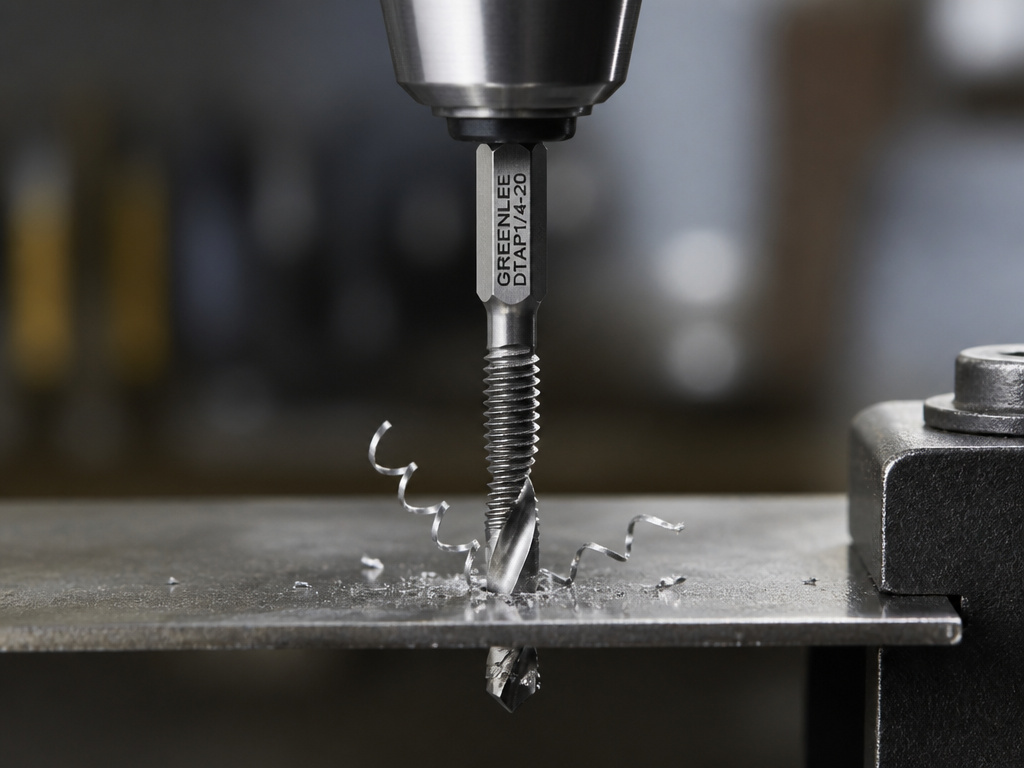
For a row of holes in thin material, stopping to swap from a drill bit to a tap is busywork. A combination drill/tap bit does both jobs in one pass. The Greenlee DTAP1/4-20 (Catalog No. 17616) is the classic example.
This tool has a split-point drill tip, a threaded tapping section, and a tapered end that countersinks. You run it in with a drill on slow speed, and it literally pulls itself through the material. The official datasheet states it can drill and tap up to 1/2″ mild steel in its long-length version.
Worth knowing before you start: Always reverse the drill rotation to back the bit out. For material thicker than 1/4″, the instructions say to stop and reverse mid-way to clear chips. If you don’t, packed chips will weld to the flutes and strip the threads you just cut.
The limitation is depth and control. It’s fantastic for sheet metal, brackets, or mounting plates under 1/2″ thick. For a deep blind hole in a thick block, you need the control of a separate tap drill and hand tap. The combo bit wants to feed aggressively; in a deep hole, that can lead to broken bits if the chips don’t clear.
They’re also material-sensitive. They work best in consistent, machinable metals like mild steel, brass, and aluminum. Avoid them in cast iron or stringy stainless steel where chip clearance is a constant fight.
Matching the Tap to Your Material and Hole Type

The drill bit is half the equation. The tap’s geometry decides whether you get clean threads or a bag of broken steel.
For a through hole (where the thread goes all the way through the material), use a spiral point tap (also called a gun tap). The flutes are ground at an angle that pushes chips forward and out the bottom of the hole. It’s fast and keeps the hole clean. A Guhring 3904 series tap is a standard ANSI spiral point design.
For a blind hole (where the thread stops before exiting the material), you must use a spiral flute tap. Its flutes are helical, like a drill bit, and they drag chips back up and out of the hole as you turn. If you use a spiral point tap in a blind hole, chips pack at the bottom, pressure builds, and the tap snaps. Every time. A Guhring 3964 series tap is built for this.
Material strength caps your options. A HELICOIL manual tap (Typ 0140.0) is explicitly rated for materials with a strength up to 700 N/mm². Trying to use it on hardened tool steel past that limit will chip the cutting edges on the first revolution.
The other spec is class of fit. For a 1/4-20 UNC, a 2B or 3B class is standard. A 2B fit is tighter, for precision assemblies. A 3B fit is looser, for general use where a little slop is fine. Your drill bit size remains the same (#7), but the tap’s own manufactured tolerances are different.
Step-by-Step: Drilling and Tapping a 1/4-20 Hole
- Identify the tap. Look for “1/4-20” and check for “STI” or “17/64.” If it’s an STI tap, grab a 17/64″ bit. For a standard tap, proceed with a #7 bit.
- Secure the workpiece. Clamp it in a vise or to your bench. Tapping requires steady, aligned pressure; a wobbly part guarantees a crooked thread.
- Drill the pilot hole. Use a sharp #7 jobber drill bit. For metal, use cutting fluid and a slow, steady feed. Drill perpendicular to the surface.
- Deburr the hole. Use a countersink or a larger drill bit by hand to break the sharp edge at the top of the hole. This helps the tap start straight.
- Set up the tap. Mount the tap in a T-handle tap wrench for control. For machine tapping, use a adjustable tap holder in your drill press or mill.
- Start tapping. Align the tap perfectly vertical. Apply downward pressure and turn clockwise about two full turns. For blind holes, use a spiral flute tap.
- Reverse to break chips. After every one to two turns forward, reverse a half-turn. This snaps the metal chips and clears them from the flutes.
- Test the fit. Once the tap goes through (or reaches depth), back it all the way out. Blow out the hole. Test with a 1/4-20 bolt, it should screw in smoothly by hand.
Common mistake: Forcing the tap when it binds. The instant you feel a hard bind, stop. Reverse to clear chips, add more cutting oil, and try again gently. More force is how you turn a $5 tap into two pieces of scrap.
If the bolt fits but feels gritty, you might have a slight mismatch. This is where knowing the 118 vs 135 drill bit point angle matters, a 135-degree split-point bit often walks less, giving you a straighter starter hole for a cleaner thread.
Frequently Asked Questions
Can I use a 7/32 drill bit for a 1/4-20 tap?
You can, but you shouldn’t for a standard thread. A 7/32″ bit (0.2188″) is drastically oversized, resulting in only about 50% thread engagement. The threads will be shallow and weak, stripping easily under load. Only use this in an emergency or if you’re deliberately cutting weak threads for a temporary fixture.
What if I only have metric drill bits?
The nearest metric equivalent to a #7 bit (0.2010″) is a 5.1 mm bit (0.2008″). A 5.2 mm bit (0.2047″) is slightly larger, closer to a 13/64″ bit. Both will work. The 5.1 mm is the better choice for full-strength threads in steel.
Why does my tap keep breaking?
Three likely reasons. First, the pilot hole is too small or you used an STI tap in a standard hole. Second, you’re not clearing chips in a blind hole, causing hydraulic lock. Third, you’re not keeping the tap aligned, forcing it sideways and snapping it. Always use cutting oil, go slow, and reverse often.
Is a hand tap different from a machine tap?
The cutting geometry is often identical. The difference is the shank. Machine taps have a straight shank for a collet or holder. Many hand taps have a square drive on the end for a tap wrench. You can use a machine tap by hand, and you can use most hand taps in a drill press with a proper adjustable tap holder.
The Bottom Line
For a standard 1/4-20 thread, drill the hole with a #7 bit. Keep a 13/64″ bit nearby for softer metals or when the tapping feels tight. The one rule that overrides all charts: read the tap in your hand. If it says “17/64,” it’s for a Heli-Coil, drill the bigger hole or you’ll break it. For speed in thin metal, a Greenlee DTAP1/4-20 combination bit is hard to beat. Match the tap type to your hole (spiral point for through, spiral flute for blind), use fluid, and back off every turn to clear chips. That’s the whole process.
