
What Drill Bit for 5/16 Tap | The NASA-Approved Answer
This post contains affiliate links. As an Amazon Associate, we earn from qualifying purchases.
For a standard 5/16-18 UNC thread, use a 17/64-inch drill bit. That’s the tap drill size listed in every major manufacturer’s chart, and it corresponds to a Letter F drill. This size leaves the correct amount of material for the tap to cut a 75% thread, which is the default target for strong, reliable fastening in most materials like steel, aluminum, and brass.
That 17/64″ number is where the work starts, not where it ends. The actual hole you drill is defined by three more things: its depth, the shape of the bottom, and the point angle of the bit itself. Get one wrong and the tap either bottoms out early or leaves a weak, shallow thread that strips on the first tightening.
What follows: the exact drill size and why it works, the critical depth rules pulled from an aerospace specification, the two specialized drill bits that change the game, and a head-to-head look at the tools that combine drilling and tapping into one step.
Key Takeaways
- The standard drill bit for a 5/16-18 tap is a 17/64-inch or Letter F drill, targeting a 75% thread for general use.
- Hole depth is not guesswork. For a plug tap, drill deeper than the needed threads; NASA specs add the length of five incomplete threads to the insert length.
- A combination drill/tap bit like the Greenlee DTAP5/16-18 saves time on thin materials but is limited to about 1/4-inch thickness.
- The drill point angle matters. A standard 60° point leaves a deeper cone at the bottom of a blind hole, limiting usable thread depth.
- For precision in tough materials, a carbide tap drill like the Haas Tooling 03-0375 (0.264″ diameter) with a 118° point is the professional’s choice.
The Standard Answer: 17/64″ or an F Drill
Open any tap and drill chart, from a basic hardware store reference to a manufacturer’s technical PDF, and you’ll find the same pairing. For a 5/16-18 National Coarse (UNC) thread, the designated tap drill is 17/64 of an inch. In the numbered and lettered drill bit system, this corresponds directly to a Letter F drill.
A 17/64-inch (0.2656″) drill bit produces a hole with a minor diameter that allows a standard 5/16-18 tap to cut threads to approximately 75% of full thread depth. This percentage represents the optimal balance between thread strength and required tapping torque for common materials such as low-carbon steel, aluminum, and brass.
This isn’t a random size. The math is based on the thread’s pitch, 18 threads per inch means the distance between threads is about 0.0556 inches. The tap drill diameter is calculated to leave enough material for the tap’s flutes to cut a defined percentage of that full thread height. A 75% thread is the industrial standard because it delivers over 90% of the strength of a 100% thread while dramatically reducing the risk of tap breakage. Trying to cut a full 100% thread requires significantly more force, increases heat, and is the most common cause of snapped taps in hard materials.
If you only have a numbered bit set, a #3 drill bit (0.2130″) is for a 1/4-20 tap, and a #7 bit (0.2010″) is for a 1/4-28 tap, don’t confuse them. The jump to 5/16-18 is a clear step up. This is the foundational rule for selecting a drill bit. The goal is to match the bit to the job, not to force a close-enough size.
Why Depth and Point Angle Are Not Afterthoughts
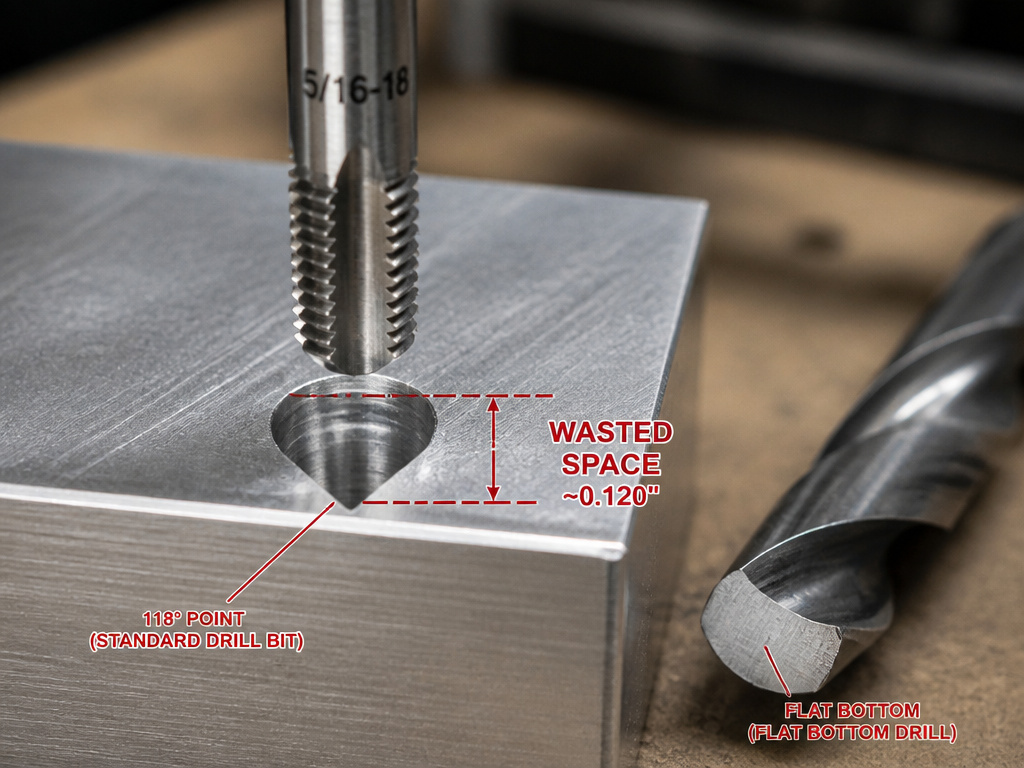
Knowing the diameter is half the battle. The other half happens in the third dimension. A hole that’s the right width but the wrong depth, or one with the wrong shape at the bottom, will ruin the thread.
Drill depth is non-negotiable for blind holes. You must drill deeper than the length of the bolt or insert you plan to install. The tap cannot cut threads all the way to the bottom of the hole; it needs clearance. The NASA screw thread insert specification (PRC-9006) gives the exact formula. For a standard plug tap, the drill depth must equal the maximum insert length, plus the depth it sits below the surface, plus the length of five incomplete threads. If you’re using a bottoming tap, which can cut closer to the bottom, you only add the length of three incomplete threads.
Common mistake: Drilling to the exact depth of the desired thread. The tap will jam against the uncut material at the bottom, likely snapping the flutes off inside the hole.
Drill point angle changes the game. A standard twist drill has a 118° or 135° point angle. This creates a conical bottom to the hole. A tap cannot create threads in that cone. If your engineering drawing calls for maximum thread depth in a blind hole, you might need a flat-bottom drill bit or a specific point angle called out. The NASA document states the standard drill point is 60°, but a 135° or flat bottom bit can be used “if necessary but must be called out on the engineering drawing.”
This is where understanding drill bit point angles pays off. A 118° point is more aggressive and common for general purpose. A 135° point is stronger and walks less on hard metals. For the deepest possible threads in a blind hole, you grind the web or use a specialty bit.
| Hole Requirement | Drill Bit Spec | Consequence If Ignored |
|---|---|---|
| Full Thread Depth (Blind Hole) | Flat-bottom or specified-point-angle drill | Tap cannot reach full depth; fastener is short by the cone’s height. |
| Precise Minor Diameter | Correct tap drill size (e.g., 17/64″) | Threads are too shallow (weak) or too deep (no material for threads). |
| Chip Clearance (Deep Hole) | Drill deeper than tap by 3-5 thread pitches | Chips pack at the bottom, increase torque, and break the tap. |
Combination Drill/Tap Bits: The Fast Path for Thin Material
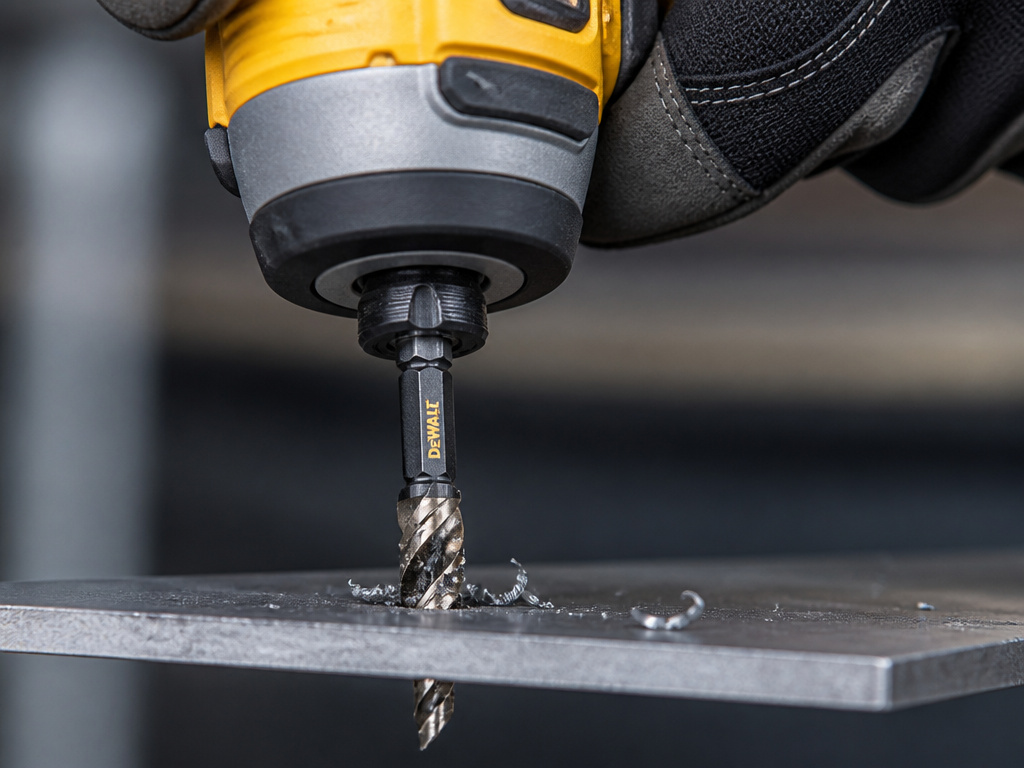
Sometimes, the answer isn’t a separate drill and tap. A combination drill/tap bit does both operations in one shot. You chuck it into a drill or impact driver, push into the workpiece, and it sequentially drills a pilot hole and then cuts the threads. It’s a huge time-saver for jobs like installing electrical boxes, adding mounting points to sheet metal, or any high-volume run on material under 1/4-inch thick.
These tools, like the Greenlee DTAP5/16-18 or the DEWALT DWADTQTR51618, are made from hardened high-speed steel (HSS) and have a built-in stop for depth and often a deburring/countersink edge. The DEWALT version is specifically marked “Impact Ready” with a 1/4-inch hex shank for use in impact drivers, which provides the intermittent torque that helps power through tapping.
Where this goes sideways: Using a combo bit on material thicker than its rated capacity. The DEWALT DWADTQTR51618 is rated for 1/4-inch capacity. In thicker steel, the flutes clog with chips halfway through, the bit binds, and you either snap it or strip the threads. These are for thin stock only.
They work because they are precisely engineered. The drill portion is ground to the exact tap drill diameter, the IDEAL Industries 36-5/16-18 NC bit, for example, has a hole diameter of 0.257 inches. The tap section immediately behind it is the correct 5/16-18 size. The transition is seamless, but the limitation is fundamental physics: chip evacuation. For a through-hole in thin material, chips fall out the back. In a blind hole in thick material, they have nowhere to go.
The Professional’s Choice: Dedicated Tap Drills and Precision
For machinists, aerospace techs, or anyone working with tough alloys or requiring perfect threads, the two-step method with separate, optimized tools is the only way. Here, the “drill bit” is often called a tap drill and is selected for the specific material and machine.
The Haas Tooling 03-0375 is a prime example. It’s a carbide tap drill with a diameter of 0.264 inches, a 118° point angle, a 30° helix, and a DLC coating specifically for aluminum. The “5XD” in its description means its usable flute length is five times its diameter, about 1.693 inches, allowing for deep, stable holes. This level of specificity is for CNC machining where speed, feed rate, and tool life are calculated.
Why carbide? It holds its edge longer and runs at higher speeds in abrasive materials without dulling. The precise diameter (0.264″) is a hair under the 17/64″ standard (0.2656″), which might be chosen for a specific thread fit class in a precision assembly. This is the realm of identifying drill bit size with micrometers, not guesswork.
When you use a dedicated, high-quality tap drill, you also have full control over the pilot hole quality before the tap ever touches the metal. You can peck drill to clear chips, use cutting fluid, and inspect the hole for size and finish. This separate step is what makes threads in stainless steel or titanium possible without destroying tools. The purpose of a tap drill is to set the stage perfectly for the tap.
Step-by-Step: Drilling and Tapping a 5/16-18 Hole Correctly
- Mark and Center Punch. Mark the hole location accurately. Strike a solid center punch to create a dimple. This prevents the drill bit from “walking” across the surface when you start. For absolute precision, use a center drill first.
- Select and Secure the Drill Bit. Use a sharp 17/64-inch (Letter F) drill bit. For a drill press, secure it in the chuck tightly. For a hand drill, ensure it’s straight. A split point drill bit is excellent here as it requires less center punch force and starts with less walking.
- Drill the Pilot Hole. Apply steady pressure and use a cutting fluid (even for aluminum). Drill to the required depth. Remember: for a blind hole, drill deeper than the finished thread depth. For a 1-inch deep thread, drill at least 1 1/4 inches deep.
- Deburr the Hole. Remove the sharp edge from the top of the hole with a countersink bit or a larger drill bit by hand. This allows the tap to start straight and prevents cross-threading.
- Select and Align the Tap. Use a sharp 5/16-18 UNC tap. For blind holes, a plug tap is standard; a bottoming tap is only needed if you require threads very close to the bottom. Mount it in a tap handle or a reversible drill at very low speed.
- Cut the Threads. Start the tap perfectly square to the workpiece. Apply downward pressure and turn slowly, about a quarter turn forward, then back a half turn to break chips. Keep using cutting fluid. Feel for binding. If resistance spikes, stop, back out, and clear chips.
- Test the Fit. Once tapped, blow out or vacuum the hole to remove all metal chips. Test the fit with a 5/16-18 bolt or a thread gauge. It should screw in smoothly by hand for the first few turns. If it’s tight, the pilot hole may be too small; if it’s loose, it’s too large.
Before you start: Wear safety glasses. Secure the workpiece in a vise or with clamps, never hold it in your hand. Ensure your drill bits and taps are sharp. A dull tool requires more force, slips more easily, and produces poor results.
Material Matters: When to Deviate from 17/64″
The 17/64″ rule assumes you’re working with common, machinable materials. The real world has harder stuff. The thread percentage you target can and should shift based on what you’re cutting.
For hard or brittle materials like cast iron, tool steel, or some plastics, a larger pilot hole is often better. You might aim for a 60-65% thread. This dramatically reduces tapping torque and the likelihood of the material cracking or the tap shattering. In these cases, moving to an F drill (0.257″) or even a 9/32-inch drill (0.2812″) can be the difference between success and a broken tap stuck in a expensive part.
Conversely, for soft materials like pure aluminum or mild plastics where strip-out is a bigger risk than tap breakage, you might go slightly smaller to get an 80% thread for more grip. A 0.264-inch carbide tap drill (like the Haas 03-0375) would serve this purpose.
This decision is part of the broader skill of matching drill bits to the task. There’s no universal chart for exotic alloys. You consult the material machinability ratings, start with the standard, and adjust based on the feel of the first hole. If the tap is screaming and smoking, your hole is too small for that material.
Frequently Asked Questions
Can I use a 1/4-inch drill bit for a 5/16-18 tap?
No. A 1/4-inch bit (0.250″) is drastically too small. The 5/16-18 tap would have to cut away 0.015 inches of material per side to form the thread, which is an enormous amount of metal removal. The tap would bind instantly, generate extreme heat, and almost certainly snap. Always use the specified 17/64-inch (0.2656″) drill.
What if I don’t have a 17/64″ drill bit?
You have a few options, listed in order of preference. First, use a Letter F drill, which is the same size. Second, use the closest metric drill bit, which would be 6.7mm or 6.8mm (both are slightly larger, resulting in a slightly weaker thread). Third, carefully grind down a 9/32-inch bit (0.2812″), this is a last resort and requires a caliper to check your work. The wrong size compromises the joint.
How deep should I drill for a 1-inch long 5/16-18 bolt?
For a through-hole, drill completely through the material. For a blind hole where the bolt sits inside, you need clearance. A good rule is to drill at least 1 1/4 inches deep. This accounts for the bolt length, the tap’s non-cutting point, and space for chips. Referencing the NASA fastener installation procedure, you would add the length of five incomplete threads (about 0.278 inches for 5/16-18) to your desired thread depth.
What’s the difference between a tap drill and a regular drill bit?
Tap drill is defined by its specific diameter for creating a pilot hole for a tap. A “regular” twist drill, like a jobber drill bit, is a general-purpose tool. A tap drill can be a jobber-length bit, but its size is non-negotiable. High-end tap drills, often carbide, have geometries optimized for chip evacuation and hole finish before tapping.
Can I use an impact driver to tap a hole?
Yes, but with caution and the right tool. Use a combination drill/tap bit designed for impacts, like the DEWALT DWADTQTR51618. For traditional tapping with a separate tap, use a dedicated tapping attachment or set your impact driver to its very lowest speed setting with no hammer action. The impact mechanism can help break chips, but it’s easy to over-torque and break a tap if you’re not experienced.
The Bottom Line
The drill bit for a 5/16-18 tap is a 17/64-inch or Letter F drill. That’s the answer you find in the chart. The craft is in everything that surrounds that number: drilling deep enough, choosing the right point angle, and knowing when to use a one-step combo bit versus separate precision tools.
For most DIY and repair work in mild steel or aluminum, a sharp 17/64″ jobber bit and a quality HSS tap will get the job done. Drill deeper than you think, use cutting fluid, and back the tap out often to clear chips. If you’re doing repetitive work in sheet metal, grab a Greenlee combination bit. If the material is tough or the tolerance is tight, step up to a dedicated carbide tap drill and treat the two steps as separate, critical operations.
That’s the difference between making a hole that holds and making a thread that lasts.
