What Is a Drill Chuck | The Standard That Defines the Grip
This post contains affiliate links. As an Amazon Associate, we earn from qualifying purchases.
A drill chuck is a mechanical tool holder that connects to a drill’s spindle and uses three movable, self-centering jaws to grip a cylindrical tool shank. Its job is to transmit torque from the drill motor to the cutting tool while holding the tool as concentrically as possible. The official Indian Standard IS 2243 defines it as a device for machine tools and portable power tools, with specifications for mounting, accuracy, and torque transmission.
That definition from a government standards body is the baseline. It leaves out the reality on the shop floor: a chuck is the single biggest source of “why won’t my drill work right?” complaints. Bits slip, holes wander, and the tool you need is stuck inside.
What follows: the three things that separate a generic tube of jaws from a precision component, type, mount, and accuracy grade. By the end, you’ll be able to read any chuck’s model number and know exactly what job it’s built for.
Key Takeaways
- A chuck’s rated runout is the single most important spec for precision work. A budget chuck can have 0.15 mm of runout, while a precision model like an Albrecht holds 0.01 mm. That difference decides whether you’re drilling holes or making ovals.
- Keyed chucks don’t drop bits more than keyless chucks; cheap keyless chucks do. The mechanical advantage of a key provides a stronger, more reliable grip under heavy load. A loose hand-tighten on a keyless model is what causes slippage.
- The mount is not universal. A Jacobs Taper (JT) is for bench tools; a UNF thread is for handheld drills. Mismatching them, forcing a JT arbor into a threaded spindle, ruins the taper and guarantees wobble.
- Drill chucks are consumables. In a daily-use workshop, expect 3–7 years of service before runout degrades past usable limits. They are not lifetime components.
- Official standards like IS 2243 and JIS4634 provide the only objective benchmarks for accuracy and testing. Marketing terms are meaningless without a standard behind them.
What Exactly Does a Drill Chuck Do?
Its function is deceptively simple: convert the rotary force of a drill into a secure, centered grip on a cutting tool. But “secure” and “centered” have measurable, standardized definitions.
The Indian Standard IS 2243 drill chuck specification from 1971 doesn’t just describe a chuck; it lays out how it must be tested. The standard mandates that a chuck must transmit a specified torque to a test mandrel when tightened by hand (and with a key, if keyed). If the mandrel slips or the chuck body deforms, it fails. This marketing is a pass/fail test for the core job of holding under load.
A drill chuck conforming to IS 2243 must firmly grip a specified test mandrel and transmit torque without slippage when tested per the standard’s procedures. This verifies the chuck’s basic mechanical integrity.
The three jaws are the heart of the system. They ride in slots machined into the chuck body and are driven in and out by a threaded nut or ring gear. Their movement is what gives the chuck its clamping range, a single 1-13 mm chuck can theoretically hold every standard drill bit size in between. That versatility is the trade-off. A collet chuck, which uses a single split sleeve, offers far better concentricity but only for one specific shank diameter.
The chuck is the critical link between the power source and the work. A worn or low-quality chuck turns a capable drill into a frustrating, inaccurate tool. You’ll feel it as vibration, see it as a wandering hole, and hear it as a chattering bit.
Keyed vs. Keyless Drill Chucks: The Real Difference
Both designs use three jaws. They diverge completely in how those jaws are tightened and who is responsible for keeping them tight.
A keyed chuck uses a geared key (often called a chuck key) that engages with a ring gear inside the chuck body. Turning the key provides significant mechanical advantage, multiplying your hand force to create immense clamping pressure on the tool shank. This is why keyed chucks are the default for drill presses, milling machines, and lathes, environments where tool slippage under high torque means ruined work or broken tools.
A keyless chuck is tightened by hand directly on the chuck’s outer sleeve. It’s faster for tool changes, which is why it dominates the cordless drill market. The common belief is that keyless chucks slip more. The truth is more specific: poorly tightened keyless chucks slip. The grip is only as strong as your last twist of the wrist.
Where this goes sideways: Assuming a keyless chuck will self-tighten under load. Only specific “self-tightening” models have a one-way clutch mechanism that does this. On a standard keyless chuck, drilling torque can actually work to loosen the grip.
Modern cordless drills often use a hybrid: a keyless chuck with a self-tightening clutch. Once you hand-tighten it, the drilling load activates a ratchet that further tightens the jaws. This solves the slippage problem for handheld tools but these chucks are typically integrated and not designed for replacement on stationary machines.
For a bench drill where you’ll be making repeated, precise holes, the choice is clear. The Röhm 871012 keyed chuck is a benchmark for a reason, its defined 0.05 mm maximum runout and positive key drive mean the bit stays put. For a cordless drill you’re using all day on a jobsite, the convenience of a keyless design like those from Makita or DeWalt wins. Just don’t use that keyless chuck on a drill press expecting mill-grade accuracy.
Anatomy of a Drill Chuck: The Named Parts
Knowing the parts is how you diagnose problems and understand specifications. The official nomenclature from standards like IS 2243 gives us the precise terms.
| Part Name | Function | Fails When |
|---|---|---|
| Chuck Body | The main housing that encloses the mechanism and carries the jaws. | It cracks from overtightening or impact, or the jaw slots wear, causing uneven jaw movement. |
| Jaws | Three hardened steel members that move in the body slots to grip the tool shank. | The gripping teeth wear down, leading to slippage. They can also jam if debris gets in the slots. |
| Ring Gear (Keyed) | A geared ring engaged by the chuck key to drive the jaw mechanism. | Teeth strip if the key is hammered or forced, rendering the chuck inoperable. |
| Chuck Nut | An internal threaded component that converts rotation of the ring gear or sleeve into linear jaw motion. | Threads wear or cross-thread, causing jaws to close unevenly or not reach full clamping pressure. |
| Sleeve (Keyless) | The outer cover you grip to tighten or loosen a keyless chuck. | The knurling wears smooth, making it hard to grip. It can also crack if dropped. |
| Mounting Taper/Thread | The interface (like a Jacobs Taper or UNF thread) that connects the chuck to the drill spindle. | The taper gets scored or the threads strip from cross-threading, causing permanent runout and wobble. |
The pilot holes are the small holes in the chuck body that accept the pins on a chuck key, ensuring it drives the ring gear squarely. The back registering face is the flat surface that seats against the drill spindle, ensuring the chuck is square to the machine’s axis.
When you need to remove a drill chuck, you’re almost always dealing with the mounting taper or thread. Understanding that the chuck body and the mount are separate entities is the first step. A worn jaw mechanism might mean a new chuck, but a damaged JT taper on the arbor might mean you need a new arbor or a drill sleeve adapter.
The Critical Specs: Capacity, Runout, and Mount
Choosing a chuck means matching three numbers to your machine and your work.
Chuck Capacity
This is the range of tool shank diameters the chuck can grip, like “0.5 – 13 mm” or “1/4″ – 1/2”. Always match the capacity to your most common bit sizes. A 0-10 mm chuck is useless if you regularly use a 13 mm masonry bit. The capacity is physically limited by how far the jaws can travel in their slots.
Runout Accuracy
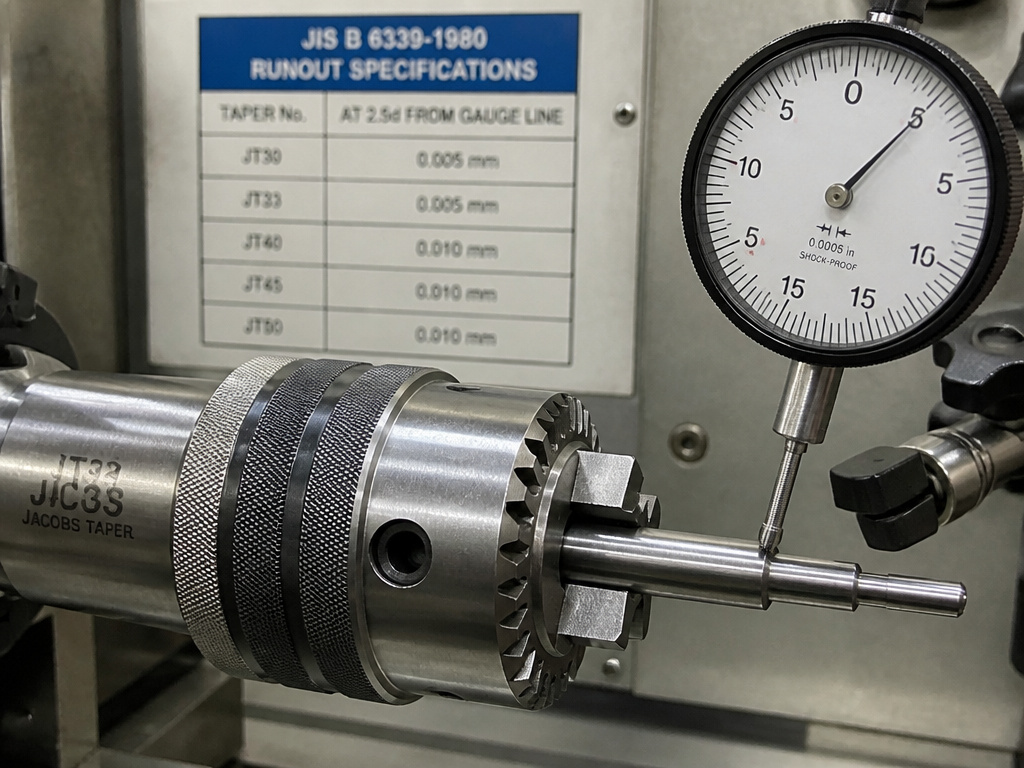
This is the measure of how much the gripped tool wobbles off-center when the chuck spins. It’s the difference between a precise hole and a sloppy one. Standards provide the only reliable numbers here.
- JIS4634 (Japanese Industrial Standard): Defines two grades. “MG” (Machine Grade) requires runout of 0.08 mm or less. This is the benchmark for a quality keyed chuck for machine tools.
- Precision Chucks (Albrecht, Röhm): Advertise runout as low as 0.01-0.03 mm. These are for milling and precision drilling.
- Budget Chucks: Can exhibit runout of 0.15 mm or more. This is why a cheap chuck makes even a good drill feel inaccurate.
Runout is checked with a dial indicator on a precision test rod. If your chuck’s runout exceeds 0.20 mm and it used to be better, the jaws or body are worn. It’s time for a drill head replacement.
Mounting Type
This is how the chuck physically attaches to your drill. Getting this wrong means the chuck won’t fit, or will fit poorly and destroy itself.
| Mount Type | Typical Use | Key Identifiers |
|---|---|---|
| Jacobs Taper (JT) | Drill presses, mill spindles, lathe tailstocks. | Tapered shank. Sizes like JT2, JT3, JT6. The number corresponds to the taper size. |
| Morse Taper (MT) | Larger machine tools, often with a drill sleeve adapter. | Larger, steeper taper than JT. Sizes like MT1, MT2, MT3. |
| UNF Thread | Handheld corded and cordless drills. | Threaded hole in the chuck base. Common sizes: 1/2″-20 UNF or 3/8″-24 UNF. |
| Direct Spindle | Integrated chucks on cordless drills. | The chuck is often not designed to be removed; it’s part of the drill’s chuck assembly. |
The 3/8-inch chuck on a compact drill has a different mount than the 1/2-inch chuck on a heavy-duty model. Trying to swap them requires an adapter and introduces another potential source of error. Always check your drill’s spindle specification before buying a replacement chuck.
How to Choose the Right Drill Chuck
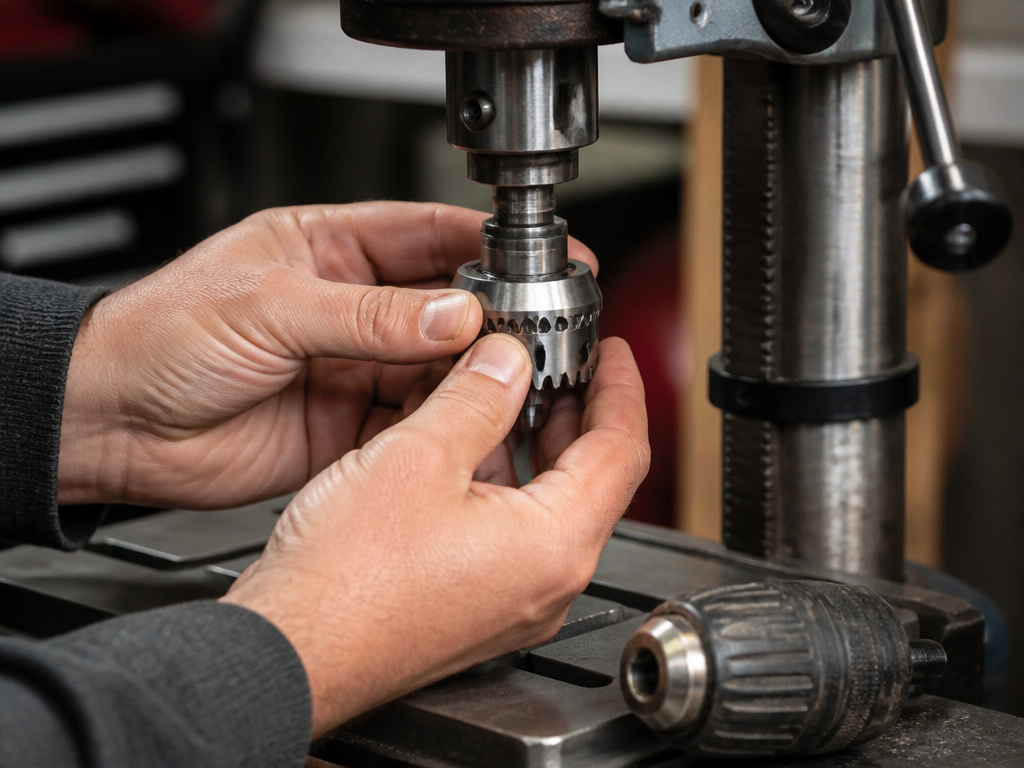
The choice flows from your machine to your task. Start with the mount your spindle accepts, this is non-negotiable. Then, let accuracy needs drive the budget.
For a drill press used for woodworking and general metal fabrication, a solid keyed chuck with a JT33 or JT6 mount and JIS MG grade (≤0.08 mm runout) is the standard. The Yukiwa brand is a reliable workhorse here. You get the positive grip of a key and accuracy good enough for 95% of shop work.
For precision metalworking on a mill or lathe, runout is everything. This is where you step up to a true precision keyed chuck like a Röhm Spiro or an Albrecht. The extra cost buys you measured concentricity under 0.03 mm and jaws that close with near-perfect alignment. This is not a luxury; it’s a requirement for reaming, spot drilling, and any operation where hole location is critical.
For a cordless drill, you’re usually stuck with the integrated keyless chuck it came with. If it’s performing poorly, slipping bits, excessive wobble, the solution is rarely to replace just the chuck. It’s often more cost-effective to consider a new tool. However, if you have a older corded drill with a replaceable threaded chuck, upgrading from a worn original to a new keyless model can feel like getting a new drill.
Common mistake: Buying a high-precision chuck for a wobbly, low-end drill press. You’ll never see the benefit. The machine’s own spindle runout will be greater than the chuck’s accuracy. Fix the machine first, then upgrade the chuck.
Always remember the standard’s caveat: IS 2243 explicitly does not cover the types of chucks fitted to carpenters’ and blacksmith’s tool chucks. Specialized tools often use specialized holders. For the vast world of machine tools and portable power drills, however, the standard’s definitions and specs are your map.
Frequently Asked Questions
Can I convert a keyed chuck to keyless?
No. The internal mechanisms are fundamentally different. A keyed chuck uses a ring gear and pinion; a keyless chuck uses a direct threaded connection to the sleeve. You cannot modify one into the other. You must replace the entire chuck unit.
Why does my new chuck wobble on my drill?
This almost always points to a mount mismatch or a damaged spindle. You may have a JT3 taper chuck on a JT33 spindle (they are different). Or, the taper on your drill’s arbor is scored. Ensure you have the correct chuck adapter for your machine. A wobble here will ruin both the chuck and the spindle.
How do I prevent a drill bit from getting stuck in the chuck?
Overtightening is the main culprit, especially on keyed chucks. It deforms the soft steel of the bit shank, creating a mechanical lock. Tighten firmly, but don’t throw your body weight on the key. For keyless chucks, ensure the jaws and bit shank are clean and dry. A little bit of dust or moisture can act like glue under pressure. If it’s already stuck, our guide on removing a stuck drill bit has the step-by-step solutions.
What’s the difference between a drill chuck and the chuck on an impact driver?
An impact driver has a 1/4″ hex quick-release collet, not a three-jaw chuck. It’s designed solely for hex-shank driver bits and cannot hold round-shank drill bits. Some adapters exist to attach a hole saw or a small chuck to an impact driver, but it’s a workaround, not a proper drilling setup.
Are all drill bits compatible with all chucks?
In terms of shank shape, mostly yes. Standard round-shank twist drills are designed for three-jaw chucks. Some specialized drill bit types like SDS-Plus masonry bits have their own dedicated chucks and cannot be used in a standard chuck. Always check the shank before you try to clamp it.
Before You Go
A drill chuck is a precision mechanical component defined by international standards, with tolerances that directly translate to the quality of your work. The right chuck for your drill press is a keyed model meeting JIS MG grade.The right chuck for your cordless drill is the one that tightens securely every time you twist it.
Ignore the marketing fluff about “high precision” without a cited standard. Look for the runout number, the mount type, and the capacity. A good chuck turns force into control. A bad one turns it into frustration and wasted material. Your drill is only as good as the connection between its spin and the cutting edge.
