
3/8″ Drill vs 1/2″ Drill | The Specs That Change Your Work
This post contains affiliate links. As an Amazon Associate, we earn from qualifying purchases.
A 3/8″ drill accepts bits with a shank diameter up to 3/8 of an inch, while a 1/2″ drill accepts bits up to 1/2 inch. The difference is chuck capacity, which dictates the tool’s maximum torque output and the size of bits you can physically use. A 1/2″ drill is built for heavier applications like large spade bits, augers, and high-torque driving; a 3/8″ drill handles general drilling and fastening up to its size limit.
That chuck size is a hard mechanical limit, not a suggestion. Put a 1/2-inch bit in a 3/8-inch chuck and you have two problems: the bit won’t fit, and the drill’s motor and gearbox aren’t rated for the load that bit demands. The choice between them locks you into a tier of work.
What follows is a breakdown of the three specs that actually matter, chuck capacity, torque, and duty cycle, plus a direct comparison of electric and pneumatic models. By the end, you’ll know which drill fits the holes you need to make.
Key Takeaways
- The chuck size is the maximum bit shank diameter the tool can hold. A 1/2″ drill can use 3/8″ bits, but not vice-versa.
- Torque scales with chuck size. A 1/2″ drill like the Ryobi PBLDD02K1 delivers 850 in-lbs; a compact 3/8″ model might top out under 300 in-lbs.
- Pneumatic 3/8″ drills are a different category. Tools like the Ingersoll Rand 7802 run at 2000 RPM on air, built for continuous industrial use, not home workshops.
- The wrong choice breaks things. Using a 3/8″ drill for a 1/2″ task strips the chuck, stalls the motor, or snaps the bit.
- Your existing battery platform often decides. If you’re invested in 18V or 20V tools, you’re likely choosing between 1/2″ cordless models, as 3/8″ cordless drills are now niche.
What’s the Real Difference Between a 3/8″ and 1/2″ Drill?
Chuck capacity is the gatekeeper. Every other difference, power, weight, cost, flows from that single measurement.
A 3/8″ drill has a collet designed to grip bit shanks up to 9.5mm (3/8 inch) in diameter. A 1/2″ drill’s chuck opens to 12.7mm. This isn’t about convenience; it’s about the physical strength of the chuck jaws and the spindle they’re mounted on. The larger assembly handles higher rotational force.
The gearbox and motor behind that chuck are built to match. A drill engineered for a 1/2″ chuck expects to encounter the resistance of drilling a 1-1/2 inch hole in wood or driving a large lag screw. Its components are heavier. A 3/8″ drill is built for the loads associated with smaller bits, driving deck screws, drilling pilot holes, or using twist bits up to about 3/8″ in metal.
Here’s the consequence if you ignore it: force a 3/8″ drill to perform a 1/2″ drill’s job. The chuck jaws slip on the larger bit shank, scoring it and ruining the chuck’s grip. The motor overheats trying to deliver torque it wasn’t designed for. You smell the insulation burning after the third stalled hole. The tool might not die that day, but its lifespan just shortened by years.
The 3/8″ vs 1/2″ Drill Comparison Table
This table shows where each size excels and where it fails. Match your most common task to the right column.
| Aspect | 3/8″ Drill | 1/2″ Drill |
|---|---|---|
| Best For | General DIY, assembly, pilot holes, screw driving. | Framing, deck building, large diameter holes (spade/auger bits). |
| Bit Size Range | Up to 3/8″ shank diameter. | Up to 1/2″ shank diameter. |
| Typical Max Torque | 200–450 in-lbs (cordless). | 450–1400 in-lbs (cordless). |
| Weight & Size | Lighter, more compact. Often under 3.5 lbs. | Heavier, larger. Usually 4–5 lbs with battery. |
| Failure Point | Chuck slip, motor burnout on high-load tasks. | Overkill for small jobs, leading to user fatigue. |
| Cost Trend | Generally lower, but high-end pneumatic models are expensive. | Higher, especially for pro-grade brushless models. |
Chuck Capacity: The One Spec You Can’t Cheat
The number stamped on the chuck is a limit. Drills are not rated for “occasional” use beyond their capacity.
Common mistake: Assuming a keyless chuck can “grip just a little more.” The spindle inside the drill that the chuck mounts to has a maximum shaft diameter. A 3/8″ drill’s spindle is literally too small to accept a 1/2″ chuck assembly. You cannot upgrade it.
This is why understanding drill bit types is crucial. A 1/2″ drill unlocks the use of heavy-duty concrete drill bits and large wood bores that a 3/8″ tool can’t physically hold. Your project’s required bit dictates the minimum chuck size.
The 1/2-inch chuck is the default for a reason. Modern cordless technology packs enough power into a 1/2″ format that there’s little penalty for having the extra capacity. The market has largely retired the consumer-grade 3/8″ cordless drill. When you see a 3/8″ drill today, it’s usually one of two things: an ultra-compact 12V tool for tight spaces, or a pneumatic tool for industrial shops.
Torque and Power: Why Size Determines Strength
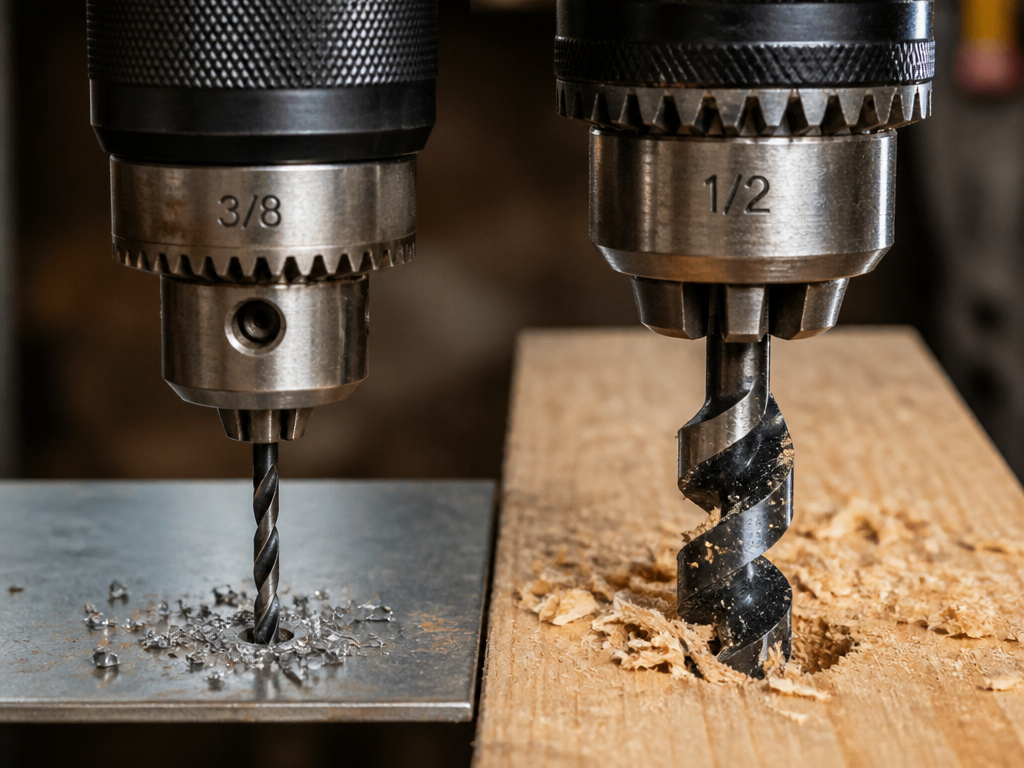
Torque is the twisting force. Chuck size predicts it.
A 1/2″ drill like the DeWalt DCD801B is engineered for high torque. Its brushless motor and two-speed gearbox are built to deliver up to 109% more power than previous models, according to its spec sheet. This lets it drive a 7/8″ auger through lumber or sink 3/8″ lag bolts without stalling. The Consumer Reports drill review of the Ryobi PBLDD02K1 noted its “very powerful” performance, capable of driving the largest screws, a hallmark of a true 1/2″ tool.
A 3/8″ drill has a lower torque ceiling. A model like the corded DeWalt DWD112 has a strong 8-amp motor, but its design prioritizes higher RPM (2,500) for drilling over raw twisting force. It’s fantastic for mixing thinset or drilling repeated holes in metal with cobalt bits, but it will bog down and clutch out if you try to drive a 4″ screw into dense hardwood.
| Drill Model | Chuck Size | Max Torque / Power | Ideal Use Case |
|---|---|---|---|
| Ryobi PSBDD02 | 1/2″ | 450 in-lbs | Light-duty driving, compact work. |
| Milwaukee M18 Fuel 2904 | 1/2″ | 1,400 in-lbs | Heavy framing, concrete, demanding professional work. |
| DeWalt DWD112 (Corded) | 3/8″ | 8 Amp Motor | High-RPM drilling, mixing, continuous use. |
| Ingersoll Rand 7802 (Pneumatic) | 3/8″ | 0.5 HP Motor | Industrial metalworking, honing, production drilling. |
The takeaway? If your work involves anything larger than a 3/8″ bit or screws longer than 3 inches, you need the torque reserve of a 1/2″ drill. The smaller tool will fight you, overheat, and fail.
Electric vs. Pneumatic: The 3/8″ Drill’s Second Life
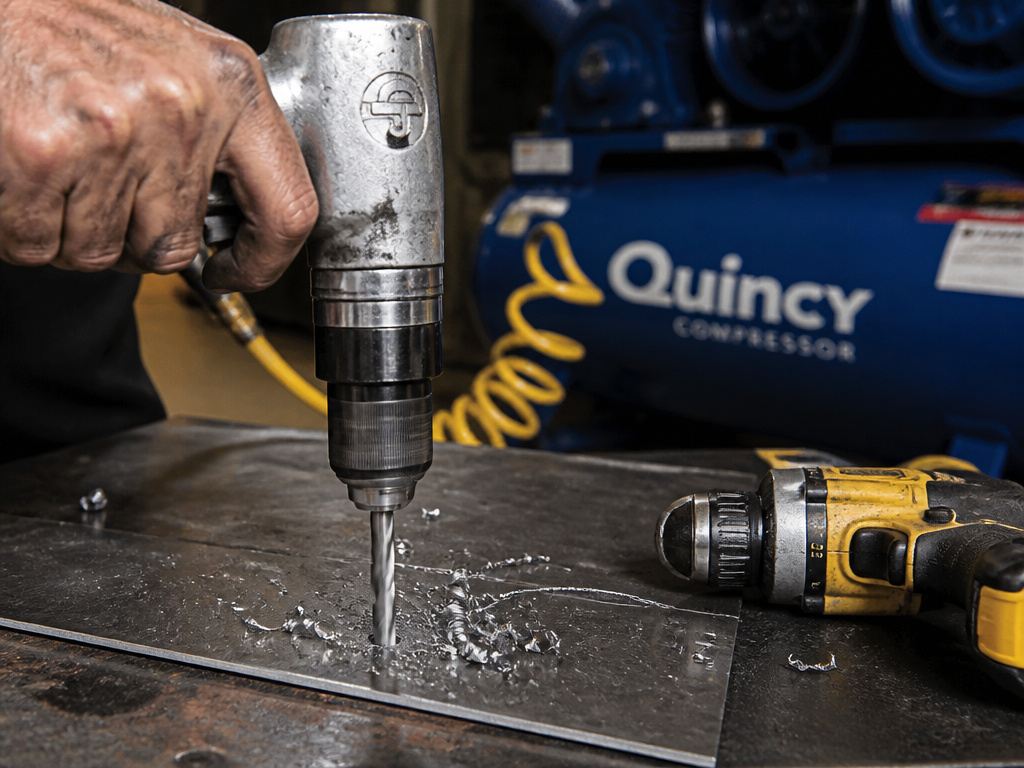
In the cordless world, 1/2″ is king. But walk into an auto shop or metal fabrication plant, and you’ll see 3/8″ drills everywhere. These are pneumatic tools, and they play by different rules.
An electric 3/8″ drill is defined by its chuck and its battery. A pneumatic 3/8″ drill is defined by its air motor and duty cycle. Models like the Ingersoll Rand 7802 Series run at a free speed of 2,000 RPM on 90 PSI of air. They are lighter (around 2.6 lbs), have fewer moving parts, and can run continuously without overheating. This makes them perfect for repetitive drilling in metal, where their high RPM and consistent power excel.
Where this goes sideways: Plugging a home 6-gallon compressor into a pneumatic industrial drill. The Ingersoll Rand 7802 requires 4 CFM at 90 PSI. A small pancake compressor can’t sustain that airflow. The drill will sputter, lose power mid-hole, and the compressor will run non-stop until it burns out. You need a compressor rated for the tool’s CFM demand.
So when does a 3/8″ pneumatic drill make sense for you?
- You already have a large, industrial air compressor (15+ gallons, 3+ HP).
- Your work is primarily metal fabrication, automotive, or other high-RPM drilling.
- You need a tool that can run all day without a battery swap.
For 99% of homeowners and DIYers, the infrastructure cost of capable air compressors makes a cordless 1/2″ drill the pragmatic choice. The versatility and power of tools like the Milwaukee M18 Fuel or the DeWalt DCD801B are unmatched for mixed-material work.
Choosing Your Drill: A Step-by-Step Match to Your Work
Don’t pick a drill. Pick the tool that matches your most frequent, most demanding task. Follow this sequence.
- Identify your largest bit. What’s the biggest hole you need to drill? If it’s for a 1-1/2″ door knob or a 1″ auger, you need a 1/2″ chuck. Write that down as your minimum.
- Assess your torque needs. Are you driving large lag bolts or screws into framing lumber? High torque is critical. If you’re mostly assembling furniture or drilling pilot holes, a compact 1/2″ drill or even a capable 3/8″ model might suffice.
- Check your power ecosystem. Are you already invested in a battery platform like Ryobi 18V or DeWalt 20V? Staying within that system is almost always cheaper. Your choice will be among that brand’s 1/2″ offerings.
- Consider weight and balance. A full-size 1/2″ hammer drill is overkill for installing cabinet hardware. A compact brushless model like the Ryobi PSBDD02 offers a 1/2″ chuck in a much lighter package.
- Decide: Cordless, Corded, or Air? Cordless is the default for mobility. Corded (like the DeWalt DWD112) offers unlimited runtime for stationary tasks. Pneumatic is for specialized, shop-based work.
Skip this if: You only do light assembly. A 12V drill-driver or even a good impact driver might be a better, lighter, and more affordable choice. Don’t buy capacity you’ll never use.
This process prevents the classic mistake: buying an underpowered tool for a big job, or an oversized, cumbersome tool for small jobs. Your drill should feel like the right instrument for the work, not a compromise.
The Bottom Line
Forget 3/8″ versus 1/2″ as an abstract debate. Your next drill is the one that holds the bits you use and delivers the torque your projects demand.
For the vast majority of people building, repairing, or maintaining a home, a brushless 1/2″ cordless drill is the only answer. It’s the modern standard because it can handle 95% of tasks without breaking a sweat. Models like the DeWalt DCD801B or the Milwaukee M18 Fuel 2904 are professional benchmarks for a reason. If your budget is tighter, the Ryobi PBLDD02K1 kit delivers remarkable power and value, proving you don’t need to spend a fortune for capable 1/2″ performance.
Reserve the 3/8″ drill for two scenarios: you need a ultra-compact 12V tool for confined spaces, or you have the industrial air supply to run a pneumatic workhorse like the Ingersoll Rand 7802. For drilling metal all day in a shop, the air tool wins. For everything else, the 1/2″ cordless drill is the undisputed, versatile champion.
Frequently Asked Questions
Can a 3/8″ drill use 1/2″ bits?
No. The bit’s shank (the smooth part that goes into the chuck) must be 3/8″ in diameter or smaller to fit. A 1/2″ shank will not physically enter a 3/8″ chuck. You would need a drill bit with a reduced shank, which is a specialty item.
Is a 1/2″ drill more powerful than a 3/8″?
Almost universally, yes. The larger chuck is paired with a motor and gearbox designed for higher torque output. A heavy-duty 1/2″ drill like the Milwaukee M18 Fuel produces over 1,400 in-lbs of torque, while a typical 3/8″ cordless model might max out around 300-450 in-lbs.
Why are most cordless drills 1/2″ now?
Battery and motor technology advanced. Manufacturers can now pack enough power into a compact 1/2″ drill format that there’s no significant weight or cost penalty compared to a 3/8″ model. Giving users the larger capacity by default is a better value. The 3/8″ cordless drill has become a niche product.
Can I use a 3/8″ bit in a 1/2″ drill?
Yes, absolutely. A 1/2″ chuck can securely grip any bit with a shank diameter of 1/2″ or less. This is a key advantage, the larger tool is backward compatible with all your smaller types of drill bits.
What’s better for metal drilling: 3/8″ or 1/2″?
It depends on the power source. For precise, high-RPM drilling in sheet metal or steel, a pneumatic 3/8″ drill like an Ingersoll Rand is often the tool of choice in shops. For general-purpose metal drilling (angle iron, drilling bolt holes), a cordless 1/2″ drill with a low-speed setting and a good cobalt drill bit is more versatile for most users.
