
12 Volt vs 20 Volt Drill: The Torque Gap That Stalls Cabinets
This post contains affiliate links. As an Amazon Associate, we earn from qualifying purchases.
Choose a 20V drill for decks, framing, and concrete; a 12V drill for cabinet installs, furniture assembly, and tight spaces. The dividing line is about 400 inch-pounds of torque—below that, a 12V tool is lighter and adequate. Above it, a 20V brushless model like the DeWalt DCD800B won’t stall. Voltage alone is a poor predictor; motor technology and battery capacity decide actual performance.
That 400 in-lb threshold isn’t arbitrary. It’s the point where a 12V motor’s armature starts to bind under load, its copper windings heat up, and the electronic clutch disengages to prevent burnout. You’ll feel it as a sudden loss of power mid-screw, followed by a faint smell of hot electronics. A 20V platform delivers the current to push past that bind.
What follows: the real difference between marketing volts and working volts, the three specs that actually predict stall points, and the one field test that reframes the entire choice.
Key Takeaways
- “20V Max” is a peak, not sustained voltage. The nominal working voltage is 18V; the extra 2V is marketing headroom for initial battery charge.
- Torque under 400 in-lbs is 12V territory. The WORX Nitro 20V drill hits 531 in-lbs; most 12V models tap out around 350 in-lbs.
- Brushless motors win on efficiency, not just power. They transfer more battery energy to the chuck, which is why a brushless 12V can sometimes outwork a brushed 20V.
- Battery Ah rating dictates runtime, not voltage. A 2.0Ah 20V battery dies faster under load than a 5.0Ah 20V pack.
- Match the chuck to your bits. A 1/2-inch metal chuck holds spade bits and hole saws; a 3/8-inch plastic chuck is for drill bits and drivers.
The Voltage Misconception: “20V Max” vs. Working Power
Technical Snippet: The “20V MAX” label denotes the initial peak voltage of a freshly charged lithium-ion battery pack under no load. The nominal, sustained voltage during discharge is 18V. This marketing terminology distinguishes platforms but does not indicate a 20V tool is inherently 66% more powerful than a 12V (12V nominal) tool. Actual performance is governed by motor design, battery amperage (Ah), and system electronics.
You see “20V MAX” stamped on the tool and the battery. The competitor uses “18V”. The instinct is to assume a two-volt advantage. It’s a dead end. Both systems use lithium-ion cells with a nominal voltage of 3.6V per cell. Five cells in series give you 18V nominal. A “20V MAX” battery hits about 20 volts off the charger with no load attached—a marketing peak that lasts for the first few minutes of use. The difference between 20V and 18V is purely in labeling, not cell chemistry.
The real performance separator is how the tool’s electronics manage that voltage. A brushed motor routes current through physical carbon brushes that wear down and create electrical resistance. A brushless motor uses a circuit board to electronically commutate the current, eliminating that friction point. That’s why a brushless drill motor can extract more useful work from the same battery.
So a drill isn’t something you buy by its label. It’s something you bench-test by its torque curve. A 12V brushless drill with a high-torque gearbox can drive 3-inch deck screws. A cheap brushed 20V drill will bog down on the second screw. The voltage gets you in the door; the motor and gearing decide if you can stay.
How Does a 20V Drill Actually Outperform a 12V?
The answer lives in the unit watts out (UWO) specification and the motor’s ability to deliver current under load. When you lean into a 2-inch paddle bit in a pine stud, the resistance causes the drill’s RPM to drop. The electronics sense this drop and call for more current from the battery to maintain torque. A 20V system has a higher voltage “ceiling,” which allows it to deliver that current with less overall amperage draw, generating less heat in the motor windings.
The DeWalt DCD800B is engineered to provide up to 40% more UWO than its predecessor when paired with a high-output battery. That translates to drilling up to 175 holes per charge in certain materials. The physical limit is heat dissipation. A 12V motor trying to pull the same wattage would need to draw nearly double the amperage, cooking its own armature.
Where this goes sideways: Using a 20V drill with a worn nickel-cadmium battery. The voltage sags under load, the motor can’t sustain RPM, and you end up with a burnt clutch and stripped screw heads. The tool is fine; the battery is the bottleneck.
Here is the performance gap, sourced from manufacturer specs:
| Performance Metric | Typical 12V Drill | Typical 20V Drill | Why the Gap Matters |
|---|---|---|---|
| Max Torque | 250 – 350 in-lbs | 400 – 600+ in-lbs | 12V stalls on lag bolts, large spade bits. |
| No-Load Speed (High Gear) | 1,300 – 1,500 RPM | 1,800 – 2,000 RPM | Higher speed drills cleaner in metal and hardwood. |
| Motor Type | Often brushed | Often brushless | Brushless adds ~30% efficiency, longer runtime. |
| Battery Compatibility | 12V platform only | 20V/18V platform | 20V platforms offer larger Ah packs (5.0Ah, 8.0Ah). |
The table shows a clear divide. For driving hundreds of 3-inch screws into a deck, the 20V’s torque reserve is non-negotiable. For assembling an IKEA cabinet where you’ll drive two dozen 1.5-inch screws, the 12V’s lighter weight is the advantage. This is the core of the 12V vs 20V drill decision.
The Three Specs That Matter More Than Voltage
Forget the big number on the side of the tool. These three specifications, buried in the manual or on the spec sheet, tell you what the drill will actually do.
1. Torque (in-lbs or Nm): This is twisting force. The WORX Nitro 20V claims 531 in-lbs. Most 12V drills claim between 250 and 350 in-lbs. The catch: these are peak values, often achieved just before the clutch disengages. Continuous torque, the force it can sustain without slipping, is about 60-70% of that peak. If your project involves anything over 3/8-inch diameter in wood or driving screws into dense framing lumber, you need the 20V’s higher continuous torque.
2. Chuck Size and Type: A 1/2-inch metal ratcheting chuck grips large shanks securely. A 3/8-inch keyless chuck is for drill bits and driver bits. If you ever plan to use a hole saw, a paddle bit, or a large spade bit, the 1/2-inch chuck is mandatory. Many 12V drills top out at 3/8-inch. This is a hard limit, not a preference. The 3/8 vs 1/2 inch drill choice is made for you by your bit collection.
3. Battery Amp-Hour (Ah) Rating: A 20V drill with a 1.5Ah battery will die faster than a 12V drill with a 4.0Ah battery under the same load. Runtime is about energy capacity (Watts = Volts x Amps), not just voltage. Always check the Ah rating. For a full day of intermittent use, a 4.0Ah or 5.0Ah pack is the minimum.
Easy to miss: The SKIL 20V drill’s manual specifies a recommended working temperature of 14°F to 104°F (-10°C to 40°C). Using a lithium-ion battery outside that range, especially in cold weather, cuts its effective capacity by half and can trigger the tool’s thermal protection. Let the battery warm up in your pocket first.
The 12V vs 20V Decision Matrix
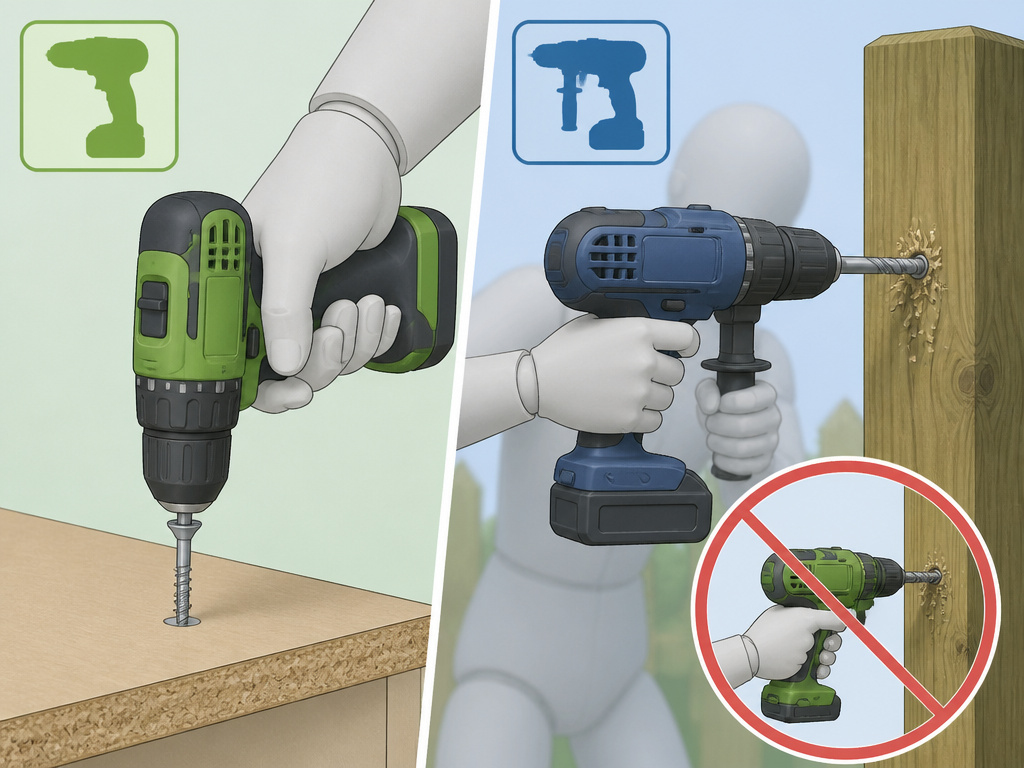
This isn’t about “more power.” It’s about matching the tool’s physical limits to the mechanical demands of your project. The following matrix uses real task descriptions to steer you.
| Your Project | Recommended Voltage | Critical Spec to Check | What Happens If You Pick Wrong |
|---|---|---|---|
| Cabinet installation, furniture assembly | 12V | Clutch settings (15+), weight under 2.5 lbs | 20V drill is overkill, heavier, can over-torque particle board. |
| Deck building, fence construction | 20V Brushless | Torque over 450 in-lbs, 1/2″ chuck | 12V drill stalls on 3rd screw, burns out motor on 10th. |
| Drywall installation, shelf mounting | 12V or 20V Compact | Variable speed trigger, auxiliary handle | Overpowered drill drives screws through drywall. |
| Concrete drilling (with hammer drill function) | 20V Hammer Drill | Hammer drill mechanism, battery Ah (5.0Ah+) | Regular drill spins without biting, dulls bits instantly. |
| Automotive interior work, tight-space plumbing | 12V Compact | Head length under 6.5 inches, LED work light | Full-size drill won’t fit between studs or under dash. |
The matrix reveals the niche. The 12V’s home is any task where precision and access trump raw power. The 20V takes over when the material fights back. For a deeper dive into platform comparisons, see our analysis of 12V and 18V cordless drills.
TL;DR: Pick 12V for control in confined spaces. Pick 20V for overcoming material resistance. There is almost no overlap.
Brushless vs. Brushed: The Efficiency Multiplier
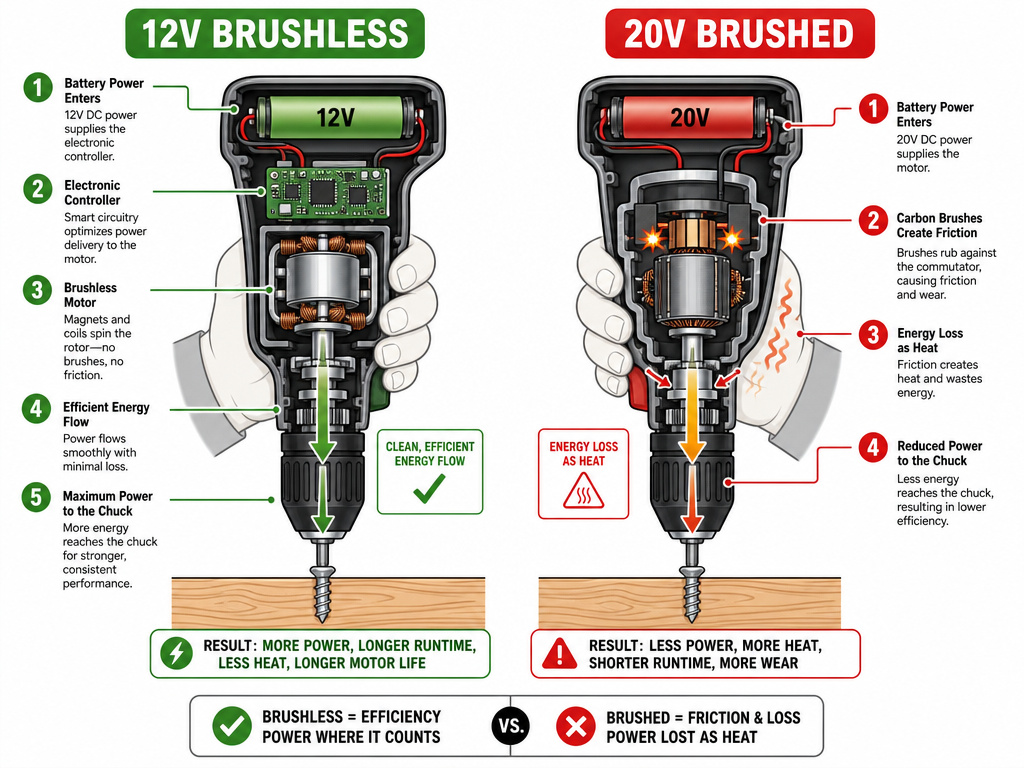
A brushless motor isn’t just more powerful. It’s smarter. By using electronic circuits instead of carbon brushes to control the magnetic fields that spin the motor, it reduces friction and waste heat. This means more of the battery’s energy reaches the chuck. In practical terms, a brushless 12V drill can often match or exceed the runtime and performance of a brushed 20V drill.
The DeWalt DCD801B and DCD800B are both brushless. The difference is in the transmission and electronics tuning. The DCD801B boasts an anti-rotation system that kills the motor if it senses a dangerous bind-up—a safety feature for when a large bit catches in metal. That’s a layer of protection brushed motors simply don’t have.
I won’t recommend a brushed motor for any new drill purchase in 2025. The efficiency gain is real, the longevity is proven, and the price gap has narrowed to almost nothing. The only reason to buy brushed is for a beater tool you expect to kill.
The brushless vs brushed drill debate is settled. Brushless wins on every metric except initial cost for the very cheapest models. For a homeowner who uses a drill ten times a year, a brushed motor is fine. For anyone building, renovating, or maintaining a property, brushless is the only choice that makes long-term sense.
When to Step Up to an Impact Driver or Hammer Drill
The standard drill driver has two siblings that specialize. Knowing when to switch tools saves your drill’s clutch and your sanity.
Impact Driver: When you’re driving long screws or bolts, especially into hardwoods or metal. The impact driver delivers sudden, rotational hammering blows to break torque, not just continuous twisting force. It prevents cam-out and wrist strain. For decking, framing, or assembling metal structures, an impact driver vs drill is the next tool you buy. Use the drill for pilot holes and precision work; use the impact to sink the fastener.
Hammer Drill: For masonry—concrete, brick, stone. The hammer drill adds a percussive forward hammering action to the rotation, chipping away material as it drills. A regular drill will just spin and glaze over the surface of concrete. If your project involves anchoring anything to a foundation or block wall, you need the hammer drill mechanism. A 20V platform is the minimum for effective hammer drilling; 12V hammer drills exist but are only for very light duty.
Here is a simple flow chart for tool selection: 1. Drilling a clean hole in wood, metal, or plastic? → Use a drill driver. 2. Driving a screw longer than 2.5 inches or a bolt? → Use an impact driver. 3. Drilling into concrete, brick, or masonry? → Use a hammer drill.
Mixing them up costs time and ruins bits. An impact driver is terrible for drilling precise holes. A hammer drill is overkill and damaging for wood.
Battery Technology: Lead-Acid vs. Lithium-Ion
The 12V and 20V drills we discuss use lithium-ion batteries. But “12V” also refers to a world of lead-acid batteries used in cars, solar systems, and backup power. It’s worth understanding why they’re not interchangeable.
Flooded Lead Acid (FLA) batteries, like the US 12VRX XC2, are heavy, require ventilation, and need periodic watering. They’re designed for deep-cycle applications where they’re slowly discharged and recharged, like in a solar bank. An AGM (Absorbent Glass Mat) battery, like the one in the Oracle DC12-12, is sealed and maintenance-free. Neither is designed for the rapid, high-current bursts a power tool demands.
Lithium-ion packs, in contrast, can deliver massive current for short periods without significant voltage sag. They’re also light. A 12V 2.0Ah lithium drill battery weighs about a pound. A 12V 12Ah AGM battery weighs over 8 pounds. The chemistry dictates the application. You wouldn’t try to start your car with a drill battery, and you shouldn’t try to run a drill from a marine deep-cycle battery.
The Default Pick and Final Recommendation
If you want one answer for the majority of homeowners: a 20V brushless drill/driver. The DeWalt DCD800B or the equivalent from Milwaukee, Makita, or Bosch. It covers framing, decking, concrete with the hammer function, and general household tasks. The platform lets you expand to impacts, saws, and lights.
If you already own a 20V system and find yourself doing finish work or working in tight spaces: add a compact 12V drill to your kit. Its light weight and smaller head will save your shoulder on overhead work and give you better control on delicate materials.
Skip the corded drill unless you’re running a shop where the tool never moves and you need continuous, all-day power. For everyone else, the cordless drill advantages in portability and convenience outweigh the corded tool’s unlimited runtime.
The voltage war is a distraction. Look at the torque, the chuck, and the motor. Then match the tool to the resistance your project will offer. That’s how you buy a drill that works, not just one that looks powerful on the shelf.
Frequently Asked Questions
Is a 20V drill overkill for home use?
Not necessarily. While a 12V drill can handle many tasks, a 20V drill provides headroom for tougher jobs like building a deck, drilling into masonry, or using large-diameter bits. It’s about capability, not overkill. For a simple apartment dweller, 12V might suffice. For a homeowner with a yard and projects, 20V is the more versatile investment.
Can I use my 20V battery on a 12V tool?
No. The battery platforms are physically and electronically incompatible. A 20V battery will not fit a 12V tool, and the higher voltage would damage the tool’s electronics. Each voltage tier is its own ecosystem of tools and batteries.
Does more voltage mean longer battery life?
No. Battery life (runtime) is determined by the battery’s amp-hour (Ah) capacity and the tool’s efficiency. A 20V drill with a 2.0Ah battery will run out of power faster than a 12V drill with a 4.0Ah battery doing the same work. Voltage relates to power potential; Ah relates to energy storage.
What’s better for driving screws: drill or impact driver?
For screws longer than 2.5 inches or for driving many screws, an impact driver is better. It uses concussive blows to prevent cam-out and reduces wrist strain. The drill is better for precision, controlled driving, and of course, drilling holes. Most pros own both. See our guide on the compact drill vs impact driver for details.
Is a hammer drill the same as an impact driver?
No. They are fundamentally different. A hammer drill hammers forward as it spins to drill into masonry. An impact driver hammers rotationally to drive screws. They are not interchangeable. You need a hammer drill for concrete; you need an impact driver for long fasteners.
Before You Go
Your drill is the most reached-for tool in the box. Choosing between 12 volt and 20 volt isn’t about winning a spec sheet battle. It’s about honestly assessing the toughest task you’ll ask it to do. If that task involves thick material, large fasteners, or masonry, the 20V platform is your only real choice. If your world is finish work, tight spaces, and light assembly, the 12V tool will feel like an extension of your hand.
Don’t buy for the dream project. Buy for the Saturday afternoon reality. And always, always buy brushless.
