
12v vs 18v Drill: The Critical Weight and Power Comparison
This post contains affiliate links. As an Amazon Associate, we earn from qualifying purchases.
Choosing between a 12v drill and an 18v drill is a weight-to-power tradeoff. A 12v drill, like the Bosch GSR12V-300N at 1.6 lbs, excels in tight spaces and overhead work but tops out around 30-35 Nm of torque. An 18v drill, like the Bosch GSR18V-400B12, delivers 50+ Nm of torque for boring large holes and driving hundreds of screws, but it weighs over 2 lbs and has a larger footprint. Your project scope dictates the winner.
The gap between 30 Nm and 64 Nm isn’t just a number. It’s the difference between drilling a 3/4-inch hole in a stud with patience and drilling a 2-inch hole through a joist without stalling. That extra power comes with physical bulk and a higher price for the battery ecosystem.
What follows: a breakdown of real torque and weight specs from Bosch, Skil, and DeWalt, the Consumer Reports classification that defines “general use” versus “heavy-duty,” and the specific project lines where each voltage category fails or succeeds. By the end, you’ll know which platform to invest in.
Key Takeaways
- Weight is the 12v drill’s superpower. Tools like the Bosch GSR12V-300N weigh under 1.8 lbs, making overhead cabinet work or all-day use feasible without fatigue.
- Torque defines the ceiling. An 18v brushless drill like the Bosch GSR18V-1330CB14 delivers over 1,300 in-lbs (147 Nm), enough to power large auger bits and hole saws that would stall a 12v motor.
- Battery platform commitment is long-term. Choosing 12v locks you into a compact system ideal for drivers and lights; 18v opens doors to saws, grinders, and outdoor power tools.
- Chuck size often follows voltage. Most 12v drills have a 3/8-inch chuck, limiting bit selection. Most 18v drills have a 1/2-inch metal chuck, accepting standard spade bits and hole saws.
- The wrong choice costs time and burns out tools. Using a 12v drill for deck building overheats the motor and drains batteries in minutes. Using an 18v drill for trim work is clumsy and often leads to stripped screws.
The 12V Drill: Compact Power for Overhead Work
Look at the head length. The Bosch PRO GSR12V-31 has a head length of 144 mm, which is 18 percent shorter than its predecessor. That dimension is why you buy a 12v drill. It fits inside kitchen sink cabinets, between studs in a wall, and above your head when mounting a ceiling fan without requiring a contortionist’s grip.
The performance envelope is specific. Per Bosch’s own spec sheets, models like the GSR 12V-15 are intended for drilling in wood up to 19 mm (3/4 inch) and steel up to 10 mm. Its hard torque is 30 Nm (266 in-lbs). This is the definition of a general-use drill, a category Consumer Reports defines as having “plenty of power for most household tasks” but not for heavy framing.
Where this goes sideways: Using a 12v drill with a paddle bit larger than 3/4 inch. The motor lacks the rotational force to clear chips, so it bogs down, overheats, and the battery depletes in under ten minutes. You smell the plastic housing before you see smoke.
The top-tier 12v models pack surprising punch. The Bosch GSR12V-300N uses a brushless motor to deliver 300 in-lbs (33.9 Nm) of torque in a 1.6-lb body. For versatility, the GSR 12V-35 FC with its FlexiClick system is unmatched, offering a right-angle attachment for truly impossible spots. But the physical limit is the battery. A 12v 2.0Ah battery stores less total energy than an 18v 2.0Ah battery, so runtime on demanding tasks is shorter.
The 18V Drill: Muscle for Bigger Projects
An 18v drill answers a different question. Can you bore a 2-inch hole through a double top plate? Can you drive 200 3-inch deck screws on a single charge? The platform is built for that. Consumer Reports categorizes 18-20 volt drills as heavy-duty, suitable for “difficult tasks like boring a large hole through studs or joists.”
The spec sheets tell the story. The Bosch GSR 18V-90 C delivers 64 Nm of torque and is rated for drilling up to 68 mm in wood. The PROFACTOR series GSR18V-1330CB14 claims 1,330 in-lbs (150 Nm) using a BITURBO Brushless motor and a high-power 8Ah battery. This isn’t just more power; it’s a different class of work.
| Task | 12V Drill Viability | 18V Drill Viability |
|---|---|---|
| Assembling furniture | Excellent – light, precise | Overkill – bulky, easy to over-torque |
| Installing cabinet hardware | Excellent – fits inside boxes | Good, but head length can hinder |
| Drilling for 3/4″ plumbing | Marginal – may stall in wet wood | Confident – power reserves prevent bogging |
| Building a deck frame | Poor – will overheat, slow | Required – sustains high-torque driving |
| Boring 2″ holes for venting | Will fail | Easy – high torque and battery capacity |
The tradeoff is mass and money. The Bosch GSR18V-400B12 is a compact 18v option, but it still weighs 1.95 lbs without its battery. The high-power batteries themselves are a significant investment. You buy into an 18v system for the ecosystem—the ability to run a circular saw, an angle grinder, or a string trimmer off the same battery packs.
Technical Snapshot: Heavy-duty 18V drills utilize brushless motors and metal gearboxes to transfer high torque efficiently. A model like the GSR18V-1330CB14 operates in two distinct ranges: 0–550 rpm for high-torque driving and 0–2,200 rpm for high-speed drilling, a flexibility most 12V drills cannot match.
What’s the Real-World Power Difference?
It’s about sustained output, not peak spin. A YouTube side-by-side test showed an 18v drill driving a screw in 3 seconds, a 40v in 2 seconds, and a 12v failing to seat it fully. The 12v motor lacks the low-end rotational force, or torque, to push through dense material once the screw bites.
The numbers from OEM manuals are concrete. The DeWalt DCD701F2 12v drill has a maximum recommended capacity of 3/4″ for flat boring in wood. The Bosch GSR 18V-90 C is rated for 68 mm, which is roughly 2.6 inches. That’s not a linear increase; it’s a capability multiplier. When you exceed a drill’s rated capacity, the clutch can’t protect the motor. You either stall or you burn it out.
I used a 12v drill to install a dozen cabinet pulls. It was perfect—light, quick, no fatigue. The next weekend, I tried to drill a 1-inch hole through a pine beam for a cable run. The drill screamed, the bit barely moved, and the battery was dead in four minutes. The project required a tool I didn’t own yet.
This is the sourced-number reality. The Skil PWRCore 12 brushless hammer drill delivers 350 in-lbs of torque. Its 18v counterparts start at 400 in-lbs and scale to over 1,300. That gap determines whether you’re drilling into concrete block or just dreaming about it.
Head-to-Head: Key Specifications Compared
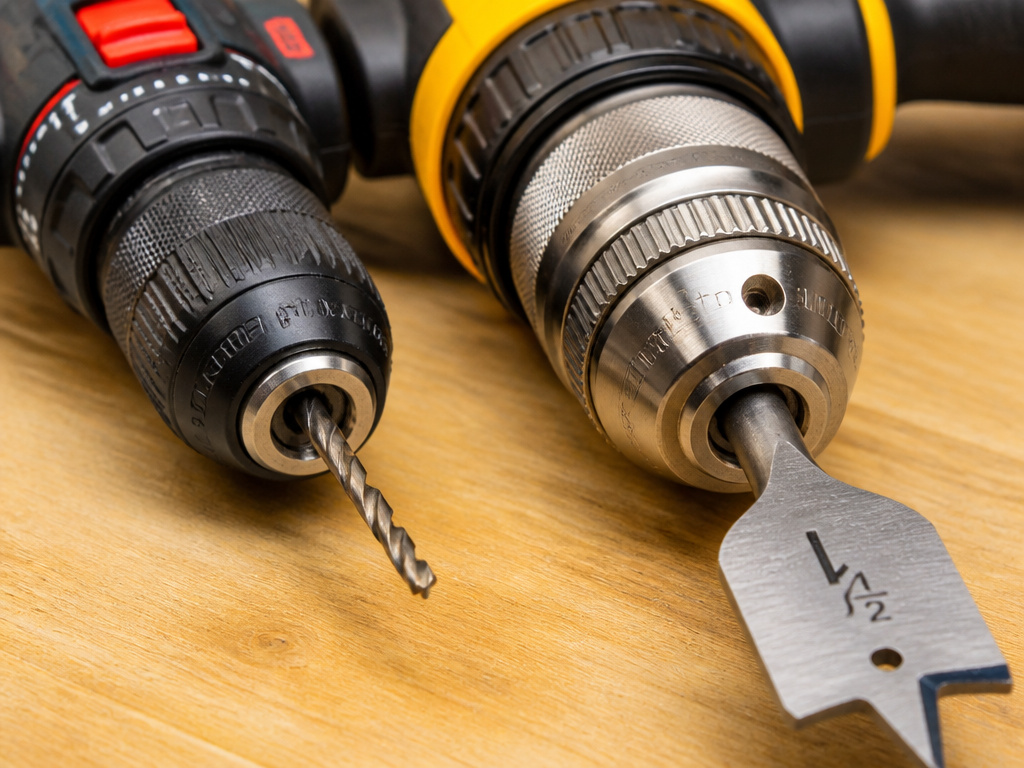
Don’t focus on voltage alone. The motor type, chuck size, and gearbox design are what you actually use. This comparison table uses data pulled directly from manufacturer specifications.
| Specification | Typical 12V Drill (e.g., Bosch GSR12V-300N) | Typical 18V Drill (e.g., Bosch GSR18V-400B12) |
|---|---|---|
| Weight (Tool Only) | 1.2 – 1.8 lbs | 1.9 – 3.5 lbs |
| Max Torque | 265 – 350 in-lbs (30 – 40 Nm) | 400 – 1,330 in-lbs (45 – 150 Nm) |
| Chuck Size | 3/8″ Keyless Common | 1/2″ All-Metal Standard |
| Max Wood Drilling | 3/4″ – 1-1/4″ (19 – 32 mm) | 2″ – 2-5/8″ (51 – 68 mm) |
| Battery Cost/Scale | Lower cost, compact, smaller ecosystem | Higher cost, larger, vast tool ecosystem |
| Best For | Overhead work, tight spaces, light-duty assembly | Framing, decking, large-diameter holes, all-day use |
The chuck size is a hard limit. A 3/8-inch chuck cannot accept the shank of a standard 1-inch spade bit or a hole saw with a 1/2-inch arbor. You must use reduced-shank bits, which are less common and often weaker. The 18v platform’s standard 1/2-inch chuck removes this limitation, which is a practical advantage as much as a power one.
How to Choose: Your Project List Decides

Your next three projects are the filter. Write them down. If your list is “hang curtains, assemble a bookshelf, mount a TV,” a 12v drill is the efficient, comfortable choice. If your list is “build a shed, install a fence, run new electrical lines,” you need the raw power and battery life of an 18v system.
Easy to miss: The noise difference. An 18v drill under heavy load is louder. In a finished home, the whine of a high-RPM motor drilling a large hole is disruptive. A 12v drill is often quieter, making it less intrusive for indoor finish work.
Consider the long-term battery platform. If you see yourself adding an impact driver vs drill or a cordless drill and impact driver set later, which voltage family has the tools you’ll want? Major brands invest more in their 18v lines, offering everything from leaf blowers to job site radios. The 12v line is typically focused on compact mechanics’ tools and lights.
Bottom line: For most homeowners, an 18v drill is the safer, more versatile first purchase. Its power ceiling is higher, and it prevents project paralysis when you inevitably need to drill a bigger hole. Buy a compact 12v drill later as a specialized partner for finish work and tight spaces.
Frequently Asked Questions
Is an 18v drill overkill for apartment living?
Often, yes. The bulk and power are unnecessary for hanging pictures, assembling furniture, and minor repairs. A compact 12v drill is easier to store, quieter to use, and less likely to damage drywall from over-torquing. The 18v drill’s advantages only materialize when you’re drilling into studs or masonry.
Can a 12v drill drive lag bolts?
It can start them, but it will struggle to fully seat a 3/8-inch lag bolt into hardwood. The lack of sustained torque means you’ll likely finish with a hand wrench. This is a classic example of where the impacting action of a 12V impact driver is a better fit than any drill.
Do I need a hammer drill function?
Only if you drill into masonry, concrete, or brick regularly. Most 12v and 18v “hammer drills” have a hammering mechanism, but their effectiveness is limited compared to a dedicated rotary hammer. For occasional concrete anchors, a standard drill with a good carbide bit is often sufficient.
What about the difference between 20V and 18V drill platforms?
It’s primarily marketing. 20V Max and 18V tools often use identical battery cells; the 20V label indicates nominal voltage, while 18V indicates maximum under load. They are compatible within the same brand’s ecosystem. Focus on the tool’s torque and feature specifications, not the voltage label alone.
Is brushless motor technology worth the extra cost?
In both 12v and 18v drills, yes. A brushless motor provides more power, longer runtime, and greater durability because it eliminates the friction and wear of physical brushes. It’s the single most meaningful performance upgrade you can buy.
Can I use 18v batteries on a 12v tool?
No. The battery platforms are physically and electrically incompatible. You cannot plug an 18v battery into a 12v tool, or vice versa. Your choice of voltage commits you to a specific family of batteries and chargers.
Before You Go
If you do small repairs and finish work in a finished home, get a 12v brushless drill like the Bosch GSR12V-300N. Its light weight and compact size will make you actually use it.
If you build things, renovate spaces, or work outdoors, the 18v platform is non-negotiable. Start with a capable mid-torque model like the Bosch GSR18V-400B12 or a drill and impact driver combo kit. The power reserve pays for itself the first time you don’t have to stop a project.
The data from Consumer Reports battery tool reviews confirms this split: general use versus heavy-duty. Your project list is the final test. Match the tool to the work, and you’ll never stall out halfway through.
