
Cordless Drill vs Corded Drill: Pros, Cons, and Best Uses
This post contains affiliate links. As an Amazon Associate, we earn from qualifying purchases.
A cordless drill trades unlimited runtime for portability, while a corded drill trades convenience for consistent high power. The choice isn’t about which is better overall, but which fits your specific job: a cordless model for mobility and most household tasks, or a corded model for sustained heavy-duty work like mixing or drilling masonry.
The voltage and wattage ratings tell you the ceiling, but the real decision lives in the details of your project list. Drill through drywall once a year? Cordless. Mix thinset for a tile floor or bore dozens of holes through studs? That’s corded territory.
What follows: a breakdown of torque numbers, runtime limits, and the specific scenarios where each type fails. We’ll name the models that define each category and give you a clear path to the right pick.
Key Takeaways
- Cordless drills max out around 110 Nm of torque (Bosch GSR 18V-110 C), while a mid-range corded drill like the Bosch GBM 1600 RE delivers a constant 11 Nm from its 850W motor, the sustained output is the differentiator.
- Using an underpowered 12V drill for deck building burns out the motor clutch within a month; the job demands an 18V or 20V brushless model or a corded drill.
- Corded drills are not just more powerful; their lack of a battery means no voltage sag under load, which is critical for tasks like stirring thick compounds or running large hole saws.
- The convenience of a cordless drill disappears if you need to drill more than 175 holes per charge (per DeWalt’s spec for the DCD801B), for big jobs, you need multiple batteries or a cord.
- For 90% of homeowners, a brushless 18V or 20V cordless drill is the correct default. Reserve a corded model for the specialized, high-demand tasks you already know are coming.
Cordless Drill vs Corded Drill: The Core Differences
The divide concerns physics, not quality. A cordless drill stores energy in a chemical battery, delivers it in bursts, and needs recharging.A corded drill pulls energy directly from the wall, delivering it continuously until you stop.
A brushless cordless drill like the DeWalt DCD801B is engineered for up to 109% more power than its predecessor and can make up to 175 holes per charge using a specific battery. A corded rotary drill like the Bosch GBM 1600 RE provides an 850W input power and 11 Nm of rated torque indefinitely, with no performance drop over time.
That “indefinitely” clause changes everything for long tasks. Let’s map the specs.
| Feature | Cordless Drill (e.g., Bosch GSR 18V-90 C) | Corded Drill (e.g., Bosch GBM 1600 RE) |
|---|---|---|
| Max Power Source | Battery (18V, 20V) | Wall Outlet (110V/120V) |
| Typical Max Torque | 64 Nm – 110 Nm | 11 Nm – 60 Nm+ (continuous) |
| Key Limitation | Battery Runtime & Voltage Sag | Cord Length & Access to Power |
| Best For | Mobility, overhead work, quick jobs, most DIY | Sustained high-power tasks (mixing, masonry, large holes) |
| Weight (Tool Only) | 1.1 kg – 1.8 kg | 2.1 kg – 5.8 kg |
The torque numbers can be misleading. A cordless drill’s 110 Nm is a peak, short-burst figure. A corded drill’s 11 Nm is a rated, sustainable output. The corded tool will maintain that 11 Nm while mixing a five-gallon bucket of drywall mud from start to finish; the cordless drill’s torque will plummet as the battery depletes.
This is why understanding cordless drill basics matters. The battery isn’t just a power source; it’s the tool’s fuel tank and governor combined.
When a Cordless Drill Wins
Portability involves working on a ladder, inside a cabinet, or in a corner where dragging an extension cord is a tripping hazard, not merely walking across a yard. For the vast majority of common cordless drill applications, hanging shelves, assembling furniture, installing curtain rods, a cordless is the only sensible choice.
The modern brushless motor drill technology amplifies this advantage. A brushless model like the DeWalt DCD801B is more efficient, runs cooler, and lasts longer than old brushed models. This efficiency translates directly into the 175 holes per charge claim, a figure pulled straight from DeWalt’s spec sheet.
Common mistake: Using a compact 12V drill for building a deck. The clutch will slip on every other screw, the motor will overheat, and the battery will die after two dozen joist hangers. You’ll finish the job, but you’ll hate every minute of it.
For a deck, you need the muscle of an 18V or 20V brushless model. The difference between a 12V drill and an 18V drill isn’t just six volts; it’s the ability to deliver power without stalling. If your project list includes any sort of framing, skip the 12V category entirely.
When a Corded Drill Wins
There are jobs where “battery-powered” is a synonym for “underpowered.” If your task requires constant, high-torque output for more than 30 minutes, you need a cord.
- Mixing. The Bosch GBM 1600 RE is literally marketed for “stirring liquids” with baskets up to 160mm. Try that with a cordless drill. The battery will be dead before the thinset is smooth.
- Masonry Drilling. A dedicated corded hammer drill like the Bosch HD18-2, with its 8.5 Amp motor and 51,000 BPM, will drill into concrete all day. A cordless hammer drill like the DeWalt DCD805B has a hammer function, but it’s for a dozen tapcons, not for core-drilling a foundation.
- Large-Diameter Holes. Drilling a 3-inch hole through a double top plate with a hole saw demands steady torque. A corded drill’s power doesn’t fade on the third hole.
The Consumer Reports cordless drill tests are invaluable for comparing cordless models, but their data also reveals the ceiling. When they note that “heavy-duty tasks” like deck building generally require “higher-voltage drills,” they’re implicitly pointing you toward the corded aisle for the most demanding versions of those tasks.
Power & Performance: Specs That Actually Matter
You’ll see two numbers: voltage (V) for cordless, watts (W) or amps (A) for corded. Neither tells the whole story alone.
For cordless, voltage is the potential, but the motor and battery chemistry deliver the punch. A DeWalt 20V MAX XR drill and a Bosch 18V drill can perform nearly identically, despite the different numbers, because of brushless motor design and battery cell quality. The real metric to compare is Units Watts Out (UWO) or Newton-meters of torque (Nm).
- DeWalt DCD805B: Up to 40% more UWO than its predecessor.
- Bosch GSR 18V-110 C: 110 Nm max torque.
For corded, watts or amps indicate the motor’s appetite for current. A 550W motor (Bosch GBM 13 HRE) is good for drilling steel. An 850W motor (Bosch GBM 1600 RE) is for mixing. A 1500W monster (Bosch GSB 162-2 RE) is for drilling large-diameter holes in masonry.
Where this goes sideways: Comparing a 20V cordless drill to a 750W corded drill by the numbers. The 20V drill might have a higher peak torque figure, but the 750W corded drill will deliver its rated torque without interruption for an hour. The cordless drill’s battery will be dead in 20 minutes under the same load.
The takeaway? For short, high-power bursts, a top-tier cordless can match a corded tool. For any task measured in hours, the corded tool wins by default.
The Mobility vs. Runtime Trade-Off
This is the heart of the choice. Let’s break it down with a scenario table.
| Your Project | Better Choice | Why |
|---|---|---|
| Assembling IKEA furniture in a room | Cordless | No cord to manage, lightweight, sufficient power. |
| Installing a ceiling fan | Cordless | Overhead work; a cord is a hazard and a nuisance. |
| Drilling 50+ 3/8″ holes for shelving in a garage | Depends | Cordless if you have 2+ batteries; Corded if you have one outlet and want to finish in one go. |
| Mixing mortar for a small patio | Corded | Sustained high torque will drain cordless batteries in minutes. |
| Building a full-size deck | Both | Use cordless for 90% of screws; use a corded drill for boring large post holes with an auger bit. |
The runtime of a cordless drill depends on the task, not just the battery size. DeWalt’s “175 holes per charge” spec assumes a specific 7/8″ auger bit in softwood.Switch to drilling into seasoned oak or using a hole saw, and that number can drop by half.
This is where your cordless drill operation habits matter. Letting the tool cool between batteries, using sharp bits, and not forcing it extends both the runtime and the tool’s life. A corded drill doesn’t need that care; it will simply run until the motor overheats, which on a pro-grade model, takes a very long time.
Making the Choice: A Step-by-Step Guide
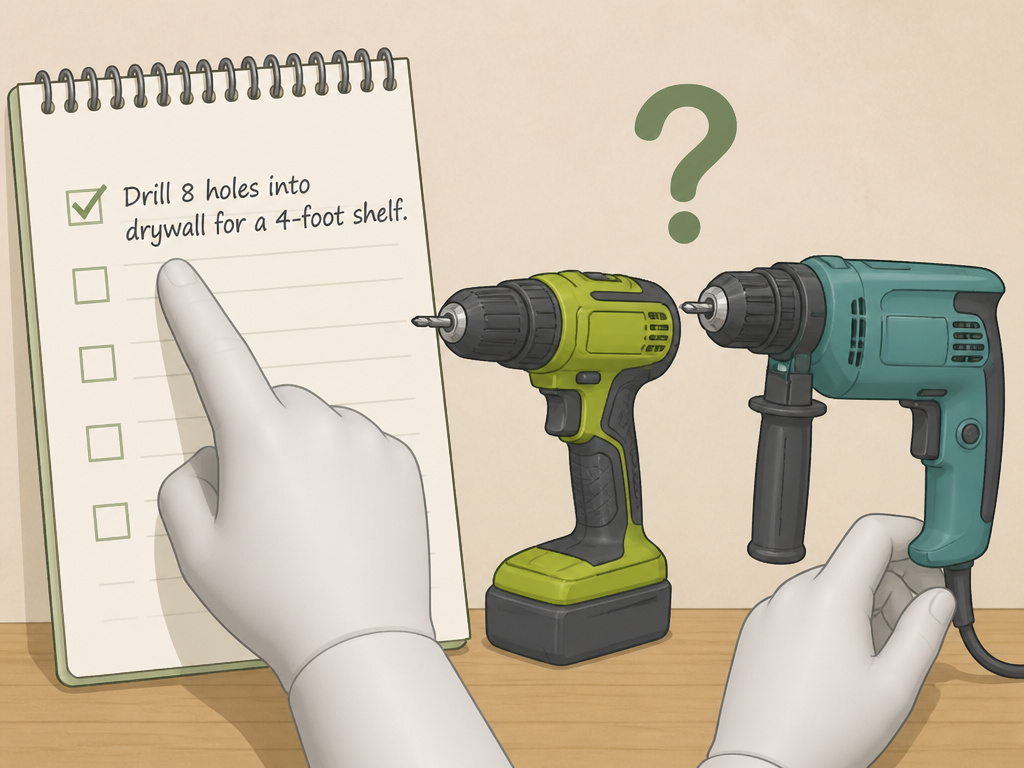
Stop thinking about drills. Start thinking about your next three projects.
- List the next three things you need to drill or build. Be specific. “Hang some shelves” is vague. “Drill 8 holes into drywall for a 4-foot shelf, then drive 8 screws” is specific.
- Identify the hardest task on that list. Is it drilling into a concrete basement wall? Driving 4-inch lag bolts? Stirring a bucket of floor leveler?
- Match the tool to the hardest task. If the hardest task is within a cordless drill’s capabilities, buy cordless. If the hardest task clearly requires a cord (like mixing or core drilling), you need a corded model.
- Consider the ecosystem. If you already own a 20V drill and batteries, buying another cordless tool is cheap. If you’re starting from zero, the decision is wider open.
- Buy for the 90%, rent for the 10%. Need a corded hammer drill for one weekend project? Rent it. Don’t let a single outlier task dictate your primary tool purchase.
For most people, the answer lands here: a brushless 18V or 20V cordless drill is the first and most used tool in the box. It covers the majority of cordless drill tasks. A corded drill is a specialty tool you add later for specific, high-demand jobs.
Frequently Asked Questions
Can a cordless drill be as powerful as a corded drill?
For short bursts, yes. Modern brushless cordless drills like the Bosch GSR 18V-110 C have impressive peak torque (110 Nm). However, they cannot sustain that power output like a corded drill can. The battery drains, voltage drops, and performance falls off. For any task requiring more than 10-15 minutes of continuous high power, the corded drill is stronger.
How long does a cordless drill battery last?
It depends entirely on the task. Using a DeWalt DCD801B for small pilot holes, you might get 175 holes per charge. Using the same drill to drive 3-inch deck screws, you might get 30-40 screws before needing a swap. For light-duty screwdriving, a 4.0Ah battery can last a couple of hours. For heavy drilling or mixing, plan on 20-30 minutes.
When should I definitely use a corded drill?
Use a corded drill in three scenarios: 1) When mixing thick compounds like mortar, thinset, or drywall mud. 2) When drilling many large-diameter (over 1 inch) holes in wood or masonry. 3) When you have access to power and will be working in one spot for more than an hour, making the cord a non-issue.
Is a hammer drill better corded or cordless?
For serious, frequent masonry work, a corded hammer drill is better. It provides consistent impact energy without battery fade. For occasional use, hanging a TV bracket on a concrete wall or setting a few tapcons, a cordless hammer drill like the DeWalt DCD805B is perfectly adequate and far more convenient.
What’s more important, drill voltage or amp hours?
For cordless, first ensure the voltage is right for the job (18V/20V for general use). Then, amp-hours (Ah) determine runtime. A 2.0Ah battery is lighter and good for short jobs. A 5.0Ah or 6.0Ah battery is heavier but will let you work much longer. For corded, amperage (A) or wattage (W) directly indicates power, higher is more capable for tough jobs.
The Bottom Line
Your drill choice locks you into a work style. A cordless drill offers freedom and speed for 90% of projects. A corded drill offers relentless power for the other 10%.
Most workshops should start with a capable brushless cordless model, the DeWalt DCD801B or Bosch GSR 18V-90 C are benchmarks. Learn its limits. When you hit a project that clearly exceeds those limits, that’s your signal to buy or rent a corded drill. That’s how you build a toolkit that’s both versatile and capable, without overspending on power you’ll rarely use.
