When to Use an Impact Driver vs a Drill | Tool Comparison
This post contains affiliate links. As an Amazon Associate, we earn from qualifying purchases.
Use an impact driver for high-torque fastening into dense materials, driving long screws, lag bolts, or self-tapping metal screws. Its hammer-anvil mechanism delivers bursts of rotational force (impacts) to overcome resistance. Use a drill for making holes and for precision screwdriving where controlled torque matters. A drill provides constant rotational force and often includes a clutch to prevent over-tightening.
The distinction isn’t about power; it’s about the type of force. An impact driver’s 200 Nm feels different from a drill’s 200 Nm. One is a rapid series of concussive blows to the socket. The other is a steady, insistent push.
What follows: the physics of each tool’s mechanism, the specific fasteners and materials each is built for, and the three most common mistakes that strip screws, stall motors, or break chucks. By the end, you’ll pick up the right tool without thinking twice.
Key Takeaways
- An impact driver’s hammer-anvil mechanism delivers sudden rotational impacts, making it superior for driving fasteners into hard wood or metal. A drill provides smooth, constant torque.
- Never use an impact driver on small screws (#8 or smaller) or when an exact torque is specified, the tool will over-tighten and snap the fastener or damage the workpiece.
- The drill’s keyed or keyless chuck is its greatest weakness for high-torque driving; the gripping force can be exceeded, causing the bit to spin inside the chuck and cam out.
- For making holes of any size, the drill is the only correct choice. Impact drivers are not designed for drilling and will damage drill bits and provide poor control.
- If you only own one tool, make it a drill. If you drive more than a dozen 3-inch screws in a sitting, you need an impact driver.
The Core Difference: Torque Delivery vs. Pure Rotation
The internal mechanism dictates everything. Open an impact driver, and you’ll find a spring-loaded hammer and an anvil. A drill contains a motor, gears, and a clutch.
The hammer-anvil system in an impact driver rotates freely until it meets resistance. Then, the hammer cams back, compresses a spring, and slams forward into the anvil. This delivers a sudden, high-torque rotational impact. The process repeats thousands of times per minute, 3,500 impacts/minute on the Hilti SID 4-A22. This pulsed force is why an impact driver can drive a lag bolt your drill would only stall on.
A drill delivers torque through direct gear reduction. Pull the trigger, and the chuck spins at a constant speed with a consistent twisting force. When the resistance matches the motor’s maximum output, the tool stalls or the clutch disengages. There is no hammering action.
This difference explains the noise. An impact driver’s distinctive rattle is the hammer striking the anvil. A drill whines or grinds.
| Mechanism | Best For | Fails When |
|---|---|---|
| Impact Driver (Hammer-Anvil) | Driving long/deck screws, lag bolts, self-tapping metal screws. | Precision torque tasks, drilling holes, small fasteners (#8 or less). |
| Drill (Direct Drive + Clutch) | Drilling holes, driving screws to a set depth, applications requiring finesse. | High-torque fastening into hard materials; the chuck grip fails before the motor stalls. |
The drill’s clutch is a safety for screws, not an advantage for power. It slips to prevent over-driving. An impact driver has no such safety. Its force is the point.
Why Chuck Design Is a Deal-Breaker
This is the physical limitation most guides gloss over. A drill uses a keyless chuck that grips drill bits and driver bits with three metal jaws. The grip strength of those jaws is finite.
Where this goes sideways: The chuck’s grip force is often lower than the motor’s torque output. Under high load, the bit spins inside the chuck instead of turning the screw. This “cam-out” inside the tool rounds off the bit’s shank, generates heat, and strips the screw head. You smell a faint burning metal odor before you see the damaged bit.
An impact driver uses a 1/4-inch hex collet. The bit snaps in and is locked rotationally by the hex shape, not by friction. The hammer’s impacts are transferred directly to the bit with no chance of internal slippage. This is why an impact driver can apply 1,717 in-lbs (Hilti SID 4-A22, gear 3) without failing at the connection.
For assembling furniture or mounting a shelf, the drill’s chuck is fine. For building a deck? It’s the wrong connection.
When the Impact Driver Is Non-Negotiable
Reach for the impact driver when the job involves high rotational resistance. The hammering action conquers friction that would stall a drill or break your wrist.
Driving Long or Large-Diameter Fasteners:
- Lag Bolts & Structural Screws: The Hilti SID 4-A22 is rated for driving lag bolts up to 1/2″ diameter in wood. A drill would struggle, burn out, or require a cumbersome socket adapter that stresses the chuck.
- Decking: Driving dozens of 3-inch deck screws into pressure-treated lumber. The impact driver drives them flush without pre-drilling in most cases, and the tool’s weight and balance reduce user fatigue.
- Self-Tapping Metal Screws: The same Hilti model is specified for driving screws into 12-gauge sheet metal. The impact action helps form the threads in the metal without pushing back against you.
High-Volume Repetitive Driving:
If you’re installing subflooring, assembling a fence with screws, or running any production-style fastening job, the impact driver is the efficiency tool. The lack of kickback lets you work faster with one hand. The Bosch GDR 18V-200 exemplifies this with its compact, 126-mm head length for tight spaces and a brushless motor for runtime.
Common mistake: Using an impact driver on small screws. The tool’s minimum force is often too high. A #6 or #8 wood screw will snap at the head or strip its drive socket before you can release the trigger. That’s a $200 tool solving a problem that didn’t exist.
Breaking Free Stuck Fasteners:
The hammering action works in reverse. An impact driver can often loosen a rusted or over-tightened screw that a drill’s smooth torque cannot budge. The impacts shock the fastener free. This is a core technique for any weed trimmer repair involving disassembly.
When the Drill Wins: Precision, Holes, and Control
The drill is the versatile foundation. Its smooth power and adjustable clutch make it the only choice for a range of fundamental tasks.
Making Holes (The Primary Job):
This is the drill’s exclusive domain. From a 1/8-inch pilot hole to a 1-inch spade bit cut, the constant rotation is what a drill bit needs. Impact action will destroy standard twist drill bits, the impacts will snap the flutes or dull the cutting edge immediately.
- Masonry & Concrete: A hammer drill (a drill with an impact function for forward pounding) is required. A standard impact driver does nothing here.
- Large Diameter Holes: The DeWalt DCD801B drill driver has a 1/2-inch metal ratcheting chuck designed to securely hold large-diameter bits without slippage. An impact driver’s 1/4-inch collet cannot accept these bits at all.
Precision Screw Driving:
When you need to stop exactly flush, not countersink, the drill’s clutch is your friend. Setting the clutch to a low number allows the tool to disengage once a certain resistance is met. This is critical for: – Assembling cabinetry where over-driving splits the wood. – Installing outlet covers or other decorative hardware. – Driving screws into soft materials like drywall or PVC where the material offers little resistance.
Tasks Requiring a Specific Tool Attachment:
The drill’s universal chuck accepts more than just bits. It holds wire wheels, buffing pads, mixing paddles for paint or mortar, and hole saw arbors. The impact driver’s hex collet cannot. For stirring a bucket of drywall mud or using a string trimmer line spool that requires a mandrel, you need a drill.
The 3 Tool-Kit Scenarios: What to Buy and When
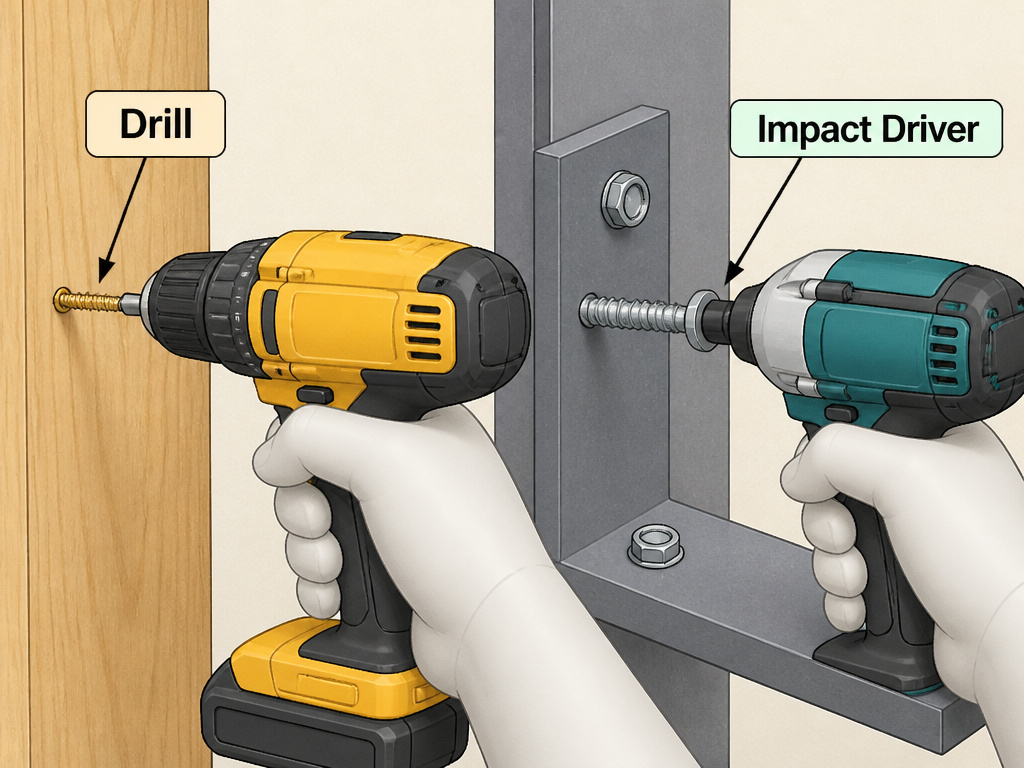
Your projects dictate your tools. Here’s the breakdown for common user profiles.
| Your Profile | Primary Tool | Add This Tool When | Skip This Combo |
|---|---|---|---|
| Occasional DIY / Homeowner | Drill (e.g., DeWalt DCD801B or Bosch GSR18V-975CN). | You start a project with 50+ screws (e.g., a deck, fence, shed). | Buying an impact wrench—you don’t need its higher torque for automotive work. |
| Regular DIY / Workshop Hobbyist | Both. Start with a drill, add a basic impact driver like the Ryobi PBLID02. | You work with hardwoods or metal frequently. | Using the impact driver for all tasks; keep the drill for holes and precision. |
| Professional / Contractor | Both, from the same battery platform (e.g., DeWalt 20V MAX, Milwaukee M18). | You need an impact wrench for lug nuts or structural bolts. | Using a drill for production screw driving—it’s too slow and hard on the tool. |
For the homeowner, the drill is the default. It handles 80% of tasks. The impact driver is a specialty tool for the other 20%. If you budget for one specialty tool, make it an impact driver before a hedge trimmer or an edger. It saves more time and frustration.
What about a Combo Kit?
Combo kits offering a drill and impact driver are typically the best value. You get two tools that share batteries and a charger. Ensure the drill has a metal, ratcheting chuck (not plastic) and the impact driver has a brushless motor. The brushless motor, like in the Bosch GDR 18V-200, provides longer runtime and tool life. This is a smarter investment than buying a single high-end drill.
Safety & Tool-Killing Mistakes to Avoid
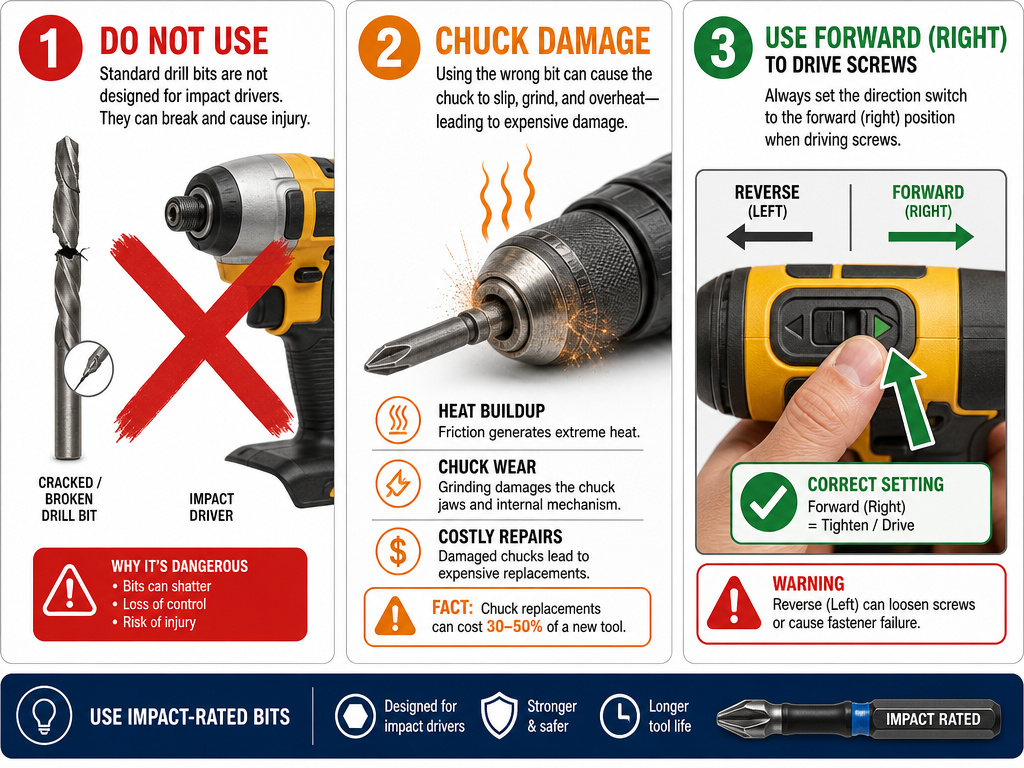
Power tools fail predictably. Here are the failures tied directly to misuse.
Before you start: Always wear safety glasses. Impact drivers propel metal shavings and broken bit fragments. Use hearing protection with impact tools, they exceed 85 dB(A). Ensure your workpiece is securely clamped; the high torque can spin it violently.
1. Using an Impact Driver to Drill Holes.
This destroys drill bits. The hammering action applies lateral stress to the bit’s flutes, causing them to crack. A standard HSS twist drill bit will fail on its first use in an impact driver. If you must drill with an impact driver, you need specifically labeled “impact-rated” drill bits, which have a tougher, shock-absorbing design. It’s still a poor substitute for a drill.
2. Using a Drill for High-Torque Driving.
You’ll hear a grinding sound and smell hot metal. That’s the chuck jaws slipping on the bit shank. The bit and the screw head are both being rounded off. Stop immediately. If the task requires this much force, you need an impact driver. Continuing will permanently damage the drill’s chuck.
3. Ignoring the Tool’s Directional Setting.
Both tools have a forward/reverse selector. Always check it before pulling the trigger. Driving a screw in reverse strips it instantly. This is especially critical when performing maintenance, like during weed trimmer storage disassembly, where you’re removing screws.
The Ryobi PBLID02 manual explicitly warns: “Never change modes while the tool is running. Doing so may result in serious damage to the tool.” The gearbox isn’t designed for that shock.
Frequently Asked Questions
Can an impact driver replace my drill?
No. An impact driver cannot perform a drill’s core function: making clean, controlled holes. Its mechanism is wrong for the task, and it lacks a universal chuck. It is a supplement, not a replacement.
I have a hammer drill setting. Is that the same as an impact driver?
No. A hammer drill provides a linear, in-and-out pounding action along the axis of the bit to help break up masonry. An impact driver provides a rotational hammering action (turning force). They are completely different mechanisms for different materials.
What size impact driver do I need for home use?
Mid-torque model in the 150-200 Nm (1,100-1,800 in-lb) range is ideal for home use. This covers deck building, furniture assembly, and light automotive work. The Bosch GDR 18V-200 (200 Nm) or the Ryobi PBLID02 (2,300 in-lb) are excellent choices. More torque isn’t better for home use, it increases the risk of damaging fasteners.
Why does my impact driver strip screw heads?
You are likely using the wrong bit type, a worn bit, or too much force on a small screw. Ensure you use impact-rated bits, which are hardened against the tool’s hammering. Match the bit size exactly to the screw drive (e.g., #2 Phillips for a #8 screw). Let the tool do the work; don’t lean into it.
Can I use socket adapters with my impact driver?
Yes, for light-duty bolts (e.g., furniture assembly, lawnmower blades). Use a 1/4-inch hex to square drive adapter. Remember, your impact driver’s torque is far lower than an impact wrench’s. Do not use it for automotive lug nuts or other critical, high-torque fasteners. For that, you need to understand the string trimmer mechanism of a proper impact wrench.
Is a brushless motor important?
For an impact driver, yes. Brushless motors are more efficient, run cooler, and last longer, especially under the high-stress, stop-start cycles of impact driving. They provide more runtime per battery charge. For a drill used occasionally, brushed motors are acceptable. For regular use, go brushless.
The Bottom Line
If you’re making holes, fastening with precision, or using accessory attachments, the drill is your tool. Its chuck and clutch are designed for that world. If you’re driving a pile of screws, lag bolts, or anything into a material that fights back, the impact driver’s hammer-anvil system is the only thing that works without stalling or breaking your wrist.
Most homes need both. Start with a quality drill, it’s the foundation. The day you embark on a project with a box of 3-inch screws, add an impact driver. You’ll finish the job in half the time, with half the frustration, and your drill will thank you by lasting twice as long.
