What Is a Portable Drill Used For? Core Functions & Applications
This post contains affiliate links. As an Amazon Associate, we earn from qualifying purchases.
A portable drill is a handheld power tool that rotates a cutting tool, a drill bit, to bore holes in materials like wood, metal, plastic, and masonry. Its secondary function is driving screws and other fasteners. The tool’s defining feature is mobility; you bring it to the workpiece.
That definition comes from a 1941 U.S. Department of Commerce standard. The NIST CS93-41 document still defines the minimum specs for a portable electric drill, including ampere ratings that separate a light-duty homeowner tool from a model built for all-day professional use. The difference isn’t marketing. It’s a measurable electrical load that predicts whether the motor burns out on its third concrete hole or runs for a decade.
What follows is a breakdown of that standard, the four jobs a portable drill actually does, and the three other tools, hammer drills, impact drivers, rotary hammers, that people confuse with it. By the end, you’ll match the tool to the material based on its published rating, not its brand name.
Key Takeaways
- The formal definition and electrical specifications for a portable drill are still governed by the 1941 NIST Commercial Standard CS93-41.
- A drill’s ampere rating (corded) or voltage (cordless) directly indicates its duty class: Class B for standard use, Class A for heavy-duty, continuous operation.
- Beyond drilling holes, a portable drill’s clutch allows it to drive and remove screws without damaging the head or the material.
- For concrete or brick, you need a hammer drill’s impacting action; a standard drill will overheat and dull bits.
- An impact driver is for high-torque fastening, not drilling; using it as a drill risks breaking bits and damaging workpiece surfaces.
What Exactly Is a Portable Drill? (Definition & Core Specs)
A portable drill isn’t just a motor in a case. The NIST portable drill standards from 1941 established the technical minimums that still shape tool design. That document, Commercial Standard CS93-41, defines it as a rotary electric drill sized by its maximum chuck capacity and divided into two performance classes.
The key metric is full-load ampere rating. This isn’t peak draw. It’s the sustained current the motor pulls while maintaining speed under a load that reduces its RPMs by 30–45%. This number tells you everything about the drill’s guts.
A 1/2-inch Class A (heavy-duty) drill must pull a minimum of 5.0 amps at 115V. A 1/2-inch Class B (standard) drill pulls at least 3.5 amps. The Class A motor has thicker windings, a larger commutator, and heavier-duty bearings to handle the heat from that extra current. It’s built for a production line, not a weekend shelf project.
If you’re holding a modern cordless drill, voltage is the rough equivalent. An 18V or 20V drill is the standard Class B analog for most tasks. A 60V or 80V brushless cordless model enters the Class A heavy-duty territory. The principle is the same: energy input determines work output and durability.
The Chuck: What Holds the Bit
The chuck is the adjustable clamp at the front of the drill. Its size, 1/4-inch, 3/8-inch, or 1/2-inch, refers to the maximum shank diameter of the drill bit it can hold. A 1/2-inch chuck doesn’t mean you drill 1/2-inch holes; it means you can use bits with 1/2-inch shanks, which are typically for holes over 3/8-inch.
Most modern drills use a keyless chuck you tighten by hand. The older standard required a geared chuck tightened with a key. The keyless is faster, but the geared chuck provides superior grip and runout accuracy, which matters for metalworking or when using large-diameter bits.
The 4 Core Jobs of a Portable Drill
A drill spins. That rotation lets it do four specific things. Confusing these jobs with the functions of a hammer drill or impact drill is where projects get messy.
1. Drilling Holes (The Primary Function)
This is the straightforward job: making a round hole. The drill bit you choose is as important as the tool. A twist bit for wood, a brad point bit for cleaner entry holes, a masonry bit for concrete, a step bit for thin metal.
The drill’s power determines how smoothly it does this. A low-amp corded drill or a basic 12V cordless will bog down and stall in hardwoods or thick metal. You’ll smell the hot motor winding insulation, a sharp, acrid odor, before you see smoke. A tool rated for the job maintains speed under pressure.
2. Driving & Removing Screws
The adjustable clutch is what makes a drill a driver. It disengages the motor from the chuck at a preset torque level. Set it low for assembling furniture into particle board. Crank it high for driving lag bolts into a stud.
Common mistake: Driving screws with the drill set to the drill icon. This bypasses the clutch, sending full torque to the screw. You’ll strip the screw head, sink the fastener too deep, or split the wood every time.
For this job, you use a screwdriver bit, not a drill bit. The hex shank on these bits locks securely into the chuck.
3. Mixing & Stirring
With a paddle mixer attachment, a drill becomes a potent stirrer for paint, drywall mud, thinset mortar, or concrete. This is a high-torque, low-speed application. Use a power drill with a half-inch chuck and a side handle. The centrifugal force on a full bucket can wrench the tool right out of your hands.
Where this goes sideways: Using a compact 12V drill for mixing thick mortar. The plastic gear train will shear. You’ll hear a sharp crack, then free-spinning.
4. Wire Brushing & Surface Prep
Lock a wire cup brush or a stripping wheel into the chuck. You can remove rust, paint, or corrosion from metal, or clean grout from tile. Always wear heavy gloves and full-face protection. The bristles shed at high speed and become dangerous projectiles.
Portable Drill vs. The Other Tools (Hammer Drill, Impact Driver, Rotary Hammer)
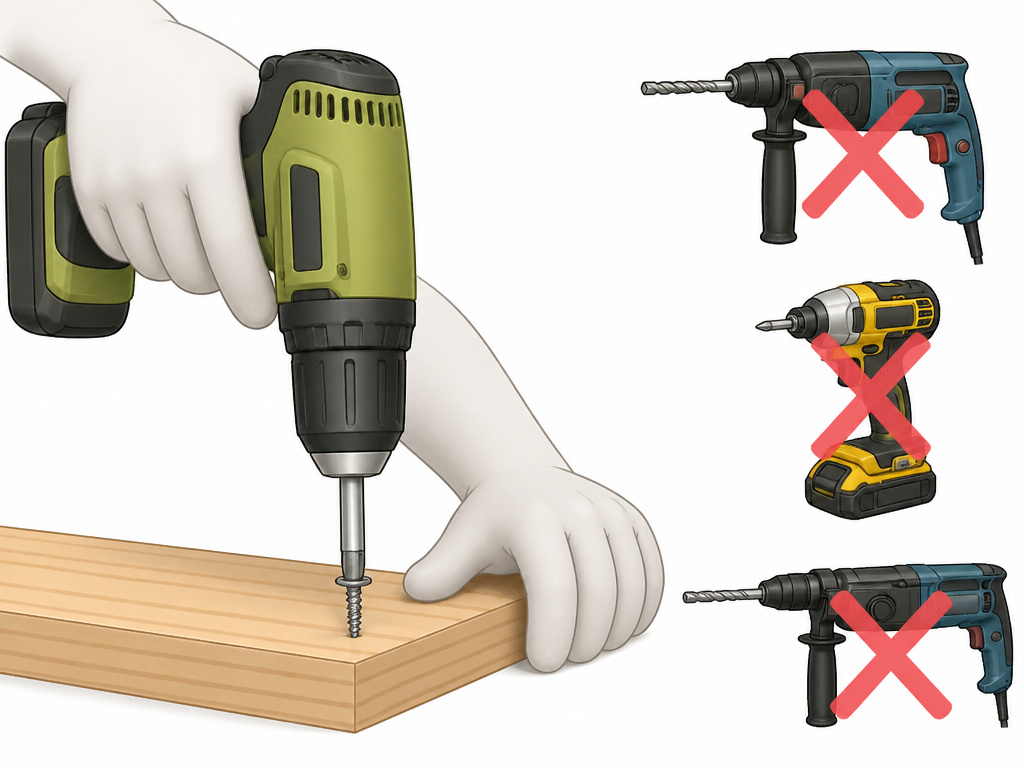
This is the most common point of confusion in the aisle. Each tool has a distinct mechanism.
| Tool | Primary Mechanism | Best For | Will Fail At |
|---|---|---|---|
| Portable Drill | Constant rotary force | Holes in wood/metal, driving screws | Drilling into concrete or brick |
| Hammer Drill | Rotation + forward impacts | Holes in masonry (concrete, brick, block) | Heavy-duty chiseling, prolonged core drilling |
| Impact Driver | Rotation + concussive hits | High-torque fastening (lag bolts, deck screws) | Precision drilling, brittle materials |
| Rotary Hammer | Rotation + piston-driven impacts | Core drilling, chiseling, heavy masonry | Driving screws, drilling in wood |
When You Need a Hammer Drill
A hammer drill adds a pounding action along the axis of the bit. It’s like someone tapping the back of the drill while it spins. This pulverizes masonry as the bit rotates. The switch is usually marked with a hammer icon.
Use it for setting anchors in a concrete wall, drilling for a mailbox post in brick, or any task involving stone or block. Without the hammer function, a standard drill bit will just spin, overheat, and dull against the concrete surface.
When You Need an Impact Driver
An impact driver applies rotational impacts, sudden, concussive twists, to deliver extreme torque. It’s for fasteners, not holes. The anvil mechanism inside produces a loud, rapid rattling sound.
It’s the right tool for building a deck, assembling a shed, or any job with long, thick screws. It will drive a 3-inch lag bolt where a standard drill’s clutch would simply give up. Do not use it with standard drill bits. The impact action can shatter them, especially masonry or glass bits.
When You Need a Rotary Hammer
A rotary hammer drill (SDS-Plus or SDS-Max) uses a piston mechanism for much more powerful impacts. It’s for serious masonry work: drilling large-diameter holes for plumbing, chiseling away tile, or demolition. It’s in a different weight class altogether.
Choosing the Right Portable Drill: Corded vs. Cordless & Duty Class
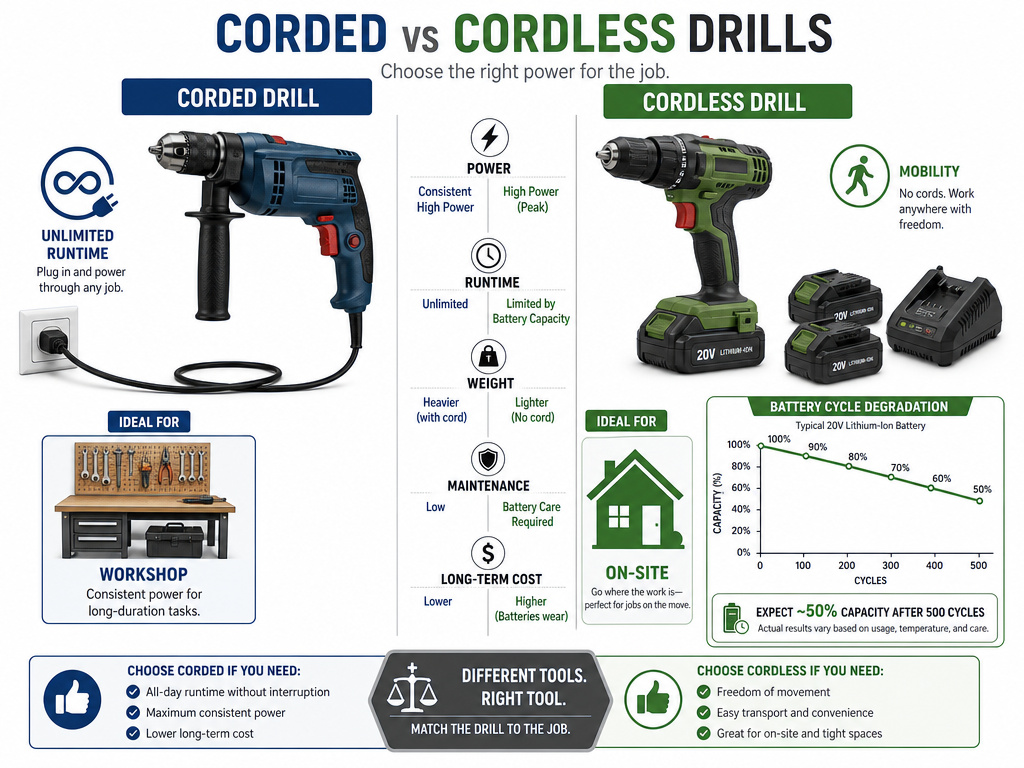
Your choice boils down to power source and duty rating. This table uses the 1941 standard’s logic applied to modern tools.
| Drill Type | Duty Class (Analog) | Typical Spec | Best Use Case | Limitation |
|---|---|---|---|---|
| Corded, 3/8″ Chuck | Class B (Standard) | 2.5–4.0 Amps | Workshop use, extended runtime, mixing | Cord management, less portable |
| Corded, 1/2″ Chuck | Class A (Heavy-Duty) | 5.0–8.0+ Amps | Professional construction, all-day drilling | Heavier, more expensive |
| Cordless, 12V/18V | Class B | Compact, lightweight | 90% of home DIY, overhead work, tight spaces | Limited runtime on dense materials |
| Cordless, 20V/60V | Class A | High torque, brushless | Framing, decking, heavy fabrication | Higher cost, heavier battery |
Corded Drills: Unlimited Runtime, Tethered
A corded drill plugs into an outlet. It provides consistent, unlimited power. There’s no battery to die mid-project. This makes it ideal for a workshop station, for using a drill press attachment, or for high-drain tasks like mixing thick compounds.
The downside is the cord. It limits range, creates a trip hazard, and requires you to be mindful of not cutting through it. For repetitive all-day work, a high-ampere corded power drill is still the professional’s choice.
Cordless Drills: Total Mobility, Limited by the Battery
Cordless drills run on rechargeable battery packs, usually in an 18V or 20V platform. Mobility is their supreme advantage. You can work anywhere. Modern brushless motors are efficient and powerful.
The limitation is the battery’s energy density. Drilling a long series of large-diameter holes will drain a 2.0Ah battery in under 30 minutes. For a full day of work, you need multiple high-capacity batteries (5.0Ah or more) and a fast charger.
The part nobody mentions: Battery technology degrades. A lithium-ion pack loses about 20% of its capacity after 300–500 full charge cycles. In three years of weekly use, your 5.0Ah battery effectively becomes a 4.0Ah battery. Plan for replacement cost.
Safety & Maintenance: The Non-Negotiables
Portable drills are safe when treated with respect. They are dangerous the moment you get complacent.
Before you start: Always wear safety glasses. A broken drill bit or a metal shaving travels at eye level. Secure your workpiece with clamps, not your hand. A spinning bit can catch and whip the material or the tool with enough force to break bones.
Maintenance is simple but critical:
- Keep it clean. Blow out dust from the vents after each use. Dust clogs cooling and traps heat.
- Check the cord. For corded models, inspect for frays or cuts. A damaged cord is a shock hazard.
- Store batteries properly. For cordless tools, store batteries at room temperature, partially charged. Never leave a battery in a hot car or fully depleted for months.
- Lubricate the chuck. Once a year, open the jaws and apply a single drop of light machine oil to the threads. This prevents seizing.
Frequently Asked Questions
Can I use a portable drill as a screwdriver?
Yes, and this is one of its most common uses for a cordless drill. Use the adjustable clutch and a screwdriver bit. Start with a low clutch setting and increase until the screw seats flush without stripping.
What’s the difference between a drill and an impact driver?
Drill provides constant rotational force for drilling holes and driving screws with precision. An impact driver delivers sudden, high-torque rotational impacts designed specifically for driving stubborn or long fasteners. They are complementary tools, often bought together in drill and driver sets.
How do I know if I need a hammer drill?
If you need to drill into concrete, brick, stone, or masonry block, you need a hammer drill function. Trying with a standard drill will be slow, will destroy bits, and risks overheating the motor. For one or two small holes, you can rent one.
What does the voltage mean on a cordless drill?
Voltage is a general indicator of the tool’s potential power and is the cordless equivalent of the ampere rating in the old portable electric drill specifications. Higher voltage (e.g., 20V vs. 12V) typically means more torque and ability to handle tougher jobs, but also a heavier battery.
Can I use my drill to sand or grind?
Not safely or effectively. Drills rotate too fast for most sanding attachments, causing uneven wear and burning the material. For grinding, the chuck isn’t designed for side load and can loosen. Use a dedicated angle grinder or sander.
What is a drill press used for?
Drill press** is a stationary tool that provides extreme precision, perfect perpendicular holes, and consistent depth. It’s for metalworking, woodworking joinery, or any task where handheld wobble is unacceptable. It’s the opposite of portable.
Before You Go
A portable drill is the anchor of any toolkit because it’s versatile. But its real value comes from knowing its limits. Match the ampere or voltage rating to the job’s demands. Use the clutch for screws. Reach for a hammer drill for masonry and an impact drill for heavy fastening.
For most homeowners, a mid-range 18V or 20V cordless drill with a two-battery kit handles 95% of tasks. If you’re running conduit or building a cabin, step up to a high-ampere corded model or a heavy-duty cordless platform. Don’t buy a tool for the one giant project you might do. Buy for the fifty small ones you definitely will.
