What Are Drill Bits Made Of? The Core Materials Guide
This post contains affiliate links. As an Amazon Associate, we earn from qualifying purchases.
Drill bits are made from specific grades of high-speed steel (HSS), cobalt steel alloys (HSS-Co), solid carbide, or tool steel, each chosen for its balance of hardness, heat resistance, and flexibility. The material determines what you can drill, how fast, and how long the bit lasts before it dulls or snaps.
That list is the commodity answer. It’s correct, but it’s also what every other guide says before they move on. The difference between a good hole and a ruined bit, or a ruined workpiece, isn’t the category name. It’s the specific alloy number, the exact point geometry tied to that alloy by standard, and the one mechanical property (flexibility) that most charts leave out.
What follows is a breakdown of the four core materials, the coatings that modify them, the geometry that makes them cut, and the one mistake that turns a premium bit into scrap in under a minute.
Key Takeaways
- High-Speed Steel (HSS) is the default for a reason: it’s tough, it flexes under hand pressure, and it handles heat up to about 600°C. Its common alloy, M-7, is your go-to for wood, plastic, and soft steel.
- Cobalt Steel (HSS-Co) isn’t just “harder HSS.” Alloys like M-42 trade some flexibility for wear resistance. They’re for stainless steel and hardened alloys, but they chip if you don’t keep the drill rigid.
- Solid Carbide is for production shops, not hand drills. It’s ultra-hard and brittle, requiring perfect alignment and constant coolant. It snaps from lateral pressure.
- Coatings like Titanium Nitride (TiN) add surface hardness and lubricity, but they’re a wear layer, not a magic upgrade. They extend life on HSS and cobalt, but a coated bit drilling the wrong material fails just as fast.
The 4 Core Drill Bit Materials (And When They Fail)
Forget “metal” versus “masonry” for a second. The first split is between materials that bend and materials that shatter. Your drilling method, hand-held drill press versus a shaky cordless driver, decides which side of that line you should be on.
High-Speed Steel (HSS): The Flexible Workhorse
Standard HSS, like the common M-7 alloy, will flex under pressure. This is advantageous when being used in hand held applications. The material’s toughness prevents snapping from the slight wobble inherent in portable drills.
High-Speed Steel is a family, not a single thing. The “high-speed” part refers to its ability to retain hardness at the temperatures generated by friction during cutting, roughly up to 600°C (1112°F). The most common grade for general-purpose twist drills is M-7.
Why it works: M-7 HSS has a fine balance of tungsten, molybdenum, and vanadium. This gives it enough hot hardness to drill through mild steel without immediately softening, while keeping a crucial degree of toughness. That toughness translates to flexibility.
When you’re drilling freehand with a cordless drill, the bit never runs perfectly true. There’s lateral pressure. An M-7 HSS bit can absorb that minor deflection without cracking. It’s the reason your basic Ruko Jobber Length Drill Bits set works for 90% of home projects.
Where it fails: Push it into hardened steel, stainless steel, or run it too fast without coolant, and the heat wins. The cutting edges soften, round over, and the bit stops cutting. It just spins, generates more heat, and turns blue. At that point, it’s scrap.
The default pick: For most DIYers, a set of M-7 HSS jobber-length bits covers wood, plastic, aluminum, and mild steel. The Wera 19-piece metal twist drill bit set with its hex shank is a solid, portable kit that leverages HSS’s flexibility for on-site repairs.
Cobalt Steel (HSS-Co): Hardness Over Flexibility
Cobalt alloys, like HSS-Co5 or the M-42 grade, are the next step up. They incorporate 5-8% cobalt into the steel matrix. Cobalt increases the material’s “red hardness”, its ability to stay hard at even higher temperatures.
The trade-off is direct: The added hardness and wear resistance come at the cost of some toughness. According to aerospace tooling specs, “HSS-E (HSCo) tool material is harder and more wear resistant but will allow slightly less flex under pressure. Rigid and stable running conditions are best when applying tools from this material.”
Translation: use these in a drill press or a very stable stand. The bit is more brittle. The lateral force from a wobbly hand drill can chip the cutting edges, especially on the smaller diameters.
When to reach for cobalt: Your workpiece is stainless steel, cast iron, or high-tensile alloy steel. The bit’s increased heat resistance means it can maintain a sharp edge longer under the higher friction these materials create. For a deep dive on this choice, see our comparison of cobalt vs HSS drill bits.
The classic mistake: Using a cobalt bit because it’s “better” to drill soft aluminum or brass. The material is so soft it can gum up and weld to the ultra-hard cutting edges, a phenomenon called built-up edge. It ruins the finish and can tear the material.
Solid Carbide: The Brittle Specialist
Solid carbide bits are made from tungsten carbide particles sintered together with a cobalt binder. They are exceptionally hard and excel at drilling abrasive materials like fiberglass composites, ceramics, and hardened steel.
They are not for hand drills. Full stop. Their hardness means zero forgiveness for misalignment or lateral load. They snap. They also require high, consistent RPM and flood coolant to manage heat, as the carbide itself is a poor conductor.
You’ll find these in machine shops running CNC equipment. For a homeowner, a carbide-tipped masonry bit is a different beast, here, only the tip is carbide, mounted on a more flexible steel body.
Tool Steel: The Legacy Choice
Before HSS, there was tool steel (like water-hardening W1 grades). It’s still used for some specialized, large-diameter drills or custom shapes where extreme toughness is needed and the cutting speeds are very low. It loses hardness at much lower temperatures than HSS. For modern power drilling, it’s largely obsolete. You might encounter it in antique tool collections, not in a new drill index.
Drill Bit Coatings: The Wear Layer, Not a Superpower
A coating doesn’t change the core material. It adds a thin, hard, often slippery layer on top of it. This layer reduces friction, resists material adhesion (like aluminum gumming), and protects the underlying steel from initial wear. Think of it as a sacrificial shield that prolongs the bit’s sharp life.
| Coating | What It Is | Primary Benefit | Visible Color |
|---|---|---|---|
| Black Oxide | A magnetite (Fe₃O₄) layer created by a hot chemical process. | Increases lubricity and provides mild corrosion resistance. Heat-treated look. | Dull matte black. |
| Titanium Nitride (TiN) | A ceramic coating of titanium nitride applied via Physical Vapor Deposition (PVD). | High surface hardness (~2300 HV), reduces friction, resists heat to 600°C. | Brassy gold. |
| Titanium Aluminum Nitride (TiAlN) | A PVD coating with aluminum added to the titanium nitride matrix. | Higher heat resistance than TiN, better for harder materials at higher speeds. | Violet/bronze. |
| Bright/Steam Oxide | A polished (bright) or steam-oxidized finish on the base steel. | Bright finish improves chip flow on soft metals. Steam oxide adds lubricity. | Silvery metal or dark grey. |
Titanium nitride (TiN) coating resists heat and friction, providing up to six times longer life than standard high speed steel bits. – Irwin TURBOMAX® catalog.
That “six times” claim is under ideal, matched conditions. A gold TiN-coated bit will still die instantly if you try to drill hardened steel with a hand drill. The coating is only a few microns thick. Once it wears through, you’re back to the base material.
So, which coating?
- For general use: Black oxide on HSS is cost-effective and improves performance on steel and cast iron. Learn about the common uses for black oxide drill bits.
- For extended life in various materials: TiN on HSS or cobalt. The gold coating is a proven performer. Understand its role in the debate between black oxide vs titanium coatings.
- For high-heat scenarios (stainless, alloys): TiAlN on cobalt bits.
The coating choice often matters less than matching the base material to the job. A cobalt bit with no coating will outlast a TiN-coated HSS bit in stainless steel every time.
The Anatomy of Performance: Point Geometry & Shank Design
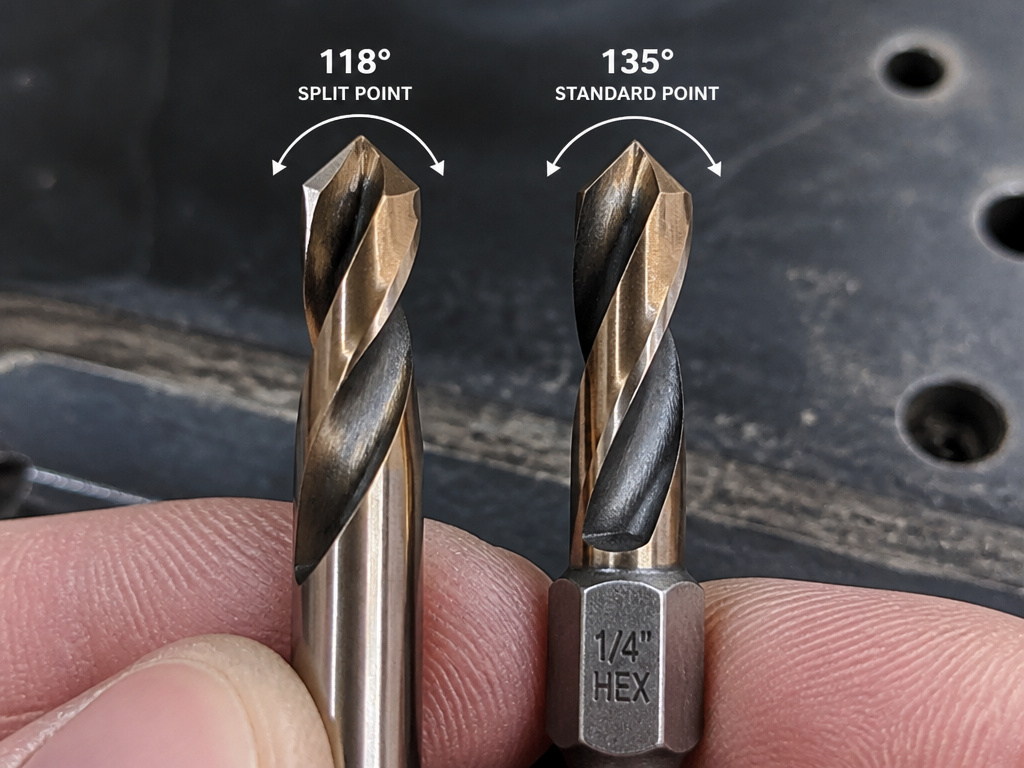
The material does the cutting, but the shape determines how well it can do its job. Two bits made from identical HSS-Co5 can behave completely differently based on their point angle and flute design.
Point Angle: 118° vs. 135°
This is the angle ground at the very tip of the bit. It’s not arbitrary; it’s specified by material standards.
- 118° Point: The standard for HSS and TiN-coated bits (per DIN 1412 C). It’s a sharper, more aggressive point that plunges into material quickly. Excellent for soft steels, wood, and plastic. The downside is it can “walk” or skate on harder, curved surfaces before biting.
- 135° Point: The standard for cobalt (HSS-Co5) bits. It’s a flatter, more blunt point. This design provides more web support behind the cutting edges, making it stronger and less prone to chipping. It also requires more downward force to start cutting, but it’s far more resistant to walking on hard metals.
The rule: Use the point angle that matches your bit’s material. If you’re using a cobalt bit, it likely has a 135° point because that’s what the alloy is designed for.
Split Point & Self-Centering Tips
Many modern bits feature a split point or a specially ground “Speed Point” tip. This isn’t just a marketing gimmick. By grinding away a small section of the web (the central spine) at the tip, the bit has less surface area contacting the workpiece before the cutting edges engage.
The result: The bit starts cutting with less downward force and resists walking. This is crucial for drilling hard metals or starting holes on curved surfaces without a center punch. The HSS-G Drill Bits for Metal from TME advertise that their split-point tip “eliminates pre-punching or pilot drilling up to 10mm diameter.”
Helix Angle & Flute Design
The helix angle is the spiral of the flutes. A higher helix (steeper spiral, around 30°) is for soft, stringy materials like aluminum and wood. It acts like a screw conveyor, pulling long chips up and out of the hole efficiently. A lower helix (shallower spiral, around 20°) is for hard, brittle materials like cast iron or stainless steel. It provides more flute strength and breaks chips into small pieces.
Most general-purpose jobber bits have a middle-ground helix of 20° to 30°, which is a compromise that works acceptably across many materials.
Shank Design: Grip Matters
The shank is the part that goes into your drill chuck. Its design affects power transfer and stability.
- Straight Round Shank: The standard. Works in any 3-jaw chuck.
- Hex Shank (1/4″): Found on impact-rated bits like the Bosch PRO Metal HSS-G. The flat sides prevent slipping in the chuck under high torque, especially from impact drivers. They also allow quick changes in certain holders.
- Three-Flatted Shank: Common on larger diameter bits (3/16″ and up). The three flat spots give the chuck jaws extra grip to prevent the bit from spinning under heavy load, a common failure mode with slick coatings like TiN on round shanks.
Matching the Bit to the Material: A Decision Table

Choosing the right bit isn’t about buying the “best.” It’s about matching properties to the task. This table pairs common materials with the optimal bit type and highlights the consequence of a mismatch.
| Material to Drill | Recommended Bit Type | Why It Works | What Happens With a Mismatch |
|---|---|---|---|
| Wood, Plastic, Soft Aluminum | HSS (M-7), bright finish. | Sharp 118° point cuts cleanly; flexibility handles variance. | Cobalt bits gum up; carbide snaps from lateral force. |
| Mild Steel, Cast Iron | HSS with Black Oxide or TiN coating. | Good hot hardness; coating reduces friction and chip welding. | Basic HSS dulls quickly; slow, squealing cuts. |
| Stainless Steel, Hardened Alloys | Cobalt (HSS-Co5, M-42) with 135° split point. | High red hardness resists softening; strong point resists chipping. | HSS overheats and dulls in seconds; bit may snap. |
| Masonry, Concrete, Tile | Carbide-tipped masonry bit. | Tungsten carbide tip grinds through abrasive material. | Any metal bit dulls instantly; makes dust, not a hole. |
| Composite Materials (Fiberglass) | Solid Carbide or specialty composite point. | Extreme hardness abrades composite without delaminating layers. | HSS or cobalt fray edges; poor hole finish. |
Where this goes sideways: Using a “premium” cobalt bit to drill thin sheet metal with a hand drill. The bit’s low flexibility and aggressive cut can grab, snatch the drill, and twist the sheet metal violently or break the bit.
For hard metals, the real secret isn’t just the bit, it’s technique. Use a center punch, start with a slow speed, apply steady pressure, and use a cutting fluid (even simple oil works). This is especially true when deciding between cobalt vs carbide for the toughest jobs.
Specialized Standards: NAS, DIN, and What They Guarantee
When you see references to DIN 338 N or NAS 907 on a spec sheet, you’re looking at a manufactured guarantee. These are published standards that define everything from material composition to dimensional tolerances.
- DIN 1412 C: Specifies the split point geometry for drill bits with a diameter of 1/8″.
- DIN 338 N: The standard for HSS-G and Cobalt HSS-E drill bits for metal, covering dimensions and performance.
- NAS 907 & NAS 965: National Aerospace Standards. NAS 907 covers HSS and cobalt standard drills. NAS 965 defines threaded shank drills (Type B for HSS hex, Type D for cobalt square) used in aerospace right-angle drilling heads. These drills have specific threads (1/4-28 UNF) and wrenching flats.
A bit manufactured to these standards isn’t necessarily “better” for your home garage, but it is consistent. It means the 5mm bit you buy today will have the same flute length, point angle, and material as the 5mm bit you replace next year. This matters for professionals and serious hobbyists who rely on repeatable results.
Frequently Asked Questions
Are titanium drill bits actually made of titanium?
No. “Titanium” drill bits are standard High-Speed Steel (HSS) bits coated with a thin layer of titanium nitride (TiN). The titanium is only in the gold-colored coating, which adds hardness and reduces friction. The core of the bit is still steel.
What makes cobalt drill bits different?
Cobalt drill bits are made from a steel alloy that contains 5-8% cobalt (often called HSS-Co5 or M-42 grade). The cobalt increases the material’s “red hardness,” allowing it to stay hard at the high temperatures generated by drilling tough metals like stainless steel. They are more wear-resistant but also more brittle than standard HSS.
What is the strongest drill bit material?
For sheer hardness and wear resistance, solid tungsten carbide is the strongest material used in drill bits. However, it’s also very brittle and not suitable for hand drills. For a balance of strength and toughness in hand-tool applications, cobalt steel alloys (like M-42) are considered the strongest drill bits.
Can a drill bit be too hard for my project?
Absolutely. Using an ultra-hard, brittle bit like solid carbide or even a rigid cobalt bit in a hand drill for soft materials (like drilling aluminum sheet) is a common error. The lack of flexibility can cause grabbing, poor hole quality, and breakage. Always match the bit’s flexibility and cutting geometry to your workpiece and tool stability.
Why do some drill bits have a black finish?
The black finish is a black oxide coating. It’s a chemical conversion layer that offers increased lubricity (so chips flow easier) and provides mild rust resistance. It’s a cost-effective performance enhancement for high-speed steel bits used on metals. You can learn more about the specific uses for black oxide drill bits.
The Bottom Line
You don’t need a chemistry degree to buy a drill bit. You need to know three things about your next job: what material you’re drilling, how stable your drill will be (hand-held or press), and how many holes you need to make.
For the home workshop, a set of quality HSS jobber bits covers the majority of tasks. Step up to cobalt when stainless steel or hardened alloy appears on your project list. See coatings like titanium nitride as a longevity bonus, not a core capability.
The material is the foundation, but the cut is decided by the point geometry and your technique. A sharp, correctly angled bit with steady feed and lubrication will always beat a fancy bit used wrong. Start with the basics, a good HSS set, and let the project demands guide your upgrades to cobalt versus titanium or specialized tools.
