
Cobalt vs Titanium Drill Bits Compared for Heat & Hardness
This post contains affiliate links. As an Amazon Associate, we earn from qualifying purchases.
Cobalt drill bits are solid alloys with 5–8% cobalt mixed into the steel, giving them high heat tolerance for drilling stainless steel and hardened alloys. Titanium drill bits are standard High-Speed Steel (HSS) bits with a thin titanium nitride (TiN) coating that reduces friction but fails above 550°C, making them best for wood, plastic, and mild steel.
The 550°C threshold is the line. Cross it, and the titanium coating oxidizes and flakes off, leaving plain HSS that dulls in seconds. Stay below it, and the coating’s low friction lets you drill faster with less heat buildup in the first place. That’s why material choice decides the winner before you even pick up the drill.
What follows: a breakdown of the alloy versus coating distinction, the exact temperatures where each fails, and the jobsite scenarios that make one choice obvious. You’ll also see why resharpening is a deal-breaker for one type and a non-issue for the other, and how to avoid the single most common mistake that burns out bits regardless of material.
Key Takeaways
- Titanium bits are coated HSS, once the coating wears at the cutting edge, performance drops to basic drill-bit levels.
- Cobalt bits are solid alloy, the cobalt is mixed into the steel, so heat resistance is uniform throughout the bit’s life.
- The titanium nitride coating fails at 550°C (1022°F); cobalt’ red-hardness lets it cut at temperatures where HSS would soften.
- Titanium bits are not resharpenable, sharpening removes the coating. Cobalt bits can be resharpened multiple times.
- For impact drivers on mild steel, choose impact-rated titanium bits like Bosch Impact Tough or DEWALT IMPACT READY. For drill presses on stainless, choose M35 cobalt.
What is the core difference between cobalt and titanium drill bits?
One is a alloy. The other is a coating. That sentence explains ninety percent of the performance gap, cost difference, and appropriate use cases.
A cobalt drill bit is made from High-Speed Steel that has been alloyed with 5% to 8% cobalt by weight during the steel-making process. The resulting material, designated M35 (5% cobalt) or M42 (8% cobalt), has a property called red-hardness, it maintains its hardness at temperatures where standard HSS would soften and deform.
This isn’t marketing. The cobalt atoms integrate into the steel’s crystal structure, raising the temperature at which the metal loses its temper. You can drill into stainless steel, cast iron, or hardened steel plate, and the bit’s cutting edge stays hard even as the tip glows dull red. A cobalt bit wears gradually; you’ll see the flutes polish and the cutting edge round over many holes before it finally stops cutting.
A titanium drill bit starts as plain High-Speed Steel. A Physical Vapor Deposition (PVD) process applies a microscopic layer of titanium nitride ceramic, typically one to three microns thick. This coating is extremely hard and has a low coefficient of friction. It lets the bit slice through material with less heat generation and resists abrasion better than bare steel.
But the coating only exists on the surface. The instant the cutting edge wears through that thin layer, which happens quickly if you hit a hard inclusion or exceed the coating’s thermal limit, you’re left with a standard HSS bit. The performance cliff is immediate.
Where this goes sideways: Assuming a “titanium” bit is made of titanium. It’s not. The name refers only to the coating. The core is ordinary steel, which is why these bits can’t handle the sustained heat of hard metals.
How does heat tolerance decide which bit to use?
Heat is the enemy of every cutting tool. The question isn’t whether a bit gets hot, it’s how the bit’s material behaves when it does.
Titanium nitride has a maximum service temperature around 550°C (1022°F). At that point, the ceramic coating begins to oxidize and break down. Once it goes, its friction-reducing and wear-resistant properties vanish. The bit will then dull at the rate of an uncoated HSS bit, which in hard metal is approximately two or three holes later.
Cobalt’s advantage is bulk properties, not surface treatment. An M35 cobalt bit retains its hardness up to approximately 650°C, and M42 can go even higher. This red-hardness means the bit can survive the intense, localized heat generated by cutting abrasive or work-hardening metals like stainless steel. The heat dissipates along the bit’s body instead of concentrating at the edge and softening it.
This difference dictates the failure mode. A titanium bit often fails suddenly, the coating strips off a cutting edge or flute, and the bit immediately stops cutting cleanly. A cobalt bit fails gradually, showing increased cutting pressure, more burrs, and a polished wear pattern along the flutes over dozens of holes.
| Heat & Wear Factor | Titanium (TiN-Coated HSS) | Cobalt (M35/M42 Alloy) |
|---|---|---|
| Maximum Service Temperature | ~550°C (coating fails) | ~650°C+ (alloy softens) |
| Primary Wear Mode | Coating abrasion & sudden delamination | Gradual edge rounding & flute polishing |
| Performance After Wear | Drops to basic HSS level | Slow, predictable decline |
| Best Match For | Materials that don’t work-harden: wood, plastic, mild steel, aluminum | Work-hardening & abrasive metals: stainless steel, cast iron, titanium alloy |
The table shows why material choice is non-negotiable. If your project involves stainless steel, you are generating heat above the titanium coating’s limit on the first hole. The bit might complete the hole, but the coating at the cutting edge is already compromised. The second hole will be harder, the third will smoke, and the fourth will likely snap.
For a deeper look at materials suited for metal, our guide on drill bits for steel breaks down the options by metal grade.
Can you resharpen titanium or cobalt drill bits?
Resharpening is the single biggest long-term cost differentiator, and it’s where the coating-versus-alloy distinction hits your wallet directly.
Titanium nitride-coated bits are generally not resharpenable. The coating is only a few microns thick on the cutting surfaces. Any grinding or sharpening that touches the cutting edges removes the coating entirely. What you’re left with is a plain HSS bit that will perform exactly like a cheap hardware-store bit, it might still cut, but you’ve lost the low-friction and wear-resistant benefits you paid for. For this reason, most pros treat titanium bits as consumables: use them until they’re dull, then replace them.
Cobalt bits are designed to be resharpened. Because the cobalt is distributed throughout the steel, sharpening the cutting edges simply exposes fresh alloy. A properly sharpened cobalt bit will perform nearly as well as a new one. This makes the higher upfront cost more palatable over hundreds of holes. Many industrial shops have a dedicated sharpening schedule for their cobalt tooling.
The part nobody mentions: Resharpening requires the correct geometry, especially on split-point or pilot-point tips common on modern bits. Freehand sharpening on a bench grinder often ruins the precise point angles and flute clearance, leading to worse performance than a dull bit. For most DIYers, sending cobalt bits out for professional sharpening after significant wear is more economical than replacing them.
Titanium vs Cobalt: direct comparison by job scenario
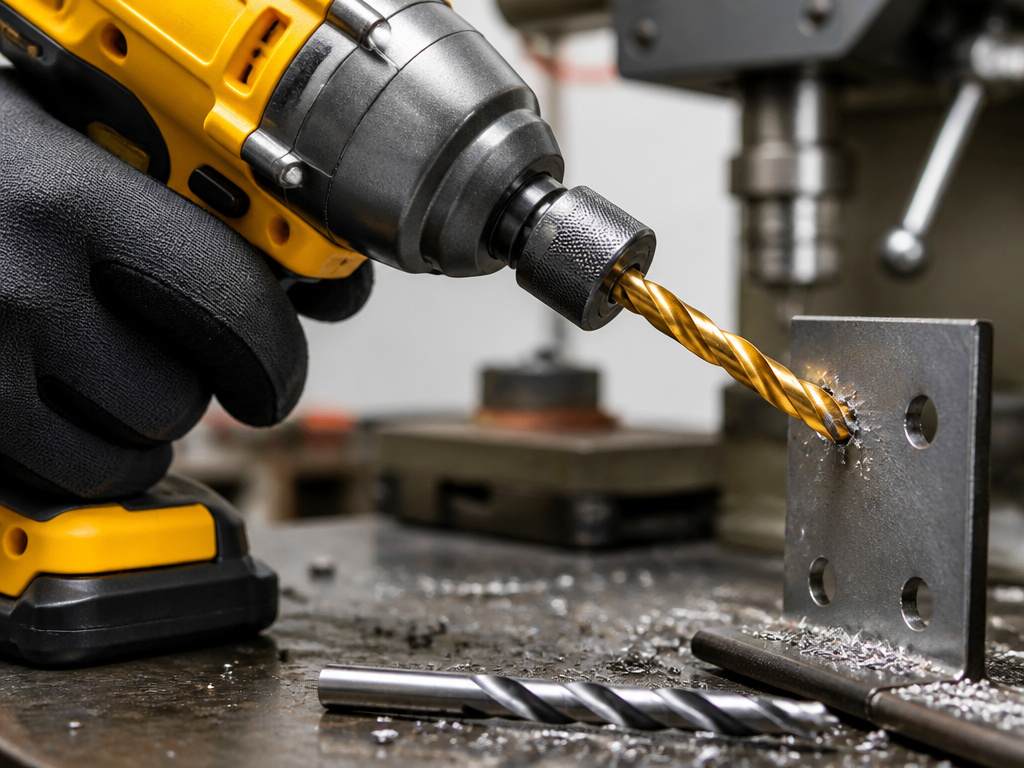
Don’t think in terms of “better.” Think in terms of “for this job, with these tools.”
General DIY & Construction (Wood Framing, Drywall, Plumbing)
For drilling pilot holes in studs, notching PVC pipe, or drilling through sheet metal ductwork, titanium bits win. The coating’s low friction lets cordless drills work faster with less battery drain. The bits are affordable enough that wearing out a set every few years isn’t a burden. The Bosch Impact Tough series, with its hex shank, is built for the chatter and high torque of impact drivers used in framing.
You aren’t generating enough heat to threaten the coating. The convenience and speed outweigh the lack of resharpening. If you need to drill into hardened nails or steel straps occasionally, slow your drill speed and use cutting oil, the bit will likely survive the encounter.
Metal Fabrication, Automotive, & Machining
This is cobalt territory. Drilling into stainless steel exhaust brackets, automotive suspension components, or thick steel plate generates intense, localized heat. A titanium bit’s coating vaporizes at the point of cut. A cobalt bit shrugs it off.
For hand drilling with a corded drill or cordless hammer drill (in drill-only mode), choose M35 cobalt (5%). It offers the best balance of hardness and shock resistance. For a drill press where lateral force is zero, you can step up to harder, more brittle M42 (8%) for even longer life. Brands like Norseman or Champion are staples in professional shops.
The cobalt vs carbide drill bits debate starts here, for most metal shops, cobalt is the practical sweet spot before jumping to the expense and brittleness of solid carbide.
Impact Driver Use
This is a special case. Impact drivers apply concussive rotational blows, which can shatter the brittle cutting edges of standard twist drill bits. Both Bosch and DEWALT make lines specifically engineered for this: Bosch Impact Tough™ and DEWALT IMPACT READY®.
These bits feature reinforced webs, specific flute geometries, and impact-rated shanks (usually hex) to absorb the punishment. Crucially, they are most commonly found with titanium nitride coatings. Why? Because the primary use for impact drivers isn’t drilling into tool steel, it’s fast drilling into wood, plastic, and light gauge metal where the coating’s speed advantage is paramount. If you need to use an impact driver on harder metal, you must use extreme caution, very low speed, and ample lubrication, regardless of bit type.
What about other drill bit coatings and materials?
Cobalt and titanium sit in the middle of a performance ladder. Understanding the rungs above and below helps frame your choice.
Below them is standard High-Speed Steel (HSS). It’s the base material for both titanium-coated and some lower-grade cobalt bits. It’s fine for soft materials but lacks the heat resistance for serious metalwork. Our comparison of cobalt vs HSS details the jump.
Another common coating is black oxide. It’s a corrosion-resistant finish that also reduces friction slightly, but it offers minimal wear resistance compared to TiN. It’s a budget option. The trade-offs are outlined in our black oxide vs titanium guide.
Above cobalt is solid carbide. Incredibly hard and heat-resistant, but also brittle and expensive. It’s for production machining, not hand tools. The step up is covered in our titanium vs carbide article.
The global supply of cobalt, as detailed in the USGS Cobalt Commodity Summary 2026, influences the raw material cost of these bits, making the alloy a significant part of their price.
Common mistakes that ruin any drill bit
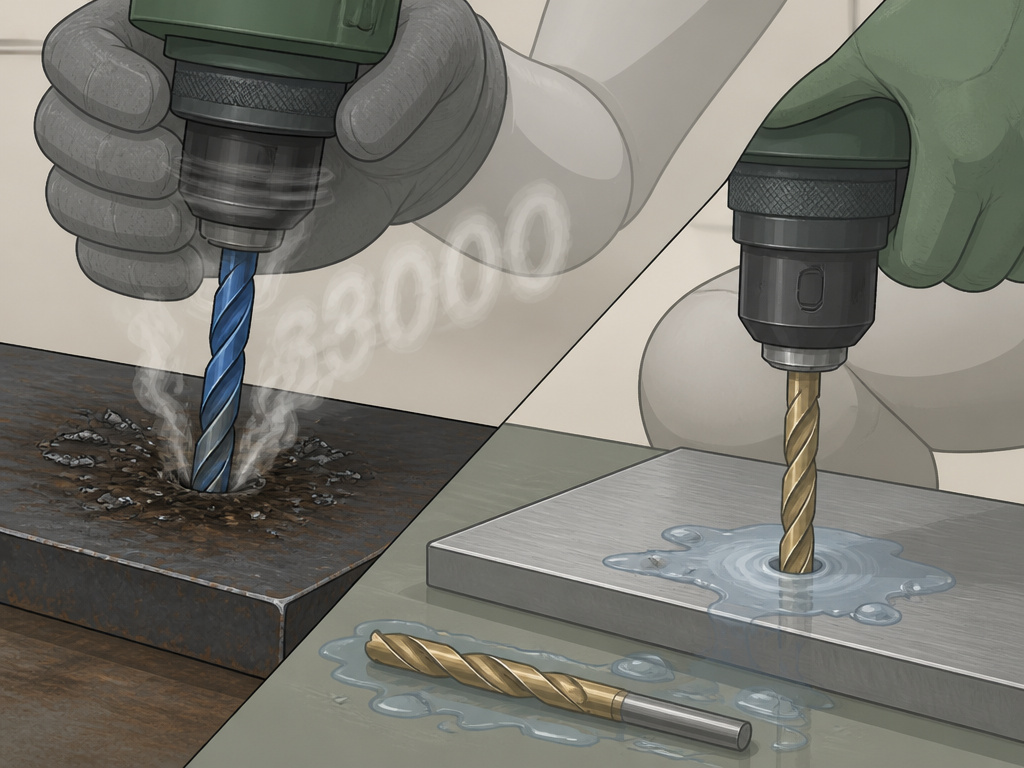
The right bit in the wrong hands fails just as fast as the wrong bit.
Using Hammer Mode on Metal. The hammering action of a hammer drill is for fracturing masonry. On metal, it instantly chips and shatters the precise cutting edges of both cobalt and titanium bits. Always ensure your drill is in “drill only” mode for metal.
No Cutting Fluid. Drilling metal is a machining operation. Cutting oil or fluid does three things: cools the bit, lubricates the cut, and helps eject chips. Even a drop of oil dramatically extends bit life and improves hole quality. For stainless steel, it’s not optional.
Too High RPM. Speed generates heat. A general rule: larger diameters need slower speeds. For a 1/4″ bit in steel, 3000 RPM will smoke it in seconds. 800 RPM with steady pressure will produce a clean hole. Let the bit’s design do the cutting; don’t force it with speed.
Dull Bits. A dull bit doesn’t cut; it rubs. Rubbing creates friction, and friction creates heat. That heat then softens the bit, making it duller faster, a thermal runaway that ends in a burned-up bit. If a bit isn’t cutting with moderate pressure, stop and inspect the edges. For techniques, see our guide on how to drill through metal.
Wrong Point Angle. The standard 118-degree point is a compromise. For harder steel, a 135-degree split point is better, it bites more aggressively and is less likely to “walk” on the hard surface. Many cobalt bits come with this geometry. Trying to drill hardened steel with a 118-degree point meant for soft wood is a recipe for frustration.
Frequently Asked Questions
Are cobalt drill bits better than titanium?
For drilling hard metals like stainless steel, cast iron, and titanium alloy, yes, cobalt bits are objectively better. They are made from a heat-resistant alloy throughout. Titanium bits have a thin coating over standard HSS steel; the coating improves initial performance but fails under the heat of hard metals. For wood, plastic, and mild steel, titanium bits are more cost-effective.
Can you use titanium drill bits on stainless steel?
You can, but you shouldn’t expect them to last. The titanium nitride coating will break down rapidly under the heat generated by stainless steel, often within a few holes. The bit will then perform like a plain HSS bit, which dulls quickly on stainless. For any volume of work on stainless, cobalt bits are the correct choice.
Why are cobalt drill bits so expensive?
The cost comes from the raw material and manufacturing. Cobalt is a strategic metal with a volatile global market, as shown in historical data like the USGS Cobalt Commodity Summary 2025. Alloying it into steel requires precise metallurgy. The resulting alloy is also tougher to machine into drill bits than standard HSS. You’re paying for the material in the bit, not just a surface treatment.
What do the M35 and M42 designations mean?
These are standard industry designations for cobalt high-speed steel alloys. M35 contains approximately 5% cobalt. M42 contains approximately 8% cobalt. M35 offers a better balance of toughness and hardness, making it ideal for hand drilling. M42 is harder and more heat-resistant but also more brittle; it’s best suited for stable, rigid setups like drill presses or CNC machines.
Is there a safety concern with cobalt dust?
When grinding or sharpening cobalt drill bits, yes. Inhalation of cobalt metal dust can be a respiratory hazard. The OSHA cobalt exposure limits set permissible levels for airborne cobalt in workplaces. For occasional DIY sharpening, always use a grinder with a dust collection shroud or wear a properly fitted respirator rated for metal dust. Good workshop ventilation is essential.
Before You Go
Match the bit’s guts to the material’s hardness. Titanium for speed on soft stuff, cobalt for endurance on hard stuff.
Keep a set of impact-rated titanium bits in your bag for general construction, they’re fast, affordable, and tough enough for everything but metal. Keep a smaller, quality set of M35 cobalt bits in a separate case for metalwork. Label the case.
And use oil. Every time you drill metal, even if it’s just one hole. That single habit will double the life of your most expensive bits. Your projects will have cleaner holes, less burring, and you’ll spend less time and money at the tool counter replacing burned-out tools.
