What Are the Strongest Drill Bits for Hardened Steel?
This post contains affiliate links. As an Amazon Associate, we earn from qualifying purchases.
The strongest drill bits for metal are solid carbide and 5% cobalt high-speed steel (HSS-Co5). Solid carbide drills, like the Garr 1580HD, handle hardened steels over 40 Rc and temperatures above 600°C. Cobalt HSS bits, made to DIN 338 N, resist heat to 600°C and drill into materials like stainless steel and Hardox 500 wear plate. Titanium nitride (TiN) coating adds a 2300 HV surface hardness layer to HSS, but the underlying steel determines ultimate strength.
Forget marketing terms like “heavy-duty” or “industrial.” Drill bit strength is a measurable contest between heat resistance and material hardness. A bit that walks through mild steel will snap in seconds on a truck frame. The difference isn’t academic, it’s the line between a clean hole and a broken tool buried in your workpiece.
What follows is the breakdown the hardware store won’t give you: the three materials that actually hold up, the OEM specs that prove it, and which one to grab when the metal gets serious.
Key Takeaways
- Strength means heat resistance first, hardness second. A bit that softens at 300°C is weak, no matter how hard it starts. Cobalt HSS holds its edge to 600°C (1112°F); solid carbide goes higher.
- HSS-Co5 (5% cobalt) is the strongest common steel. It’s the DIN 338 N standard for drilling stainless steel and alloyed cast iron. Black oxide or titanium coatings are just surface treatments on weaker steel.
- Solid carbide is for hardened steel and production runs. Bits like the Garr 1580HD are for tool steels over 40 Rc and high-temperature alloys. They’re brittle and expensive, but nothing else touches them for hardness.
- Match the bit to the material’s Brinell hardness. Standard HSS taps out around Brinell 500. For anything harder (like Hardox 500 or 550), you need cobalt or carbide. Drilling mild steel with a carbide bit is overkill and risks shattering.
- Point geometry matters as much as material. A 135° split point (DIN 1412 C) on a cobalt bit stays centered in hard metal. A 118° point on the same bit will skate and break.
What Makes a Drill Bit “Strong”?
Strength in a drill bit isn’t about withstanding a hammer blow. It’s about maintaining a sharp, hard cutting edge under extreme heat and pressure until the hole is done. Two specs decide the fight: hot hardness and abrasion resistance.
Hot hardness is the bit’s ability to stay hard when the tip gets red-hot. Friction from cutting metal generates intense heat, often over 600°C (1112°F) at the cutting edge. If the bit material softens at 300°C, it dulls instantly. Abrasion resistance is the bit’s ability to withstand being worn down by the material it’s cutting, like sandpaper on wood.
The Ruko Jobber Length Drill Bit spec sheet lists a surface hardness of approximately 2300 HV and heat resistance up to 1100°F (600°C) for its Titanium Nitride-coated HSS bits. That coating is what lets it cut longer, but the underlying HSS steel softens well before that temperature.
Manufacturers rate drill bits for specific material hardness ranges, usually measured on the Brinell (HB) or Rockwell C (HRc) scales. Using a bit below its rating wastes money. Using one above its rating breaks tools.
The 3 Drill Bit Types That Actually Hold Up
Forget the dozen colors on the hardware store rack. For drilling metal, strength boils down to three core material classes. Coatings like black oxide or titanium nitride are just a surface treatment on one of these substrates.
1. High-Speed Steel (HSS) – The Baseline
High-speed steel is the common gray or silver bit. It’s an alloy of steel, tungsten, and molybdenum. Good HSS has a hot hardness around 300°C (572°F). It works for mild steel, aluminum, wood, and plastic.
Where this goes sideways: Trying to drill stainless steel or hardened alloy with a standard HSS bit. The work-hardening stainless will heat the tip past its critical temperature in seconds. The bit dulls, you push harder, it heats more, and then the tip either melts or snaps off.
HSS is your default for general purpose work. The Bosch PRO Metal HSS-G Impact Twist Drill Bit line is a solid example, ground from premium HSS for consistency. But when the material spec sheet lists anything over Brinell 400, you’ve reached its limit.
2. Cobalt High-Speed Steel (HSS-Co5) – The Workhorse
Cobalt steel is HSS with 5% or 8% cobalt added to the alloy. That cobalt is the game-changer. It raises the hot hardness to 600°C (1112°F) and significantly boosts abrasion resistance.
These are the gold-colored bits (often mistakenly called “titanium”). The gold hue usually comes from a titanium carbonitride coating, but the strength is in the cobalt steel beneath.
| Property | Standard HSS | 5% Cobalt HSS (HSS-Co5) |
|---|---|---|
| Hot Hardness | Up to ~300°C (572°F) | Up to ~600°C (1112°F) |
| Primary Use | Mild steel, aluminum, wood | Stainless steel, alloy steel, cast iron |
| Point Angle | 118° | 135° (per DIN standards) |
| Material Hardness Limit | Up to Brinell 400-450 | Up to Brinell 500-550 (e.g., Hardox 500) |
| Relative Cost | 1x (Baseline) | 3x – 5x |
Cobalt bits are made to the DIN 338 N standard for cobalt HSS-E drills. This standard calls for a 135° split point (DIN 1412 C), which is less aggressive than a 118° point and resists “walking” on hard, curved surfaces. This is the bit for automotive frames, stainless steel fixtures, and structural steel. If you’re drilling more than a few holes in anything harder than mild steel, HSS-Co5 pays for itself in saved time and broken bits.
3. Solid Carbide – The Specialist
Solid carbide bits are made from tungsten carbide particles sintered in a cobalt matrix. They are exceptionally hard and maintain that hardness at temperatures even higher than cobalt HSS. However, they are brittle and will snap under side load or in a hand drill’s slight wobble.
Common mistake: Using a solid carbide bit in a hand-held drill or impact driver. The inherent runout and vibration of a handheld tool is enough to chip the cutting edges or snap the bit, especially at smaller diameters.
These are machine-shop tools. The Garr 1580HD series, for example, is explicitly recommended for “high nickel, high temperature alloys, cobalt-based alloys, stainless steels, and tool steels >40 Rc.” They have a 30° helix for chip evacuation and tolerances measured in ten-thousandths of an inch. For a home shop, this is overkill unless you’re working with hardened tool steel or have a precision drill press.
Carbide vs. Cobalt: Which Wins for Your Project?
This is the real choice. Titanium-coated HSS is just a coated HSS bit. The cobalt vs carbide decision determines your success on tough materials.
Choose Cobalt (HSS-Co5) if:
- You’re using a hand drill, impact driver, or older drill press.
- The material is stainless steel, alloy steel, or cast iron (up to ~Brinell 550).
- You need a bit that can handle some flex and abuse without shattering.
- Your project involves interrupted cuts (like drilling through a welded seam).
Choose Solid Carbide if:
- You have a rigid, high-precision milling machine or CNC.
- The material is hardened steel, titanium, or high-temperature alloys.
- You are drilling many identical holes and need extreme tool life.
- Hole straightness and diameter tolerance are critical (as with the Garr 1580HD‘s sub-thousandth inch specs).
For the vast majority of serious DIY and professional metalwork, a quality 5% cobalt bit is the strongest tool you can realistically use. Carbide drill bits are stronger in a lab, but their brittleness makes them a liability in most real-world shop conditions.
Reading the Specs: What the Numbers Actually Mean
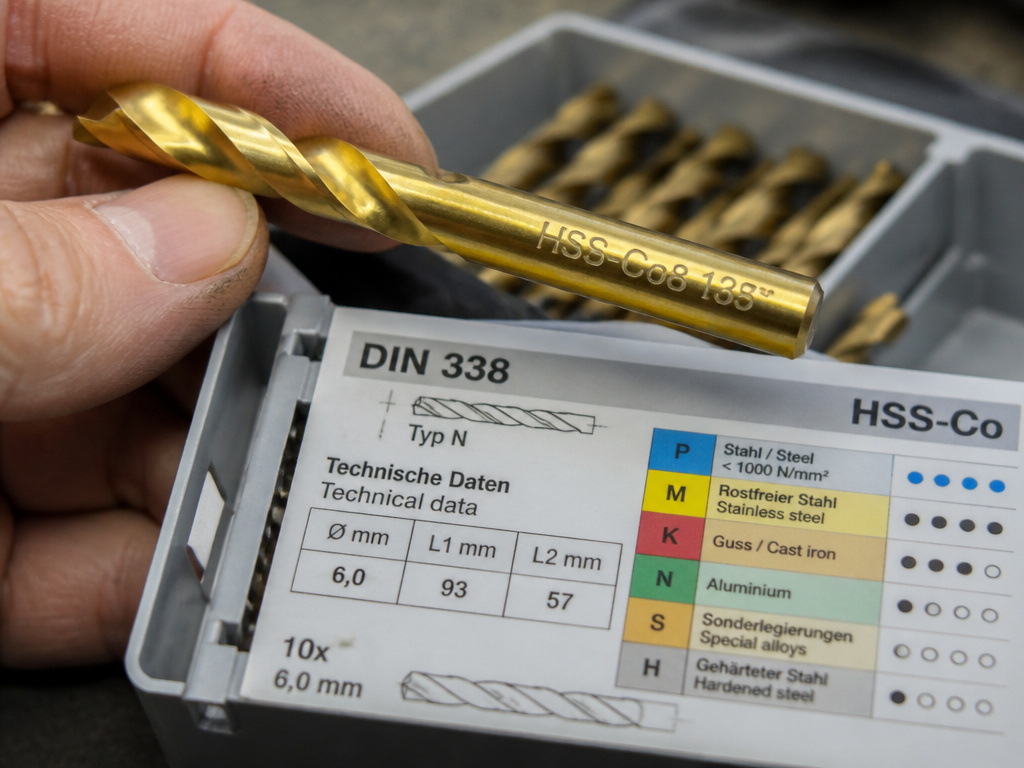
The packaging won’t help you. You need to decode the manufacturer’s data.
- HSS, HSS-E, HSS-Co: HSS is standard high-speed steel. HSS-E often denotes a higher-grade, micro-alloyed steel. HSS-Co (or HSS-Co5, HSS-Co8) is the cobalt alloy. The number is the cobalt percentage.
- DIN 338 / DIN 1412 C: DIN is the German industrial standard. DIN 338 covers HSS twist drill dimensions and tolerances. DIN 1412 C specifies the geometry of a split point for drills 1/8″ and larger, which reduces “walking” and thrust force.
- Point Angle (118° vs 135°): A 118° point is sharper and cuts faster in soft materials. A 135° point is blunter, stronger, and designed for hard metals, it’s the standard for cobalt bits and carbide bits.
- Coating (TiN, TiAlN, AlTiN): A Titanium Nitride (TiN) gold coating adds lubricity and surface hardness. TiAlN (bluish) and AlTiN (violet-black) are harder, heat-resistant coatings for carbide tools in severe applications. The coating is a wear layer, not a strength layer.
How to Use the Strongest Bits Without Breaking Them
A strong bit in the wrong hands is a short-lived bit. The material sets the rules.
Before you start: Secure your workpiece in a vise or with clamps. A shifting workpiece will snap any bit. Always wear safety glasses, metal shavings are sharp and hot. If using a cutting fluid, ensure it’s appropriate for the metal (sulfurized oil for steel, kerosene for aluminum).
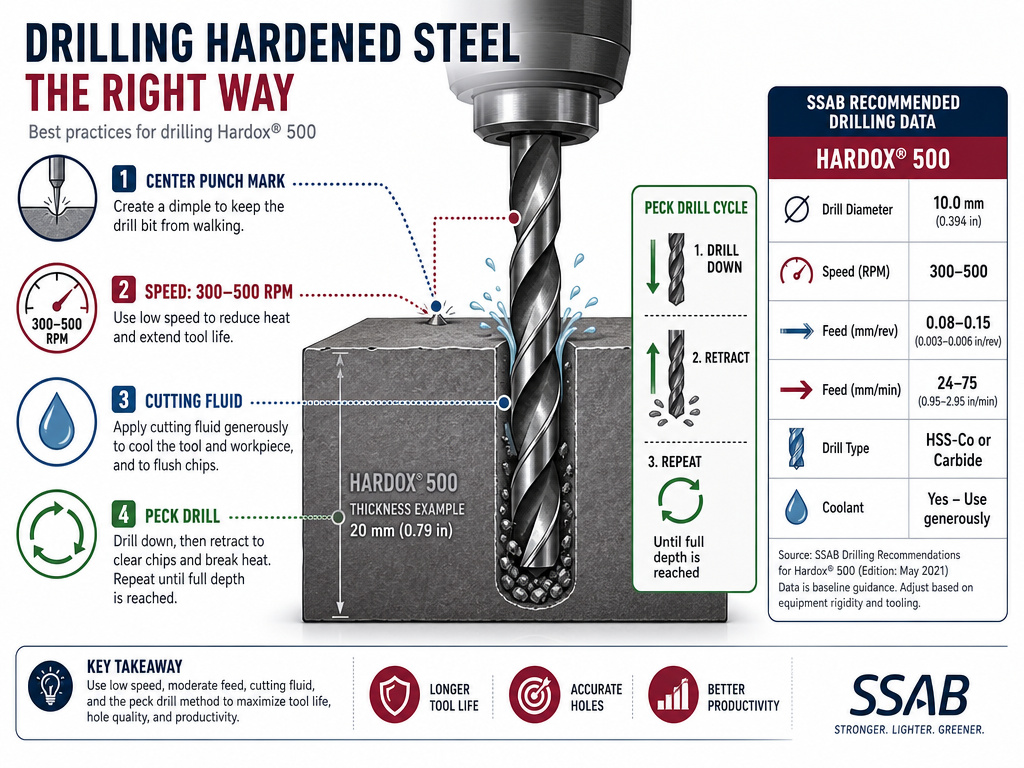
For Hardened Steel & Hard Alloys (Hardox 500+, tool steel):
- Start with a center punch. A solid dimple is non-negotiable.
- Use a slow speed. For a 1/4″ cobalt bit in hardened steel, aim for 300-500 RPM. For carbide, you can go faster, but start slow.
- Apply steady, firm pressure. Let the bit cut. Do not force it or hammer with an impact driver.
- Use cutting fluid or paste. This keeps the temperature down and washes away metal particles. For stainless steel, a dedicated stainless cutting fluid prevents work-hardening.
- Peck drill. For holes deeper than the bit’s diameter, drill a short distance, pull out to clear chips, re-apply fluid, and repeat.
The Feed and Speed Reality Check
The SSAB Hardox machining guide provides specific data. Drilling Hardox 500 (450-540 Brinell) with a 10mm HSS-Co drill calls for a cutting speed (Vc) of 3–5 meters per minute and a feed (fn) of 0.08 mm per revolution. On a standard drill press, that’s roughly 120 RPM with a very slow, steady feed. Most people run three times faster and wonder why the bit smokes.
When to Sharpen, When to Replace
Even the strongest bit wears. A sharpening jig can restore HSS and cobalt bits multiple times. Look for these signs:
- Sharpen it: The cutting edges are rounded over or have small chips. The bit requires more pressure and produces squealing sounds or discolored, stringy chips.
- Replace it: The corners of the cutting lips are completely gone. The web (the central column) has thickened from repeated sharpening, increasing thrust required. For a carbide bit, any visible chipping or fracture on the cutting edge means it’s done.
A dull bit doesn’t save money. It heats the workpiece, work-hardens metals like stainless steel, and dramatically increases the chance of breaking.
Frequently Asked Questions
Are titanium drill bits stronger than cobalt?
No. Titanium drill bits are almost always standard HSS with a thin titanium nitride (TiN) coating. The coating reduces friction and increases surface hardness, but the core steel is the same as a cheap HSS bit. Under heavy load, the coating wears through and the bit fails. A true cobalt bit is made from a stronger steel alloy throughout.
What is the hardest drill bit made?
Solid carbide, specifically micro-grain tungsten carbide, is the hardest commonly available material for drill bits. Diamond-coated or polycrystalline diamond (PCD) bits are harder but are specialized tools for abrasive non-metallics like glass, ceramics, and carbon fiber.
Can you drill through hardened steel with a cobalt bit?
Yes, but with major caveats. A 5% or 8% cobalt bit can drill through hardened steel up to about Rockwell 50 HRc (approximately Brinell 500), like an axe head or a truck leaf spring. You must use a rigid setup, very low speed, high pressure, and constant lubrication. For steel hardened above 50 HRc, you typically need a solid carbide bit and a milling machine.
Why do my cobalt bits keep breaking?
The two most common reasons are side load and heat. If the bit isn’t perfectly perpendicular to the work surface, or if the workpiece moves, the slender flutes snap. Heat is more insidious: without cutting fluid, the metal chips weld to the bit’s cutting edge (called “built-up edge”), increasing friction until the bit twists itself apart. Use a center punch, clamp everything down, and keep it cool.
What’s better for stainless steel: cobalt or carbide?
For hand tools or a drill press, cobalt is better. Stainless steel is “gummy” and generates high friction heat. Cobalt’s toughness and heat resistance handle the variable pressure of manual drilling. Solid carbide is more prone to chipping from the slight wobble of a hand drill, though it is the preferred choice for CNC machining of stainless.
The Bottom Line
For the strongest drill bit you can buy off the shelf and use in common tools, get a 5% or 8% cobalt high-speed steel (HSS-Co5) bit with a 135° split point. It bridges the gap between the weakness of standard HSS and the impractical brittleness of solid carbide for most users.
Save the solid carbide bits for a mill or lathe when you’re facing hardened tool steel. And ignore the paint job, a gold-colored bit is just TiN-coated HSS unless it’s marked “Cobalt” or “HSS-Co”. The strength is in the alloy, not the coating. Match the bit’s proven hardness rating to your material, slow your drill speed by half, and use cutting fluid. That’s how you drill the hole instead of buying another bit.
