
What Are Drill Heads Made Of? Material Composition & Build
This post contains affiliate links. As an Amazon Associate, we earn from qualifying purchases.
Drill heads are made of a hardened steel body with cutting elements of tungsten carbide, high-speed steel (HSS), or cobalt alloys. The body provides the structure and houses coolant channels, while the replaceable inserts or bonded cutting tips do the actual cutting. The specific combination, like a hardened tool steel body with solid carbide guide pads, determines the head’s application, from drilling metal to reopening lined pipes.
That material choice is practical, determining whether a head lasts for hundreds of holes in steel or shatters quickly in cast iron. The wrong body material flexes under load, ruining hole straightness.The wrong cutting grade turns to dust against hardened steel.
What follows is a breakdown of the core materials, the manufacturing processes that fuse them, and the specific grades you’ll see on spec sheets for tasks from deep-hole boring to drain cleaning.
Key Takeaways
- The drill head body is almost always a hardened alloy steel (like tool steel) for strength; the cutting elements are a harder material like tungsten carbide.
- Tungsten carbide is the default for serious metal cutting due to wear resistance; HSS and cobalt are used for lower-cost or specialized heads.
- A patented isostatic bonding process fuses cutting element shanks into a powder-metal core, creating a stronger bond than press-fitting.
- Shank diameter on exchangeable heads is held to ISO 286-2 k7 accuracy, a tight tolerance that ensures a precise fit in the tool holder.
- For pipe cleaning tools, material choice shifts: cutters for cast iron are different than PVC cutters for plastic pipes.
The Core Materials of a Drill Head
Look at any drill head. You’re seeing two distinct material systems working as one.
The body is the structural chassis. It’s typically a hardened alloy steel, such as AISI 4140 or a similar tool steel. This steel is tough. It needs to absorb vibration, transmit torque from the machine, and resist the bending forces of deep-hole drilling. A body that’s too soft will deflect, causing the hole to run out of true. For high-precision applications like the Ingersoll TBTA-H series, the body is hardened tool steel, often with additional surface treatments.
The diameter dimension of exchangeable drilling heads made of tungsten carbide is produced with k7 accuracy according to the ISO 286-2 standard. This tight fit prevents runout and ensures the cutting forces are transmitted directly.
The cutting elements are the stars. They’re made from a harder, more wear-resistant material than the body. This is where you find the common trio: tungsten carbide, high-speed steel (HSS), and cobalt alloys.
Tungsten carbide is the king for metal removal. It’s a composite of tungsten carbide grains cemented in a cobalt binder. The grade (the ratio and grain size) is tuned for the job, a fine grain for finishing, a coarser grain for roughing. For a deep-hole drill head, the inserts and guide pads are almost always solid carbide. The CERATIZIT CoreLine heads, for example, use a WOEX 05T304 carbide insert.
High-speed steel (HSS) is a step down in hardness but a step up in toughness. You’ll see it on lower-cost drill heads or on heads for non-ferrous materials where extreme wear resistance is a secondary concern. This material is easier to sharpen than carbide.
Cobalt alloys (like M42 steel with 8% cobalt) sit between HSS and carbide. They hold an edge better than standard HSS under heat, making them a good choice for drilling stainless steel without springing for a full carbide head.
How Drill Heads Are Manufactured
The magic resides in how the materials are joined. For decades, the standard was to press-fit a cylindrical carbide tip into a drilled hole in the steel body.That method has a flaw: the tips can work loose under the tremendous vibration and cyclical loading of drilling.
A better method is described in US Patent 4,520,882. The process uses isostatic bonding. The shank portions of the hard, wear-resistant cutting elements are embedded in a powder-metal core, which is isostatically compacted in a compressible mold. The result is a non-separable bond.
Think of it like concrete setting around rebar, but at a molecular level. The varied shapes of the cutting element shanks, they can be tapered, flanged, or other contours, create a mechanical lock within the sintered metal matrix. This gives far greater resistance to the forces that would pop a simple press-fit insert straight out of its socket.
Where this goes sideways: Assuming all heads are just screwed together. On a bonded head, a worn insert can’t be simply tapped out. You replace the entire cutting element assembly, or in some cases, the whole head. Trying to force it damages the precision-machined seat.
For modular, indexable heads, the process is different. The steel body is machined with precise pockets. Carbide inserts are then clamped into these pockets with screws. This is the system used by most modern CNC drilling systems. The benefit is obvious: you index (rotate) or replace the insert when one corner wears, without changing the whole head. The Ingersoll TBTA-H heads use this approach, with hardened pockets to withstand the clamping force.
Drill Head Types and Their Materials
Not all drilling is the same. The material makeup shifts dramatically based on what you’re drilling and how.
| Drill Head Type | Typical Body Material | Cutting Element Material | Primary Use Case |
|---|---|---|---|
| Indexable Insert Head | Hardened Tool Steel (e.g., Ingersoll TBTA-H) | Solid Carbide Inserts (e.g., grade IN2055) | Deep-hole drilling (BTA) in metal |
| Solid Carbide Head | Monolithic Tungsten Carbide | Monolithic Tungsten Carbide | Precision small-diameter drilling |
| Pipe Cutter Head | Hardened Alloy Steel | Carbide Tips (brazed or bonded) | Re-opening connections in cast iron pipe |
| PVC Cutter Head | Hardened Alloy Steel | Milled Steel or Softer Carbide | Cutting plastic, clay, or lined pipes |
| Twist Drill Head | High-Speed Steel (HSS) | Integral HSS Flutes | General-purpose drilling in wood/metal |
Metal Drilling Heads (Indexable & BTA)
This is where material science is front and center. The bodies are premium hardened steels. The inserts are advanced carbide grades. Ingersoll’s TBTA-H series, for instance, features an improved IN6542 carbide grade specifically for better fracture resistance in stainless and hardened steel. These heads live in a world of high pressure, high heat, and flood coolant. The material choice is what allows them to achieve surface finishes of Ra 1.2 or better and straightness tolerances of 0.001 inch per foot.
Pipe and Drain Cleaning Heads
The rules change. Here, abrasion and impact matter more than pure hardness. A Picote Special Drill Head Cutter for cast iron uses robust carbide tips brazed onto a tough steel body. It’s designed to tumble and chip away at lining material. Crucially, the manual specifies using PVC Cutters for plastic or clay pipes. Why? A carbide cutter meant for cast iron can be too aggressive and may crack or gouge a softer PVC pipe. The material match is a direct safety and efficacy issue.
Common mistake: Using a cast iron cutter on a plastic pipe. The harder, sharper carbide can catch and crack the pipe wall, turning a simple cleaning job into a repair.
Masonry and Concrete Heads
These often use a completely different architecture, like a carbide-tipped star drill or a diamond-impregnated core barrel. The “head” in a diamond core bit is a steel matrix with industrial diamonds embedded in it. The steel holds the diamonds, and the diamonds do the cutting through abrasion.
Specifications and What They Tell You
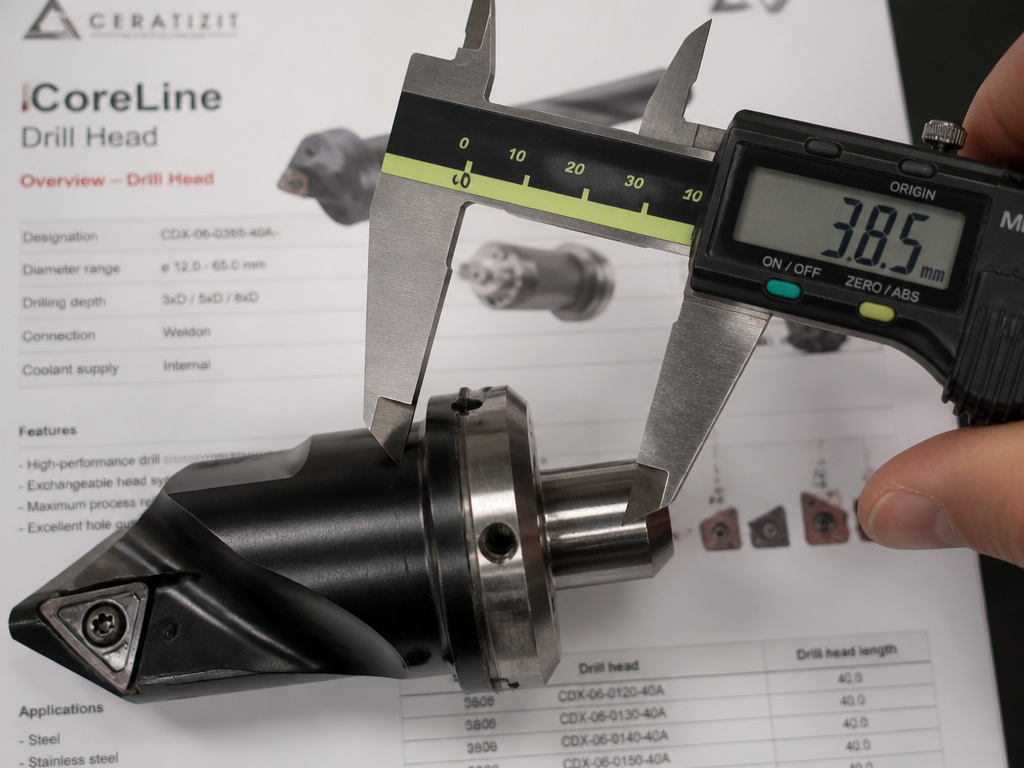 A spec sheet is a material report card. Here’s how to read it.
Take the CERATIZIT CoreLine – Drill head Ø 20–64 mm – Centron (KUB-C.BK.420.R.05-38,5). Its listing tells a full story: * Cutting diameter (DC): 42 mm – The size of hole it makes. * Mounting spigot diameter (DCONMS): 38.5 mm – This is the critical interface. It’s machined to that k7 accuracy. * Torque moment: 1.28 Nm – The recommended tightening torque for the locking screw. Over-torquing can crack the carbide insert. * Insert: WOEX 05T304 – This is the specific carbide insert grade. It tells you the exact cutting material.
For pipe tools, specs like “Shaft size: 8mm (⅓”)” tell you what power source you need, a Picote Mini Miller, for example. The operational ambient temperature range for these tools is typically 0°C to +50°C (32 to 122°F). Storing one in a freezing truck bed and then bringing it into a warm job site can cause condensation inside, leading to rust on the steel body.
Selecting the Right Drill Head Material
 Your project picks the material. This isn’t a one-size-fits-all decision.
For metal drilling (steel, stainless, aluminum):
Start with carbide. Look for an indexable head with a hardened steel body and coated carbide inserts. The coating, like titanium aluminum nitride (TiAlN), adds a slick, heat-resistant layer. For the toughest materials like Inconel or hardened steel, you might need a specialized grade like the ones Ingersoll develops. This is where understanding cobalt vs carbide pays off, carbide wins on wear, but cobalt alloys offer more shock resistance.
For pipe, drain, and renovation work:
Match the cutter to the pipe. Cast iron? Use a head with brazed carbide cutters. PVC or clay? Switch to a dedicated PVC cutter or a milled steel head. The Picote manuals are adamant about this distinction. Using the wrong one wastes the tool and risks damaging the pipe. The principle is similar to choosing the right drill bits for concrete and wood.
For general-purpose or DIY use:
A good HSS drill head or a cobalt-enhanced HSS head covers most bases. It’s more forgiving than carbide and can be sharpened. If you’re drilling a variety of materials and don’t need production-level hole counts, this is the practical choice. It’s the workhorse, much like standard high-speed steel drill bit materials are for drill bits.
Easy to miss: The fastener screws. The manual for pipe cleaning heads warns that if the hex sockets in the fastener screws are worn, replace them immediately. A loose screw means the drill head can detach and fall into the pipe. The screw material, usually a high-grade alloy steel, is as critical as the cutter material for safety.
Frequently Asked Questions
Are drill heads and drill bits made of the same thing?
They use similar material families but in different constructions. A twist drill bit is often made of a single piece of HSS or carbide. A drill head is typically a composite: a steel body with separate, attached cutting elements (inserts or tips) made of carbide or HSS. The head is a more complex, often modular assembly.
What is the hardest material used in drill heads?
Tungsten carbide is the hardest common material. Polycrystalline diamond (PCD) is harder, but it’s a specialized, expensive material used almost exclusively for non-ferrous and composite drilling. For most metal and pipe applications, carbide is the top of the line.
Can you sharpen a carbide drill head?
Not the inserts on an indexable head, you index them to a fresh cutting edge or replace them. For brazed-tip heads (like some pipe cutters), they can sometimes be resharpened with a diamond wheel, but it’s specialized work. It’s often more cost-effective to replace the worn head or insert. This differs from sharpening different drill bit kinds, which is more common.
Why are some drill heads so expensive?
The materials and precision. A high-end indexable head uses a precisely heat-treated alloy steel body, machined to tolerances within thousandths of an inch. The carbide inserts are advanced grades with multi-layer coatings, developed through extensive R&D. You’re paying for extended tool life, higher accuracy, and the ability to run the machine faster. You’re buying performance, not just a tool.
How does point angle relate to the material?
The 118 vs 135 degree point angle is more relevant to drill bits than complex heads. However, the geometry of the carbide insert (its rake and clearance angles) is critically tuned to the material being cut. A head for aluminum will have a different insert geometry than one for cast iron, regardless of both being made of carbide.
The Bottom Line
A drill head is a marriage of materials. The steel body provides brute strength and precision. The cutting element, whether carbide, HSS, or cobalt, provides the edge.
For metal, default to carbide inserts in a hardened body. For pipe work, match the cutter material to the pipe type. And always respect the specs: the torque on the fasteners, the temperature limits, and the shank accuracy that keeps everything running true.
That material pairing is what separates a tool that gets the job done from one that gets it done for the next decade. Choose based on what you’re cutting, not just what’s in the box.
