Brad Point Drill Bits: Uses for Clean, Accurate Wood Holes
This post contains affiliate links. As an Amazon Associate, we earn from qualifying purchases.
Brad point drill bits are for drilling clean, accurate holes in wood. Their sharp center spur prevents wandering for precise placement, while outer cutting spurs slice wood fibers cleanly before the flutes remove material. This design produces a hole with minimal tear-out and exact diameter, making brad points the default choice for dowel joints, shelf pins, and any visible woodworking joinery where a neat finish matters.
That clean-hole guarantee comes from three specific parts working together: the brad, the spurs, and the flutes. A standard twist bit has none of these, which is why it skates, tears, and drills oversize holes in wood.
What follows is a breakdown of where that guarantee holds, where it breaks, and how to pick the right bit from the crowded shelf. We’ll cover the one material they struggle with, the 2006 durability test that still defines value, and the simple speed rule that keeps them cutting clean.
Key Takeaways
- Brad points create clean-edged, accurately sized holes in wood, ideal for dowels and visible joinery.
- They struggle in end grain, where a twist bit or Forstner bit often produces a cleaner result.
- A 2006 FineWoodworking test drilled over 1,000 holes per bit, finding that mid-priced bits often matched premium performance.
- Carbide-tipped brad points from brands like ICS Cutting Tools last 10–20 times longer in hardwoods and glued products.
- Speed matters: use higher RPM for hardwoods, slower for plastics, and very slow for metals when using a brad point.
The Anatomy of a Clean Hole
A brad point bit looks like a twist bit that went to finishing school. The differences are functional, not decorative.
The center spur, the actual “brad point”, is a sharp, pointed tip that acts like an awl. It bites into the wood first, anchoring the bit exactly on your layout mark. This eliminates the skating and wandering that makes a standard twist bit so frustrating on curved or angled surfaces. Two outer cutting spurs protrude slightly beyond the main body of the bit. These are the secret to the clean edge. They rotate ahead of the drill’s main cutting lips, scoring a perfect circle through the wood’s surface fibers before the bit’s body enters the hole. This scoring action shears the fibers cleanly instead of tearing them out.
The outer spurs on a brad point bit act like a tiny circular knife, slicing the wood’s perimeter before the drill’s main cutting lips engage. This prevents the splintering and tear-out common with twist bits.
Finally, the flutes are designed for efficient chip removal in wood. They are typically wider and more aggressively angled than those on a metal-cutting bit, which helps pull long, stringy wood chips out of the hole quickly. Fast chip clearance keeps the bit cooler and prevents burning, especially in deep holes.
If you skip the outer spurs, which is what a standard twist bit does, the cutting lips tear into unsupported wood fibers. The result is a ragged entry hole, often larger than the bit’s stated diameter. For a 5mm dowel hole, that error means a loose, sloppy joint.
What Are Brad Point Drill Bits Used For? The Short List.
The design answers three specific problems in woodworking: placement, cleanliness, and size accuracy.
Precision dowel joinery is the classic use. When you drill a hole for a 5mm dowel, you need a true 5mm hole. A brad point bit delivers that. The outer spurs cut to the exact diameter, and the centered start prevents the misalignment that can weaken a joint. This makes them a staple for dowel joints in furniture assembly.
Shelf pin holes in cabinet sides are another perfect fit. The holes are visible, so tear-out is unacceptable. The brad point’s clean entry and exit mean you don’t need to sand or fill the holes after drilling. You can drill dozens of holes in a panel with consistent results.
Pocket holes, especially in jigs like the Kreg system, benefit from brad points. The centered start is critical when drilling at a steep angle, where a twist bit would almost certainly walk off the mark. The clean hole also ensures maximum thread engagement for the screw.
Through-holes for bolts or hardware where the exit side will be seen. The scoring action of the spurs minimizes blow-out on the back side of the workpiece, especially when paired with a sacrificial backing board.
Where this goes sideways: Assuming any bit labeled “wood” is a brad point. Many cheap “wood” bits are just twist bits with a different coating. Look for the distinct center spur and two outer spurs.
They are not general-purpose bits. Reaching for one to drill metal or masonry will dull the spurs instantly. Their home is wood, plywood, MDF, and other wood-composite materials.
Brad Point Bits vs. Other Wood Bits: A Quick Comparison
Your drill index holds several options for wood. Knowing when to use a brad point versus a spade bit or a Forstner bit saves time and material.
| Bit Type | Best For | Clean Edge? | Speed & Ease | When to Choose It |
|---|---|---|---|---|
| Brad Point | Dowel holes, shelf pins, precise through-holes | Excellent | Fast setup, moderate speed | Any visible hole where size accuracy and a clean finish are mandatory. |
| Spade Bit | Drilling large holes (over 1/2″) quickly | Poor – rough tear-out | Very fast, prone to wander | Rough plumbing/electrical holes inside walls, or any hole that will be hidden. |
| Forstner Bit | Flat-bottom holes, overlapping holes, drilling on an angle | Excellent – best of all | Slow, requires high torque | Hinge cups, decorative inlays, or when you need a dead-flat hole bottom. |
| Standard Twist Bit | Metal, plastic, general-purpose drilling in a pinch | Poor in wood | Fast, but wanders | Drilling pilot holes for screws in wood (if a brad point isn’t available), or any non-wood material. |
The spade bits win on speed for big holes but leave a mess. Forstner bits are the precision masters for flat-bottom work but are slow and expensive. The brad point occupies the middle ground: faster than a Forstner, cleaner than a spade, and far more precise than a twist bit for its specific tasks.
This is why a basic set of common woodworking drill bits always includes brad points in the smaller, most-used sizes.
Where Brad Points Fall Short (And What to Use Instead)
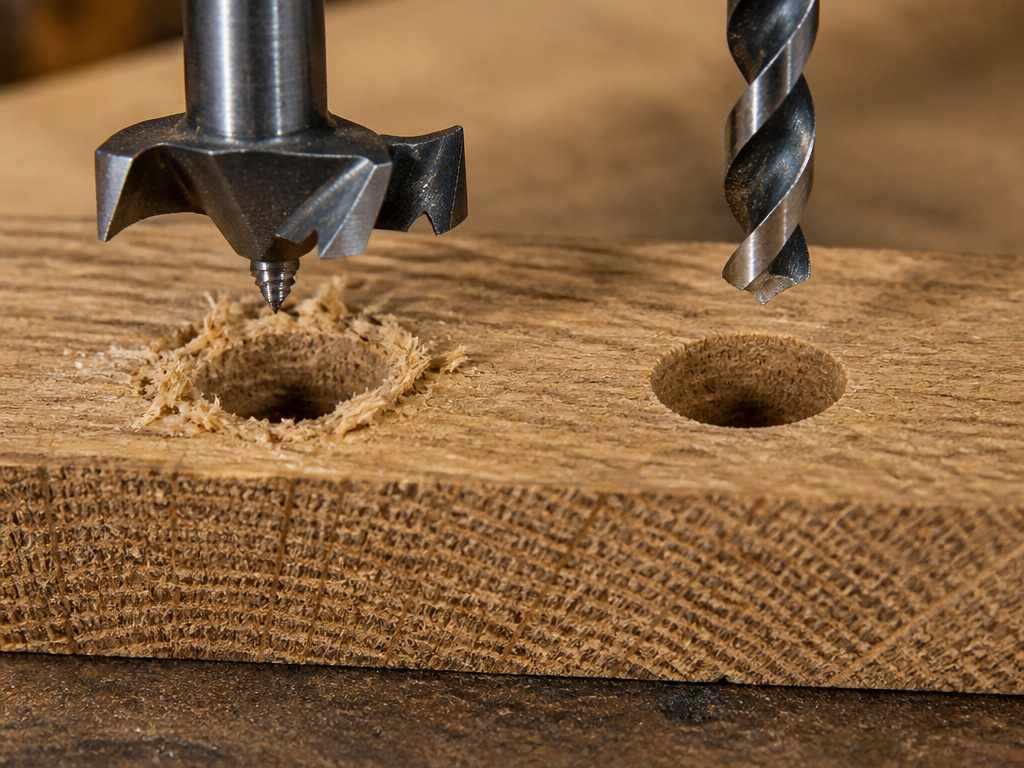
The design has two specific failure modes. Knowing them prevents a ruined workpiece.
First, brad points perform poorly in end grain. The outer spurs are designed to score across wood fibers, not along them. In end grain, the spurs can tear out chunks along the growth rings instead of cutting cleanly. The 2006 FineWoodworking test noted this exception explicitly. For drilling into the end of a board, a sharp standard twist bit or a Forstner bit will often produce a cleaner, more controlled hole.
Second, standard high-speed steel (HSS) brad points dull quickly in abrasive materials. This includes plywood with phenolic glue, MDF, or laminated products. The glue and binders act like sandpaper on the cutting edges. The solution here is a carbide-tipped brad point.
Carbide-tipped brad point drills stay sharp 10 to 20 times longer than high speed steel drills when drilling hardwoods, plywood, or glued products. ICS Cutting Tools product specification
If you’re drilling more than a few holes in maple, oak, or any manufactured board, the upgrade to carbide pays for itself in consistent results and less frequent sharpening. For the occasional DIYer, a quality HSS set like the Bosch Professional or DEWALT DT4504-QZ is sufficient.
Gear and Settings: Getting the Most from Your Bits
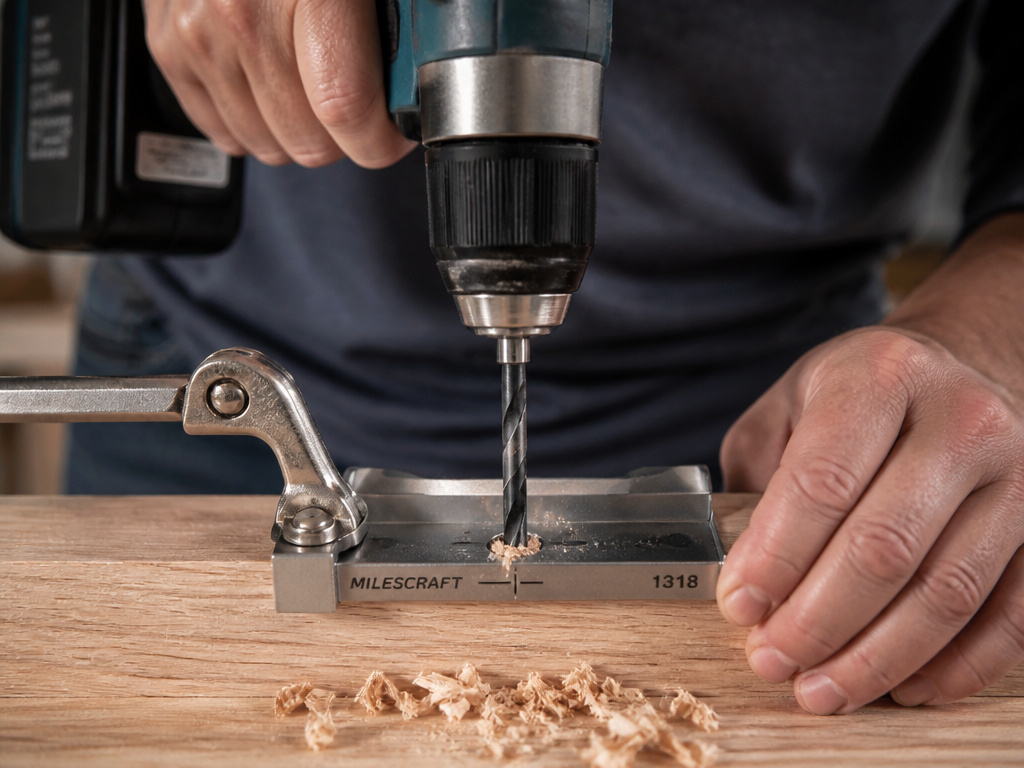
The right bit in the wrong hands still makes a bad hole. Three settings dictate success.
Speed (RPM) is critical. Dremel’s manual for their 631-01 set gives the rule: use higher speeds for hardwoods, slower speeds for metals, and very slow speeds for plastics. In practice, for a 3/8″ brad point in a handheld drill, 1000-1500 RPM in hardwoods and 500-800 RPM in softwoods is a safe range. Too slow in hardwood burns the bit; too fast in softwood increases tear-out.
Pressure should be firm and steady. Let the spurs score and the flutes pull chips. Don’t lean on the drill, forcing it creates heat, dulls the spurs, and can snap smaller bits. If you’re not making progress, the bit is dull, or you need to clear packed chips from the flutes.
Drill Type: A drill press is ideal. It guarantees a perpendicular entry, consistent pressure, and the stable RPM that brad points love. In a handheld drill, use a drill guide or jig whenever possible. The brad point helps with centering, but it can’t correct for a wobbly drill in your hands.
For the bit itself, start with a mid-range set. The FineWoodworking durability test found that after drilling over 1,000 holes, the performance gap between premium and mid-priced bits was often small. The Bosch Professional B14601 series or a DEWALT 5-piece set give you the essential sizes without the boutique price. For a rotary tool or precise small work, the Dremel 631-01 set with its 1/8″ shank is the default pick.
Material Limits: Wood, and Sometimes More
The manufacturer specs draw a clear line. Brad points are engineered for wood and wood-based materials.
Bosch and DEWALT specify their bits for “soft and hard wood” and “plywood.” Dremel notes their bits are for “hardwood, softwood, soft metal or plastic.” That last part is the expansion zone. You can use a brad point on soft metals (like aluminum) and plastics, but you must drop the speed dramatically. Use the slowest setting on your drill, and apply very light pressure to avoid melting the plastic or gumming up the flutes.
Never use a brad point bit on masonry, stone, or steel. The spurs will chip on contact, and the bit will be permanently damaged. That’s a job for a masonry bit or a cobalt twist bit.
The advanced category is the carbide-tipped brad point from industrial suppliers like ICS Cutting Tools. Their product sheet explicitly lists “hard fiber plates, plastic materials, laminated products, chip core, and any wood product containing glue.” The carbide edge handles the abrasives that would quickly dull a standard HSS bit. If your project involves melamine-coated shelving or glued-up hardwood, this is the bit you want.
Frequently Asked Questions
Can I use a brad point bit in a regular drill?
Yes. They work perfectly in both corded and cordless hand drills. The brad point’s centering ability is especially valuable when freehand drilling. For the best accuracy, use a slower speed setting and consider a simple drill guide attachment.
Why is my brad point bit burning the wood?
Burning is caused by friction heat from dull spurs, too high of an RPM, or insufficient chip clearance. Check the sharpness of the outer spurs. Reduce your drill speed, especially in hardwoods. Periodically pull the bit completely out of the hole to clear packed chips from the flutes.
How do I sharpen a brad point drill bit?
Sharpening a brad point is more complex than a twist bit because of the spurs. You need a small, fine file or a dedicated drill bit sharpening jig. The goal is to hone the inside edge of each outer spur and the leading edge of the main cutting lips, while maintaining the spur’s height relative to the lips. For most DIYers, replacing a worn mid-priced bit is more cost-effective than learning to sharpen it correctly.
Are brad point bits good for drilling plastic?
They can be, but with caution. Use a very slow drill speed and light pressure to prevent the bit from grabbing and cracking the plastic. The brad point can help with a clean start, but a standard twist bit is often a safer, more predictable choice for plastics.
What’s the difference between a brad point and a lip and spur bit?
They are the same thing. “Lip and spur bit” is the common term in the UK and among some manufacturers, while “brad point” is more common in North America. Both refer to a bit with a center point and two outer cutting spurs.
The Bottom Line
Brad point drill bits solve a specific set of woodworking problems with elegant efficiency. They start on center, cut to exact size, and leave a clean edge. That makes them the first choice for any joinery work where the hole will be seen or needs to fit a dowel precisely.
Skip them for end grain and abrasive composites unless you have the carbide-tipped version. And never confuse them with a general-purpose bit, their sharp spurs are too fragile for metal or masonry.
For your next project involving dowels, shelf pins, or any visible hole in wood, put down the twist bit. Reach for a brad point. The difference in the finished piece is immediate, and once you feel that center spur bite exactly on your mark, you won’t go back.
