
Drilling Into Concrete Without a Hammer Drill: Step-by-Step
This post contains affiliate links. As an Amazon Associate, we earn from qualifying purchases.
You can drill into concrete without a hammer drill using a standard 7-10 amp drill and a sharp, carbide-tipped masonry bit. Drill in short, low-speed bursts, clear the dust every 1/4 inch, and let the bit cool. For a 1/4-inch anchor hole, expect 2-5 minutes of work. This method works for light-duty tasks like hanging a shelf, but wait at least 7 days for new concrete to cure and 28 days for structural anchors.
That timeline is the whole game. Concrete isn’t a static material; it’s a chemical reaction that keeps hardening for years. Drilling a week-old patio slab feels nothing like drilling a fifty-year-old foundation. The American Concrete Institute’s 28-day strength guideline isn’t a suggestion, it’s the point where the mix hits 90 percent of its design strength. Drill before that on a load-bearing anchor, and you compromise the hold.
What follows is the full breakdown: the one drill spec that matters, the bit that actually works, the physical technique to stop the bit from skating, and the exact moment you should rent a hammer drill instead of burning out your own tool.
Key Takeaways
- Use a drill rated for 7-10 amps for enough torque. Cordless models need a high-torque, brushless motor.
- Carbide-tipped masonry bits are non-negotiable. A standard twist bit for wood will dull in seconds.
- Drill in short 1/4-inch bursts and pull out completely to clear dust. Clogged dust creates heat and stalls the drill.
- Wait 7 days to drill light, non-structural holes in new concrete. Wait the full 28 days for any anchor carrying weight.
- If you hit an unseen rock or rebar, stop. Do not force it. Tap the obstruction with a masonry nail or move your hole.
The One Drill Spec That Actually Matters
Forget corded versus cordless for a second. The number that decides whether your drill can handle concrete is amperage. For medium-duty tasks, you need a drill that pulls 7 to 10 amps. That’s the power range that delivers enough rotational force, or torque, to grind through aggregate without stalling the motor every three seconds.
A cordless drill can work, but it needs a modern, brushless motor and a fresh, high-capacity battery. The older NiCad drill you use for assembling furniture will die a slow, smoky death. The motor bogs down, overheats, and the battery drains before you’re an inch deep. If your drill struggles to drive a 3-inch screw into a stud, it won’t drill concrete.
The part nobody mentions: A standard drill relies on constant downward pressure from you to make up for its lack of hammering action. If your stance isn’t braced, your arm tires in under a minute and the bit stops cutting. Plant your feet wide.
This is also where people grab the wrong tool. An impact driver is for driving screws. Its concussive force is rotational, not axial. It doesn’t hammer the bit forward into the concrete. It will make a lot of noise and round off the shank of your masonry bit. For the actual act of drilling into concrete, a standard drill driver is the correct choice.
Bit Selection: Carbide or Nothing
The bit is everything. Concrete is sand, cement, and aggregate stone. A standard high-speed steel (HSS) twist bit, the kind you use for drilling into wood, is softer than the quartz in the mix. It will overheat, lose its temper (shown by a blue discoloration), and become useless in under thirty seconds.
You need a carbide-tipped masonry bit. The tip is a chunk of tungsten carbide brazed onto the steel body. Carbide is harder than the aggregate, so it grinds the stone down instead of deflecting off it.
| Bit Type | Best For | What Happens in Concrete |
|---|---|---|
| Carbide Masonry Bit | Concrete, brick, block | Grinds material; lasts for multiple holes. |
| HSS Twist Bit | Wood, metal, plastic | Rounds over instantly; ruins the bit. |
| Impact-Rated Masonry | Hammer drills, impact drivers | Withstands vibration; standard drill use is fine. |
Buy bits sized for your anchor. For a common #10 concrete screw, that’s often a 3/16-inch bit. The package will specify. Have a few sizes on hand. A concrete drill bit set with sizes from 1/8-inch to 1/2-inch covers most household jobs.
The Core Method: Drill, Clear, Repeat
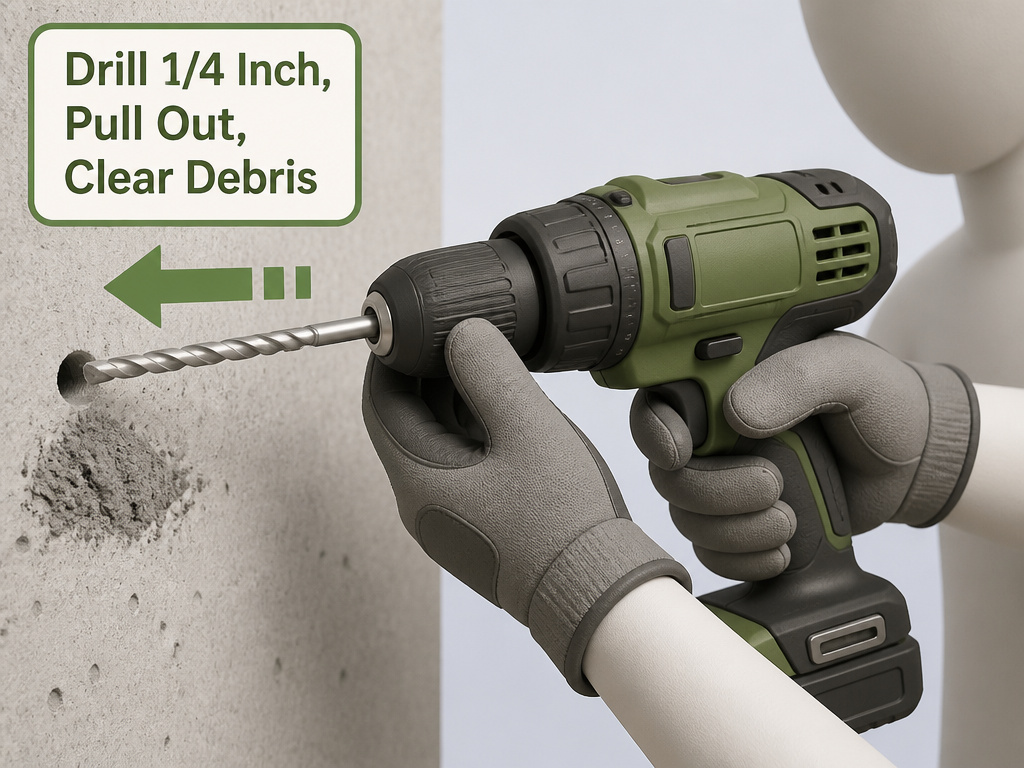 The technique is simple, physical, and repetitive. Your goal is to manage heat and remove the cutting debris. Here’s the sequence, step by consequence.
- Mark and Punch. Draw your X. Then, use a masonry nail or center punch and a hammer to tap a small starter dent. A smooth concrete surface will send a spinning bit skating sideways. The dent gives the tip a pocket to sit in.
- Set Up for Stability. Brace yourself. Hold the drill with both hands, keep your elbows in, and stand with a wide stance. The drill will want to twist.
- Start Slow, Push Steady. Place the bit in the dent. Start the drill at its lowest speed setting while applying firm, forward pressure. Let the carbide teeth grab. You’ll hear a gritty grinding sound. That’s correct.
- Drill 1/4 Inch, Pull Out. This is the critical rhythm. Advance only about a quarter of an inch. Then, pull the bit completely out of the hole while it’s still spinning. This pulls the dust out with it.
- Clear the Debris. Blow or brush the dust off the bit and out of the hole. A clogged hole creates immense friction. That friction heats the bit, glazes the concrete, and can weld the bit in place.
- Repeat and Cool. Re-enter the hole and drill another 1/4 inch. Pull out. Clear. Continue. If the bit gets hot to the touch, stop and let it air-cool. Dipping it in water cools it fast but can crack the carbide if it’s superheated.
Common mistake: Pushing too hard when the bit stalls. The stall usually means you’ve hit a hard aggregate stone or the hole is clogged. Forcing it burns out the drill motor or snaps the bit. Pull out, clear the hole, and try again with steady pressure.
How long does this take? For a single 1/4-inch hole in average concrete: 2 to 5 minutes with a standard drill. A hammer drill does it in under 30 seconds. A rotary hammer with an SDS bit takes 10-20 seconds. The trade-off is time versus tool investment.
Reading the Concrete: Age, Cure, and Obstructions
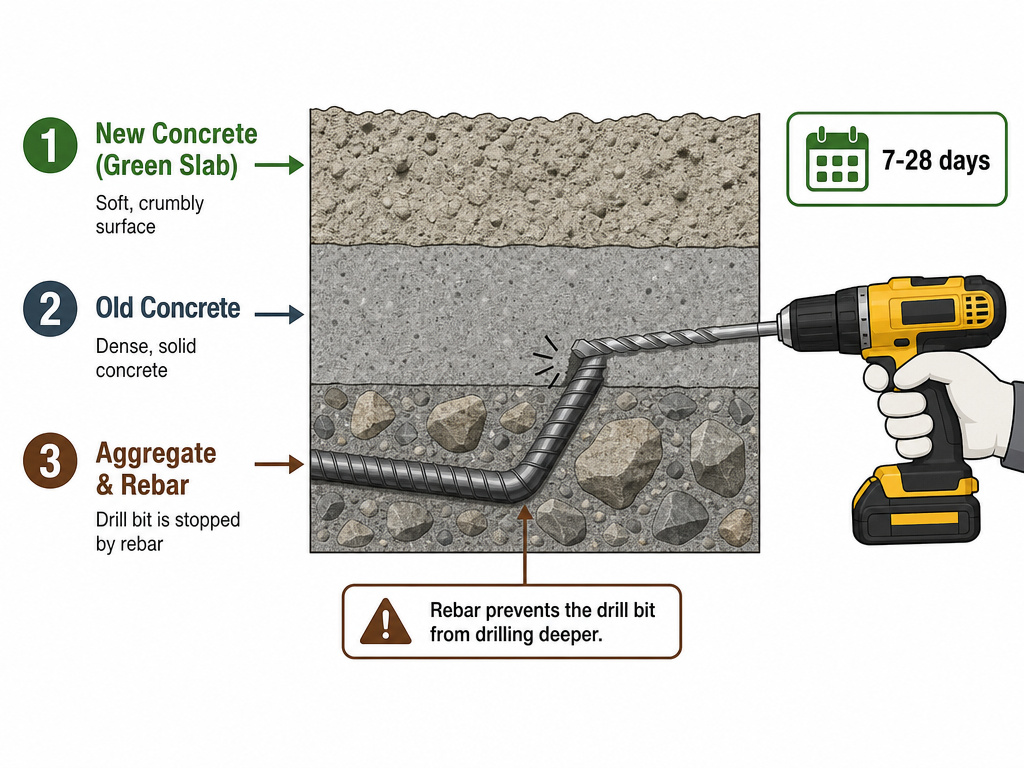 Not all concrete is the same. Your approach changes based on what you’re drilling into.
New Concrete (The “Green Slab”): Concrete gains strength over time. For a light-duty anchor like a shelf bracket in a week-old garage wall, you can drill after about 7 days. For anything structural, a deck ledger board, a safety railing, a heavy TV mount, you must wait the full 28-day cure. Drilling too early can spall the surface and create a crumbly, oversized hole that won’t hold an anchor.
Old Concrete: A decades-old foundation or sidewalk is much denser. The cement paste has fully hydrated, and the surface is often harder. Your drilling time will double, and a standard drill may simply not have the juice. This is the prime scenario for alternative methods for concrete or renting a more powerful tool.
Hitting Aggregate or Rebar: If the bit suddenly stops and you hear a high-pitched screech, you’ve hit a hard rock or the steel reinforcing bar (rebar) inside. Do not power through. * For a rock: Insert a masonry nail so its tip touches the blockage. Tap it sharply with a hammer to fracture the stone, then resume drilling. * For rebar: Stop. You cannot drill through rebar with a masonry bit. You must relocate your hole a few inches over. If you absolutely must go through that spot, you need a specialized rebar-cutting drill bit.
This variability is why techniques for drilling into cinder block or drilling into mortar are different. Those materials are softer and more predictable.
When Your Drill Isn’t Enough
There’s a clear line where this method stops making sense. Recognize it before you ruin a Saturday.
- Number of Holes: More than 5-7 holes of any size.
- Hole Diameter: Anything over 1/2-inch in diameter.
- Material Hardness: Very old concrete or concrete with especially hard aggregate (like granite).
- Physical Demand: You feel significant arm fatigue or the drill motor is overheating.
At this point, the right tool is a hammer drill or a rotary hammer. A hammer drill adds a pounding action to the rotation and is ideal for holes up to 1/2-inch. A rotary hammer (like an SDS-plus model) uses a piston mechanism for much more powerful blows and is for holes over 1/2-inch or high-volume work.
| Scenario | Standard Drill | Hammer Drill | Rotary Hammer (SDS) |
|---|---|---|---|
| 3 x 1/4″ shelf anchor holes | Yes | Overkill | Overkill |
| 10 x 3/8″ holes for a ledger board | Possible, but slow | Good choice | Excellent choice |
| 1 x 1″ hole for a pipe | No | Will struggle | Required |
| Drilling into 50-year-old foundation | Poor choice | Possible | Best choice |
Renting a rotary hammer for a half-day costs less than a new drill motor. It’s also quieter and transfers less vibration to your hands. Knowing what a hammer drill drills helps you understand its real purpose.
Safety and Setup You Can’t Skip
Concrete dust is not sawdust. It contains crystalline silica, a known respiratory hazard. Drilling is also loud and sends sharp chips flying.
Before you start: Wear sealed safety goggles, not glasses. Concrete chips fly unpredictably. Use a respirator or a tight-fitting N95 mask to avoid inhaling silica dust. Hearing protection is necessary; the grinding is a high-decibel whine.
Manage dust at the source. Have a shop vacuum hose next to the hole or a helper hold it. You can also drill a small amount of water into the hole to keep dust down, but this creates slurry. For indoor work, tape a dust bag or a folded piece of paper beneath the hole to catch debris.
Check your bit before each hole. Run your finger over the carbide edges. If they feel rounded or you see chips, the bit is dull. A dull bit requires more pressure, heats up faster, and makes the job miserable. A sharp bit does the work for you.
Frequently Asked Questions
Can I use an impact driver to drill into concrete?
You can, but you shouldn’t. An impact driver delivers rotational blows, not the forward hammering action needed to fracture concrete. It will take longer, be extremely loud, and risk damaging the bit or the tool’s anvil. It’s the wrong tool for making holes, though it’s perfect for driving the screws into concrete once the hole is drilled.
How do I know if my drill is powerful enough?
Check the amperage (corded) or the voltage and motor type (cordless). A corded drill under 7 amps will struggle. A cordless drill needs to be 18V or higher with a brushless motor. If the drill bogs down and stops when you press firmly into wood, it won’t handle concrete.
What if the bit gets stuck in the hole?
This is usually from heat and dust welding. Stop drilling immediately. Reverse the drill direction if possible. Try rocking the bit gently side-to-side while pulling. If it’s truly stuck, you may need to break the bit out with pliers, sacrificing it. This is why clearing debris every 1/4 inch is non-negotiable.
Is it easier to drill into stucco?
Yes, significantly. Stucco is a cement-based plaster, not solid concrete aggregate. You can use the same carbide masonry bit and technique, but it goes much faster. The principles for drilling into stucco are similar, but watch for underlying wood or metal lath.
Can I install an anchor without drilling first?
For very light duty in soft materials, maybe. But for concrete, no. A plastic anchor needs a clean, sized hole to expand into. Trying to install anchor without drill by hammering it into concrete will destroy the anchor and leave you with a weak hold.
The Bottom Line
Drilling into concrete with a standard drill is a test of patience, not strength. It works for the occasional small hole if you use a sharp carbide bit, drill in short bursts, and respect the concrete’s cure time. The 7-day rule for light anchors and the 28-day rule for structural ones are there because chemistry doesn’t care about your schedule.
When the job grows, more holes, bigger holes, harder concrete, that’s your signal to upgrade. Renting a hammer drill isn’t a failure; it’s the smart way to save your tools, your time, and your shoulders. For everything else, the method above gets it done.
