
How to Create a Hole in a Concrete Wall Without Using a Drill
This post contains affiliate links. As an Amazon Associate, we earn from qualifying purchases.
You make a hole in a concrete wall without a drill by using impact and rotation with a hardened steel star drill and a 3-pound hammer, or by creating a pilot hole with a masonry nail. The star drill method requires striking the tool, rotating it one-eighth of a turn after each blow, and clearing dust. For a screw, a masonry nail driven ¾ to 1 inch deep creates the needed pilot hole.
This is a full-body workout that trades watts for sweat and time for control. The physics are simple: you’re concentrating the force of a hammer swing into four hardened points to crush the concrete’s crystalline structure bit by bit.Where a drill spins at 3,000 RPM, you provide the rotation manually with your wrist.
What follows is the breakdown of when these methods actually make sense, the precise motions that keep the hole straight, and the two concrete scenarios where trying this will cost you more in broken tools and frustration than calling a pro ever would.
Key Takeaways
- A star drill and 3-lb hammer is the only manual method for a clean, cylindrical hole deeper than an inch. Rotate the drill one-eighth of a turn after every strike to keep the hole round.
- For mounting lightweight items, a masonry nail driven ¾ to 1 inch into the wall creates a sufficient pilot hole for a concrete screw. The nail’s ridges do the cutting.
- Manual methods are only viable for holes under ½ inch in diameter. Anything larger requires a rotary hammer or core drill, trying it by hand will destroy the star drill.
- Clean the hole thoroughly before inserting any fastener. Residual concrete dust acts as a lubricant and will cause the anchor to spin out under load.
- In environments designated as “hot work prohibited zones”, like areas with flammable vapors, spark-producing power tools are banned, making manual methods your only legal option.
The Core Manual Method: Star Drill & Hammer
This is the classic technique, unchanged for decades. You are the motor. A star drill is a hardened steel chisel with a four-pointed tip designed to fracture concrete under concentrated impact.
A star drill concentrates a hammer’s force into four distinct points to defeat concrete’s compressive strength through localized fracturing, not cutting. The user must rotate the tool one-eighth to one-quarter turn after each strike to advance the hole evenly.
Your swing is everything. A 3-pound drilling hammer is the minimum. A standard 16-ounce claw hammer won’t deliver enough energy per blow, you’ll work ten times as long and likely chip the drill’s tip. Grip the star drill loosely near its top, letting it recoil slightly in your hand with each hit. A death grip transmits shock to your elbow and stalls the tool’s natural vibration.
Step 1: Punch a Starter Dimple. Hold the drill perpendicular to the wall. Give it a firm, centered tap with the hammer to create a small dent. This dimple keeps the drill from “skating” across the hard surface on your first real swing.
Step 2: Strike and Rotate. Swing with controlled, full-arm motions. Aim for the center of the drill’s head. After each solid strike, rotate the drill in your fingers about one-eighth of a turn. This is the non-negotiable rhythm. If you don’t rotate, you’ll create a star-shaped pit instead of a round hole, and the drill will jam.
Step 3: Clear Debris Every 10–15 Blows. Pull the drill out and blow or brush away the concrete dust. Compacted dust at the bottom absorbs impact energy and halts progress. This is the moment you’ll want to quit. The hole seems to stop deepening. That’s the signal to clear it.
Step 4: Manage Depth. For a sleeve anchor or wedge anchor, drill at least ½ inch deeper than the anchor’s length. This gives space for debris so the anchor can seat fully. For a screw, match the hole depth to the screw’s length.
| Step | Action | Why It Matters | Risk If Skipped |
|---|---|---|---|
| Starter Dimple | Light hammer tap to create a dent. | Prevents the drill bit from skating off the mark. | The drill slides, scarring the concrete and wasting energy. |
| Strike & Rotate | Full swing, then rotate drill 1/8 turn. | Creates a round hole by working all four cutting edges. | Hole becomes misshapen, jams the drill, ruins the tool. |
| Clear Debris | Remove drill and blow out dust every 10-15 strikes. | Prevents compacted dust from cushioning hammer blows. | Progress stops completely; hammering becomes futile. |
| Depth Check | Drill ½” deeper than the fastener length. | Provides space for debris so the anchor seats flush. | Anchor bottoms out on dust, won’t tighten, fails under load. |
Where this goes sideways: Not rotating the drill. The hole walls bind the tool after about an inch, and you’ll spend twenty minutes hammering with zero forward progress. The fix is to remove the drill, clear the hole, and restart the turn rhythm.
The entire process for a 2-inch deep, ¼-inch hole takes about 15–20 minutes of steady work. A hammer drill does the same job in under 60 seconds. That’s the trade you’re making.
The Masonry Nail Pilot Hole Method
This is for one thing only: installing a concrete screw or a small plastic anchor to hang something light. It is not for structural anchoring. A masonry nail has fluted ridges along its shaft that act as cutting edges.
The nail does the drilling. You’re not just making a dent; you’re using the hammer to drive the nail’s threads into the concrete, grinding out a small, rough hole. Choose a nail with a diameter slightly smaller than the screw you plan to use.
Before you start: Wear safety glasses. A glancing blow or a shattered nail head can send metal fragments flying. Masonry nails are hardened and brittle.
- Mark the spot with a pencil or chalk.
- Hold the nail straight against the wall. Start with light taps to set it, ensuring it doesn’t bounce and skid.
- Drive it to depth. Hammer the nail in until you have ¾ to 1 inch of embedment into the concrete itself (not counting any surface material). This depth provides enough grip for the screw threads to bite. The nail will become harder to drive as it goes deeper, that’s normal.
- Remove the nail. Use a claw hammer or pliers to pull it straight out. Twist slightly if it’s stuck.
- Clear the hole. Blow into it or use a thin wire to hook out the fine, gritty dust.
- Insert and drive your concrete screw. It should thread in with firm resistance. If it spins freely, the hole is too big or too dirty.
Skip this if: You need to hang anything over 10 pounds, install a bolt anchor, or the concrete is aged and crumbly. The hole created is ragged and offers poor thread engagement compared to a drilled hole.
When Manual Methods Are Actually the Right Call
Most of the time, renting a rotary hammer for $40 is smarter than spending an afternoon hammering. But three scenarios flip the equation.
Scenario 1: The “Hot Work” Prohibition. On job sites near fuel lines, chemical storage, or grain silos, permits ban any tool that can create a spark, that includes all electric drills. Your only option for adding a safety sign, conduit clamp, or emergency equipment bracket is a star drill. The rule exists because a single spark in the wrong atmosphere can ignite an explosion.
Scenario 2: Tool Failure in the Field. Your hammer drill dies on a remote site. The replacement is a day away, but you need to mount a critical bracket now. Manual methods get the job done when logistics fail. This is a stopgap, but it’s a functional one.
Scenario 3: One Tiny Hole, Miles from a Store. You’re in a basement or remote cabin and need to hang a single fire extinguisher bracket. Buying or renting a drill for one ¼-inch hole is absurd. The manual method costs you 20 minutes and zero dollars.
For any other situation, more than two holes, holes larger than ½ inch, or holes deeper than 2 inches, the manual tax is too high. Your time and energy have value.
What You Can’t Do (And What to Use Instead)
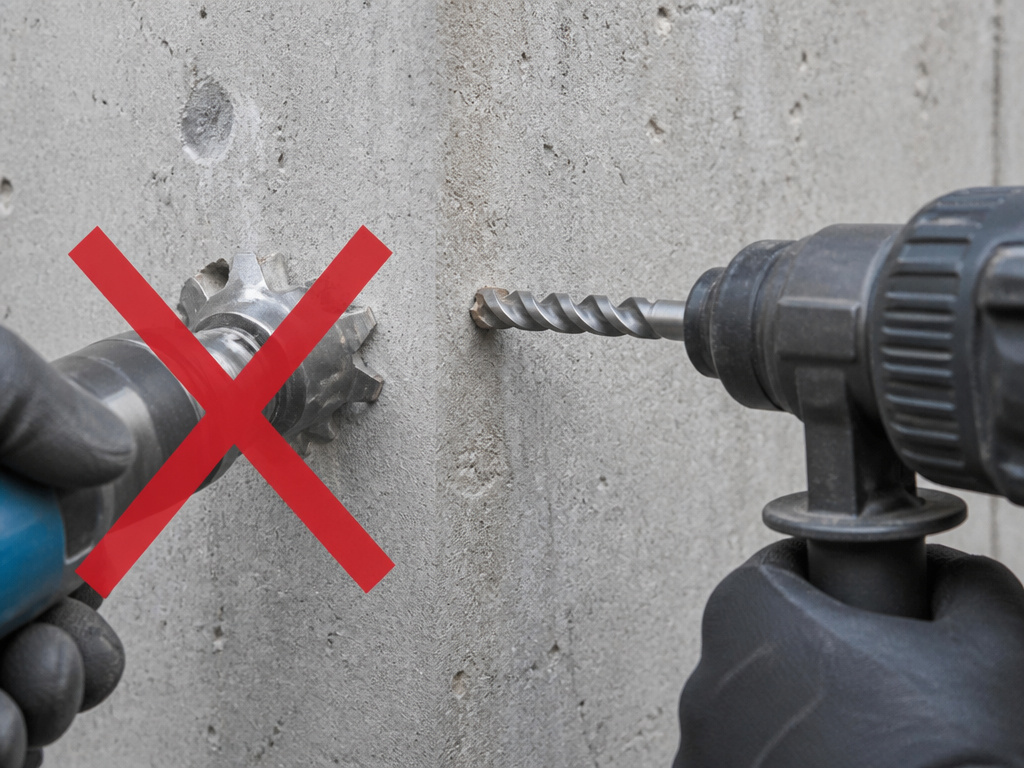
A star drill has hard limits. Understanding them saves you from a broken tool and a wasted day.
| Task | Can a Star Drill Do It? | Why Not? | Correct Tool |
|---|---|---|---|
| Hole larger than ½” diameter | No | The cutting edges can’t reach; the core won’t fracture out. | Rotary hammer with a carbide masonry bit. |
| Hole deeper than 4 inches | No | Debris cannot be cleared from the depth; tool binds and snaps. | Rotary hammer with an extended flute bit. |
| Clean, round hole for pipe | No | A star drill hole is rough and irregular. | Core drill with a diamond-tipped barrel. |
| Making a large cutout (for a window, outlet) | Absolutely Not | The linear cut required is impossible with a punch tool. | Concrete saw (gas or electric) with a diamond blade. |
Making a cutout, like for an electrical box or a pipe penetration, is a different operation entirely. As outlined in a 2013 Weekand article by Emily Beach, the process involves drilling guide holes at the corners with a rotary hammer, then connecting them with a concrete saw. You then knock the center out with a sledgehammer. A star drill is irrelevant here.
The principle is specialization. Each tool is shaped for a specific type of force. A star drill is for concentrated impact. A saw is for linear abrasion. Trying to swap their jobs breaks them.
When to Call a Pro (And When You Absolutely Must)
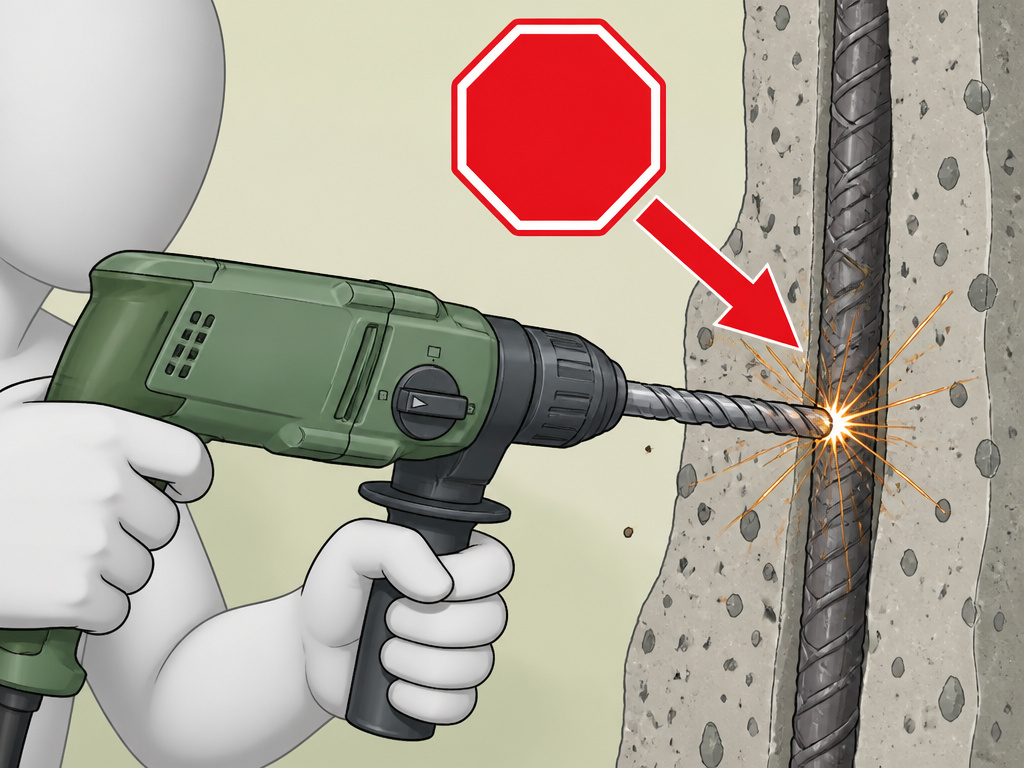
Drilling into concrete requires understanding what’s inside the wall and what’s holding the wall up.
Call a pro if you hit an obstruction. If your star drill or nail suddenly stops dead or the concrete dust shows metal shavings, you’ve hit rebar or a conduit. Never force through it. You could sever an electrical line, a water pipe, or compromise the structural rebar. A professional has a rebar locator and the experience to navigate around it.
Call a pro for any structural modification. This includes creating new openings for doors or windows in a concrete wall. As the old guide notes, you must consult a structural engineer to plan for proper support during and after the cut. The weight above the opening needs a temporary beam (a header) before you cut, or the wall can crack catastrophically.
Call a pro if you lack the strength or stability. Swinging a 3-pound hammer overhead for 20 minutes requires real shoulder and core strength. If you’re on a ladder or an unstable surface, the risk of a missed swing causing injury is high. There’s no shame in paying for safety and a job done in minutes instead of hours.
The line is simple: if the project involves unknowns behind the wall, structural loads, or your own physical safety, the cost of a professional is cheaper than the cost of a mistake.
Frequently Asked Questions
Can you screw directly into concrete without any hole?
No. Concrete screws like Tapcons or Spax multi-material screws are designed to tap their own threads, but they still require a properly sized pilot hole. Trying to drive one directly into solid concrete will snap the screw head off or strip its drive recess. The pilot hole guides the screw and provides a path for dust to escape.
What’s the difference between a star drill and a cold chisel?
Cold chisel has a flat, wedge-shaped tip for splitting or chipping. A star drill has a four-pointed, star-shaped tip designed specifically for drilling cylindrical holes. Using a cold chisel will create a ragged, conical pit, not a hole suitable for an anchor.
How do I keep the hole straight when using a star drill?
Start perpendicular and check your angle every few blows. The starter dimple is critical. Visualize the drill as an extension of your arm. Any tilt will be magnified over depth, causing the hole to angle off. If it goes crooked, you cannot correct it, you must start over in a new spot.
Can I use an anchor in a hole made with a masonry nail?
Yes, but only expansion-style anchors like wedge anchors or sleeve anchors that grip the sides of the hole. The hole will be rough, which can actually help these anchors bite. Do not use adhesive anchors (like epoxy-set studs) in a nail-made hole, as the irregular surface prevents proper adhesive coverage and bonding.
Is manual drilling bad for the concrete?
It’s more disruptive. A hammer drill uses rapid, controlled percussion. A star drill uses fewer, heavier blows that can cause more localized micro-fracturing. For a single small hole, this doesn’t matter. For multiple holes close together, especially in older concrete, it can increase the risk of spalling or cracking around the hole.
The Bottom Line
Making a hole in concrete without a drill is a technique of last resort, born of necessity, not preference. It works for a small pilot hole with a masonry nail or a shallow, sub-½-inch hole with a star drill. The rhythm, strike, rotate, clear, is everything. Your success depends entirely on matching the method’s severe limits: hole size, depth, and your own endurance.
For every other task, from a simple shelf bracket to a core hole for plumbing, the right power tool is the only tool that applies the correct type of force without breaking your back or your timeline. Rent a rotary hammer.Your future self, with a finished project in ten minutes instead of a sore arm and a jagged hole, will thank you.
