
How Does an Air Compressor Work? Understanding the Physics
This post contains affiliate links. As an Amazon Associate, we earn from qualifying purchases.
An air compressor works by using a motor to drive a pump that forces atmospheric air into a smaller volume, increasing its pressure. This compressed air is stored in a tank as potential energy. When released, this energy powers pneumatic tools. The core mechanism follows Boyle’s Law: at a constant temperature, reducing a gas’s volume increases its pressure.
The physics are simple, but the engineering is what separates a reliable compressor from one that fails in a humid garage. That volume reduction happens in one of two ways, and the method dictates everything from noise to maintenance cost.
What follows is the breakdown most guides skip: the exact amount of water a compressor makes, the maintenance schedule that prevents sludge, and why a two-stage unit isn’t just more powerful, it runs cooler and lasts longer.
Key Takeaways
- Compressors work by either trapping and squeezing air (positive displacement) or accelerating it with an impeller (dynamic displacement). The first is for your garage; the second is for factories.
- A compressor pulling in humid air creates liquid water inside the tank, an Atlas Copco manual calculates 10 liters per hour for a mid-sized unit. If you don’t drain it, that water causes rust and tools to spit moisture.
- Follow the manufacturer’s break-in oil change at 100 hours, then stick to the 500-hour change interval. Skipping the first change leaves metal shavings in the system, grinding down the pump from day one.
- Two-stage compressors run cooler and more efficiently by compressing air in two steps with an intercooler between them. They’re not just for higher pressure; they’re for longer life under daily use.
- Your compressor’s CFM (flow) rating is useless if your hose, fittings, or filter create restriction. A kinked hose can cut delivered air volume by half, stalling an impact wrench mid-torque.
The Two Methods of Air Displacement
Every air compressor uses one of two fundamental methods to increase air pressure: positive displacement or dynamic displacement. Your choice determines the machine’s noise, efficiency, and best application.
Positive displacement is the method in 99% of home and shop compressors. It mechanically traps a volume of air in a chamber and then reduces the size of that chamber. As the space gets smaller, the air molecules are forced closer together, increasing the pressure. Think of it like sealing air in a syringe and pushing the plunger.
Positive displacement compressors enclose a volume of gas and increase pressure by reducing that volume. This category includes reciprocating piston, rotary screw, and scroll compressors. (Atlas Copco Compressed Air Manual)
Dynamic displacement, also called non-positive displacement, works differently. It uses a high-speed rotating impeller, like a fan, to accelerate air to a high velocity. This fast-moving air is then forced into a diffuser chamber where its velocity drops abruptly, converting that speed energy into pressure energy. It’s great for moving huge volumes of air continuously, which is why it’s used in large industrial systems and turbochargers, not in your garage.
The choice comes down to consistency versus volume. A positive displacement compressor delivers a steady pressure perfect for starting and stopping tools. A dynamic compressor provides a massive, constant airflow for processes that never pause.
Inside a Reciprocating Piston Compressor
The reciprocating piston compressor is the workhorse of workshops. It’s reliable, repairable, and loud. Understanding its cycle explains why maintenance isn’t optional.
The process mirrors a car engine but in reverse. Instead of using an explosion to drive a piston, it uses a motor to drive a piston and create compression.
The Reciprocating Piston: A Step-by-Stage Breakdown
Here is the four-stroke cycle for a single-stage, single-cylinder piston compressor.
- Intake Stroke: The piston moves down the cylinder, creating a low-pressure area (a vacuum) above it. The intake valve opens, and atmospheric air rushes in to fill the space. The exhaust valve stays shut.
- Compression Stroke: The piston reverses and moves back up the cylinder. Both valves are closed, trapping the air. The volume of the chamber decreases sharply, compressing the air and raising its pressure and temperature.
- Discharge Stroke: Near the top of the stroke, the compressed air pressure exceeds the pressure in the discharge line. This forces the exhaust valve open. The piston continues upward, pushing the high-pressure air out of the cylinder, through the discharge valve, and into the storage tank.
- Reset: The piston reaches the top and begins its next downstroke. The exhaust valve closes from the tank’s back-pressure, and the cycle repeats with a new intake stroke.
Single-stage compressors do this all in one cylinder. Two-stage models add an intercooler and a second, smaller cylinder for greater efficiency and higher pressure.
| Stage | Pressure Target | Cylinder Size | Key Benefit |
|---|---|---|---|
| Single-Stage | Up to 145 PSI | Large, single cylinder | Simpler, cheaper, adequate for most intermittent tools. |
| Two-Stage | Up to 175 PSI | Large first stage, smaller second stage | Runs cooler, more efficient, longer lifespan under heavy use. |
Where this goes sideways: Running a compressor in an unheated space with large temperature swings. Condensation forms inside the pump as it cools, mixing with oil to create a milky sludge that causes premature wear. The Ingersoll-Rand manual calls this out specifically.
The intercooler between stages is the secret. It cools the air after the first compression. Cooler air is denser and easier to compress further, reducing the work the second-stage piston must do. This lowers the final discharge temperature, which means less moisture condensing in your tank and less thermal stress on the pump.
CFM, PSI, and Why Your Tools Stall
The numbers on the compressor’s tag. CFM and PSI, tell you what it can theoretically do. The reality in your hose line is often different.
PSI (Pounds per Square Inch) is the force of the compressed air. It’s like water pressure. Most common air tools need 90 PSI to operate correctly. A compressor must reach a PSI higher than your tool’s requirement to account for pressure drop across the line.
CFM (Cubic Feet per Minute) is the volume of air the compressor can deliver. It’s the flow rate. This is the number that matters most for tool operation. An impact wrench might need 4 CFM at 90 PSI. If your compressor only delivers 3 CFM at that pressure, the tool will stall.
The factory CFM rating is usually measured at a lower pressure (like 40 PSI) and under ideal conditions: 68°F inlet air at 0% humidity, as noted in the CR Range compressor manual. Your humid, 85-degree garage air is less dense, so actual delivered CFM will be lower.
| Common Tool | Typical CFM @ 90 PSI | Why It Stalls |
|---|---|---|
| Framing Nailer | 2-3 CFM | Low CFM is okay, but a tiny tank will cause frequent motor cycling. |
| Die Grinder | 4-6 CFM | High, continuous demand drains a small tank in seconds. |
| Impact Wrench | 4-5 CFM | High burst demand. A restrictive hose or fitting chokes the flow. |
| Sandblaster | 8-20+ CFM | Demands a large, industrial-grade compressor. |
Restriction is the silent killer of performance. A 25-foot air hose with a 3/8-inch inner diameter flows less air than one with a 1/2-inch ID. A cheap, kinked quick-connect fitting can cut your effective CFM by 30% or more. The tool doesn’t get the air it needs, so it bogs down. This is why pairing your compressor with the right best air compressor hoses is a performance upgrade, not an accessory.
The Water Problem: More Than Just Rust
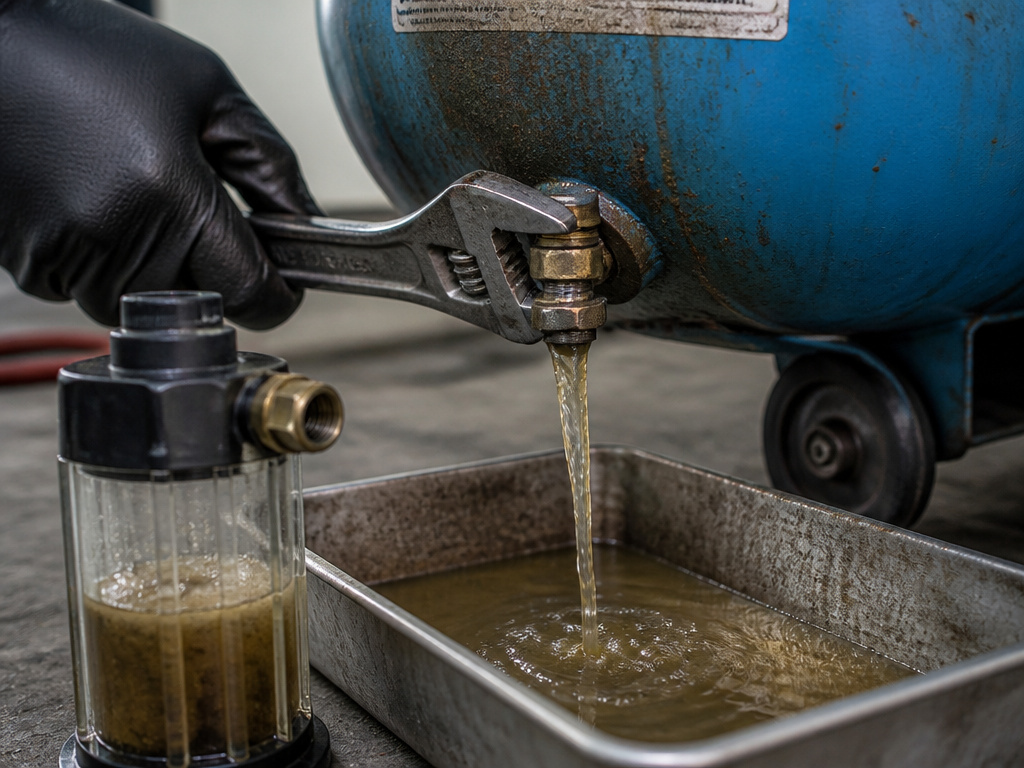 Air contains water vapor. When you compress air, you squeeze that vapor out like water from a sponge. The amount is shocking.
The Atlas Copco manual provides a concrete example: a compressor with a working pressure of 7 bar (about 100 PSI) and a capacity of 200 liters per second, drawing in air at 20°C with 80% humidity, will release 10 liters of water per hour into the air line.
That water sits in your tank. If you don’t drain it, it causes internal rust that flakes off and travels to your tools. It also mixes with oil vapor from lubricated compressors, forming an acidic sludge that gums up valves. In freezing temperatures, that water can ice up inside the tank drain or even crack the tank.
Common mistake: Only draining the tank. You must also drain moisture from drop legs and air traps in your distribution line weekly. Water settles at every low point.
The solution is a three-part system: a tank drain, an air line filter before sensitive tools, and for high-humidity areas, a refrigerated air dryer. An automatic drain valve is the single best upgrade for forgetful owners, it purges water on a timer so the tank never sits wet.
Lubrication: Oil vs. Oil-Free
 The pump needs lubrication to prevent metal-on-metal wear. There are two paths, and each has trade-offs.
Oil-lubricated (oil-flooded) compressors use a dedicated oil sump, much like a car engine. This oil lubricates the cylinder walls, piston rings, and bearings. It also helps seal the compression chamber and carries away heat. They run cooler, quieter, and last significantly longer with proper maintenance. The downside: they require regular oil checks and changes, and there’s a risk of oil carry-over contaminating the air line, which is bad for painting or sandblasting.
Oil-free compressors use permanently lubricated bearings and cylinders coated with low-friction materials like Teflon. They’re marketed as maintenance-free, no oil changes. The reality is they run hotter, wear out faster under heavy use, and are much louder. The coatings eventually degrade, and the whole pump usually needs replacement.
For a home shop running nail guns and inflating tires occasionally, an oil-free unit is fine. For a busy garage running an impact wrench daily, the longevity of an oil-lubricated model is worth the extra care.
The care is non-negotiable. The CR Range manual specifies an initial oil change at 100 hours to remove break-in metal particles, then changes every 500 hours. Using the wrong air compressor oil, like motor oil with detergents, causes carbon buildup and valve failure.
The Non-Negotiable Maintenance Schedule
A compressor isn’t a buy-it-and-forget-it tool. Its maintenance schedule is its lifespan predictor.
Manufacturer manuals don’t suggest these intervals; they mandate them. Here’s a consolidated schedule from the Ingersoll-Rand and CR Range manuals, translated from hours to real-world use for a weekend warrior.
| Interval | Action | Consequence If Skipped |
|---|---|---|
| After each use | Drain moisture from the tank. | Tank rusts from the inside out; water sprays from tools. |
| Weekly | Check oil level (lubricated units). Visually inspect for leaks. | Low oil leads to overheating and seized pistons. |
| Monthly | Check belt tension and wear. Clean intake filter vents. | A loose belt slips, reducing efficiency; a dirty filter chokes airflow. |
| Every 6 Months | Change the oil (or per 500-hr interval). | Old oil loses viscosity and leads to accelerated wear; sludge clogs valves. |
| Annually | Manually test the tank safety relief valve by pulling the ring. Inspect hoses for cracks. | A stuck relief valve is a bomb risk if the pressure switch fails. |
The safety relief valve test is critical. This valve is the last line of defense if the pressure switch fails to turn the motor off. If it’s corroded shut, pressure can build until the tank fails catastrophically. Pull the ring once a year, you should hear a loud blast of air. If it’s silent, replace the valve immediately.
Choosing the Right Compressor for the Job
Matching the compressor to the task prevents frustration. It’s not about buying the biggest one you can afford; it’s about buying the right one for your actual use.
For a homeowner doing occasional trim work, a small, portable oil-free pancake compressor (like a California Air Tools model) is adequate. It’s light, requires no oil changes, and has enough CFM for a framing nailer in bursts.
For a serious DIYer or auto enthusiast, a stationary, oil-lubricated two-stage compressor is the default. The twin-cylinder design balances the load, reducing vibration and noise, a major factor if you value a quiet air compressor. The 60-gallon tank provides a large reservoir of air, so the motor doesn’t cycle on every nail shot, which is essential for running a spray gun for more than 30 seconds.
For a small professional shop running multiple pneumatic tools simultaneously, a rotary screw compressor becomes viable. It delivers constant, high CFM with less noise and heat than a piston compressor running flat-out. The investment is high, but the duty cycle is 100%.
The bottom line: add up the CFM requirements of the tool you’ll use most intensively, then add a 25% buffer. That’s your target CFM at your required PSI. Buy the compressor that meets that spec in the oil-lubricated category if you can. You’ll spend less time waiting for the tank to refill and more time working.
Frequently Asked Questions
What’s the difference between a pump and a compressor?
Pump moves fluid (liquid or gas) from one place to another, with a modest increase in pressure to overcome friction. A compressor is specifically designed to take a gas and dramatically increase its pressure by reducing its volume. All compressors have a pump mechanism inside them (like a piston pump), but not all pumps are compressors.
Why does my compressor run but not build pressure?
This usually indicates a mechanical failure inside the pump allowing air to escape faster than it can be compressed. Common culprits are a stuck or broken intake valve, worn piston rings, or a leaking head gasket. You’ll often hear a continuous chuffing sound from the pump area. This requires disassembly and part replacement.
Can I use my air compressor in the cold?
Yes, but with caveats. The General Air Products manual states a minimum inlet air temperature of 40°F (4.5°C). Below that, the oil thickens, making startup hard on the motor, and moisture in the tank and lines will freeze. If you must operate in freezing temps, use a synthetic oil rated for cold weather, drain the tank immediately after use, and store the unit in a heated space if possible.
How loud are air compressors, and can I quiet them?
Reciprocating piston compressors are loud, often between 80-90 dBA. Oil-free models are typically louder due to higher RPMs and lack of sound-dampening oil. You can reduce noise by placing the compressor in an insulated enclosure (with proper ventilation), on a vibration-damping pad, and by using longer hoses to keep the unit farther away. Dedicated air compressor silencers that fit on the intake filter can also cut several decibels.
Is the air from my compressor safe to breathe?
No. Unless it is specifically equipped with a high-grade filtration system designed for breathing air, the output from a standard workshop compressor is not safe to breathe. It contains oil vapors (from lubricated pumps), carbon monoxide (if the intake is near an engine), and other contaminants. Never use shop air for filling scuba tanks, paintball guns, or for any respiratory purpose without the proper, certified purification setup.
Before You Go
An air compressor converts electricity into stored air power through simple physics and precise mechanics. The magic isn’t in making pressure, it’s in managing the heat, water, and wear that come with it.
Choose positive displacement for your shop. Respect the water it creates, drain the tank every time you use it. Follow the oil change schedule like religion, especially that first 100-hour break-in. And match the CFM to your most demanding tool, not your lightest one. That’s how a compressor works for a decade, not just a season.
