
The Quietest Air Compressor: What It Is & How to Find It
This post contains affiliate links. As an Amazon Associate, we earn from qualifying purchases.
The quietest air compressor you can buy is the Newport ACGP-02, which operates at 30 dB(A) measured at one foot. That’s quieter than a library whisper. For continuous-duty shop work, oil-free scroll compressors like the Atlas Copco SF 1+ (52 dB) and Chicago Pneumatic SPR 2 (53 dB) lead the category, combining industrial-grade airflow with sound levels comparable to a quiet conversation.
That 30 dB figure isn’t a marketing claim. It’s a measured spec from a manufacturer datasheet, and it defines the practical limit for portable compressor silence. Most “quiet” compressors sold for garages run between 56 and 70 dB(A), a range that spans from a quiet office to a loud vacuum cleaner. The difference between those numbers isn’t academic. It’s the difference between using a tool in your basement at night without waking the house and needing hearing protection.
What follows is a breakdown of how compressor noise is measured, the technology that makes quiet operation possible, and a direct comparison of the top contenders across different power classes. By the end, you’ll be able to read any spec sheet and know exactly how loud that compressor will sound in your space.
Key Takeaways
- The decibel (dB) scale is logarithmic. A 10 dB increase doubles the perceived loudness, so a 70 dB compressor sounds twice as loud as a 60 dB model.
- Look for the dB(A) rating measured at 1 meter per ISO 2151. Ratings taken at 3 feet or without a standard are not comparable.
- Oil-free scroll compressors are the quietest technology for continuous duty, often hitting 52-63 dB(A). Piston compressors are louder, starting around 70 dB.
- For ultra-quiet needs under 50 dB, your only real options are specialized lab compressors like the Newport ACGP-02 or medical-grade scroll units.
- Never trust a “quiet” label without a published dB(A) rating. A missing number is a red flag.
How Air Compressor Noise Is Measured
You cannot compare two sound ratings unless they were taken the same way. A manufacturer claiming “56 dB” without stating the distance or standard is giving you a useless, and likely optimistic, number.
ISO 2151 is the international standard for measuring the mean sound pressure level of air compressors at a distance of 1 meter. The standard permits a tolerance of ±3 dB(A), which is a significant margin. A compressor rated at 60 dB(A) could legally measure 63 dB(A) in your shop and still be within spec.
The “A” in dB(A) matters. It denotes “A-weighting,” a filter that mimics human hearing sensitivity. We hear mid-range frequencies (like a compressor’s motor hum) more acutely than very low or high ones. An unweighted dB measurement would include inaudible rumble, making a compressor seem quieter than it actually feels.
The measurement distance is everything. Sound pressure decays with distance. A rating taken at 3 feet will be roughly 5 dB higher than one taken at the standard 1-meter (3.28-foot) distance. That’s why the Newport ACGP-02’s 30 dB rating at 1 foot is so exceptional, convert it to 1 meter, and it’s still well under 40 dB.
| Measurement Variable | Industry Standard | Why It Matters |
|---|---|---|
| Standard | ISO 2151 (or equivalent) | Ensures consistent test conditions and microphone placement. |
| Distance | 1 meter (3.28 feet) | The baseline for all comparable ratings. |
| Weighting | A-weighting (dB(A)) | Reflects perceived loudness to the human ear. |
| Operating Condition | At full load, 8 bar(e) pressure | Measures noise under actual working stress, not idle. |
Confusion between sound pressure level (what you hear) and sound power level (the total acoustic energy the machine emits) is common in older documents. The 1980 EPA portable air compressor sound study compared these two methodologies, highlighting why standardized testing is critical for honest comparisons.
The 30 dB Benchmark: Lab-Grade Silence
The Newport ACGP-02 exists in a category of its own. It’s not a tool for running an impact wrench. It’s a dedicated system for powering pneumatic optical tables and vibration isolation workstations in labs, where even minor vibrations ruin experiments.
Its 30 dB(A) operating sound is the result of extreme engineering: a fully enclosed, sound-damped chamber, a very slow-running motor, and a tiny 3.5-liter tank. It delivers only 0.68 CFM at 20-80 PSI. For context, a basic brad nailer needs about 0.3 CFM, so this compressor can handle very light, intermittent pneumatic tasks, but it’s not built for a woodshop.
The part nobody mentions: The ACGP-02’s pressure release valve still hits 62 dB when it vents. That brief, sharp hiss is louder than the compressor’s entire run cycle. It’s a reminder that “operating” noise and “peak” noise are different specs.
If your goal is absolute silence for airbrushing, inflating bike tires, or running a small pneumatic actuator in a shared office, this is the machine. For any standard garage air compressor workload, you must step up in size, airflow, and inevitably, noise.
Scroll vs. Piston: The Physics of Quiet
The internal mechanism dictates the noise floor. Piston compressors are fundamentally loud. Scroll compressors are fundamentally quiet. Here’s why.
A piston compressor works on a brute-force principle. An electric motor drives a piston up and down inside a cylinder, slamming a valve open and shut with each cycle. This creates a rapid, hammering pulse of noise, the characteristic “ka-chunk, ka-chunk” that defines most workshop compressors. Vibration is high, and mechanical wear is constant.
A scroll compressor uses two interleaved spiral scrolls. One remains stationary while the other orbits, continuously trapping and compressing air pockets in a smooth, tightening spiral. There are no slamming valves, no sudden pressure releases, and no reciprocating mass. The motion is rotary and balanced, resulting in significantly lower vibration and a steady, tonal hum instead of a bang.
This isn’t a minor difference. A typical 5-HP two-stage compressor might hit 85-90 dB(A). A 5-HP oil-free scroll compressor like the Powerex SES1518 runs at 51 dB(A). That’s less than half the perceived loudness.
| Compressor Type | Noise Range (dB(A)) | Sound Character | Best For |
|---|---|---|---|
| Single-Stage Piston | 70 – 85+ | Loud, rhythmic “bang-chunk” | Budget, intermittent use (nail guns, inflation) |
| Two-Stage Piston | 80 – 95+ | Very loud, deeper rumble | High-CFM shop demands (sanders, grinders) |
| Oil-Free Scroll | 51 – 65 | Quiet, steady hum | Continuous duty in sound-sensitive environments (labs, dental, home shop compressor) |
| Oil-Injected Screw | 61 – 75 | Moderate whir/rumble | Large industrial shops needing high volume 24/7 |
Where this goes sideways: Assuming a “quiet series” piston compressor is as quiet as a scroll. Engineering can dampen a piston compressor’s noise (better mounts, enclosures), but it can’t change the violent physics of its compression cycle. The quietest piston models still start around 56-60 dB, and they achieve that with significant trade-offs in airflow and duty cycle.
Contenders by Decibel Range
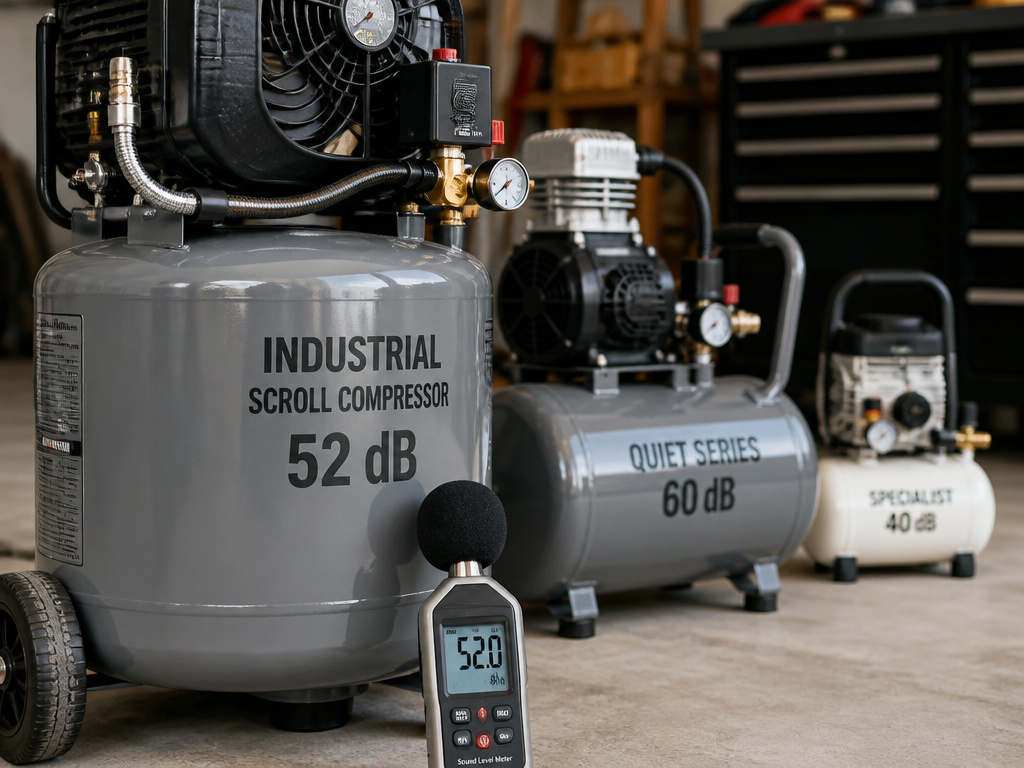
Matching a compressor’s noise rating to your actual environment requires knowing what those numbers sound like. Here’s how the top quiet models break down.
Under 50 dB(A): The Specialist Tier
- Newport ACGP-02 (30 dB): The record holder. For micro-airflow applications only.
- Medical/Dental Scroll Compressors: Many niche units from brands like Jun-Air operate in the 40-48 dB range. They are expensive, specialized, and designed to run continuously next to a patient.
50-60 dB(A): The Premium Shop Tier
This is the sweet spot for a serious quiet air compressor that can power real tools without driving you out of the room.
- Powerex SES1518 (51 dB): A 5-HP, 13-gallon tank scroll unit. This is a professional-grade machine that delivers clean, oil-free air at a sound level quieter than a normal conversation. It’s the benchmark for a full-capacity workshop air compressor where noise matters.
- Atlas Copco SF 1+ (52 dB): A 2-HP scroll compressor delivering 6.1 CFM at 8 bar. Its performance is certified to ISO 1217 and its noise to ISO 2151. This is what industrial quiet looks like, verified, reliable, and built for years of service.
- Chicago Pneumatic SPR 2 (53 dB): A 1.5-HP scroll compressor delivering 100% oil-free air certified to ISO 8573-1 Class 0. It’s a compact, vertical-design unit perfect for a compressor for your garage where floor space and clean air are priorities.
60-70 dB(A): The “Quiet” Homeowner Tier
Most compressors marketed as “quiet” or “ultra-quiet” fall here. They are almost exclusively improved piston designs.
- California Air Tools 8010A (60 dB): An 8-gallon, oil-free piston model. It uses a dual-piston design and a low-RPM motor to dampen noise. It’s a great compressor for airbrushing and light finishing work.
- Makita MAC210Q (60 dB): A 2-gallon “quiet series” piston compressor with a full roll cage. It’s a rugged, portable option for job-site finish work where 60 dB is a major improvement over a standard 78 dB compressor.
Common mistake: Buying a 60 dB piston compressor expecting it to be silent. At 60 dB, you can have a normal conversation next to it, but it’s still clearly audible. It’s a good neighbor, not an invisible one.
Four Factors Beyond the dB Rating
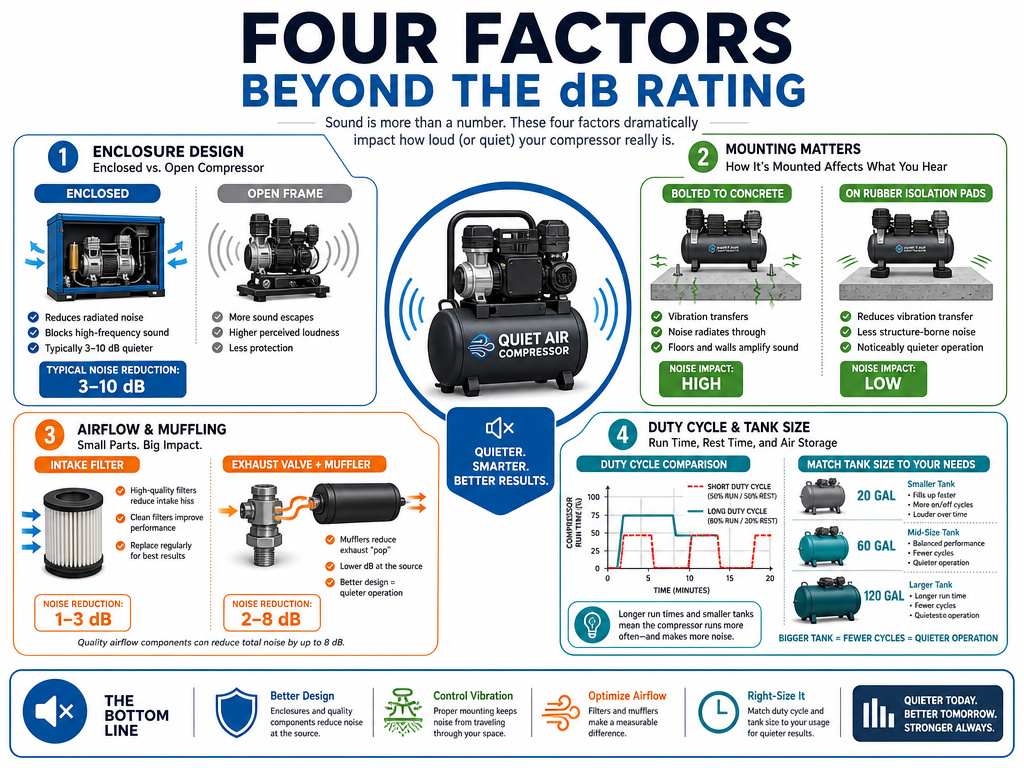
The published decibel number is the starting point, not the finish line. These four elements determine how disruptive a compressor will actually be.
- The Enclosure: A fully enclosed compressor (like the Powerex) traps noise internally. A pancake or hot-dog compressor broadcasts it in all directions. An enclosure can cut perceived noise by 5-10 dB.
- The Mounting: Bolting a compressor directly to concrete transmits vibration noise throughout a building. Isolate it with rubber vibration pads or a suspended platform. This is often more effective than an aftermarket air compressor silencer on the intake.
- The Intake & Exhaust: The suction of air at the intake filter and the blast from the pressure release valve are distinct noise sources. Some high-end models have specially designed mufflers on both.
- The Duty Cycle: A compressor that runs for 30 seconds every 10 minutes is less annoying than one that runs for 4 minutes every 5. A larger tank reduces how often the motor kicks on, which can make a slightly louder compressor less intrusive overall.
For a painting compressor or spray gun compressor, where the tool itself is often louder than the compressor, a mid-tier quiet model is sufficient. For a compressor living in an attached garage beneath a bedroom, invest in the lowest dB you can afford and prioritize isolation.
Frequently Asked Questions
Is a 50 dB compressor twice as quiet as a 60 dB compressor?
No, it’s half as loud. The decibel scale is logarithmic. A 10 dB increase represents a doubling of perceived loudness. Therefore, a 60 dB compressor sounds twice as loud as a 50 dB compressor, and a 70 dB compressor sounds four times as loud as a 50 dB model.
Can I make my existing compressor quieter?
You can reduce it, not transform it. Start with anti-vibration pads under the feet. Build a simple sound-dampening enclosure with ventilation (never seal it completely). Ensure all fittings are tight to eliminate air leak hiss. For the intake, you can install an aftermarket compressor noise silencer. These steps might net you a 3-8 dB reduction, which is noticeable but won’t turn a 80 dB piston into a 60 dB scroll.
Are “oil-free” compressors quieter?
Not inherently. “Oil-free” refers to the pump lubrication (teflon-coated parts instead of oil), not the noise profile. However, most modern oil-free scroll compressors are also designed for quiet operation, so the two features often coincide. A cheap oil-free piston compressor can still be very loud.
What’s a reasonable quiet compressor for a home garage?
For most homeowners, a model in the 58-65 dB(A) range offers the best balance of power, price, and quiet operation. The California Air Tools 8010A (60 dB, 8-gallon) or a Harbor Freight compressor from their “Fortress” quiet series are typical starting points. They’re quiet enough for weekend projects without annoying the household.
Why are some compressors so much more expensive for just a few decibels less?
Engineering silence is expensive. Scroll mechanisms are precision-machined from costly alloys. Sound-dampening enclosures add material and complexity. Low-vibration, high-efficiency IE3 motors cost more than standard ones. You’re paying for advanced materials, tighter manufacturing tolerances, and third-party certification to standards like ISO 2151.
The Bottom Line
The quest for the quietest air compressor ends with a simple rule: trust the number, not the label. Insist on a dB(A) rating measured at 1 meter per a known standard. For lab-silent operation under 50 dB, your choices are limited and expensive. For a truly quiet compressor for your shop that can handle real work, invest in an oil-free scroll compressor from a brand like Atlas Copco or Chicago Pneumatic. For the budget-conscious homeowner, a modern “quiet series” piston compressor around 60 dB will be a dramatic and welcome improvement over the roar of a standard model. Your ears, and your neighbors, will thank you.
