
A Guide on How to Drill Hardened Steel Using Cobalt Bits
This post contains affiliate links. As an Amazon Associate, we earn from qualifying purchases.
To drill hardened steel, you need a carbide drill or an 8% cobalt HSS drill, a rigid machine, and a 75% reduction in spindle speed versus mild steel. The exact settings depend on the steel’s hardness: for Hardox 500 (450-540 HBW), target 35-50 meters per minute cutting speed with a feed of 0.06-0.10 mm per revolution for a 10mm drill. The most common point of tool failure is breakthrough shock, which snaps carbide tips if feed isn’t reduced by 40-50% just before the hole exits.
That speed reduction is a physical limit. Carbide has low thermal conductivity; running it at mild-steel RPMs in hardened material generates friction heat above 800°C.The tool doesn’t cut—it thermally self-destructs. This is why shops that get it right use flood coolant at slow speeds to enable cutting, not just to clear chips.
What follows is the data sheet most articles skip: the OEM-recommended 8-12% coolant mix, the 20% feed reduction for deep holes, the single grade of HSS that works up to 500 Brinell, and the one-second pause that saves a $300 drill. We’ll walk through machine selection, the two viable drill types, and the exact numbers for common Hardox grades.
Key Takeaways
- Use solid carbide drills for any Hardox grade above 500 Brinell or for precision holes. HSS with 8% cobalt (HSS Co) works only up to 500 Brinell and only in a pinch.
- Cut your spindle speed by roughly 75%. If you’d run mild steel at 1000 RPM, start at 250 RPM for hardened material. Target 100-130 surface feet per minute (SFM).
- Reduce feed by 20% for holes 7x the drill diameter deep, and by 40-50% just before breakthrough to prevent the shock that snaps carbide.
- Flood coolant is non-negotiable. Mix at 8-12% concentration. It cools the tool and prevents work-hardening of the steel.
- Handheld drills will fail. You need a rigid, powered machine like a drill press, magnetic drill, or CNC mill to maintain the precise, steady pressure required.
The Two Drill Types That Actually Work
The wrong bit turns a $50 plate into scrap. The right one makes the hole. For hardened steels like Hardox, AR400, or any material over 400 Brinell, you have exactly two legitimate choices.
Solid cemented carbide drills are the first pick. The manufacturer SSAB calls them the “optimum choice” for all Hardox wear plate grades when used in a stable machine. Carbide’s hardness exceeds that of the steel, so it shears the material instead of deforming. But it’s brittle. Any vibration, chatter, or uneven feed pressure will chip the cutting edge instantly. That’s why machine rigidity isn’t just helpful—it’s the condition that makes carbide viable.
Solid cemented carbide drills are the optimum choice for drilling into all Hardox® wear plate grades when used in a stable and powerful machine with good clamping facilities. — SSAB Technical Support
Your second option is a high-speed steel drill with 8% cobalt (HSS Co). This is the exception to the “no HSS” rule. The cobalt increases hot hardness, allowing the bit to retain its edge at the high temperatures generated. However, SSAB explicitly limits its use: HSS Co drills are only suitable up to 500 Brinell and are recommended only when machine conditions are unstable. Think of it as a fallback for a worn drill press or a job-site magnetic drill where absolute rigidity isn’t guaranteed. You’ll get a few holes before it needs resharpening.
What about standard HSS or black oxide bits? They’ll skate on the surface, work-harden the steel, and blunt in seconds. For a detailed breakdown of bit materials, see our guide on the strongest drill bits.
| Drill Type | Best For Hardness | Machine Requirement | Real-World Outcome |
|---|---|---|---|
| Solid Carbide | All grades, especially Hardox 550+ (525+ HBW) | High rigidity, high power, internal coolant | Clean, precise holes. Shatters on breakthrough if feed isn’t managed. |
| HSS Co (8% Cobalt) | Up to 500 Brinell (e.g., Hardox 500) | Tolerates some instability, lower power | Gets the job done in a pinch. Limited hole count before regrind. |
| Standard HSS | Under 400 Brinell (mild steel) | Any machine | Will not cut. Glazes the surface and destroys itself. |
Machine and Setup: Where Handhelds Fail
A handheld drill lacks the rigidity, power, and control to drill hardened steel. The human arm is a spring, not a vise. Any side-to-side movement chips a carbide edge, and you cannot maintain the constant, firm feed pressure required.
You need a machine that locks the tool and workpiece in a fixed relationship. A heavy-duty drill press with a quality chuck is the minimum for shop work. A magnetic drill press (mag drill) is the professional’s choice for plate steel, as it clamps directly to the workpiece. For the highest precision and deepest holes, a CNC milling machine is ideal.
The checklist before you power on: 1. Secure the workpiece. Use clamps, a vise, or the magnet itself. Any movement translates to broken tools. 2. Use a sharp, new bit. Never attempt this with a used or questionable drill. Start fresh. 3. Set up flood coolant. If your machine has internal coolant, use it. If not, use an external pump or brush coolant on generously. The mix should be 8-12% concentration. 4. Check runout. A wobbly drill in a worn chuck will break immediately. For more on the fundamentals, review our general metal drilling guide.
Speed, Feed, and the 20% Rule
This is where guesses cost money. The numbers for hardened steel are not intuitive. You must slow down dramatically.
For hardened material around 50 HRC, target 100-130 Surface Feet per Minute (SFM). Compare that to 200-300 SFM for mild steel. This means reducing your spindle speed by approximately 75%.
Example: For a 1/2″ (12.7mm) drill in mild steel, you might run 1000 RPM. For hardened steel, start at 250 RPM.
Feed rate is just as critical. You need enough pressure to make a chip, but not so much that you overload the tool. For Hardox 500, SSAB recommends a feed per revolution (fn) of 0.06-0.10 mm/rev for a 10mm drill. That’s a slow, steady push.
Now for the specific modifiers from the OEM data that most people miss: * For deep holes (7x the drill diameter): Reduce the feed rate by 20%. * When using only external coolant: Reduce both spindle speed and feed rate by 20%.
Where this goes sideways: Assuming “slow” means “gentle.” Too light a feed lets the drill rub instead of cut, generating extreme heat and work-hardening the steel right under your tool. Commit to the feed pressure.
The Breakthrough Shock That Breaks Tools
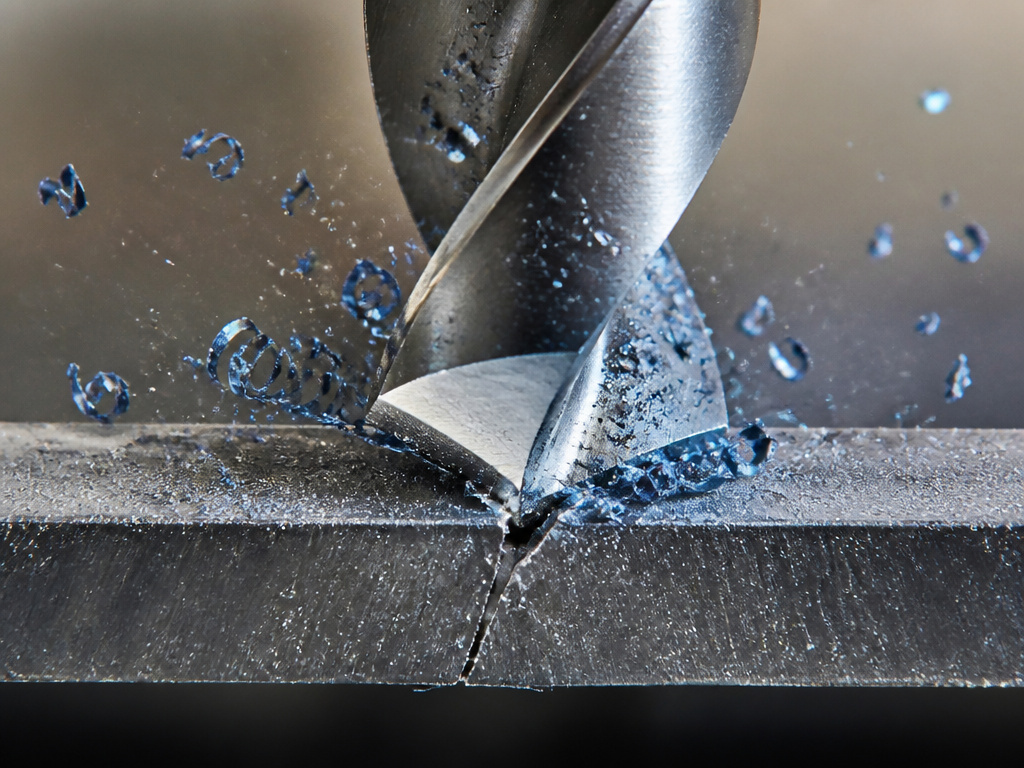 You’ve followed every step. The drill is humming, chips are flowing, and you’re 90% through the hole. This is the moment you lose the tool.
Breakthrough shock is the single most common point of carbide drill failure in hardened forgings. As the drill’s tip exits the material, the remaining thin web of steel deflects slightly, then snaps. This sudden release of pressure creates a shock load that snaps the carbide tip right off.
The fix is a two-part maneuver: 1. Reduce feed by 40-50% in the last 1-2mm of material before breakthrough. 2. Disengage the feed entirely for about one second as the tip exits, allowing for any springback in the material, then re-engage to finish the hole.
On a manual machine, this means easing up on the feed lever at the very end. On a CNC, you program a feed reduction at the drill’s break-through depth. This one habit will triple your tool life on through-holes. For techniques on managing difficult materials, our steel drilling guide has related strategies.
Coolant: The 8-12% Mix That Isn’t Optional
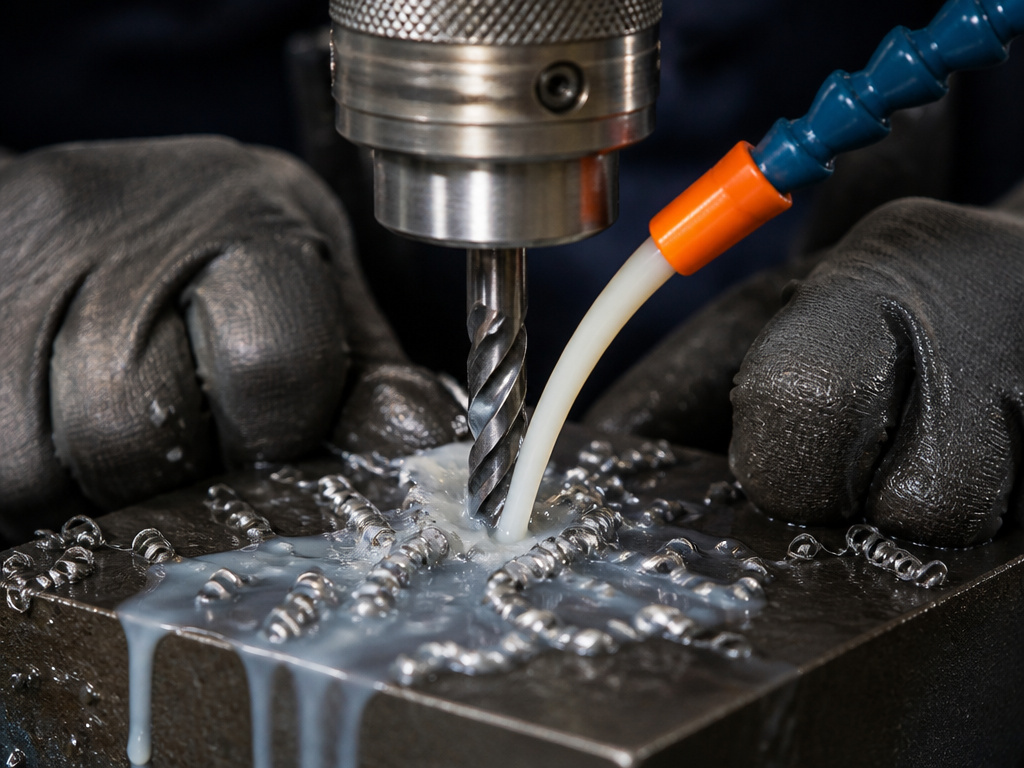 Coolant serves three vital jobs here: it cools the tool, lubricates the cut, and flushes chips. In hardened steel, skipping coolant guarantees failure.
The SSAB machining guide specifies an 8-12% coolant mix for solid cemented carbide drills. This is a properly mixed water-soluble oil or synthetic coolant at the right concentration. Too weak, and it doesn’t lubricate.Too strong, and it can leave a residue that interferes with the cut.
Flood it. The goal is to see a steady stream washing over the drill and exiting the hole, carrying away silver, curled chips. If the chips are turning blue, you’re too hot—increase coolant flow or reduce speed.
Problem → Cause → Fix
Even with perfect setup, things go wrong. Here’s how to diagnose the common failures.
| Problem | Likely Cause | Immediate Fix |
|---|---|---|
| Drill spins but doesn’t cut, just polishes the surface | Speed too high / Feed too light. The tool is rubbing, not cutting, and work-hardening the steel. | Stop. Reduce RPM by 25%. Increase feed pressure decisively on a fresh spot. |
| Drill breaks immediately on contact | Extreme runout or workpiece movement. The side load on the carbide tip is instant fracture. | Check and secure all clamps. Inspect drill chuck for wear. Use a shorter drill or a stiffer collet. |
| Drill makes progress then suddenly snaps | Breakthrough shock. The tip shattered on exit. | On the next hole, reduce feed 40-50% for the last 2mm of travel. |
| Hole is oversized or oval | Drill wandering on start or thin material flexing. Common on plate under 8mm thick. | Use a centering punch or a spot drill. For thin plate, back it with a scrap wood or metal block to prevent flex. |
| Chips are long, stringy, and discolored | Insufficient coolant or incorrect feed. | Increase coolant flow. Ensure feed rate is high enough to produce a controlled chip. |
Carbide vs. Cobalt vs. HSS: The Final Call
When you walk up to the toolbox, which bit do you grab? The choice cascades from the steel’s hardness and your machine.
- For Hardox 400, 450, or 500 on a rigid machine: Start with a solid carbide drill. A coated carbide like Guhring’s 5524 series with a TiAlN (FireX) coating handles the heat best. This is the performance choice.
- For the same steels on a less stable setup (old drill press, mag drill): Use an 8% cobalt (HSS Co) drill. Know you’ll sacrifice some hole quality and tool life. Understand the trade-offs with our cobalt vs carbide bits comparison.
- For Hardox 550, 600, or Extreme (57+ HRC): Carbide is your only option. HSS Co cannot handle it.
Annular cutters (mag drill bits) follow the same rule: carbide-tipped only. They excel at large-diameter holes in plate because they remove a slug, not chips, reducing required power. For a deep dive on bit geometry, see our article on 118 vs 135 degree bits.
The bottom line: If you can guarantee stability, buy carbide. If your setup is questionable, buy 8% cobalt HSS and accept the limits. Never buy standard HSS for this job.
Frequently Asked Questions
Can you drill hardened steel with a regular drill bit?
No. A standard high-speed steel (HSS) drill bit is softer than the hardened steel. It will not cut; it will dull immediately, overheat, and often work-harden the surface, making it even more difficult to drill. You need a carbide or 8% cobalt HSS bit. Learn more about HSS drill bits and their proper uses.
What is the best drill bit for hardened steel?
For most applications, a solid carbide drill bit is the best performer. For materials up to 500 Brinell (like Hardox 500), an 8% cobalt HSS drill bit is a viable, more affordable alternative, especially in less-than-perfect machine conditions. Our guide on drill bits for hardened metal breaks this down further.
How do you prevent drill bits from breaking when drilling hard metal?
The two biggest preventions are machine rigidity and managing breakthrough shock. Secure everything completely to eliminate vibration. Then, as the drill is about to exit the back of the material, reduce your feed pressure by 40-50% to prevent the sudden shock that snaps the tip.
Can you use a magnetic drill on hardened steel?
Yes, a magnetic drill press is an excellent tool for drilling hardened steel plate. Its rigid design and powerful motor are ideal. You must use a carbide-tipped annular cutter or a carbide twist drill in the chuck, and you must run it at the significantly reduced speeds required for the material.
What speed should I run when drilling hardened steel?
Aim for 100-130 Surface Feet per Minute (SFM). For a 1/2″ (12.7mm) drill, this translates to roughly 250-325 RPM. This is about a 75% reduction from typical mild steel speeds. Always start at the lower end of the range. The principles are similar but more critical than when drilling through steel of lower hardness.
Before You Go
Drilling hardened steel is a negotiation between hardness, heat, and pressure. You win with carbide, coolant, and brutally slow speeds. Remember the three numbers: 75% speed cut, 20% feed reduction for deep holes, and that critical 40-50% feed drop before breakthrough.
The machine matters as much as the bit. If your setup flexes, step down to 8% cobalt HSS and manage your expectations. This job requires precision, patience, and the OEM data sheet most people never read. Grab the right bit, set the numbers, and make the chip.
