How to Drill Through Metal: The Optimal Coolant Mix Guide
This post contains affiliate links. As an Amazon Associate, we earn from qualifying purchases.
To drill through metal, you need the right bit, slow speed, constant lubrication, and a rigid setup. Match the bit to the metal: HSS for soft metals like aluminum, cobalt (M35) for stainless steel and hardened alloys, and solid carbide or indexable inserts for abrasive wear plate like Hardox over 500 Brinell. Use an 8-12% coolant mix and disengage the feed for one second before breakthrough to prevent the drill tip from snapping.
That last spec—the 8-12% coolant mix and the one-second pause—isn’t a suggestion. It’s from the OEM machining guide for Hardox wear plate. Skip it on thick, hard stock and the drill doesn’t just wear out. It snaps flush with the surface because of material springback, leaving you with a broken tool extraction job.
What follows is the difference between making a hole and making a correct hole. We’ll walk through the seven physical steps, then break down the three variables that decide success or failure: bit material, machine setup, and the specific numbers for different metals.
Key Takeaways
- Use a center punch every time. A wandering start ruins hole alignment and dramatically increases the risk of bit breakage, especially with diameters over 10mm.
- Cobalt (M35) drill bits are the default for unknown or mixed metals. They bridge the gap between HSS and expensive carbide, handling everything from stainless steel to spring steel without work-hardening the material.
- Clamp everything. A workpiece that spins or vibrates produces an oval, undersized hole and can violently kick back.
- Lubricate or cool constantly. For hand drilling, use a paste like CUT-IT or tapping fluid. For machine drilling, an 8-12% soluble oil coolant mix is the OEM-recommended standard for materials like Hardox.
- Ease off before breakthrough. On hard or thin materials, reduce feed pressure or disengage the feed for about one second just before the bit exits to prevent the tip from catching and snapping.
The 7-Step Metal-Drilling Sequence for a Clean Hole
Follow these steps in order. Swapping sequence three and four is how you end up with a scored workpiece and a dull bit.
Step 1: Mark and Center-Punch
Your drill bit needs a physical detent to start in. A scribed line or pencil mark isn’t enough. Strike a center punch firmly on your mark to create a clear dimple.
Where this goes sideways: Skipping the center punch. The bit wanders on the hard surface, skating in a half-circle before biting. This not only misplaces the hole but work-hardens the starting spot, making it even tougher to drill. You’ll smell the burnt steel before the bit finally grabs.
Step 2: Secure the Workpiece
This is non-negotiable. Use a vise, C-clamps, or a dedicated fixture. The goal is zero movement. For thin sheet metal (under 8mm), use a “sacrificial sandwich”—clamp the sheet between two pieces of scrap wood. The wood supports the sheet, prevents bending, and contains the burr on breakthrough.
Step 3: Select and Install the Correct Bit
Refer to the drill bit selection guide below. For now, know that a general-purpose black oxide bit will fail on stainless steel. Install the bit tightly in the chuck, ensuring it’s straight.
Step 4: Apply Cutting Lubricant
Add lubrication to the hole and the bit before you start. For hand drilling, a paste or oil like Tap Magic works. For tougher metals or machine drilling, a proper cutting fluid or coolant is required. The SSAB guide for Hardox specifies a coolant mix of 8-12%.
Step 5: Set Low Speed and High Torque
Start slow. For a hand drill, use the low-speed setting. For a drill press, consult speed charts, but a good rule of thumb is half the speed you’d use for wood. High speed generates heat, which softens HSS bits and work-hardens stainless steel.
Step 6: Drill with Steady, Moderate Pressure
Start the drill and align the bit with your punch mark. Apply firm, steady pressure. Let the bit cut; don’t force it. For holes deeper than the bit’s flute length, periodically withdraw to clear chips.
Step 7: Deburr the Hole
When you break through, you’ll have a sharp, ragged edge called a burr. Remove it with a deburring tool, a file, or a larger drill bit turned by hand. This is a safety and finishing step.
TL;DR: Punch, clamp, lube, slow speed, steady pressure. The sequence is a physical law.
Drill Bit Selection: HSS, Cobalt, or Carbide?
The metal’s hardness decides the bit. Getting this wrong costs you bits and ruins workpieces.
| Bit Type | Best For | Hardness Limit | What Happens If You Use It Wrong |
|---|---|---|---|
| HSS (High-Speed Steel) | Aluminum, brass, copper, mild steel. | ~300 Brinell | The cutting edge rounds over, the bit overheats and turns blue, and it stops cutting. |
| Cobalt (M35 / 5-8% Co) | Stainless steel, cast iron, high-carbon steel, spring steel. The default for unknown hard metals. | ~500 Brinell | It will cut but wear rapidly, becoming expensive. On severe abrasives, it can fracture. |
| Solid Carbide / Indexable Insert | Hardened steel, Hardox wear plate (>500 Brinell), abrasive alloys. | 600+ Brinell | In a hand drill or unstable machine, it shatters. It requires absolute rigidity. |
A cobalt drill bit is the one to reach for if you drill different metals and want one set. The M35 grade (5-8% cobalt) retains its hardness at high temperatures better than HSS, which is why it can tackle stainless steel without immediately work-hardening it.
HSS bits are for soft metals and unstable conditions. The SSAB guide is explicit: “Use HSS drills only when you have unstable machine conditions.” For a hardened steel like Hardox 500, even cobalt struggles. There, you need the rigidity of a drill press and a carbide or indexable insert drill.
Speed, Feed, and Pressure: The Numbers Behind the Cut
Forget “go slow.” Specific metals demand specific speeds. Drilling cast iron dry requires a different approach than drilling aluminum, which gums up.
Cutting Speeds for Common Metals
These are starting ranges for HSS/Cobalt bits. Always prioritize lubrication and chip clearance.
- Aluminum & Soft Alloys: 200-300 Surface Feet per Minute (SFM). High speed, high feed to prevent material adhesion.
- Mild Steel: 80-120 SFM. Moderate speed, steady feed with oil.
- Stainless Steel: 30-60 SFM. Slow speed, constant feed with heavy lubricant to prevent work-hardening.
- Cast Iron: 50-80 SFM. Can often be drilled dry, but oil improves finish.
- Hardened Steel (e.g., Hardox 500): 10-30 SFM (3-5 m/min per SSAB). Very slow speed, mandatory coolant, reduced feed before breakthrough.
Just before the drill breaks through, disengage the feed rate for about a second, play/springback can otherwise snap the drill tip. Re-engage the feed rate when the play/springback has ceased. This direct quote from the SSAB Hardox machining guide addresses the #1 cause of broken bits in hard materials: the material flexes, pinching the drill’s cutting lips.
The Pilot Hole Rule
For large holes (over 1/4″ or 6mm), drill a pilot hole first. It guides the larger bit, reduces required thrust, and improves accuracy. For specialized tools like the Guhring RT 100T deep-hole drill, the pilot hole is a strict requirement. Their procedure mandates a pilot hole 1.5 to 3 times the drill’s diameter deep, entered at only 300 RPM.
Advanced Techniques for Problem Metals
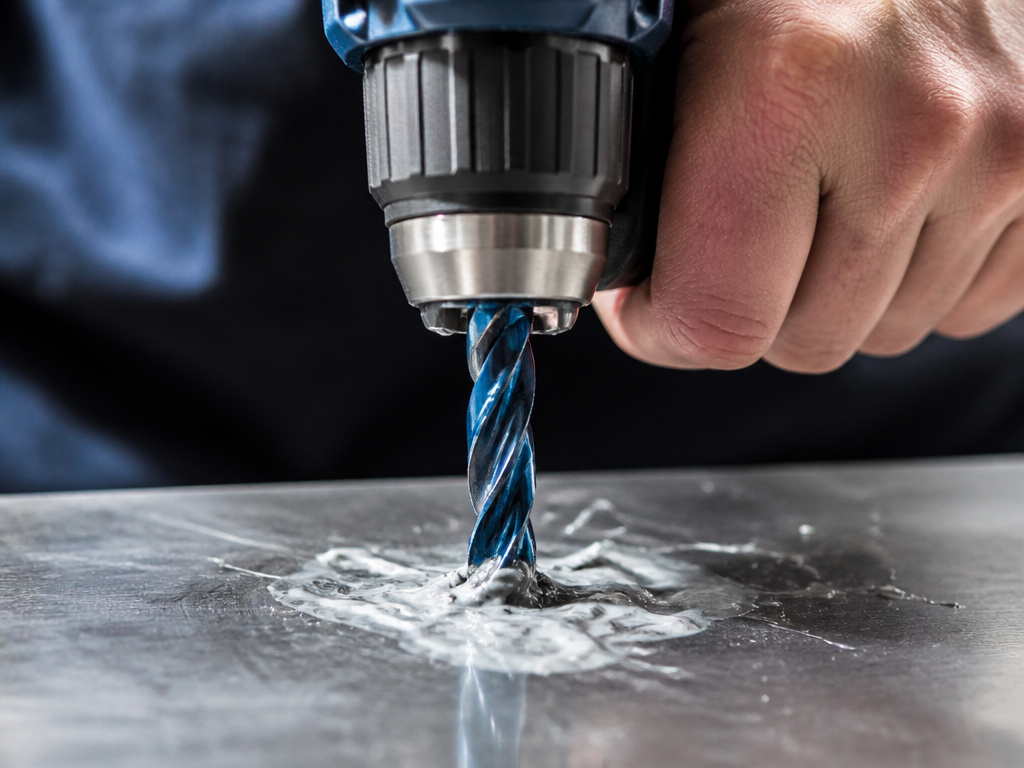 Some metals break the standard rules. Here’s how to handle them.
Drilling Stainless Steel Without Work-Hardening
Stainless steel is the classic trap. Push too slow without enough pressure, and you glaze the surface. Push too fast, and you overheat it.
- Use a sharp cobalt bit.
- Apply a generous amount of cutting paste (like CUT-IT) or sulfurized oil.
- Set a low RPM (around 500 for a 1/8″ bit).
- Apply firm, unwavering pressure. Do not let the bit rub. If you see the metal turning blue or straw-colored, you’ve already hardened it. Stop, move to a new spot, and increase your feed pressure.
Drilling Thin Sheet Metal
The enemy here is tear-out and bending. The sacrificial sandwich (wood-metal-wood) is your best friend. For holes over 10mm, SSAB advises supporting the bottom plate with metal. Without it, the drill tip can deform the sheet on exit, creating an oval and undersized hole.
Drilling Hardened Steel or Armor Plate
This is machine territory. For materials like Hardox 500 Tuf (500 Brinell), you need: * A rigid drill press or mill. * A solid carbide or indexable insert drill. * Flood coolant at an 8-12% concentration. * The precise feed/speed data from the manufacturer’s chart (e.g., 0.12 mm/rev feed for a 15mm bit). * The “disengage feed before breakthrough” technique.
The Tool Setup: Rigidity is Everything
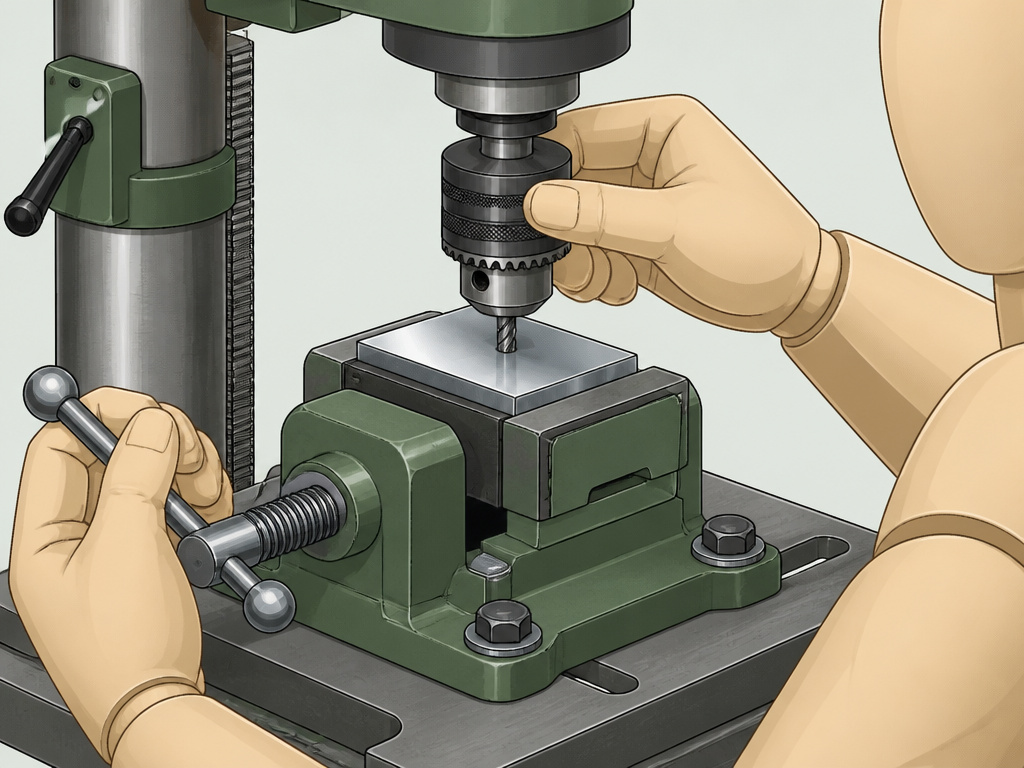 A wobbling drill or a vibrating workpiece absorbs cutting energy, dulling bits and ruining holes. Here’s how to lock it down.
- Use the shortest bit possible. Longer bits flex. For deep holes, start with a short bit for the pilot, then switch to a longer one.
- Minimize overhang. On a drill press, keep the bit as close to the chuck as the job allows.
- Solid table, solid vise. A flimsy workbench magnifies vibration. Bolt your drill press down or weight the bench.
- Check spindle play. An old drill press with a wobbly spindle cannot drill hard metal accurately. That’s when you default to HSS bits, as the SSAB guide suggests for unstable conditions.
Common mistake: Using a long, skinny bit in a hand drill for a 1/2″ hole in steel. The bit deflects, the hole bell-mouths, the bit binds and snaps, or your wrist gets a nasty jerk. Step up in sizes with shorter bits.
Frequently Asked Questions
What is the best drill bit for drilling through metal?
For a versatile set that handles most common metals, including stainless steel, cobalt (M35) drill bits are the best choice. They are more heat-resistant than standard HSS bits. For soft metals like aluminum, HSS bits work perfectly and are less expensive.
Can you drill metal with a regular cordless drill?
Yes, you can drill metal with a cordless drill, but you must use the correct bit (cobalt for hard metals), set it to the low-speed/high-torque setting, apply cutting fluid, and secure the workpiece firmly. It is ideal for holes up to about 1/4″ in thickness. For thicker or harder metals, a drill press is better.
Why does my drill bit keep getting stuck or breaking in metal?
The two most common reasons are lack of lubrication and incorrect feed pressure. Without lube, heat builds up, welding chips to the bit and seizing it. With too little pressure, the bit rubs and work-hardens the metal; with too much, especially on breakthrough, it can catch and snap. Using a dull bit or the wrong bit type also causes this.
Do I really need to use cutting oil or paste?
Yes, especially for anything harder than mild steel. Cutting fluid does three things: it cools the bit, lubricates the cut to reduce friction, and helps flush metal chips out of the hole. Drilling dry drastically shortens bit life and increases the risk of breaking a bit.
How do I drill a straight hole in metal without a drill press?
It is very difficult. Your best bet is to use a hand drill guide or a portable drill stand that clamps to the workpiece. These fixtures provide the necessary rigidity and perpendicular alignment that your hands cannot. Always start with a well-defined center punch mark.
What should I do if I break a drill bit off in the metal?
First, try not to. If it happens, stop immediately. For a broken drill bit protruding, you can sometimes grip it with locking pliers and rotate it counter-clockwise to back it out. If it’s flush or below, you’ll need a specialized screw extractor or, in a worst-case scenario, an EDM (electrical discharge machining) service. This is why the breakthrough technique is critical.
Before You Go
Drilling metal cleanly isn’t about strength. It’s about matching three things: the bit’s material to the metal’s hardness, the machine’s rigidity to the bit’s requirements, and your technique to the physics of the cut. The specifics matter—the 8-12% coolant, the one-second pause before breakthrough, the mandatory pilot hole for deep drills.
For most home shops, a set of M35 cobalt bits and a bottle of good cutting fluid will solve 90% of problems. When you encounter something like Hardox, check the OEM data. The numbers are there to prevent the snap.
