What Is a Step Drill Bit & How Does Its Unique Design Work?
This post contains affiliate links. As an Amazon Associate, we earn from qualifying purchases.
A step drill bit is a cone-shaped cutting tool with graduated, stair-like steps. Each step corresponds to a specific hole diameter, allowing you to drill or enlarge a hole to an exact size in thin sheet metal, plastic, or wood without changing bits. Its defining spec is a maximum material thickness, often 3/8″ for mild steel, beyond which the bit binds or breaks.
That 3/8-inch capacity isn’t a suggestion. It’s the physical limit of the flute design. Go thicker, and the chips have nowhere to go. The bit jams, the motor stalls, and the hardened steel edges micro-fracture. You won’t see the damage until the next cut tears the material instead of slicing it.
What follows is the spec sheet the box doesn’t include: the difference between multi-hole and single-hole bits, the two coatings that actually matter, and the exact RPM where vibration takes over. By the end, you’ll know whether a step bit belongs in your kit or if a hole saw is the right tool for the job.
Key Takeaways
- Step bits excel in thin materials, sheet metal, electrical boxes, plastic tubing. Their 3/8-inch capacity for mild steel is a hard limit, not a target.
- Aluminum Titanium Nitride (AlTiN) or Titanium Nitride (TiN) coatings aren’t just for color. They reduce heat and can make a bit last up to ten times longer than a plain steel oxide finish.
- Speed kills step bits. For bits 7/8″ and under, keep the drill at 650 RPM or lower. For larger diameters, drop to 470 RPM. High speed generates instant heat that softens the cutting edge.
- A step bit is not a hole saw. Use a step bit for precision holes up to 1-3/8″ in thin stock. Use a hole saw for thicker material or larger diameters.
- Always use cutting fluid on metal. A few drops of oil dramatically reduce heat, prevent chip welding, and preserve the bit’s sharpness.
The Anatomy of a Step Drill Bit
Look past the cone shape. The functional parts are the tip, the steps, the flutes, and the shank. A split-point tip is non-negotiable. This centered, self-starting point eliminates “walking” on curved surfaces like conduit. You don’t need a pilot hole.
The split-point tip on an ITM Kwik Stepper® penetrates faster and resists skidding on round surfaces, according to the manufacturer’s datasheet. This design requires less pressure and lets the bit’s balanced double-flute construction do the work.
Each step is a cutting edge with a specific diameter laser-etched onto it. The flutes are the spiral channels that evacuate chips. Straight flutes, like on the Klein Tools KTSB series, provide cleaner cuts in sheet metal. Spiral flutes, like on the IDEAL 36-705, pull the bit through the material faster but can leave a slightly rougher edge on thin gauge steel.
The shank must match your tool. A 1/4-inch hex shank fits impact drivers and standard drill chucks, the Klein QRST series uses this. A 3/8-inch hex shank, like on the Klein KTSB line, is for standard drills only. Using an impact-rated bit in a drill is fine. Using a non-impact bit in an impact driver snaps the shank on the third trigger pull.
What Is a Step Drill Bit Used For? (And What It’s Not For)
A step bit’s job is making clean, burr-minimized holes in thin, non-structural materials. Its primary applications are electrical work, HVAC, plumbing, and light fabrication.
- Electrical: Enlarging knockouts in metal boxes, drilling conduit holes in panels.
- HVAC: Creating holes for ducting, venting, or refrigerant lines in thin sheet metal.
- Plumbing: Drilling holes for pipes in PVC, acrylic, or thin stainless sinks.
- General DIY: Installing locksets in hollow metal doors, making cable pass-throughs in desks or shelves.
Common mistake: Using a step bit on material thicker than its rated capacity. The ITM Kwik Stepper® is rated for 3/8-inch (9.5 mm) mild steel. Drilling into 1/2-inch plate steel will bind the bit, overheat it, and dull the cutting edges permanently.
It is not for structural steel, concrete, brick, or hardwoods. It is not a replacement for a hole saw when you need a deep, clean hole in thick material. It is also distinct from a Forstner drill bit, which is for flat-bottomed, precise holes in wood. Understanding these boundaries is part of a broader guide to selecting the correct drill bit for any material.
Decoding the Spec Sheet: Capacity, Coating, and Speed
Manufacturer datasheets contain the numbers that prevent broken tools. Ignore the marketing; focus on three specs.
Material Capacity and Thickness
This is the most misunderstood number. A bit that says “1-3/8″ diameter” does not mean it can drill through 1-3/8″ of steel. The diameter is the hole size it can create. The capacity or maximum material thickness is how deep it can cut.
| Brand & Series | Max Hole Diameter | Rated Material Thickness (Mild Steel) | Source |
|---|---|---|---|
| ITM Kwik Stepper® | 1-3/8″ (34.9 mm) | 3/8″ (9.5 mm) | ITM Datasheet |
| Klein Tools QRST/KTSB | 1-3/8″ (34.9 mm) | Up to 16 gauge (~0.06″ or 1.5 mm) | Klein Sellsheet |
| IDEAL Spiral Step | 1-3/8″ (34.9 mm) | Up to 8 gauge (~0.16″ or 4 mm) | IDEAL Datasheet |
The takeaway: even a large-diameter step bit is for sheet metal. Trying to drill a 1-inch hole through a 1-inch block of aluminum is a recipe for disaster. For that, you need a different drill bit purpose entirely.
Coatings: AlTiN vs. Titanium Nitride vs. Oxide
The coating manages heat, and heat is what destroys tool edges.
- Steam Oxide (Black Oxide): The basic finish. It provides some corrosion resistance and reduces friction slightly. It’s the first to wear off.
- Titanium Nitride (TiN): The gold coating. It’s harder and slickser than oxide, reducing heat and extending life. IDEAL uses this on their spiral bits.
- Aluminum Titanium Nitride (AlTiN): The dark gray or bronze coating. Klein Tools claims it’s “10x more durable than steamed black oxide.” It withstands higher temperatures, making it ideal for harder metals or longer drilling sessions.
Choose AlTiN or TiN for any serious metalwork. The upgrade cost is minor compared to replacing a dulled bit.
The Critical RPM Limit
Speed generates heat at the cutting edge. Too much RPM softens the hardened steel.
For optimal performance, IDEAL recommends 650 RPM for step bits 7/8″ and under, and 470 RPM for bits larger than 7/8″. Exceeding this causes vibration, poor finish, and rapid wear.
This is why cordless drill triggers are dangerous. Start slow. Let the cutting edges engage. If you’re using an impact driver with a hex-shank step bit, use short, controlled bursts. The hammering action can help in thin metal, but it’s brutal on the bit.
How to Use a Step Drill Bit Correctly
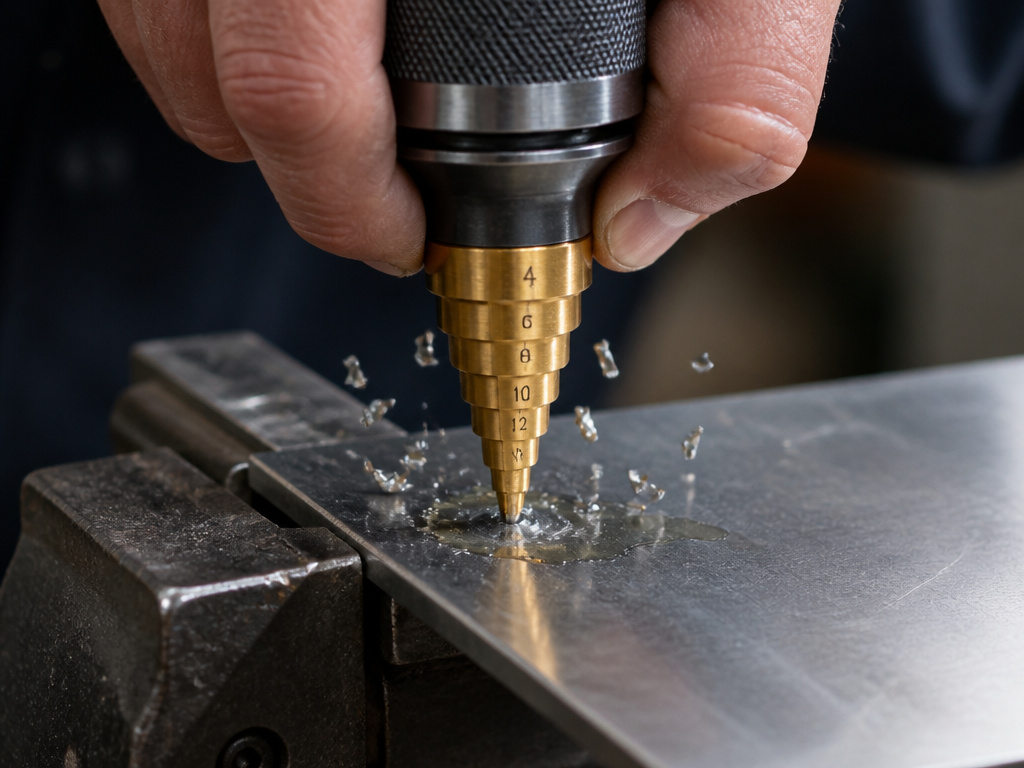
The proper technique is straightforward, but skipping one step ruins the hole.
- Secure the workpiece. Clamp thin metal or plastic. If it spins, it will grab the bit and tear.
- Mark the center. Use a center punch on metal to give the split-point a dimple to seat into.
- Apply cutting fluid. For metal, always. A few drops of oil on the first step dramatically reduces heat and prevents chips from welding to the flutes.
- Start at the lowest speed. Align the drill perpendicular to the surface. Apply firm, steady pressure.
- Progress through the steps. Drill until the first step clears through the material. Stop, pull the bit out to clear chips, add more oil, then proceed to the next step. Do not try to skip steps.
- Deburr the hole. The back side will have a slight burr. Use a deburring tool or a larger drill bit by hand to clean it up.
Where this goes sideways: Not clearing chips. The flutes pack with metal shavings, friction spikes, and the bit snaps. Clear the chips after every step, especially in aluminum.
Step Bit vs. Hole Saw vs. Forstner Bit: Which to Use?
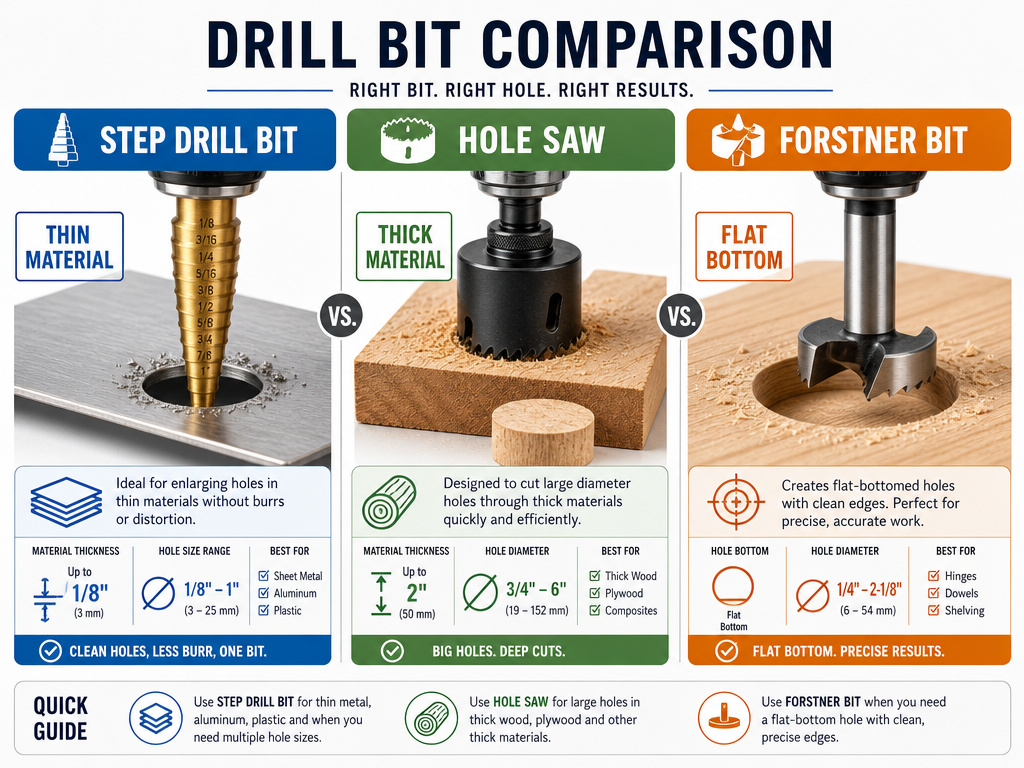
These three tools make large holes, but they are not interchangeable. Picking the wrong one wastes time and ruins material.
| Tool | Best For | Material Thickness | Key Limitation |
|---|---|---|---|
| Step Drill Bit | Precise, burr-free holes in thin sheet metal, plastic, electrical boxes. | Thin (up to ~3/8″) | Very limited depth. Cannot drill blind holes. |
| Hole Saw | Large-diameter holes (1″ to 6″) in wood, plastic, thicker metal, drywall. | Medium to Thick | Requires a pilot bit, can wander, produces a plug of waste material. |
| Forstner Bit | Flat-bottomed, precise, clean holes in wood for hinges, dowels, or millwork. | Thick Wood | Requires a powerful drill press for best results, slower cutting. |
- Need a 2″ hole through a 2×4? Use a hole saw.
- Need a perfectly flat-bottomed 3/4″ hole for a cabinet hinge? That’s a job for a Forstner bit.
- Need a clean 7/8″ hole in a 16-gauge steel electrical panel? A step bit is the only correct choice.
Similarly, if you need a perfectly centered pilot hole in wood, a brad point bit is superior. And if you’re recessing a screw head, that’s the specific uses for step drill bits of a countersink bit.
Choosing the Right Step Drill Bit: A Buyer’s Guide
Don’t buy a single bit. Buy a small kit that covers the common sizes you’ll need. The goal is to have the right diameter without buying ten individual bits.
For general electrical and DIY work, a kit covering 1/4″ to 1-1/8″ handles 95% of tasks. The Klein Tools QRST3PC kit (with QRST01, QRST03, QRST14 bits) is a robust all-purpose set. Its AlTiN coating and hex shank make it versatile for impact drivers and drills.
For a shop focused on metal fabrication, the IDEAL 36-700 4-piece spiral step bit kit offers a wider range and their faster spiral flute design. The Titanium Nitride coating is effective for production work.
Skip the bargain-bin, no-name bits. The steel is softer, the steps are inaccurately sized, and the coatings peel after the first use. A good step bit is an investment that pays off in clean holes and time saved.
What about a left-hand drill bit? That’s a specialized tool for extracting broken fasteners, a completely different primary applications set.
Frequently Asked Questions
Can a step drill bit be sharpened?
Technically yes, practically no. Sharpening the complex stepped geometry requires a specialized fixture and a skilled hand. For the cost of a new bit versus the time and effort, replacement is almost always the economical choice. A dull bit tears metal instead of cutting it.
Why does my step bit squeal and smoke?
You are running it too fast without lubrication. The friction is overheating the cutting edge and the material. Stop immediately. Apply cutting oil and reduce your drill speed by half. The squeal is the sound of the bit dulling itself in real time.
Can I use a step bit in an impact driver?
Only if the shank is a 1/4-inch hex and the packaging states it is impact-rated. The Klein QRST series is designed for this. The hammering action can be beneficial in thin metal, but it increases wear. For best results and bit life, use a standard drill at the correct RPM.
What’s the difference between single-hole and multi-hole step bits?
Single-hole bit is designed to drill one specific final diameter (like 3/4″) through a series of steps. A multi-hole bit, the most common type, allows you to stop at any step to create multiple hole sizes with one tool. Always check the size chart on the bit or packaging.
How do I prevent the bit from binding in metal?
Binding is caused by excessive feed pressure, dull edges, or clogged flutes. Use steady, moderate pressure, let the bit cut. Clear chips after every step. And never force it past its rated material thickness. If it binds, reverse the drill direction to break the chip and back it out.
Before You Go
A step drill bit is a specialist. It solves a specific problem, making clean, sized holes in thin material, exceptionally well. Its value is in precision and speed for electrical boxes, sheet metal, and plastic. Remember the three rules: respect the 3/8-inch capacity, never run it above 650 RPM, and always use cutting oil on metal.
For your first set, get a mid-range kit like the Klein QRST3PC or the IDEAL 36-700. It will cover most tasks and last for years. Keep it for the jobs it’s built for, and reach for a hole saw or a Forstner bit technique when the material gets thick. That’s how you get clean holes every time, without the broken tools.
