What Are Black Oxide Drill Bits Used For? Key Applications
This post contains affiliate links. As an Amazon Associate, we earn from qualifying purchases.
Black oxide drill bits are high-speed steel (HSS) bits with a thin chemical coating used for drilling wood, plastic, PVC, and non-ferrous metals like aluminum and brass. They last about 50% longer than bare HSS bits by reducing friction and resisting rust, but the coating is only 5 to 10 millionths of an inch thick and wears off where it contacts material. For stainless steel or hardened alloys, you need cobalt.
That thin layer is the whole game. It’s not armor plating; it’s a surface treatment that changes how the steel interacts with heat and chips. The coating works until it’s gone, which happens first at the cutting edges and flutes.
What follows is a breakdown of where that coating pays off, where it fails, and the two model lines that get the details right. By the end, you’ll know exactly when to pull a black oxide bit from the case and when to leave it there.
Key Takeaways
- Black oxide is a surface treatment, not a through-hardened alloy like cobalt. It adds lubricity and rust resistance but wears off with use.
- Use them for wood, plastic, PVC, and soft metals (aluminum, brass, copper). Never for stainless steel, cast iron, or hardened steel.
- The coating is only 5–10 millionths of an inch thick. A few sharpenings will remove it from the tip, eliminating its rust protection there.
- “Hot process” black oxide is standard for quality bits; “cold process” coatings can be scratched off with a coin and offer almost no durability.
- For general-purpose drilling in the materials they’re meant for, a set like the Milwaukee Thunderbolt or Bosch Impact Tough offers the best balance of performance and value.
What Is Black Oxide, Really?
Black oxide isn’t a plating or a paint. It’s a magnetite (Fe₃O₄) layer created through a chemical conversion process. The steel is submerged in a hot, alkaline salt bath at around 285°F, which reacts with the iron at the surface to form iron oxide.
This process changes the steel’s surface properties without adding measurable thickness. That’s critical for a cutting tool.
The part nobody mentions: A proper hot-process black oxide coating adds only 5 to 10 millionths of an inch to the steel. That’s why a sharpened bit still fits the same hole size, the coating is functionally a colored alteration of the top layer, not an added layer.
Cold-process black oxide exists. It happens at room temperature and doesn’t create a true oxide layer. You can scratch it off with a coin. Any drill bit coated this way will lose its finish, and its benefits, the first time it touches material. Assume any quality bit from a brand like Milwaukee or Bosch uses the hot process.
The coating’s jobs are simple: reduce friction, resist rust, and reduce light glare. Friction reduction means less heat, which means the bit stays sharper longer when drilling abrasive materials like wood or plastic. Rust resistance matters in a humid garage. The non-reflective finish is a side benefit.
What Materials Can You Drill With Black Oxide Bits?
Black oxide bits are general-purpose workhorses for softer materials. They are not for hard metals.
| Material | Suitability | Notes & Limits |
|---|---|---|
| Wood (All Types) | Excellent | The coating reduces pitch and sap buildup in the flutes. Best for repetitive hole-making in framing, decking, and furniture. |
| Plastics (PVC, Acrylic, ABS) | Excellent | Low friction prevents melting and gumming. The parabolic flute on bits like the Milwaukee Thunderbolt clears long, stringy chips fast. |
| Aluminum | Good | Use a cutting fluid. The soft metal can gall and clog flutes; the black oxide’s lubricity helps. Keep speed moderate. |
| Brass & Copper | Good | Similar to aluminum. The coating helps with chip flow. Avoid excessive pressure to prevent grabbing. |
| Mild Steel | Fair | Only for occasional, low-volume holes. The coating will wear quickly. For more than a few holes, step up to a cobalt drill bit. |
| Stainless Steel | Poor | Will dull almost immediately. The high chromium content work-hardens and destroys the edge. This is a job for cobalt. |
| Cast Iron | Poor | The abrasive graphite flakes in cast iron will strip the coating off the flutes in short order. |
Their sweet spot is the weekend project: hanging shelves (wood), running wiring (PVC conduit), or assembling a metal gazebo (aluminum brackets). If you’re drilling more than a dozen holes in mild steel, the bit will overheat. You’ll see the black finish turn blue at the tip, and the cutting edge will go dull.
Where this goes sideways: Using a black oxide bit on stainless steel. The bit will skate, squeal, and generate intense heat. The edge rounds over within seconds, and you’ll be left with a hardened spot on your workpiece and a ruined bit.
How Black Oxide Coating Works (And Where It Fails)
The mechanism is friction reduction. The magnetite layer is slightly slicker than bare steel. During drilling, this lowers the coefficient of friction between the bit’s flutes and the hot metal chips flowing out.
Less friction means less heat transferred back into the bit’s body. Since HSS loses hardness when overheated (a process called tempering back), keeping it cooler preserves the cutting edge longer. That’s the claimed 50% longer lifespan versus uncoated HSS.
But the coating only exists on the surface. The moment you sharpen the bit, you grind through that layer at the tip. After two or three sharpenings, the business end is back to bare steel. The flutes may still be black, but the cutting edges have lost the coating’s lubricity and rust protection.
That’s the trade-off. You can resharpen a black oxide bit, but you are converting it back toward a standard HSS bit with each grind. A cobalt vs titanium comparison is different, those materials or coatings are harder to begin with.
Black Oxide vs. Other Common Drill Bit Types
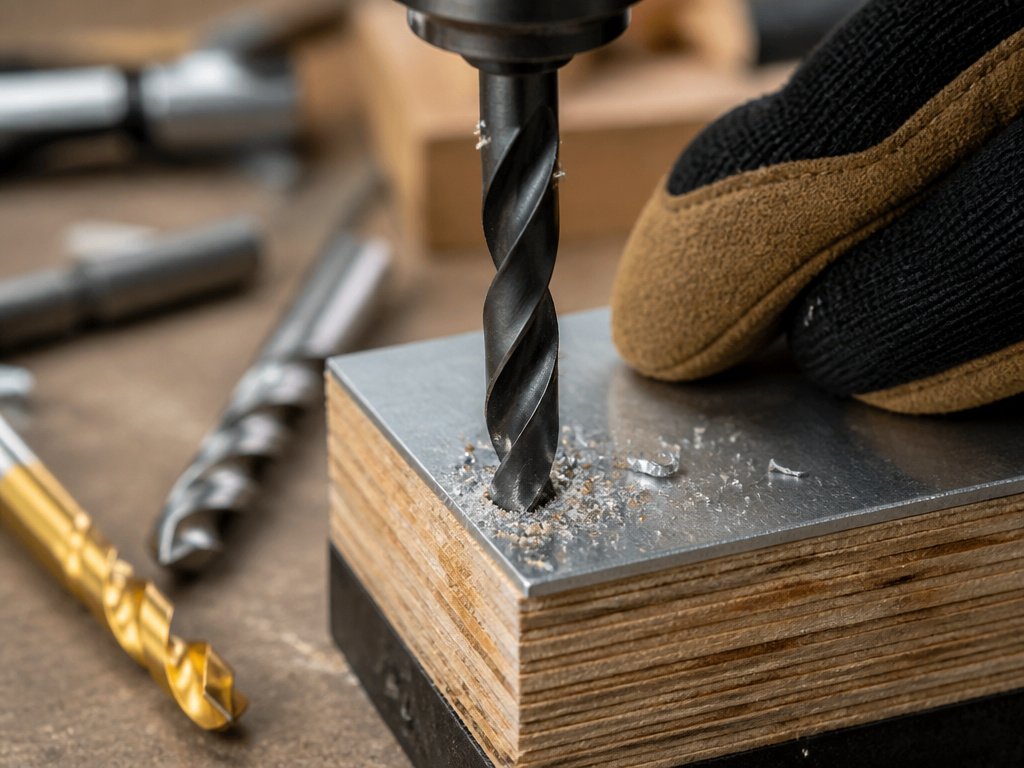 You choose a bit by the material you’re cutting. Here’s how black oxide stacks up against the other common drill bit materials.
| Bit Type | Core Material | Best For | Heat Resistance | Can It Be Sharpened? |
|---|---|---|---|---|
| Black Oxide | HSS | Wood, plastic, soft metals | Moderate | Yes, but removes coating |
| Titanium Nitride (TiN) | HSS with coating | General-purpose metal, wood | High | No, coating is only on surface |
| Cobalt (M35/M42) | HSS-Cobalt alloy | Stainless steel, hardened steel | Very High | Yes, alloy goes all the way through |
| Uncoated HSS | HSS | Light-duty wood & plastic | Low | Yes |
The black oxide vs titanium debate often misses the point. Titanium nitride (the gold-colored coating) is harder and slicks than black oxide, so it lasts longer in metal. But once that thin TiN layer wears or you sharpen through it, it’s gone. Cobalt is the through-hardened solution for hard metals.
For the DIYer drilling a mix of wood and occasional metal, black oxide is the cost-effective starting point. If your work shifts to mostly metal, that’s when you invest in titanium or cobalt.
Key Features of Quality Black Oxide Bits
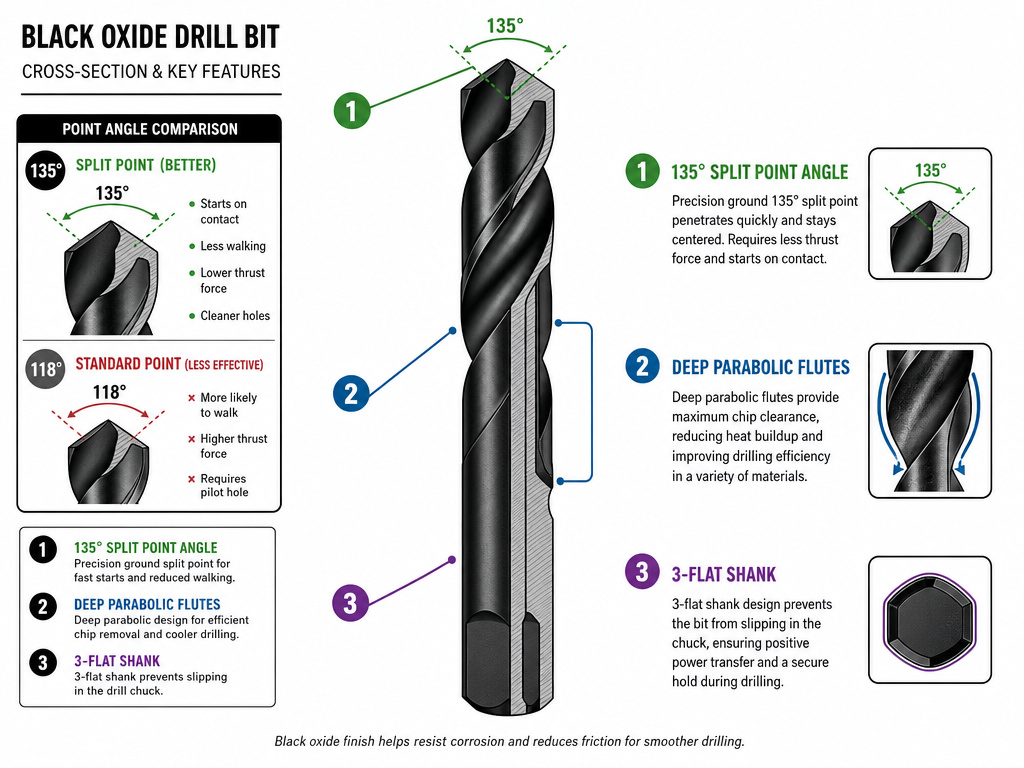 Not all black oxide bits are the same. The underlying HSS geometry matters more than the coating. Look for these three features in a good set.
1. The Point Angle
A 135° split point is the modern standard for metal and wood. It starts cutting immediately with less “walking” across the material’s surface. Older 118° points are more common on bargain bits and require a center punch to stay on target. The Milwaukee Thunderbolt line uses a 135° split point.
2. The Flute Design
Parabolic flutes are wider and deeper. They exist to move chips out of the hole faster. If chips can’t escape, they recut, creating heat and friction. The Bosch Extra Length (Aircraft) bits use a “speed helix” design claimed to clear chips three times faster than a standard bit.
3. The Shank
A round shank works, but a shank with flats (like a 3-flat or hex) prevents spin in the chuck under high torque. The Milwaukee Thunderbolt’s 3-Flat Secure-Grip shank and the Bosch Impact Tough’s hex shank are built for impact drivers, which is where most cordless drills live now.
A shank with flats is cheap insurance. The bit won’t spin and round out your chuck when you hit a knot in a 4×4.
When Should You Not Use Black Oxide Bits?
The list is short but non-negotiable.
- Stainless Steel: The chromium content work-hardens under the bit’s pressure. A black oxide bit will dull on contact, often before it even breaks through.
- Cast Iron: Abrasive and hard. It will grind the coating off the flutes.
- Hardened Steel or Alloy Steel: Anything above mild steel requires a bit that retains hardness at high temperature, that’s cobalt’s job.
- High-Volume Production Drilling: Even in soft materials, the heat from continuous use will eventually degrade the HSS underneath the coating. For production, you step up to a more durable titanium drill bit or cobalt.
If you’re unsure about a material, do a test drill on a scrap piece. If the bit starts to discolor (blue or straw-colored) at the tip within 10 seconds, you’re using the wrong bit.
Maintaining and Extending Their Life
The coating helps, but these are still consumable tools. You can make them last.
- Use the correct speed. For wood, go fast. For metal, go slow. High RPM in metal generates heat that the coating can’t dissipate.
- Use cutting fluid for metals. Even a drop of oil for aluminum or brass reduces heat and friction dramatically.
- Clear chips frequently. When drilling deep holes, pull the bit out every 1/2 inch to clear the flutes. Recutting chips is the fastest way to overheat the bit.
- Store them dry. The coating resists rust, but it’s not waterproof. A light coat of oil or keeping them in a sealed case prevents corrosion.
- Sharpen correctly. When they dull, sharpen them. But know that you’re removing the coating from the cutting lips. After sharpening, that part of the bit is more susceptible to rust. A quick cleaning drill bits routine after use is more important post-sharpening.
If you find light surface rust, removing rust from bits with a mild abrasive like a Scotch-Brite pad is straightforward. Heavy pitting means the bit is compromised, toss it.
The Bottom Line
Black oxide drill bits are the default for a reason. They’re affordable, they work better than plain HSS, and they cover 80% of what a homeowner or casual DIYer needs to drill: wood, plastic, and soft metals.
For one set that does it all, the Milwaukee Thunderbolt Black Oxide Jobber Length bits are hard to beat. The 135° split point and parabolic flutes handle the basics cleanly. If you use an impact driver often, the Bosch Impact Tough Black Oxide bits with their hex shank are the smarter buy.
Keep them for their intended jobs, know their limits with hard metals, and they’ll outlast several projects. When you finally wear them out, learning how to sharpen drill bits can give them a second life, just remember the tip won’t be black anymore.
Frequently Asked Questions
Can you use black oxide drill bits with an impact driver?
Yes, but only if the shank is designed for it. Look for a hex shank or a shank with flats (like a 3-flat design). A standard round-shank black oxide bit can spin in an impact driver’s chuck, damaging both the bit and the tool. The Bosch Impact Tough line is built for this.
Do black oxide drill bits need oil?
When drilling metal, always use a cutting fluid or oil. For wood and plastic, you can drill dry. The oil isn’t for the coating, it’s to cool the bit and lubricate the cut, which extends the life of the underlying HSS steel.
Why are some black oxide bits shiny and others matte?
The finish depends on the underlying steel’s smoothness before coating. A polished bit will have a shinier black finish; a bit with a machined surface will be matte. The performance difference is cosmetic. The colour of drill bits is a coding system, but within black oxide, shade doesn’t indicate quality.
How can you tell a cold-process from a hot-process black oxide coating?
You can’t visually. The only reliable test is durability. A cold-process coating is softer and will scratch off easily with a coin or a fingernail. A hot-process coating is much more durable. Buying from a reputable tool brand (Milwaukee, Bosch, DeWalt) is the easiest way to ensure you get the hot process.
Are black oxide bits better than titanium?
For hard metals, no. Titanium nitride (TiN) is a harder coating that provides better heat resistance and lasts longer in steel. For wood and soft metals, the difference is negligible, and black oxide bits are usually cheaper. The differences in drill bit coatings come down to the specific material you’re drilling most often.
