
Metal Drill Bit Colours Explained: What Each Shade Means
This post contains affiliate links. As an Amazon Associate, we earn from qualifying purchases.
Metal drill bits come in black, gold, bronze, and silver finishes. The color indicates the bit’s coating or base material, which dictates its heat resistance, wear life, and suitable applications. Black oxide is for general-purpose steel, gold titanium nitride (TiN) handles high-volume metal drilling, bronze is cobalt alloy for hardened steel, and bright silver is uncoated high-speed steel (HSS) for precision work.
The coating isn’t just paint. It changes how the bit sheds heat and resists abrasion. A black oxide bit on stainless steel will blue and dull in under a minute. A cobalt bit on soft aluminum will load up with gummy swarf and snap.
What follows breaks down the four core colors, the exact materials they represent, and the one spec sheet number that matters more than any finish. You’ll learn how to match a bit’s substrate. HSS or HSCo, to the metal’s hardness, why coolant can extend bit life sixfold, and when to ignore the color entirely.
Key Takeaways
- Color signals the coating or alloy, not universal quality. A gold bit is titanium nitride-coated HSS, not solid gold.
- The substrate material (HSS or HSCo/cobalt) determines toughness. HSS flexes slightly for hand-held use; HSCo is harder but more brittle, demanding rigid machine setups.
- Black oxide bits are for mild steel and general use. They run cooler but wear faster than coated bits.
- Gold (TiN) and bronze (cobalt) bits are for production work on harder metals. TiN offers lower friction; cobalt offers higher heat resistance.
- Always check the point angle (118° for general steel, 135° for harder alloys) and use cutting fluid. Dry drilling on hard metal can kill a new bit in seconds.
The Core Colors and Their Meanings
Forget the idea that a brighter color means a better bit. The finish is a functional layer, not a badge of rank. Each color serves a specific engineering purpose: reducing friction, increasing hardness, or preventing corrosion.
A drill bit’s color is its material and coating manifest. Black oxide is an iron oxide conversion coating that retains cutting oil and resists corrosion. Gold is a 2–3 micron layer of titanium nitride (TiN) applied via physical vapor deposition (PVD) to reduce friction and increase surface hardness to ~80 HRC.
This technical snippet covers the two most common finishes. The other colors follow the same logic, a solution to a specific drilling problem.
Black Oxide: The General-Purpose Workhorse
A black oxide drill bit has been chemically treated to create a magnetite (Fe3O4) layer on its surface. This isn’t a plating that adds thickness; it’s a conversion coating. The bit stays the same size, which is critical for precision holes.
The black surface is mildly corrosion-resistant and, more importantly, porous. It holds cutting oil at the cutting edge longer than a bare metal bit. This makes black oxide bits excellent for general-purpose drilling in mild steel, wood, and plastic where heat buildup is moderate.
They are the default choice for a home workshop. The Bosch PRO Metal HSS-G Twist Drill Bit in standard length often comes with a black oxide finish. It’s a balanced option for the mix of materials a DIYer encounters.
Where this goes sideways: Using a black oxide bit on stainless steel or hardened alloy steel. The coating provides no meaningful heat resistance. The bit will overheat, lose its temper, and go dull within a dozen holes. You’ll see the cutting edge turn a straw-yellow, then blue, then grey.
Gold Titanium Nitride (TiN): The Friction Fighter
The familiar gold color comes from a titanium nitride coating. This is a thin ceramic layer deposited on a high-speed steel bit. Its primary job is to reduce friction between the bit’s flutes and the hot metal swarf.
Lower friction means two things: less heat generated at the cut, and easier chip ejection. This lets you run the bit at higher speeds or feed rates. Manufacturers claim a TiN coating can extend bit life three to five times over uncoated HSS.
These bits are for high-volume metal drilling, think steel fabrication shops or repetitive installation work. The coating excels on materials like aluminum and mild steel where long, stringy chips can weld to a bare bit.
Common mistake: Assuming a gold bit is for the hardest metals. TiN is a surface treatment on an HSS core. For drilling through hardened steel or stainless, you need a harder substrate, like cobalt, not just a slick coating.
Bronze Cobalt (HSCo): The Hard Stuff Specialist
When you see a bronze-colored bit, you’re looking at high-speed steel alloyed with cobalt (HSCo), typically 5% or 8%. The color often comes from a steam oxide finish applied to the raw alloy. This is not a coating in the TiN sense; the color is the material itself.
Cobalt increases the bit’s hot hardness, its ability to retain strength at the high temperatures generated by drilling. This makes HSCo bits the go-to for stainless steel, cast iron, and hardened steels.
However, the added hardness comes with a trade-off. The Bosch-PT drilling guide notes that HSS-E (HSCo) tool material “allows slightly less flex under pressure, requiring rigid and stable running conditions.” In a hand-held drill on a wobbly ladder, a stiff cobalt bit is more likely to snap than a forgiving HSS bit.
Bright Silver (HSS): The Precision Ground Standard
A silvery-white, shiny bit is precision-ground high-speed steel with no coating. This “bright finish” is what you get straight from the grinding machine. It’s the baseline.
These bits are often used in machining applications where dimensional accuracy is paramount, as coatings can add a few microns of thickness. They’re also the raw material before any black oxide or TiN coating is applied. For the average user, a bright HSS bit is perfectly fine for metal, provided you use cutting fluid and moderate speeds.
Choosing by Material, Not Color
Color gives you a first clue, but the metal you’re drilling gives the final answer. The point angle and substrate material matter more than the surface finish when pushing through tough alloys.
| Material to Drill | Best Bit Substrate | Ideal Point Angle | Why It Works |
|---|---|---|---|
| Mild Steel (A36, 1018) | HSS (Black Oxide or TiN) | 118° | HSS has enough toughness; coating reduces friction and heat. |
| Stainless Steel (304, 316) | HSCo (Cobalt) | 135° | Cobalt retains hardness at the high temps stainless generates; 135° point penetrates better. |
| Aluminum | HSS (TiN coated) | 118° | TiN prevents aluminum from gumming and welding to the flutes. |
| Cast Iron | HSCo (Cobalt) | 118° or 135° | Cobalt withstands the abrasiveness of cast iron. |
| Hardened Alloy Steel (>38 HRC) | HSCo (Cobalt) | 135° (split point) | The split point and harder substrate prevent walking and maintain a cutting edge. |
This table moves you from color-based guessing to a material-based selection. The point angle is critical: a 118° point is stronger for general use, while a 135° point is sharper and better for penetrating harder metals.
The Point Angle Is a Silent Partner
You can’t see the point angle from across the workshop, but it’s doing half the work. A 118° point is the standard. It’s a good compromise between sharpness and strength, making it suitable for a wide range of common drill bit materials like mild steel and aluminum.
A 135° point is a self-centering, split-point design common on better metal bits, like many in the NAS 965 standard. It requires less downward pressure to start the hole and is superior for hard metals because it slices rather than pushes. The trade-off is that the sharper tip is slightly more fragile.
When HSS Beats Cobalt
Cobalt isn’t always the answer. For hand-held drilling, especially in less rigid setups, the slight flexibility of standard HSS can be an advantage. It can absorb minor deflection without snapping. The NAS 907 standard acknowledges HSS’s suitability for applications where some tool flex is beneficial.
If you’re drilling thin sheet metal, a standard HSS bit ground to a sharp 118° point will often cut cleaner and with less burr than a aggressive cobalt bit. The appearance of metal bits can be deceiving, the rugged, bronze cobalt bit is overkill for thin gauge material.
What the Color Doesn’t Tell You
A shiny coat can hide a mediocre core. The color tells you about the surface treatment or alloy, but it says nothing about the quality of the steel beneath, the precision of the grind, or the heat treatment.
The Substrate Matters Most
A gold TiN coating on poor-quality, improperly tempered HSS is a waste. The coating will flake off once the soft core underneath deforms. The real performance comes from the base material meeting a standard like NAS 907 for dimensional accuracy and material composition.
This is why buying based solely on color is a gamble. A reputable brand’s black oxide bit will outperform a no-name gold bit every time because the substrate HSS is better.
Coolant: The Unseen Multiplier
Color is visible, but the use of coolant is the single biggest factor in bit life. The Bosch-PT guide states that appropriate cooling systems can extend bit life by a factor of approximately six. A $5 bottle of cutting oil does more for a black oxide bit than a $15 TiN coating does for a dry bit.
Worth knowing before you start: For hand-held drills, flood coolant isn’t practical. That’s why bits like the Bosch PRO Metal HSS-G are designed with flute geometries for quick swarf removal. The chips themselves must carry the heat away.
How to Buy Drill Bits Without Getting Tricked
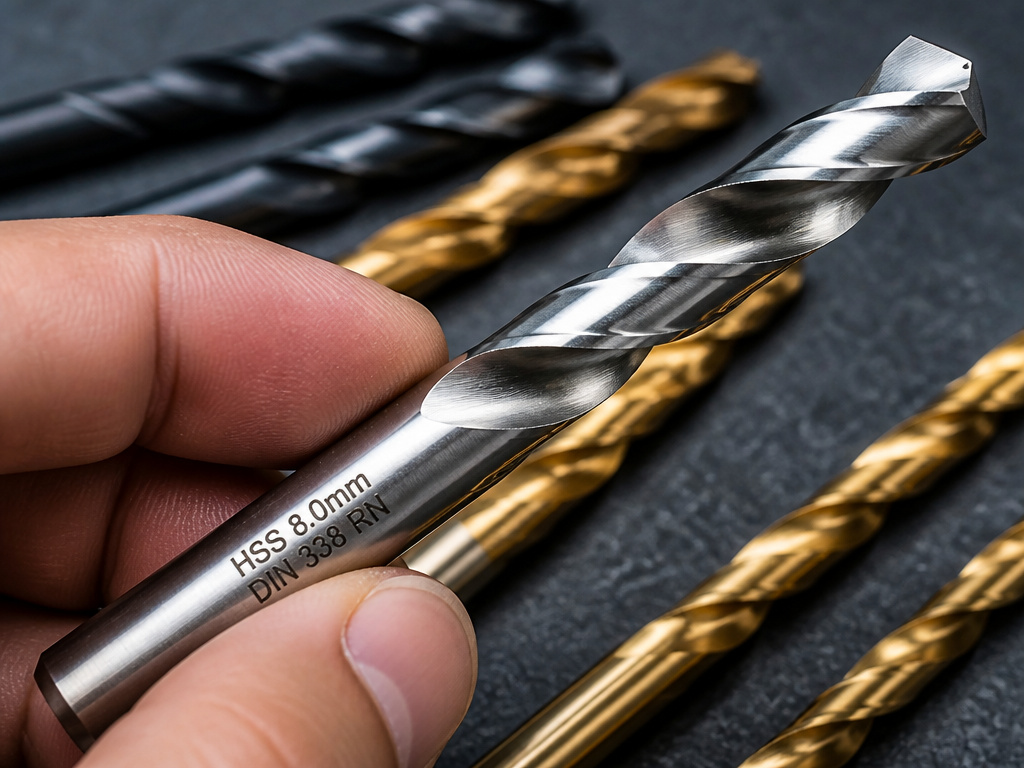
Look past the paint. Focus on the markings, the feel, and the source.
- Read the laser etch. Quality bits have size, material (HSS or HSCo), and often the point angle laser-etched on the shank. Faint, stamped markings that rub off are a red flag.
- Examine the grind. Look at the cutting edges under light. They should be symmetrical, sharp, and free of burrs. A ragged, uneven grind will never cut cleanly.
- Feel the weight (comparatively). Cobalt alloy bits are noticeably denser than standard HSS bits of the same size. If a “cobalt” bit feels light, it probably isn’t.
- Buy for the job, not the kit. Avoid giant sets with every color under the sun. You’ll use 20% of them 80% of the time. Buy smaller sets of specific drill bit types you need: a set of HSS bits for general work, a few cobalt bits for stainless.
- Store and clean them properly. Rust destroys a bit’s edge. Keep them in a dry case or rack. Learn proper methods for cleaning drill bits after use, especially after drilling corrosive metals like aluminum.
Frequently Asked Questions
Are gold drill bits better than black ones?
Gold titanium nitride bits are better for specific jobs: high-speed, high-volume drilling in metals where friction is the enemy. For a homeowner drilling a few holes in steel brackets, a quality black oxide bit is often more cost-effective and just as effective. “Better” depends on the material and pace of work.
Can you use a metal drill bit for wood?
You can, but you shouldn’t always. A standard 118° point HSS metal bit will drill wood, but it tends to cause more splintering at the exit hole than a brad-point wood bit designed to slice clean fibers. For rough work, it’s fine. For fine woodworking, use the right guide to drill bit types.
Why did my new cobalt bit break?
Cobalt is hard but brittle. If you used it in a hand-held drill with side pressure, if the workpiece wasn’t clamped, or if you hit a hard inclusion in the metal, it can snap. It demands a rigid, stable setup. Ensure you’re using a sharp bit, adequate cutting fluid, and a steady feed rate.
Do I need a special drill for cobalt bits?
No, but your technique needs to be better. Use a drill with good torque and low speed settings. Run cobalt bits slower than HSS bits, use firm, consistent pressure, and always keep the bit perpendicular to the work surface to avoid lateral stress.
How can I tell if a bit is actually cobalt?
First, check the etching on the shank, it should say “HSS-Co” or “Cobalt.” Second, the color is a dull bronze, not a bright gold. Third, try a magnet. High-cobalt steel is less magnetic than standard HSS. A strong attraction suggests a lower cobalt content.
The Bottom Line
Drill bit color is a useful shorthand, not a definitive guide. Black for general purpose, gold for high-speed production, bronze for hardened metals, silver for precision.
But the metal underneath the finish. HSS or HSCo, is what survives the heat of the cut. The point geometry, 118° or 135°, is what gets the hole started cleanly. And the bottle of cutting oil on your bench is what makes any bit last longer.
So pick the color that matches your common task. Then forget about it. Focus on the material specification, match your speed and feed, and use lubrication. Your bits will cut cleaner, last longer, and you’ll spend less time at the store buying replacements. That’s the real payoff.
